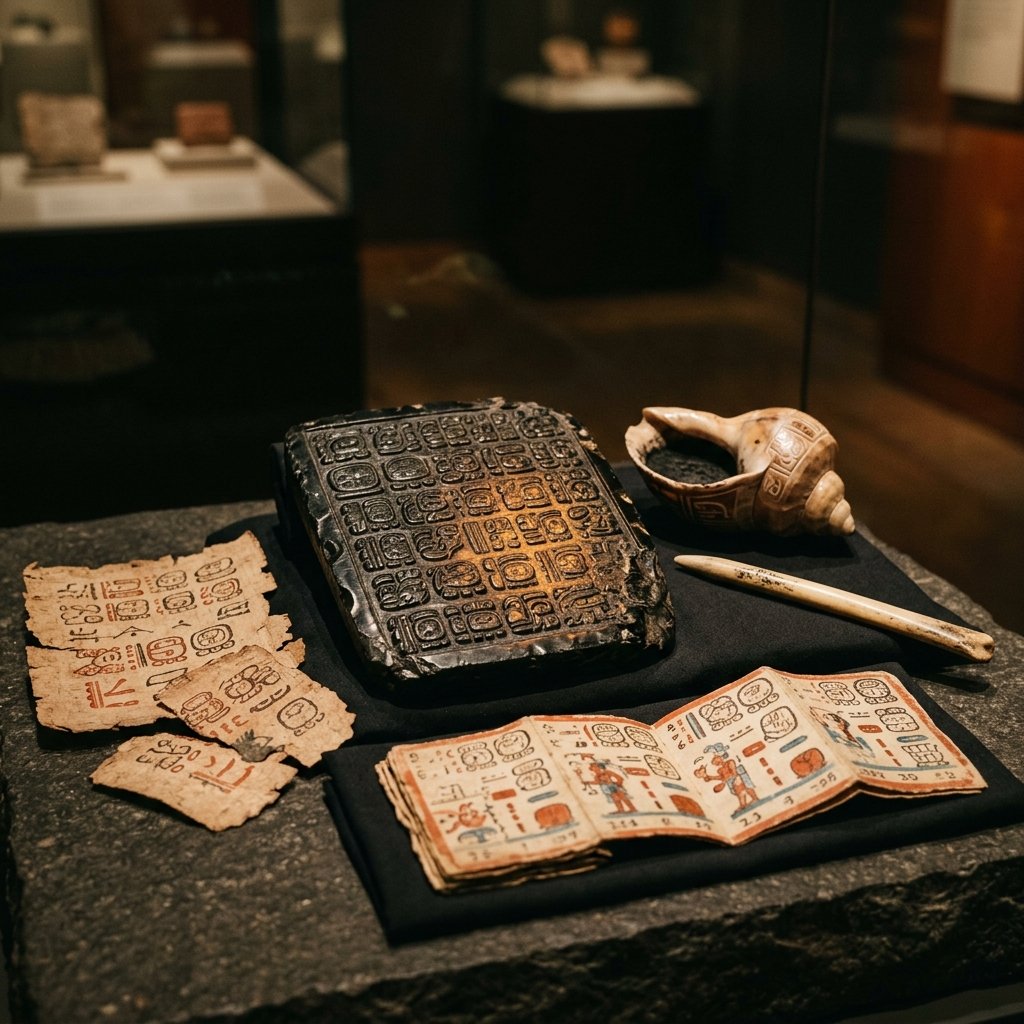
Maya Glossary at a Glance
An A–Z reference guide to Maya civilization terminology. Each entry includes pronunciation (where applicable), language of origin, scholarly definitions, and links to related articles on Mayan.org.
A
Acropolis
🏛️ Architecture & CitiesIn Maya studies, a large elevated platform supporting multiple buildings — typically royal palaces, administrative structures, and temples. Unlike the Greek usage, a Maya acropolis was built up over centuries through successive construction phases, with each new king building atop the structures of his predecessors.
Aj Tz'ib
📜 Writing & Knowledge"One who writes/paints" — a scribe. Maya scribes were high-status figures, often members of the royal family. They produced codices, painted ceramics, carved stone inscriptions, and wall murals. The patron deity of scribes was Itzamná, and the word tz'ib means both "writing" and "painting," reflecting the Maya view that these were the same art.
Ajaw
👑 Politics & SocietyThe word for "lord" or "ruler" in Classic Maya. K'uhul Ajaw ("Divine Lord") was the title of the supreme king of a Maya city-state. The glyph for Ajaw is one of the most common in Maya inscriptions and is also the name of the 20th day sign in the Tzolk'in calendar.
Ajq'ij
🔥 Ritual & Religion"Daykeeper" — a Maya spiritual practitioner who maintains the 260-day Tzolk'in calendar and performs divination, healing, and ceremonial duties. Ajq'ijab' (plural) undergo years of training and initiation. They are the living custodians of a calendar tradition stretching back over 2,500 years.
B
Bak'tun
☀️ Calendar & TimeA period of 144,000 days (approximately 394 years) in the Long Count calendar. The completion of the 13th Bak'tun on December 21, 2012, generated worldwide interest in Maya culture. In Maya cosmology, the current creation began on 13.0.0.0.0 (August 11, 3114 BC).
Ball Game
🔥 Ritual & ReligionA ritual sport played on an I-shaped stone court with a solid rubber ball weighing 3–4 kg. Known as pitz in Classic Maya. More than a sport, the ball game re-enacted the mythological contest between the Hero Twins and the Lords of Xibalba. Great Ballcourt at Chichén Itzá is the largest in Mesoamerica (168m × 70m). Some games concluded with the sacrifice of participants.
Bloodletting
🔥 Ritual & ReligionThe most sacred ritual act in Maya religion — the drawing of royal blood as an offering to gods and ancestors. Kings pierced their tongues, earlobes, or genitals with stingray spines or obsidian blades, collecting the blood on bark paper to be burned. Queens performed their own bloodletting rituals, typically passing a thorn-studded rope through the tongue. The resulting visions (conjured through pain, blood loss, and smoke) were believed to open a portal to the spirit world.
C
Cacao
🌽 Nature & AgricultureThe source of chocolate — one of the Maya's most prized luxury goods. Cacao beans were used as currency and were consumed as a bitter, frothy drink mixed with chili, vanilla, and achiote. The word "chocolate" derives from the Nahuatl chocolatl, which may itself derive from the Maya phrase chocol haa ("hot water"). Cacao was offered to gods and the dead.
Calendar Round
☀️ Calendar & TimeThe 52-year cycle produced by the meshing of the 260-day Tzolk'in and the 365-day Haab'. A specific Calendar Round date (e.g., 4 Ahau 8 Kumku) recurs only once every 18,980 days (approximately 52 years). This was the most commonly used dating system in everyday Maya life.
Ceiba
🌽 Nature & AgricultureThe World Tree (Ya'axche' in Yucatec Maya) — a massive tropical tree that the Maya considered the axis connecting the three levels of the cosmos. Its roots reach into Xibalba (the Underworld), its trunk passes through the Middleworld (human realm), and its branches extend into the heavens. The ceiba is the national tree of Guatemala.
Cenote
🏛️ Architecture & CitiesA natural sinkhole formed by the collapse of limestone bedrock, exposing groundwater beneath. Cenotes were critically important to the Maya as freshwater sources in the porous limestone terrain of the Yucatán Peninsula. They were also considered sacred portals to Xibalba — the Sacred Cenote at Chichén Itzá received valuable offerings including jade, gold, and human sacrifices.
Chaak
🐍 Gods & DeitiesThe Rain God — one of the most frequently depicted deities in Maya art. Shown with reptilian features, a curling nose, and wielding a lightning axe. Chaak was invoked through elaborate ceremonies to bring rain for agriculture. The "Chaak masks" that adorn the facades of Puuc-style buildings in the Yucatán are among the most recognizable motifs in Maya architecture.
Classic Maya Collapse
🔬 Modern & ScholarlyThe abandonment of major southern lowland Maya cities between approximately 800–1000 AD. Once attributed to a single cause, scholars now recognize a "perfect storm" of interacting factors: prolonged drought (confirmed by paleoclimate data), intensified warfare, environmental degradation from deforestation, political fragmentation, and disrupted trade networks. The collapse was not uniform — northern and highland Maya societies continued to thrive.
Codex
📜 Writing & KnowledgeA folding book made from fig-bark paper (amate) coated with white lime plaster and painted with hieroglyphic text and illustrations. Only four Maya codices survive the Spanish conquest: the Dresden, Madrid, Paris, and Grolier codices. They contain astronomical tables, ritual calendars, prophecies, and agricultural information. Bishop Diego de Landa's book burning of 1562 destroyed hundreds more.
Corbel Vault
🏛️ Architecture & CitiesThe primary roofing technique of Maya architecture, in which successive courses of stone blocks are placed so that each course projects slightly inward beyond the one below it, meeting at a capstone at the top. Also called a "false arch." This technique limited interior room widths but allowed the construction of dramatic temple interiors.
D
Day Sign
☀️ Calendar & TimeOne of 20 named days that cycle through the Tzolk'in calendar: Imix, Ik', Ak'bal, K'an, Chicchan, Kimi, Manik', Lamat, Muluk, Ok, Chuwen, Eb, Ben, Ix, Men, Kib, Kaban, Etz'nab, Kawak, and Ajaw. Each day sign carries specific symbolic associations, patron deities, and personality traits used in divination.
Decipherment
🔬 Modern & ScholarlyThe process of reading and understanding the Maya hieroglyphic writing system. The breakthrough came in 1952 when Russian linguist Yuri Knorosov proved the script was partially phonetic (syllabic). In the 1970s–1990s, scholars including Linda Schele, David Stuart, Peter Mathews, and Nikolai Grube achieved near-complete decipherment, transforming Maya studies from archaeology into history.
Dresden Codex
📜 Writing & KnowledgeThe most elaborate and best-preserved of the four surviving Maya codices — a 3.5-meter-long folding book containing Venus and Mars tables, eclipse prediction tables, almanacs, and flood imagery. Created in the Postclassic period. Now housed in the Saxon State and University Library in Dresden, Germany.
E
Emblem Glyph
👑 Politics & SocietyA hieroglyphic compound that identifies a specific Maya city-state or royal dynasty. Typically includes the K'uhul Ajaw title plus a unique toponymic sign specific to that polity. The identification of emblem glyphs was a major breakthrough in Maya decipherment, proving that the Classic Maya world consisted of independent competing kingdoms rather than a unified empire.
G
Glyph
📜 Writing & KnowledgeA sign in the Maya writing system. Maya script is logo-syllabic, meaning it uses both logograms (signs representing whole words) and syllabic signs (representing consonant-vowel syllables). Over 800 distinct glyphs have been identified. A single Maya word could be written using logograms, syllabograms, or a combination of both.
H
Haab'
☀️ Calendar & TimeThe 365-day solar calendar consisting of 18 months of 20 days each, plus a 5-day period called Wayeb'. Used for agricultural scheduling and civic administration. Each month carries a name and symbolic associations tied to seasonal cycles.
Hero Twins
🐍 Gods & DeitiesHunahpu and Xbalanque — the mythological twins who descend to Xibalba (the Underworld), defeat the death gods through cleverness and ball-playing, and rise to become the Sun and Moon. Their story, told in the Popol Vuh, is the central mythological narrative of Maya civilization and a metaphor for death and resurrection.
I
Itzamná
🐍 Gods & DeitiesThe supreme creator deity in Maya religion, often depicted as an aged, wise figure with iguana or lizard features. Itzamná is credited with inventing writing, the calendar, and medicine. He is the patron of scribes and priests, and the husband of Ix Chel.
Ix Chel
🐍 Gods & DeitiesThe Moon Goddess, associated with medicine, childbirth, weaving, and water. Depicted in two aspects: as a beautiful young woman (the waxing moon) and as an aged crone pouring water from a jar (the waning moon or floods). One of the most important female deities in the Maya pantheon.
J
Jade
💎 Art & Material CultureThe most precious material in the Maya world — valued more highly than gold. Jade (jadeite) symbolized water, breath, the life force, and royalty. It was carved into masks, figurines, beads, ear flares, and pectoral ornaments. The richest royal burials, such as Pakal's tomb at Palenque, contained lavish jade funerary masks assembled from hundreds of individually shaped pieces.
K
Kaloomte'
👑 Politics & SocietyA supreme military and political title, roughly equivalent to "emperor" or "high king." Only the most powerful Maya rulers — those who dominated other city-states — bore this title. The kings of Tikal and Calakmul both claimed the Kaloomte' title during their periods of hegemony.
K'atun
☀️ Calendar & TimeA period of 7,200 days (approximately 19.7 years) in the Long Count calendar. The K'atun was a significant unit of political and historical reckoning — Maya kings often erected monuments at K'atun endings to commemorate their reigns.
K'iche'
🔬 Modern & ScholarlyThe largest of the 30+ living Maya language groups, spoken by approximately 1.6 million people primarily in the western highlands of Guatemala (Quetzaltenango, Totonicapán, Chichicastenango). The K'iche' are the people who produced the Popol Vuh. Nobel Peace Prize laureate Rigoberta Menchú Tum is K'iche' Maya.
K'inich Ahau
🐍 Gods & DeitiesThe Sun God, depicted with large square eyes, a Roman nose, and filed teeth (a marker of solar brilliance). K'inich Ahau travels across the sky during the day and transforms into the Jaguar God of the Underworld at night as he passes through Xibalba. Many Maya kings took his name as a royal title.
K'uhul Ajaw
👑 Politics & Society"Holy Lord" or "Divine Lord" — the full royal title of a Maya king. The K'uhul Ajaw was both the political ruler and the supreme religious authority of a city-state. He was responsible for conducting blood-letting rituals, capturing enemies for sacrifice, and ensuring cosmic order through ceremony.
Kukulkán
🐍 Gods & DeitiesThe Feathered Serpent deity — a fusion of the quetzal bird and the rattlesnake. Known as Q'uq'umatz in K'iche' Maya and Quetzalcoatl in Nahuatl (Aztec). Associated with wind, rain, Venus, and learning. The great pyramid of Chichén Itzá (El Castillo) is dedicated to Kukulkán, and its equinox serpent-shadow phenomenon draws thousands of visitors every year.
L
Long Count
☀️ Calendar & TimeA continuous count of days from the Maya creation date (August 11, 3114 BC in the Gregorian calendar). Expressed as a series of five numbers (e.g., 9.14.3.1.12), the Long Count allowed the Maya to place events in absolute historical time. It was the primary dating system used on Classic Period stelae and monuments.
M
Maize
🌽 Nature & AgricultureThe sacred crop of Maya civilization. In the Popol Vuh, humans are literally created from maize dough after the gods' earlier attempts (using mud and wood) fail. Maize was the staple food, the basis of the economy, and a central religious symbol. The Maize God — depicted as eternally youthful and beautiful — represents life, death, and resurrection through the agricultural cycle.
Maya Blue
💎 Art & Material CultureAn extraordinarily durable synthetic pigment invented by the ancient Maya by combining indigo dye with palygorskite clay and heating the mixture. Maya Blue (Spanish: azul maya) resists acids, alkalis, solvents, weathering, and bio-degradation. Its vibrant turquoise color adorns murals, ceramics, and sculptures. Modern chemists have struggled to fully replicate its manufacturing process.
Mesoamerica
🔬 Modern & ScholarlyThe cultural region extending from central Mexico to northwestern Costa Rica, defined by shared cultural traits including writing systems, calendar systems, ball games, pyramidal architecture, maize agriculture, and polytheistic religion. The Maya were one of several major Mesoamerican civilizations, alongside the Olmec, Zapotec, Teotihuacan, Toltec, Aztec, and Mixtec.
N
Nawal
🔥 Ritual & ReligionA person's spirit companion or animal alter ego, determined by their birth date in the Tzolk'in calendar. Also spelled nagual. In contemporary Maya spirituality, a person's nawal influences their personality, strengths, weaknesses, and destiny — similar to a zodiac sign but grounded in a different cosmological framework.
O
Obsidian
💎 Art & Material CultureVolcanic glass used to make razor-sharp blades, projectile points, mirrors, and ritual objects. Maya obsidian blades were sharper than modern surgical steel. Major obsidian sources (El Chayal, Ixtepeque, Pachuca) were located in the highlands, making obsidian a key trade commodity. Obsidian mirrors were used for divination and were associated with rulership and sorcery.
P
Popol Vuh
🐍 Gods & DeitiesThe sacred creation narrative of the K'iche' Maya — often called the "Maya Bible." It recounts the creation of humanity from maize, the adventures of the Hero Twins, and the origin of the K'iche' royal lineage. The surviving text was written in K'iche' using the Latin alphabet in the 16th century, preserving an oral tradition of great antiquity.
Puuc
🔬 Modern & Scholarly"Hills" — an architectural style found in the hilly (puuc) region of the western Yucatán Peninsula. Puuc-style buildings (exemplified by Uxmal, Kabah, Sayil, and Labná) are characterized by smooth lower walls, elaborate upper facade mosaics of stone, and prominent Chaak rain-god masks. The Puuc style represents the highest aesthetic achievement of Terminal Classic Maya architecture.
Q
Quetzal
🌽 Nature & AgricultureThe resplendent quetzal — a bird with iridescent green tail feathers that can reach over 60 cm in length. Quetzal feathers were among the most precious materials in the Maya world, worn exclusively by royalty and high priests. The bird was associated with Kukulkán/Q'uq'umatz and was considered so sacred that killing one was a capital offense.
S
Sacbe
🏛️ Architecture & Cities"White road" — a raised limestone causeway connecting Maya buildings, plazas, and cities. Sacbeob (plural) were paved with white limestone plaster, elevated above the jungle floor, and could stretch for kilometers. The longest known sacbe connects the cities of Cobá and Yaxuná — a distance of 100 kilometers.
Star War
🔥 Ritual & ReligionA specific type of Maya warfare recorded in hieroglyphic texts — indicated by a "star-over-earth" glyph (a star shower raining down on a place name). Star Wars were total wars of conquest, timed to coincide with specific Venus or Jupiter events. The most famous Star War is Calakmul's defeat of Tikal in 562 AD, which initiated a 130-year "hiatus" at Tikal.
Stela
🏛️ Architecture & CitiesA tall, carved stone slab erected by Maya rulers to commemorate important events — accessions, military victories, period endings, and ritual acts. Stelae (plural) typically feature portraits of the king on the front, hieroglyphic inscriptions on the back and sides, and date formulas in the Long Count. They are among the most important sources for reconstructing Maya history.
T
Tzolk'in
☀️ Calendar & TimeThe 260-day sacred calendar of the Maya, consisting of 20 named days (day signs) cycling with 13 numbers. Used for divination, ritual scheduling, and personal identity. Still actively maintained by Maya daykeepers (ajq'ijab') in highland Guatemala today.
V
Vision Serpent
🔥 Ritual & ReligionA supernatural serpent that appeared during bloodletting rituals, rising from burning blood-soaked paper. The Vision Serpent served as a conduit between the human world and the realm of ancestors and gods — the figure of a deity or ancestor would emerge from its open jaws. Frequently depicted on carved lintels, especially at Yaxchilán.
W
Wayeb'
☀️ Calendar & TimeThe 5-day "nameless" period at the end of the Haab' solar calendar (after the 18th month of 20 days). Considered an extremely dangerous and liminal time when the boundaries between the human world and the underworld (Xibalba) were thin. People avoided unnecessary activity and observed fasting and ritual purification.
X
Xibalba
🐍 Gods & DeitiesThe Maya Underworld — the "Place of Fright." Described in the Popol Vuh as a dark, subterranean realm ruled by death gods who test and torture arriving souls. The Hero Twins (Hunahpu and Xbalanque) famously outwit the Lords of Xibalba to become the Sun and Moon. Cave entrances were considered physical portals to Xibalba.
Y
Yucatec Maya
🔬 Modern & ScholarlyA Maya language spoken by approximately 800,000 people in the Yucatán Peninsula of Mexico (Yucatán, Quintana Roo, and Campeche states) and northern Belize. Yucatec Maya is the language of the Colonial-era Books of Chilam Balam and was the primary language of the great Postclassic cities. Most Maya calendrical and religious terms in common Western usage derive from Yucatec Maya.
Frequently Asked Questions
What language do Maya terms come from?
Most Maya calendar and religious terms in common Western usage derive from Yucatec Maya — the language spoken in the Yucatán Peninsula. However, some important terms (like Xibalba, Popol Vuh, and K'iche') come from the K'iche' Maya language of the Guatemalan highlands. "Classic Maya" inscriptional language, sometimes called Ch'olan, differs from both modern languages.
How do you pronounce Maya words?
Maya languages generally follow phonetic spelling — vowels are pronounced as in Spanish (a=ah, e=eh, i=ee, o=oh, u=oo). The apostrophe (') indicates a glottal stop or ejective consonant. The letter "x" is pronounced "sh." Stress usually falls on the last syllable. For example, Xibalba is pronounced "shee-bahl-BAH."
What is the difference between Maya and Mayan?
In academic usage, "Maya" is the preferred adjective for the people, culture, and civilization (e.g., "Maya art," "Maya kings"). "Mayan" is primarily used for the language family ("Mayan languages"). In popular usage, both forms are widely accepted.
Scholarly References
- Coe, M.D. The Maya. Thames & Hudson, 8th ed., 2011.
- Montgomery, J. Dictionary of Maya Hieroglyphs. Hippocrene Books, 2006.
- Kettunen, H. & Helmke, C. Introduction to Maya Hieroglyphs. Wayeb/Leiden, 2020. (Free academic resource — no retail edition.)
- Sharer, R. & Traxler, L. The Ancient Maya. Stanford University Press, 6th ed., 2006.
- Stuart, D. The Order of Days. Harmony Books, 2011.