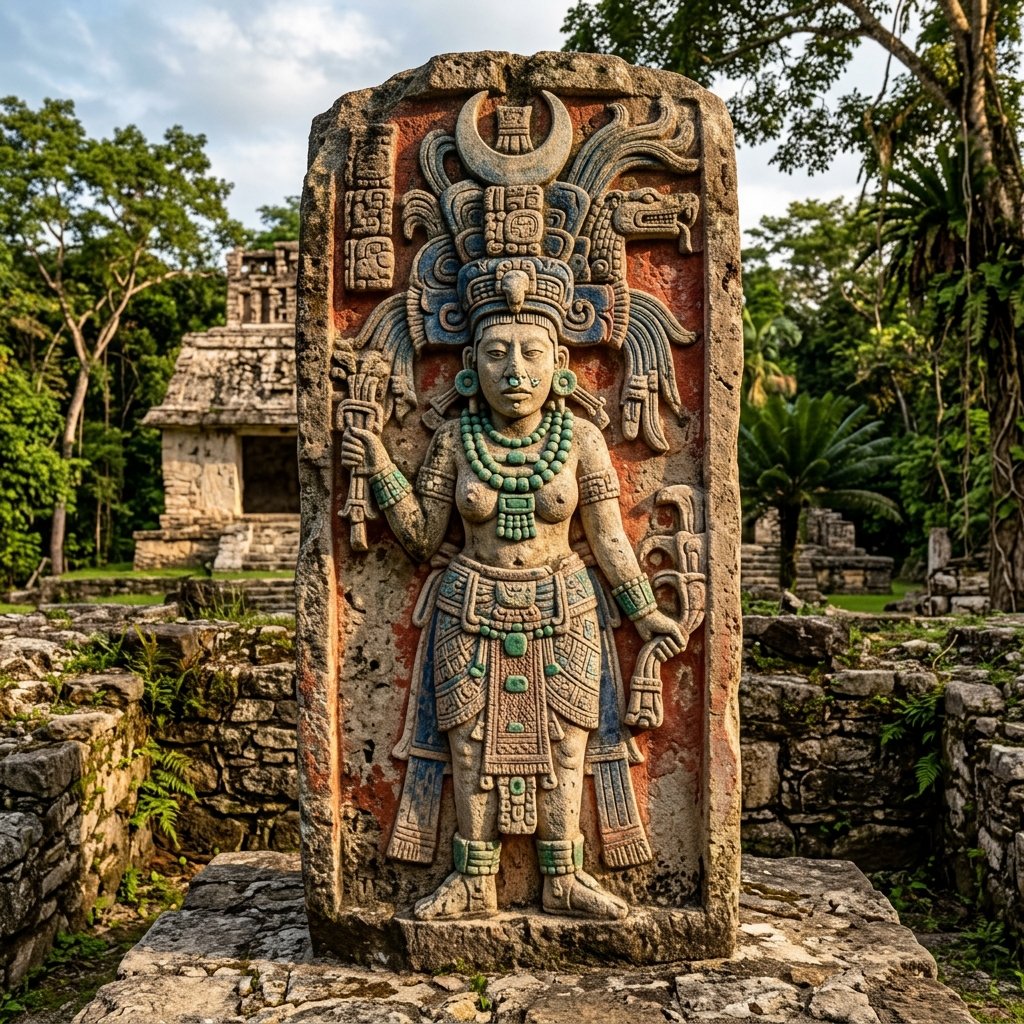
Ix Chel at a Glance
"She is woman in her entirety — maiden, mother, and crone. Beautiful and terrifying. The gentle moonlight that guides night travelers, and the flood that sweeps away villages. To understand Ix Chel is to understand that creation and destruction are not opposites — they are phases of the same feminine force."
The Most Powerful Woman in the Americas
In a civilization renowned for its male warrior-kings and patriarchal royal dynasties, Ix Chel (pronounced "eesh-CHEL") stands as a striking counterpoint: the most powerful, most complex, and most widely worshipped female deity in pre-Columbian Mesoamerica. Her name likely derives from the Yucatec Maya ix ("she/woman") and chel (variously interpreted as "rainbow," "light," or a toponym) — hence her frequent designation as "Lady Rainbow."
But to call Ix Chel merely a "moon goddess" is to drastically underestimate her. She governed medicine, fertility, childbirth, weaving, water in all its forms, and the transformative cycle of feminine life from maiden to crone. She was the patron deity of midwives, herbalists, weavers, and the oracle priestesses of Cozumel. Maya women across the Yucatan and Guatemala undertook dangerous pilgrimages to petition her for fertility, safe childbirth, and healing — making her oracle shrine at Cozumel one of the most important religious destinations in the pre-Columbian Americas.
The scholar Gabrielle Vail has argued that Ix Chel was "not simply a moon goddess but a complex deity of enormous power, governing the biological, creative, and destructive aspects of water and the feminine" (Vail, G. & Stone, A., "Representations of Women in Postclassic and Colonial Maya Literature and Art," in Ancient Maya Women, AltaMira Press, 2002, pp. 203–228).
The Two Faces: Maiden and Crone
Ix Chel's most remarkable theological feature is her dual nature — two contrasting aspects that the Paul Schellhas classification designates as Goddess I (young) and Goddess O (old, sometimes called Chak Chel, "Great Rainbow"). This duality is not a contradiction — it is the Maya understanding that the moon's waxing and waning cycle mirrors the arc of women's lives, and that each phase carries its own irreplaceable power.
Young Ix Chel — Goddess I
The maiden aspect — beautiful, sensual, creative. Associated with the waxing and full moon, romantic love, textile arts, and fertility. She is often depicted as a young woman with flowing hair, wearing a jade skirt and sitting with a rabbit in her lap (the Maya saw a rabbit, not a face, in the moon's surface). She represents the generative power of youth: desire, creativity, the capacity to bring new life into being.
Old Ix Chel / Chak Chel — Goddess O
The crone aspect — fierce, primordial, and immensely powerful. Depicted as an old woman with a serpent headdress, jaguar ears, and clawed hands, pouring water from a celestial jug to create floods and storms. She is the supreme healer, the midwife who guides souls into the world, and the destroyer who sweeps away the old to make room for the new. In the Dresden Codex, it is Chak Chel who causes the great flood that ends one world age — an act of cosmic necessity, not malice.
This dual structure encodes a profound theological insight: that feminine power is not diminished by aging but transformed. The young woman's beauty becomes the old woman's wisdom. The maiden's capacity for generation becomes the crone's authority over death and renewal. Modern scholars interpret Goddess I and Goddess O not as two separate deities but as "age-related aspects of a single divine female" (Taube, K., The Major Gods of Ancient Yucatan, Dumbarton Oaks, 1992, p. 64). The moon itself teaches this lesson nightly: the same celestial body grows from a slim crescent to a blazing full disc and then diminishes again — not dying, but preparing to be reborn.
The Mythology of Ix Chel and the Sun
One of the most enduring myths tells of Ix Chel's love affair with the Sun — a story that explains why the Sun and Moon appear in the sky at different times, forever visible to each other but unable to truly reunite.
In the story, the Sun's grandfather (or sometimes his brother) is consumed with jealousy over their love and hurls a lightning bolt at Ix Chel, killing her. Dragonflies — sacred to the goddess — sing over her body for 183 days (approximately half a year), until she revives and follows the Sun across the sky. But his jealousy and possessiveness drive her away again, and she retreats into the night sky as the Moon — visible but forever separate from her lover.
The 183-day period may correspond to the approximate interval between solstices, suggesting an astronomical encoding within the myth. The archaeoastronomer Anthony Aveni has noted that Maya myths frequently embed precise astronomical observations within narrative structures, making them simultaneously spiritual teachings and scientific records (Aveni, A.F., Skywatchers of Ancient Mexico, University of Texas Press, 2001, p. 76).
Cozumel: The Great Pilgrimage

A Maya temple ruin on the coast of Cozumel island. This island off the eastern Yucatan coast was the single most important pilgrimage destination dedicated to Ix Chel. Women from across the Maya world traveled here by canoe to consult her oracle for matters of fertility, childbirth, and healing — making it a sacred site comparable in importance to Delphi in ancient Greece.
The island of Cozumel (Cuzamil in Yucatec Maya, meaning "Island of the Swallows") was the most important pilgrimage center in the Maya lowlands — and it was dedicated entirely to Ix Chel. Maya women from across the Yucatan, and even from as far as highland Guatemala, undertook dangerous sea crossings in large canoes to visit her shrine and consult her oracle.
The pilgrimage to Cozumel served multiple functions: women sought blessings for fertility and safe childbirth; the sick came for healing; and communities sent delegations to receive oracular prophecies for the coming year. The oracle at Cozumel functioned similarly to the Oracle at Delphi in the Greek world — a sacred site where divine knowledge could be accessed through intermediary priestesses.
Colonial sources describe the shrine in considerable detail. Bishop Diego de Landa recorded that the pilgrimage to Cozumel was so well-established that "there was a well-trodden road from every village to the coast" and that canoes crossed the channel in such numbers that the sea seemed covered with boats during festival periods (de Landa, D., Relación de las cosas de Yucatán, c. 1566; translated by A. Tozzer, Peabody Museum Papers, Vol. 18, 1941, p. 109). The Spanish noted with surprise that the shrine contained a large terracotta idol with a hollow back — through which a concealed priest presumably spoke the goddess's oracular pronouncements.
Isla Mujeres ("Island of Women"), off the coast near Cancún, received its Spanish name from the numerous goddess figurines found there by the conquistadors — almost certainly representations of Ix Chel. The island served as a secondary pilgrimage destination and may have functioned as a waypoint for travelers continuing to Cozumel.
Patroness of Weaving: The Sacred Loom
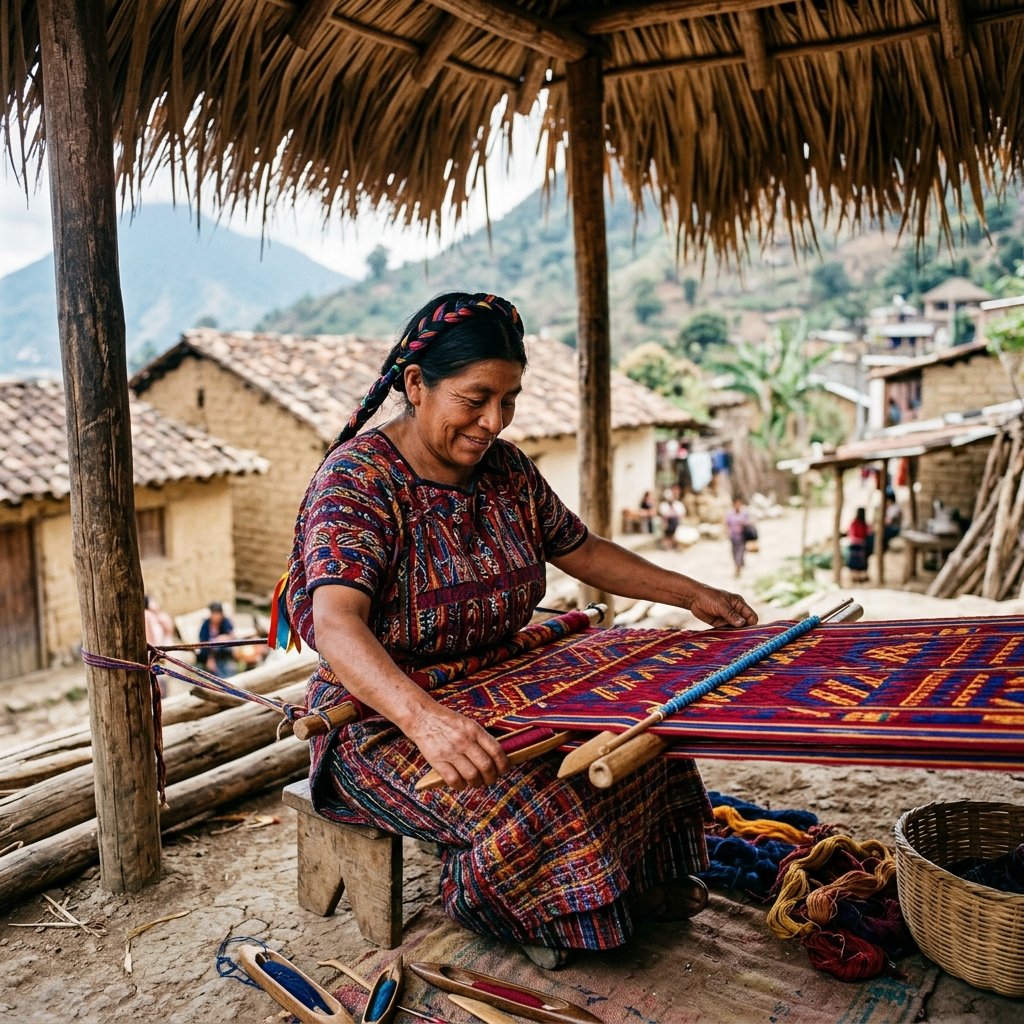
A contemporary Maya woman weaves on a traditional backstrap loom — a technology the Maya attributed directly to the goddess Ix Chel. The technique, in which one end of the loom is attached to a tree or post and the other end wraps around the weaver's body, has remained virtually unchanged for over two thousand years. The intricate patterns encode cosmological symbolism, clan identity, and regional tradition.
The Maya credited Ix Chel with inventing the backstrap loom — the elegant, portable weaving technology that has been the primary textile production method in Mesoamerica for over two thousand years. In Maya thought, weaving was not merely a practical craft but a cosmic creative act: the weaver creates order from chaos, transforming raw thread into structured pattern — just as the gods created the ordered cosmos from primordial nothingness.
Maya textiles were among the most valued trade goods in Mesoamerica, and the artistry of Maya women weavers was legendary. The intricate patterns woven into huipiles (traditional blouses) encoded cosmological symbolism, clan identity, and local tradition — a visual language as rich as the hieroglyphic script patronized by Itzamná. In this sense, weaving was the feminine parallel to writing — both were acts of encoding meaning into material form, and both were divine gifts.
Today, in highland Guatemalan communities, Maya women continue to weave on backstrap looms using techniques recognizable from depictions in Classic Maya art. The tradition is a living archaeological continuity — a practice directly traceable to the goddess who, according to Maya belief, sat at her own cosmic loom and wove the fabric of reality itself.
Medicine and Midwifery: Goddess of Healing
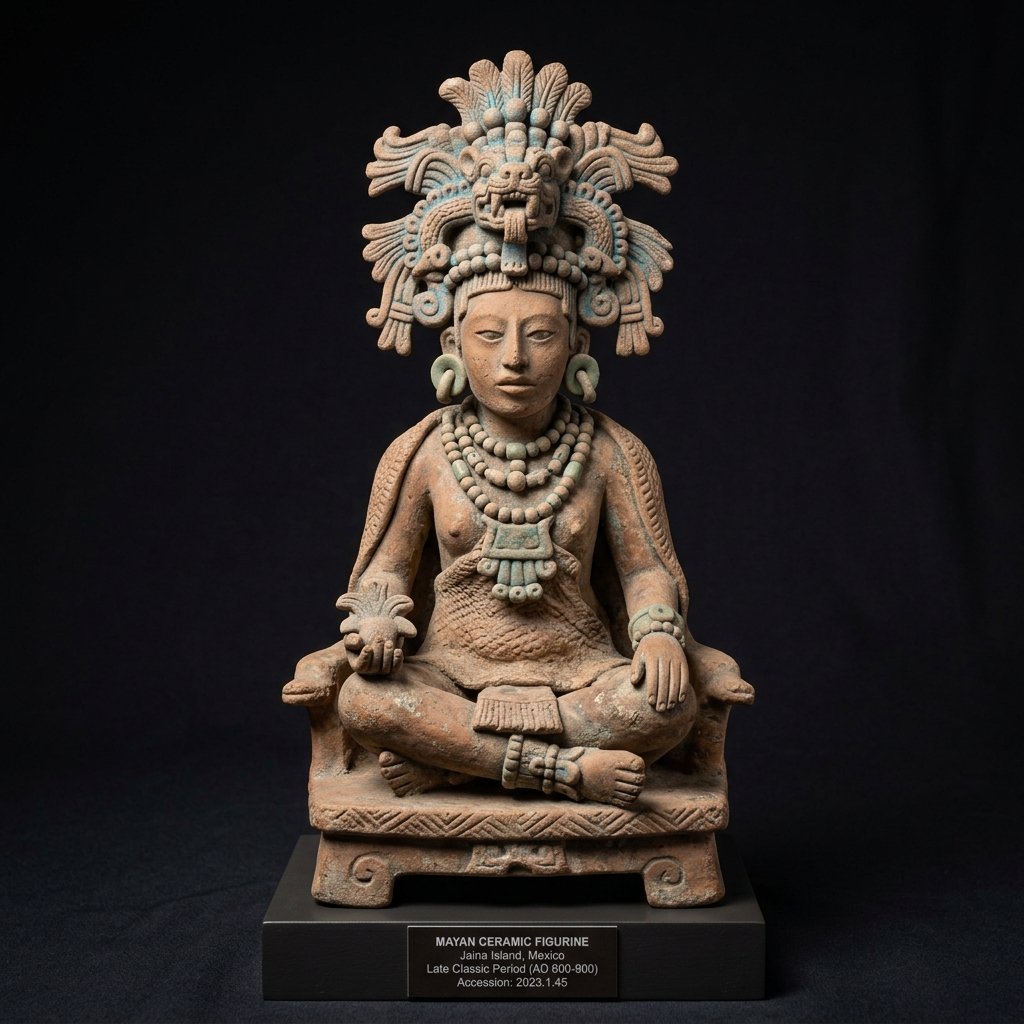
A Maya ceramic figurine depicting a female deity, from the island of Jaina off the Campeche coast. Jaina figurines are among the most artistically refined ceramic works in the ancient Americas, and many represent aspects of Ix Chel or women performing rituals associated with her worship. The delicate modeling and surviving traces of Maya blue pigment suggest these were high-status funerary offerings.
Ix Chel was the patron deity of medicine, herbalism, and midwifery. Maya medical knowledge — remarkably sophisticated for its time — included herbal pharmacology, bone setting, dental work, wound treatment, and the use of steam baths (temazcal) for therapeutic and ritual purposes. All of this fell under Ix Chel's divine patronage.
The colonial-era text Ritual of the Bacabs — a collection of Maya healing incantations preserved in the Yucatec Maya language — invokes Ix Chel repeatedly in the context of curing illness and attending difficult births. The text reveals that Maya healers understood disease in both naturalistic and supernatural terms: illnesses had physical causes that required herbal treatment, but they also involved spiritual dimensions that required ritual intervention under Ix Chel's patronage (Roys, R.L., The Ethno-Botany of the Maya, Tulane University, Middle American Research Institute, 1931).
Maya midwives (ix alanzah) occupied an especially revered social position, serving as the primary medical practitioners for women's health throughout the Maya world. Their craft — which included knowledge of medicinal plants, massage techniques, and ceremonial protocols — was understood as a sacred trust received from Ix Chel herself. In contemporary Maya communities in Guatemala and the Yucatan, traditional midwives continue to practice, and their spiritual authority often derives from dreams or visions understood as communication from the goddess.
Ix Chel and the Great Flood
In her most terrifying manifestation, Chak Chel (the crone aspect) appears in the Dresden Codex as the agent of the great flood that ends one world age to make way for the next. In this scene — one of the most dramatic images in any surviving Maya document — an enormous cosmic caiman vomits water from its mouth while Chak Chel pours water from a ceramic vessel, and the sky band above collapses as the old world is destroyed.
This image does not depict Ix Chel as evil. In Maya cyclical cosmology, the destruction of a world age is a necessary act of renewal — the cosmic equivalent of clearing a field before replanting. The old world must die so the new world can be born. That this act of world-ending devastation is performed by the same deity who governs fertility and childbirth makes perfect theological sense: she is the goddess of all transitions, including the ultimate one.
The Rabbit in the Moon
Where Western cultures see a "man in the moon," the Maya saw a rabbit. The rabbit (t'ul) was Ix Chel's animal companion, and Maya art frequently depicts young Ix Chel seated with a rabbit in her lap or arms. This association may derive from the biological observation that rabbits are prolific breeders — connecting to Ix Chel's domain of fertility — or from the rabbit's nocturnal habits, linking it to the moon.
Intriguingly, the "rabbit in the moon" motif appears independently in Chinese, Japanese, Korean, and Aztec lunar mythology — one of those striking cross-cultural parallels that scholars have debated for over a century without reaching consensus on whether it represents independent invention, deep shared human psychology, or ancient trans-Pacific contact.
Living Legacy
Ix Chel remains one of the most resonant figures in contemporary Maya cultural identity. For modern Maya women — particularly in highland Guatemala, where indigenous cultural continuity is strongest — she represents an ancient model of female power that encompasses beauty, creativity, sexual autonomy, healing wisdom, and the fierce protective energy of the storm.
Her name has been adopted by women's cooperatives, midwifery organizations, and textile collectives across Guatemala and Mexico. The phrase "daughters of Ix Chel" has become a marker of cultural pride and feminist assertion within Maya communities — a way of claiming ancient authority for contemporary women's agency and self-determination.
References
- Aveni, A.F. Skywatchers of Ancient Mexico. University of Texas Press, 2001.
- de Landa, D. Relación de las cosas de Yucatán. c. 1566. Translated by A. Tozzer. Peabody Museum Papers, Vol. 18. Harvard University, 1941.
- Roys, R.L. The Ethno-Botany of the Maya. Tulane University, Middle American Research Institute, 1931.
- Schellhas, P. Representation of Deities of the Maya Manuscripts. Harvard University, Peabody Museum Papers, Vol. 4, No. 1, 1904.
- Taube, K. The Major Gods of Ancient Yucatan. Dumbarton Oaks, 1992.
- Vail, G. & Stone, A. "Representations of Women in Postclassic and Colonial Maya Literature and Art." In Ancient Maya Women. AltaMira Press, 2002.
Frequently Asked Questions
Is Ix Chel a moon goddess?
Yes — but she is far more than that. While Ix Chel is strongly associated with the moon and its cycles, her domains include medicine, herbalism, midwifery, fertility, weaving, water, and storms. Modern scholars debate whether "Ix Chel" originally referred to a single deity or several related feminine deities who were merged over time. What is clear is that her range of influence was enormous — she governed virtually every aspect of feminine life and creative power in the Maya world.
Why does Ix Chel have two forms?
Ix Chel's dual nature — young maiden (Goddess I) and old crone (Goddess O/Chak Chel) — mirrors the waxing and waning of the moon and the biological arc of women's lives. In Maya theology, this was not a contradiction but a profound insight: feminine power is not diminished by aging but transformed. The maiden's beauty becomes the crone's wisdom; the capacity for generation becomes the authority over death and renewal. Both aspects are essential and powerful.
What is the rabbit connection?
The Maya saw a rabbit in the patterns on the moon's surface (where Western cultures see a "man in the moon"). The rabbit (t'ul) was Ix Chel's animal companion, frequently depicted in her lap in Maya art. The association likely connects to the rabbit's prolific breeding — linking to Ix Chel's domain of fertility — and to its nocturnal habits, connecting it to the moon. Intriguingly, the same "rabbit in the moon" motif appears independently in East Asian and Aztec cultures.
Why was Cozumel so important?
Cozumel was the primary pilgrimage center dedicated to Ix Chel — comparable in importance to Delphi in the Greek world. Maya women from across the Yucatan and even Guatemala made dangerous sea crossings to consult her oracle shrine, seeking blessings for fertility, safe childbirth, and healing. Colonial accounts describe fleets of canoes crossing the channel during festival periods. The shrine contained an oracular idol through which priestesses delivered Ix Chel's pronouncements to pilgrims.
Is Ix Chel still venerated today?
Yes. While explicit worship of Ix Chel by name has been largely absorbed into syncretic Catholic traditions, her functions persist in Maya communities. Traditional midwives (ix alanzah) still practice in Guatemala and the Yucatan, understanding their vocation as divinely granted. Women's weaving cooperatives identify with Ix Chel as patron and cultural ancestor. Her name has become a symbol of Maya women's cultural identity and empowerment.