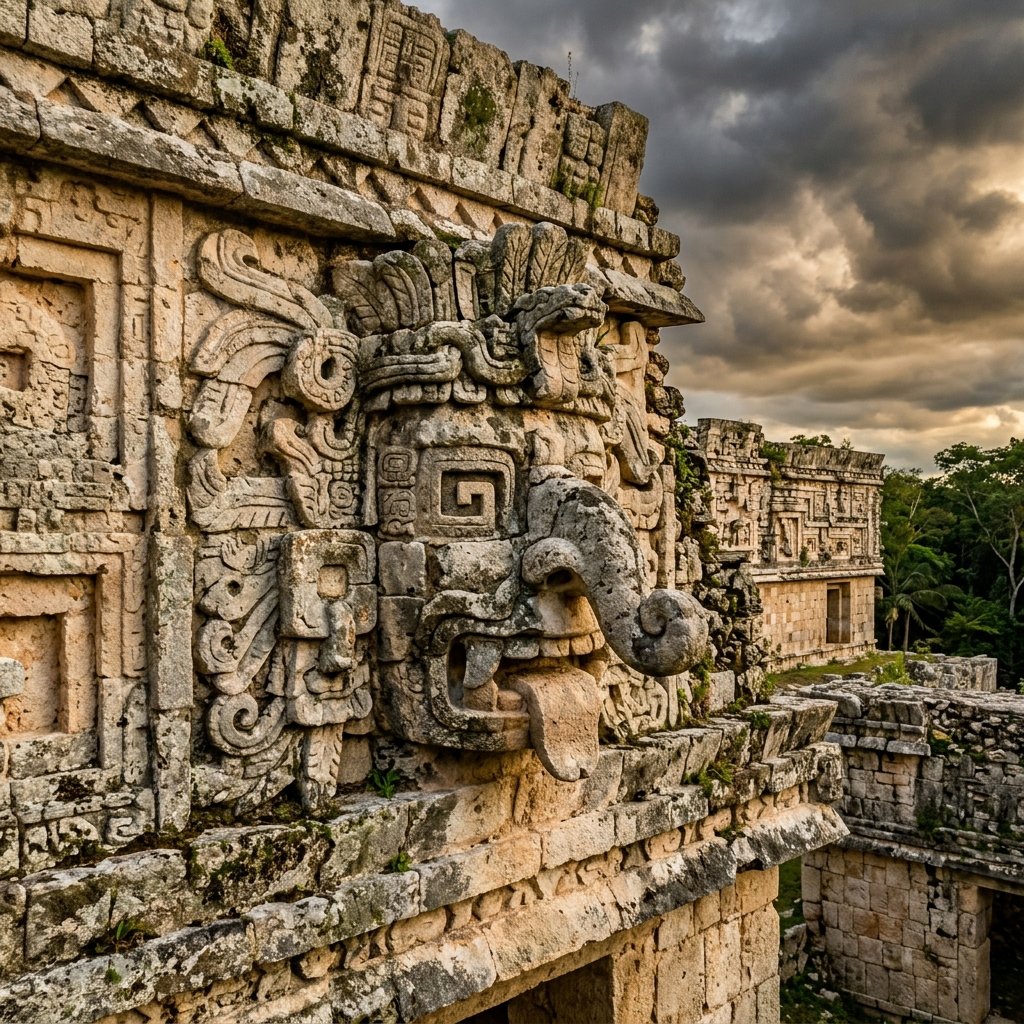
Chaac at a Glance
"In a land without rivers, the god who controlled rain controlled everything. Chaac was not an abstraction — he was the difference between harvest and famine, between a community's survival and its annihilation."
Why Chaac Matters: Rain in a Land Without Rivers
To understand why the ancient Maya devoted more architectural sculpture, more ritual energy, and more prayer to Chaac than perhaps any other deity, you must first understand the geography of the Yucatan Peninsula. The northern Yucatan is a vast limestone shelf. It has no rivers. No permanent streams or lakes exist on the surface. The porous limestone swallows every drop of rainfall almost immediately, draining it into a vast underground aquifer accessible only through natural sinkholes called cenotes (from the Yucatec Maya ts'onot, meaning "sacred well").
In this hydrological reality, rainfall was not merely important — it was the sole mechanism of agricultural survival. The Maya grew maize (ixim), their primary food source, using slash-and-burn milpa farming that was entirely dependent on seasonal rains arriving predictably between May and October. A failed rainy season meant famine. A prolonged drought — such as those that climatologists now believe contributed to the Classic Maya collapse (Hodell, D. A., Curtis, J. H., & Brenner, M., "Possible Role of Climate in the Collapse of Classic Maya Civilization," Nature, 375, 1995, pp. 391–394) — meant civilizational catastrophe.
Chaac, then, was not a remote theological concept. He was the deity upon whose mood the next meal depended. As the archaeologist Karl Taube has noted, Chaac was "the god of the common man" — more widely depicted in rural and domestic contexts than the aristocratic feathered serpent or the royal solar deity (Taube, K., The Major Gods of Ancient Yucatan, Dumbarton Oaks, 1992, p. 17).
Iconography: How to Recognize Chaac
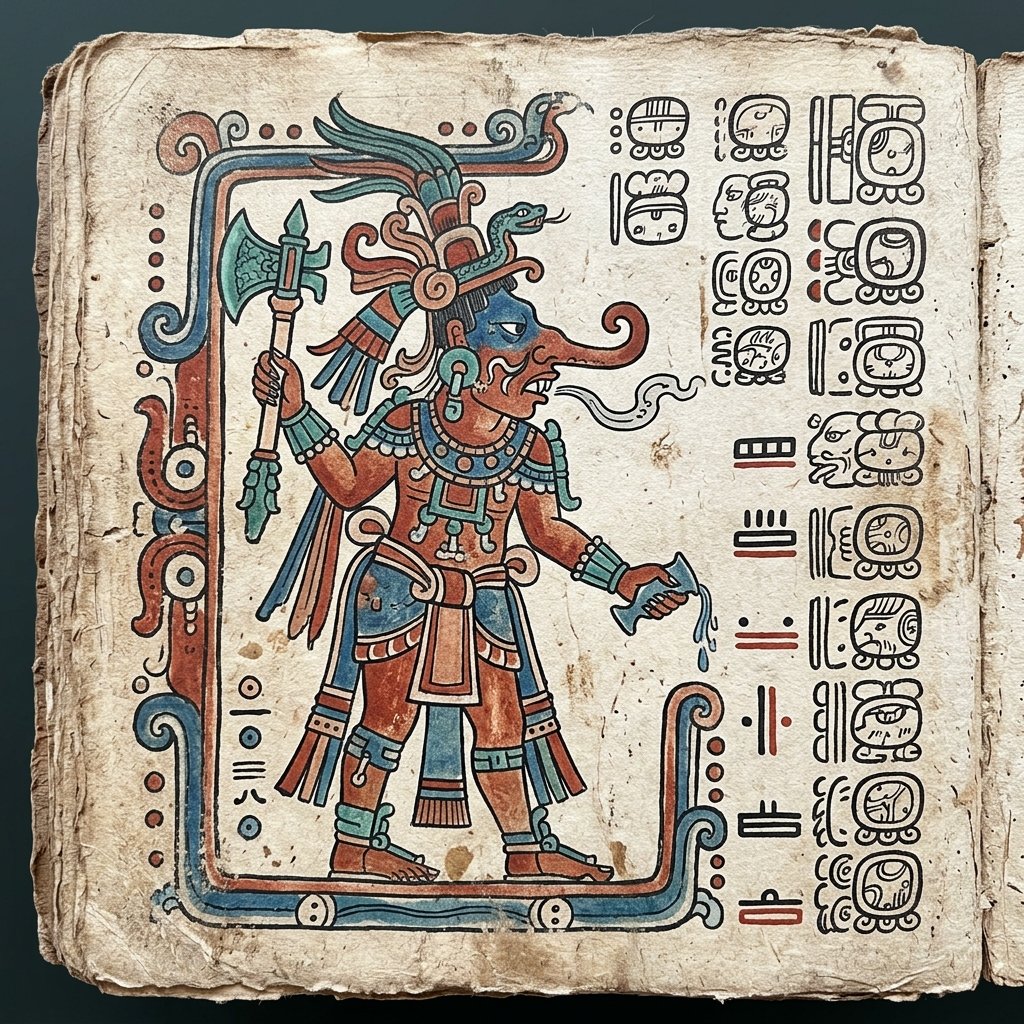
Chaac (God B) as depicted in Maya codex-style painting. Note the distinctive long curling nose — a feature so characteristic that scholars use it as the primary identifier. The axe in his hand represents the lightning bolt that splits the clouds to release rain. The Maya blue pigment was itself created using water, reinforcing Chaac's aquatic identity.
Chaac is one of the most readily identifiable deities in Maya art. The German scholar Paul Schellhas, in his pioneering 1904 classification of Maya deities from the surviving codices, designated him "God B" — and he appears more frequently in these manuscripts than any other deity (Schellhas, P., Representation of Deities of the Maya Manuscripts, Harvard University Peabody Museum Papers, Vol. 4, No. 1, 1904).
His diagnostic features, consistent across more than a millennium of Maya art, include:
Physical Features
- Long, curling proboscis nose — his single most distinctive trait, possibly representing a lightning bolt, a water stream, or a tapir's snout
- Reptilian or amphibian skin — scaled body emphasizing his aquatic nature
- T-shaped front tooth — the "Ik" (wind/breath) glyph, connecting rain to life-giving breath
- Large, spiral-scrolled eyes — often weeping, as his tears are the rain itself
- Fish barbels or catfish whiskers — linking him to underwater realms
Attributes & Symbols
- Jade lightning axe — when he strikes it against the clouds, thunder cracks and rain pours
- A shell or gourd — for pouring water from the sky
- A serpent — often coiled around his body or forming his headdress
- Frogs and toads — his earthly heralds, whose croaking announces coming rain
- The water lily — a symbol of standing water and cenote surfaces
The curling nose is so distinctive that even non-specialists can identify Chaac immediately. The Mayanist Linda Schele described it as "the single most repeated image in all of Maya art" (Schele, L. & Miller, M.E., The Blood of Kings, Kimbell Art Museum / George Braziller, 1986, p. 45). In architectural contexts, particularly in the Puuc region, this nose became an engineering marvel — projecting outward from building facades as a three-dimensional stone sculpture, sometimes extending more than a meter from the wall surface.
The Quadripartite Chaac: Four Directions, Four Colors
Like many Maya cosmological concepts, Chaac was not a single individual but a quadripartite entity — four manifestations of the same divine force, each stationed at one of the four cardinal directions and associated with a specific color. This fourfold structure mirrors the Maya model of the cosmos itself: a flat earth sustained by four cosmic trees (the Bacabs) at the corners, each holding up the sky.
Chac Xib Chaac — East (Red)
The Red Chaac of the sunrise and new beginnings. He brings the warm rains of spring that initiate the planting season. In Maya thought, east is the direction of birth and origin — the place where the sun itself is reborn each day. Chac Xib Chaac presides over the rains that awaken dormant seed corn.
Sac Xib Chaac — North (White)
The White Chaac of cold winds and the dry season. North was associated with the ancestral dead and the cessation of growth. Sac Xib Chaac governs the winter months when rainfall stops and farmers wait. His aspect reminds communities that rain is a gift, not a guarantee — and that seasons of scarcity are cosmologically necessary.
Ek Xib Chaac — West (Black)
The Black Chaac of the sunset and the underworld. West is the direction of death and transition in Maya cosmology — the place where the sun descends each evening. Ek Xib Chaac controls the devastating storms, hurricanes, and floods. His is the power that can destroy as readily as it creates — the terrifying face of water as a weapon.
Kan Xib Chaac — South (Yellow)
The Yellow Chaac of warmth, abundance, and the prime growing season. South is the direction of the zenith sun and maximum agricultural productivity. Kan Xib Chaac sends the steady, generous rains of summer that swell the corn ears and fill the reservoirs. His is the benevolent, nourishing face of water.
This directional system was not merely theological — it was practical. The ethnographer Alfonso Villa Rojas, studying Yucatec Maya communities in the 1940s, documented that contemporary rain ceremonies still station four ritual participants at the four corners of the altar, each representing one directional Chaac (Villa Rojas, A., The Maya of East Central Quintana Roo, Carnegie Institution, 1945, pp. 103–107). The cosmological model is alive.
The Cenotes: Chaac's Sacred Portals
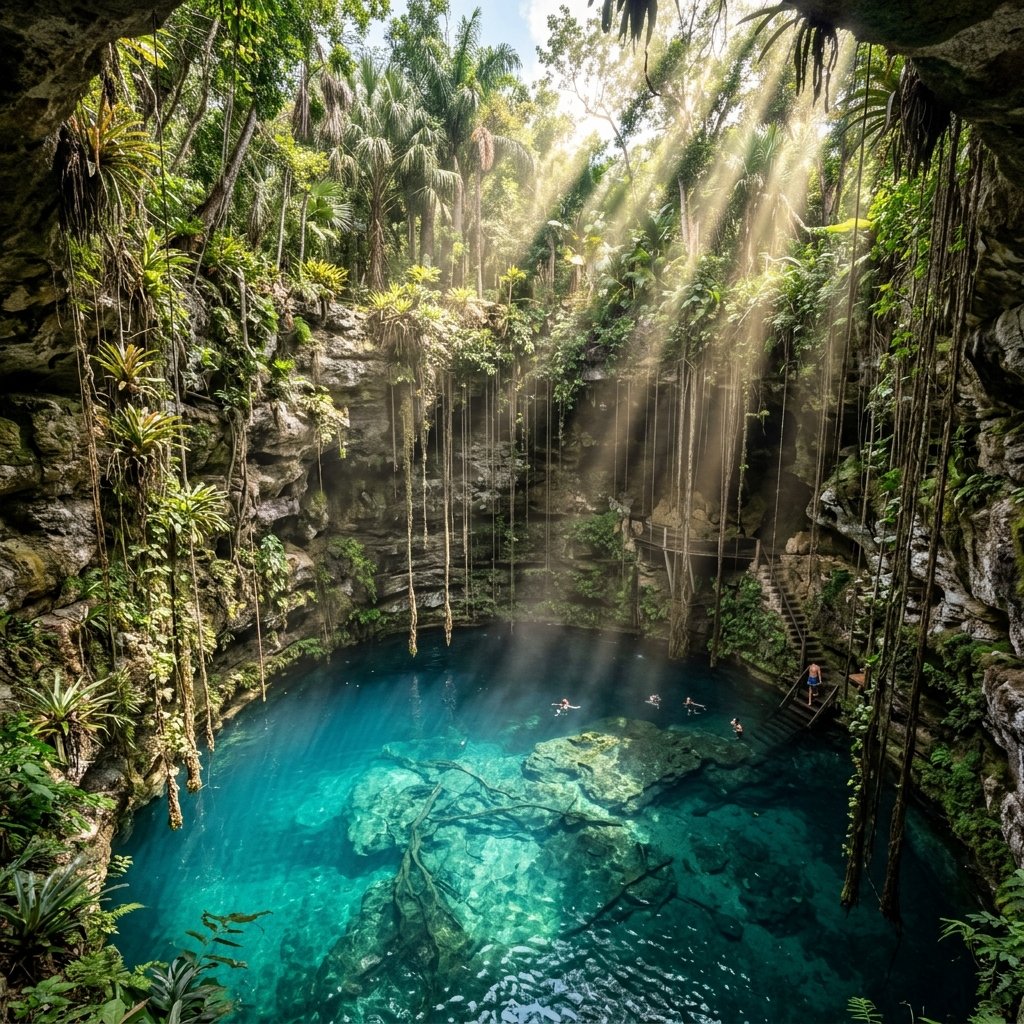
A sacred cenote in the Yucatan Peninsula. These natural limestone sinkholes were the primary access points to fresh water in a landscape without rivers — and the Maya understood them as portals to the watery underworld where Chaac dwelled. Cenotes were the most sacred sites for rain god worship and ritual offerings.
Cenotes were not merely water sources. In Maya cosmology, they were openings to Xibalba — the watery underworld where Chaac resided. The vast underground aquifer of the Yucatan became, in the Maya imagination, a subterranean ocean over which Chaac held dominion. To pray for rain was, in essence, to petition the god who lived beneath your feet.
Archaeological excavation of cenotes has revealed staggering quantities of offerings deposited over centuries: jade, obsidian, gold, ceramics, human bone, animal remains, copal incense, and wooden effigies. The Sacred Cenote at Chichén Itzá (the Cenote Sagrado) was dredged by Edward Herbert Thompson between 1904 and 1911, yielding thousands of objects and confirming what Bishop Diego de Landa had written in the sixteenth century: that the Maya threw "living men as well as other things" into the cenote as offerings to the rain gods (de Landa, D., Relación de las cosas de Yucatán, c. 1566; translated by A. Tozzer, Harvard University Peabody Museum Papers, Vol. 18, 1941, p. 180).
Modern archaeological analysis, however, has complicated the narrative of large-scale human sacrifice at cenotes. While skeletal remains have been found, many show evidence of post-mortem deposition rather than live sacrifice, and the vast majority of offerings were objects, not people (Coggins, C. & Shane, O.C., eds., Cenote of Sacrifice: Maya Treasures from the Sacred Well at Chichén Itzá, University of Texas Press, 1984). What is clear is that cenotes were among the most sacred sites in the entire Maya world — places where the boundary between the human realm and Chaac's domain was thinnest.
Architecture: The Puuc Mask Facades
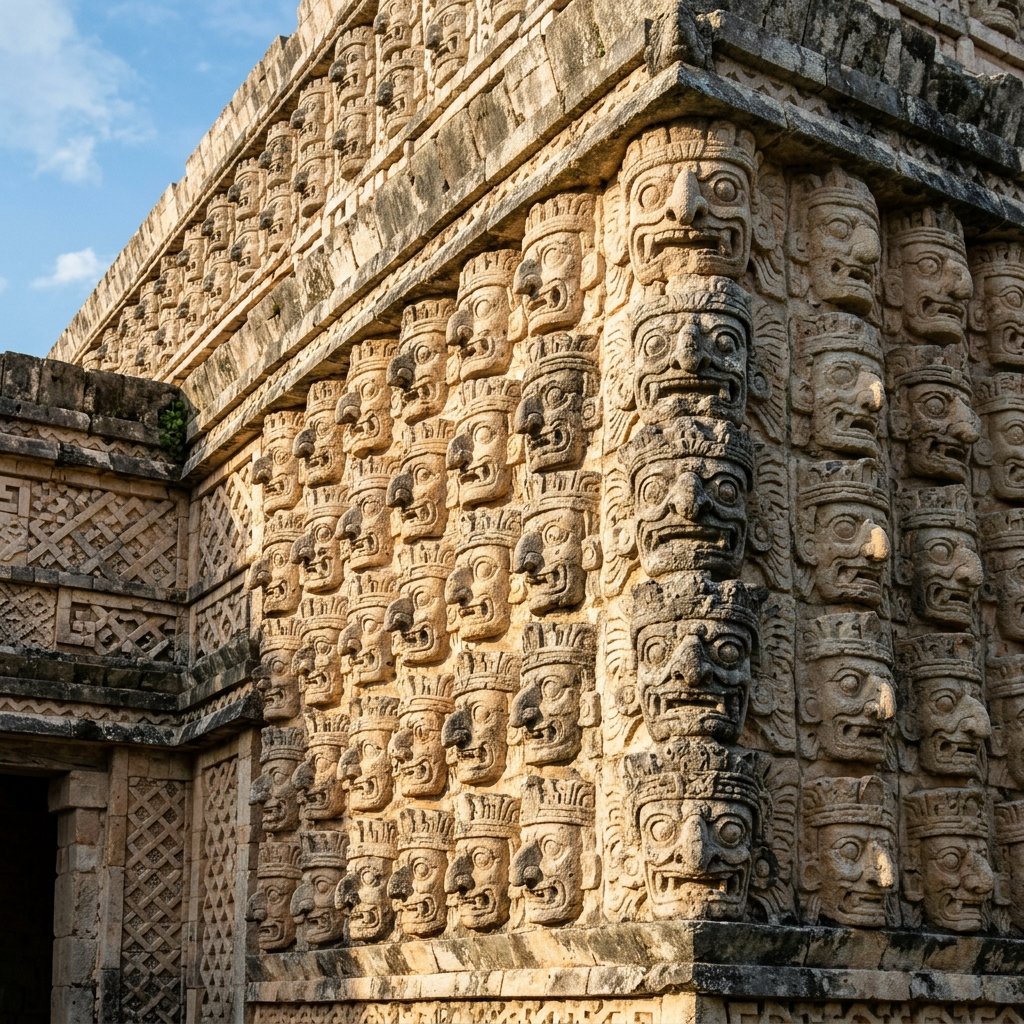
Repeating Chaac masks on a Puuc-style temple facade at Uxmal. Each mask was assembled from thousands of individually carved stones in a mosaic technique unique to the Puuc architectural tradition. The sheer repetition — sometimes hundreds of Chaac faces on a single building — is a monumental prayer in stone for rain.
Nowhere is the architectural devotion to Chaac more spectacular than in the Puuc region of the northern Yucatan — a cluster of cities including Uxmal, Kabah, Sayil, Labná, and Xlapak that flourished between approximately 750 and 1000 AD. These cities developed a unique architectural style characterized by elaborate mosaic facades assembled from precisely cut stone blocks — and the most common motif, by an overwhelming margin, is the face of Chaac.
At Uxmal, the Palace of the Governor displays one of the most sophisticated architectural compositions in the ancient Americas: a 100-meter-long facade covered in approximately 20,000 individually carved stone elements arranged into an intricate pattern of Chaac masks, serpents, lattice work, and stepped frets. The Mayanist Jeff Karl Kowalski, who conducted the definitive architectural study of the building, described it as "perhaps the single greatest work of architecture in pre-Columbian Mesoamerica" (Kowalski, J.K., The House of the Governor: A Maya Palace at Uxmal, Yucatan, University of Oklahoma Press, 1987, p. ix).
But the most obsessive concentration of Chaac imagery is at Kabah, approximately 20 kilometers southeast of Uxmal. The Codz Poop (Palace of the Masks) at Kabah features an entire building facade — roughly 45 meters long — covered entirely with Chaac masks. There is no bare wall surface. Each mask's projecting nose once functioned as a step for Maya masons performing maintenance on the upper facade. Standing before this wall, the viewer is confronted with the face of rain repeated hundreds of times — a monumental prayer carved in stone for the water these Puuc cities so desperately needed.
The reason for this architectural obsession is geographical: the Puuc region sits on elevated limestone hills with no cenotes. Unlike Chichén Itzá to the east, Puuc cities had no natural access to groundwater. They relied entirely on chultunes — artificial cisterns carved into the bedrock to collect and store rainwater. When rain failed, there was no backup. Chaac was not merely worshipped in the Puuc cities; he was the only reason they could exist at all.
The Ch'a-Cháak: The Rain Ceremony
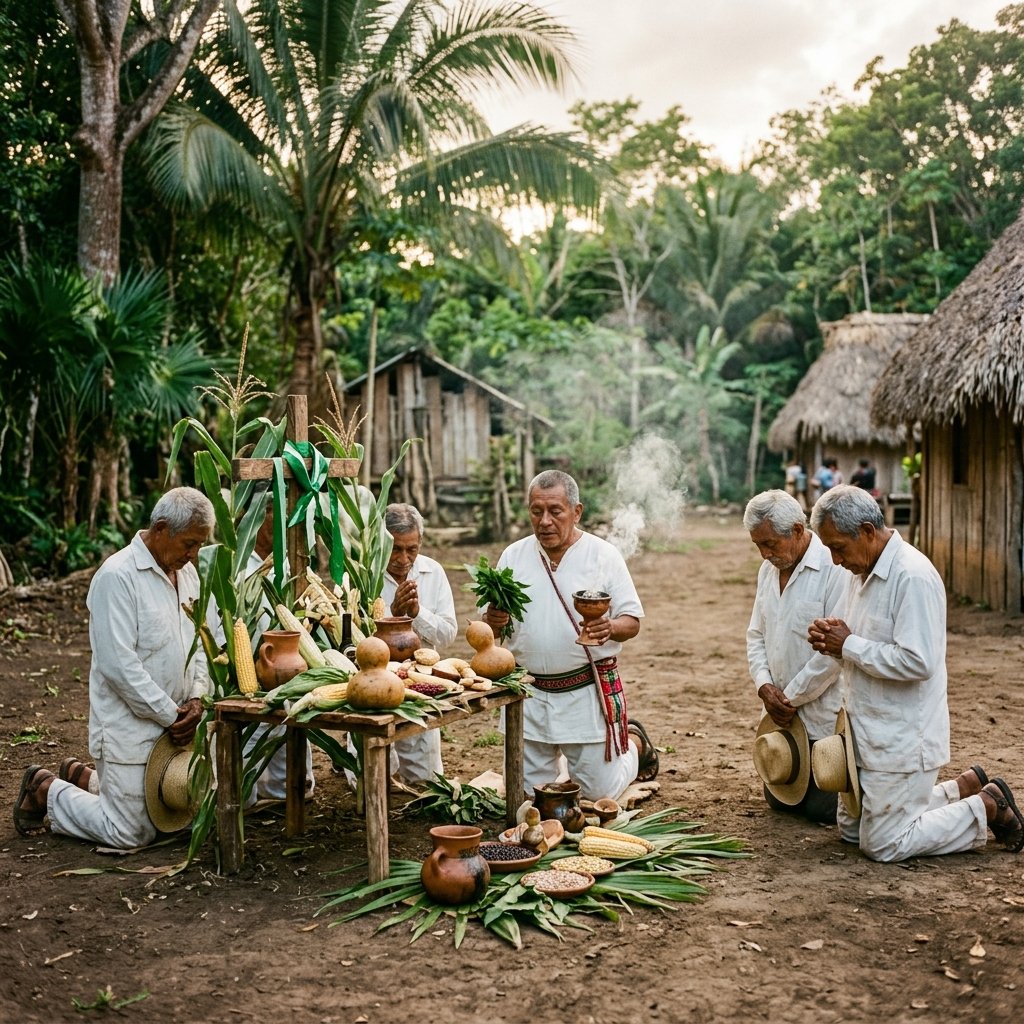
A traditional Ch'a-Cháak rain ceremony in rural Yucatan. This living ritual — documented by ethnographers since the colonial period and still practiced today — preserves a ceremonial structure that has remained remarkably consistent for over a thousand years. The four-cornered altar mirrors the quadripartite cosmos.
The most important ritual devoted to Chaac is the Ch'a-Cháak (literally "bring Chaac" or "fetch the rain") — a community rain ceremony that has been documented from the colonial period through the present day, making it one of the longest-continuously-practiced religious rituals in the Americas.
The ceremony, as described by the ethnographers Redfield and Villa Rojas in their landmark study of Chan Kom village (Redfield, R. & Villa Rojas, A., Chan Kom: A Maya Village, Carnegie Institution, 1934, pp. 138–143) and confirmed by subsequent fieldwork, follows a remarkably consistent structure:
The Altar
A temporary altar is constructed in the milpa (cornfield) or village clearing. It is oriented to the four cardinal directions, with posts at each corner representing the four directional Chaacs. The altar is a microcosm — a miniature version of the four-cornered Maya cosmos.
The Offerings
Ritual offerings include maize breads (nohoch wah), ground squash seeds, cacao, copal incense, tobacco, and a sacred fermented honey drink called balché. Each item carries specific symbolic meaning within the rain-petition framework.
The Frog Boys
Four young boys are stationed at the four corners of the altar, where they imitate the croaking of frogs (uo) throughout the ceremony. Frogs are Chaac's earthly heralds — their appearance and vocalizations announce coming rain. The boys serve as sympathetic magic, calling rain into being through imitation.
The H-Men
The ceremony is led by a ritual specialist called the h-men (or j-men) — a spiritual practitioner who maintains knowledge of traditional prayers, offerings, and the proper sequence of ritual actions. The h-men chants invocations to Chaac in Yucatec Maya, petitioning each of the four directional Chaacs in turn.
What makes the Ch'a-Cháak extraordinary from an anthropological standpoint is its continuity. The basic structure — four-cornered altar, directional offerings, frog impersonation, community participation — appears to have remained fundamentally unchanged since the pre-Columbian period, surviving the Spanish conquest, forced conversion to Catholicism, and five centuries of colonial and post-colonial disruption. Contemporary Maya farmers in villages across the Yucatan still perform the ceremony when seasonal rains fail to arrive on schedule.
Chaac in the Dresden Codex
The most detailed pre-Columbian depictions of Chaac appear in the Dresden Codex — one of only four surviving Maya books. This remarkable document, now housed in the Saxon State Library in Dresden, Germany, contains almanacs in which Chaac appears repeatedly in agricultural contexts: holding axes, pouring water from vessels, and seated on directional thrones.
In the so-called "farmer's almanac" sections of the Dresden Codex (pages 29–30 and 36–39), Chaac is depicted performing agricultural activities — chopping trees, scattering seed, and standing in rain. These passages appear to be ritual prescriptions, instructing farmers on the proper timing of agricultural activities in coordination with the Tzolk'in calendar. Each action is tied to a specific day sign, suggesting that the Maya believed Chaac's favor depended on performing the right agricultural action on the right sacred day (Thompson, J.E.S., A Commentary on the Dresden Codex, American Philosophical Society, 1972, pp. 67–73).
Chaac and Tlaloc: Rain Gods Across Mesoamerica
Chaac is often compared to Tlaloc, the Aztec rain god, and the comparison illuminates both shared Mesoamerican heritage and important differences. Both deities control rain and agricultural fertility. Both wield lightning as a weapon. Both are associated with directional quadruplication and mountain-dwelling. Both have goggle-like eyes and prominent mouths that scholars associate with the "storm god" archetype traceable to Olmec predecessors more than 2,000 years before either the Maya or the Aztec civilizations (Taube, K., "The Rainmakers: The Olmec and Their Contribution to Mesoamerican Belief Systems," in The Olmec World: Ritual and Rulership, The Art Museum, Princeton University, 1996, pp. 83–103).
However, notable differences exist. In Maya art, Chaac is frequently depicted with humor, playfulness, and even tenderness — particularly in scenes showing him nurturing crops or weeping rain-tears. Tlaloc, by contrast, tends toward the fearsome in Aztec representation: goggle-eyed, fanged, and associated with child sacrifice at mountain shrines. Whether this reflects genuine theological differences or simply different artistic conventions remains debated. What is clear is that the Mesoamerican rain god archetype — whether called Chaac, Tlaloc, Cocijo (Zapotec), or Tajín (Totonac) — represents one of the most ancient and widely distributed religious concepts in the Americas.
The Croaking of Frogs: Chaac's Living Heralds
One of the most charming aspects of Chaac worship is the role assigned to frogs and toads. The Maya observed that frog vocalizations increase dramatically before rainfall — a biological reality caused by frogs' sensitivity to atmospheric pressure changes. The Maya interpreted this correlation theologically: frogs were Chaac's earthly servants, announcing his imminent arrival.
This belief was encoded in ritual (the frog-imitating boys of the Ch'a-Cháak ceremony), in art (frogs appear frequently at the base of Chaac representations, particularly on ceramic incense burners), and even in language: the Yucatec Maya word for the month Wo may derive from uo, meaning "frog," and this month corresponds to the period just before the start of the rainy season (Roys, R.L., The Book of Chilam Balam of Chumayel, University of Oklahoma Press, 1967, p. 185n).
In some Maya communities today, hearing the first frog chorus of the season is still treated as a cause for optimism and minor celebration — a sign that Chaac has not forgotten his people.
Living Legacy: Chaac in the Twenty-First Century
Unlike many ancient deities whose worship ended with the civilizations that created them, Chaac remains a living presence in Maya communities. Anthropological fieldwork in the twenty-first century continues to document active Ch'a-Cháak ceremonies in rural villages across the Yucatan Peninsula and Quintana Roo (Love, B., The Paris Codex: Handbook for a Maya Priest, University of Texas Press, 1994; Restall, M., The Maya World, Cambridge University Press, 1998).
In some communities, Catholic saints have been syncretized with traditional rain deities — Saint Michael or Saint Isidore the Farmer may be invoked alongside or in place of Chaac — but the underlying ritual structure remains recognizably pre-Columbian. The four-cornered altar, the directional offerings, the role of the h-men as ceremonial leader, and the community's collective petition for rain persist as a living archaeological record of one of the world's oldest continuously practiced religious traditions.
For the Maya farmer standing in a parched milpa in May, watching the sky for the first clouds of the rainy season, Chaac is not a museum artifact or a chapter in a textbook. He is the answer to the most urgent question a person can ask: will the rain come?
References
- Aveni, A. F. Skywatchers of Ancient Mexico. University of Texas Press, 2001.
- Coggins, C. & Shane, O.C. (eds.). Cenote of Sacrifice: Maya Treasures from the Sacred Well at Chichén Itzá. University of Texas Press, 1984.
- de Landa, D. Relación de las cosas de Yucatán. c. 1566. Translated by A. Tozzer. Peabody Museum Papers, Vol. 18. Harvard University, 1941.
- Hodell, D. A., Curtis, J. H., & Brenner, M. "Possible Role of Climate in the Collapse of Classic Maya Civilization." Nature, 375, 1995, pp. 391–394.
- Kowalski, J.K. The House of the Governor: A Maya Palace at Uxmal, Yucatan. University of Oklahoma Press, 1987.
- Love, B. The Paris Codex: Handbook for a Maya Priest. University of Texas Press, 1994.
- Redfield, R. & Villa Rojas, A. Chan Kom: A Maya Village. Carnegie Institution, 1934.
- Restall, M. The Maya World. Stanford University Press, 1998.
- Roys, R.L. The Book of Chilam Balam of Chumayel. University of Oklahoma Press, 1967.
- Schele, L. & Miller, M.E. The Blood of Kings. Kimbell Art Museum / George Braziller, 1986.
- Schellhas, P. Representation of Deities of the Maya Manuscripts. Harvard University, Peabody Museum Papers, Vol. 4, No. 1, 1904.
- Taube, K. The Major Gods of Ancient Yucatan. Dumbarton Oaks, 1992.
- Thompson, J.E.S. A Commentary on the Dresden Codex. American Philosophical Society, 1972.
- Villa Rojas, A. The Maya of East Central Quintana Roo. Carnegie Institution, 1945.
Frequently Asked Questions
Why does Chaac have a long nose?
Chaac's curling, proboscis-like nose is his single most diagnostic feature and the subject of scholarly debate. The most widely accepted interpretation is that it represents a streaming flow of water — rain pouring from the sky in a curved path. Other scholars have proposed it represents a stylized lightning bolt, or an association with the Baird's tapir (Tapirus bairdii), whose prehensile snout resembles Chaac's nose and which was native to the Maya region. The nose may also connect Chaac to the cosmic serpent through which rain was believed to flow between the sky and earth (Taube, 1992, pp. 17–22).
Is Chaac still worshipped today?
Yes. Modified versions of ancient rain ceremonies called Ch'a-Cháak are still performed in rural Maya communities across the Yucatan Peninsula and Quintana Roo. While Catholic elements have been incorporated in many communities — with saints like San Isidro Labrador sometimes invoked alongside traditional deities — the core ritual structure (four-cornered altar, directional offerings, copal incense, the role of the h-men specialist) remains recognizably pre-Columbian. This makes Chaac one of the longest continuously worshipped deities in the Western Hemisphere.
What is the difference between Chaac and Tlaloc?
Both are Mesoamerican rain gods sharing a common ancestry traceable to Olmec prototypes (c. 1200–400 BC). However, Chaac (Maya) tends to be depicted with a long, curling nose and often appears with playful or nurturing qualities, while Tlaloc (Aztec) features goggle-shaped eyes, prominent fangs, and a more fearsome aspect. Their worship practices also differed: Maya Chaac worship centered on cenotes and community rain ceremonies, while Aztec Tlaloc worship was associated with mountain-top shrines and elaborate state-level sacrificial rituals.
What did the Maya throw into cenotes?
Archaeological excavation of cenotes — particularly the Sacred Cenote at Chichén Itzá — has recovered jade ornaments, gold discs, obsidian blades, ceramic vessels, wooden effigies, rubber balls, copal incense, and human skeletal remains. While colonial-period accounts (notably Bishop Diego de Landa) emphasized human sacrifice, modern archaeological analysis shows that the vast majority of offerings were objects, not people, and that many skeletal remains show evidence of post-mortem deposition rather than live sacrifice (Coggins & Shane, 1984).
Why are there so many Chaac masks at Uxmal?
The Puuc region, where Uxmal is located, sits on elevated limestone terrain with no cenotes — meaning no natural access to groundwater. These cities depended entirely on collected rainwater stored in artificial cisterns (chultunes). The obsessive architectural repetition of Chaac's face — hundreds of masks on single buildings — reflects the existential importance of rain to communities that had no backup water source. The architecture is, in essence, a monumental prayer carved in stone.