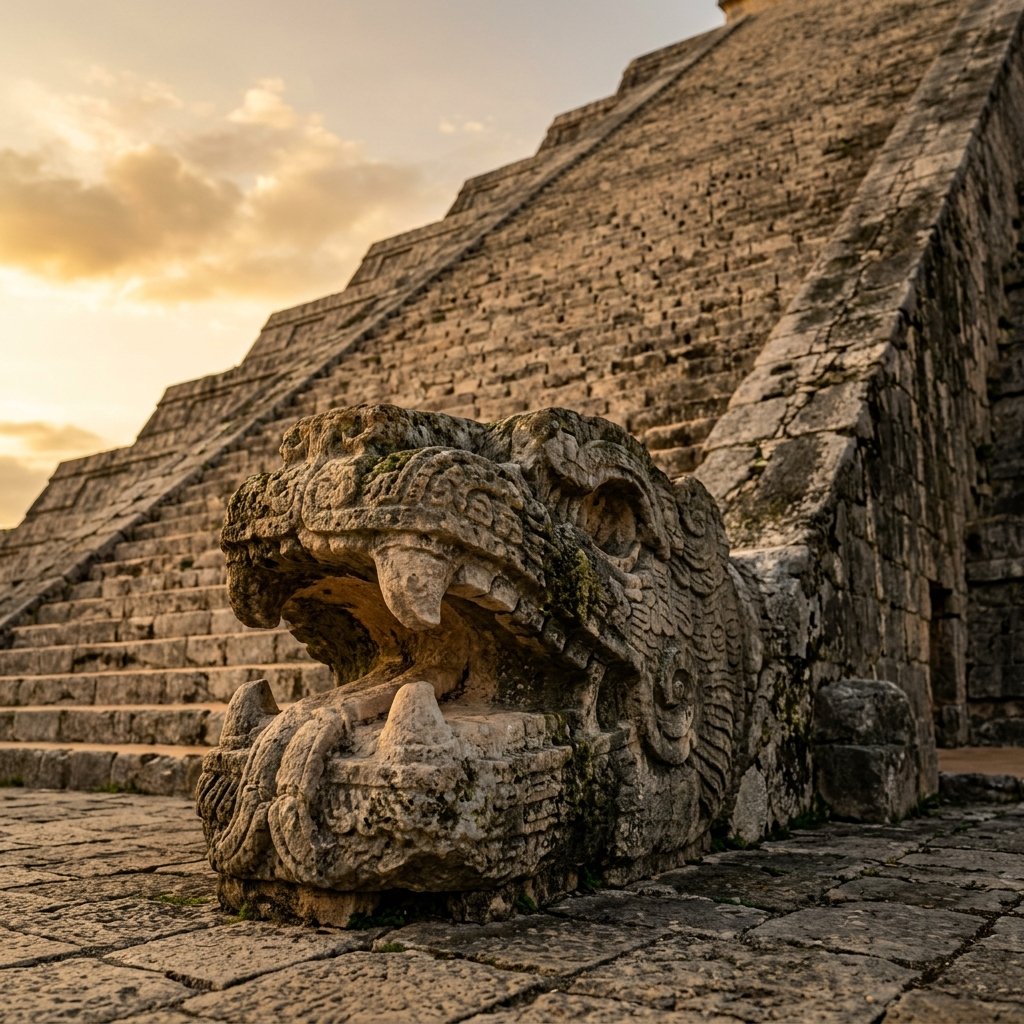
Kukulkán at a Glance
"A serpent that grows feathers. A creature of the earth that learns to fly. The Feathered Serpent is the most ancient, most widely distributed, and most enduring religious symbol in the Americas — an image that captivated civilizations across two millennia and a continent's breadth, from the humid Olmec heartland to the arid highlands of central Mexico."
The Concept: Why a Feathered Serpent?
To understand Kukulkán, begin with the image itself. A feathered serpent is a paradox made visible — a fusion of two creatures from opposite realms: the serpent, which crawls on and within the earth, symbolizing the terrestrial, the chthonic, the underground; and the bird, specifically the resplendent quetzal (Pharomachrus mocinno), which soars above the canopy, symbolizing the celestial, the ethereal, the divine.
To combine these two creatures into a single being is to declare that the earth and the sky are not separate — they are aspects of the same reality. The Feathered Serpent is the axis mundi made incarnate: the bridge between the underworld and the heavens, the connector of all cosmic levels. As the epigrapher David Stuart has observed, the feathered serpent motif in Classic Maya art functions as a "visual metaphor for the dynamic interplay between earthly and celestial forces" — it appears on royal thrones, ceremonial bars, and architectural facades precisely at the points where human rulers claim to channel divine power (Stuart, D., The Order of Days: The Maya World and the Truth About 2012, Harmony Books, 2011, pp. 193–198).

The resplendent quetzal (Pharomachrus mocinno) — the bird whose iridescent plumage inspired the "feathered" half of the Feathered Serpent. Quetzal feathers were the most precious material in Mesoamerica — more valuable than gold or jade. Killing a quetzal was punishable by death in some Maya polities. The bird's long tail streamers, which can exceed 60 cm, shimmer between green and blue depending on the light — an iridescence the Maya associated with divine presence.
The name Kukulkán itself encodes this duality: from the Yucatec Maya k'uk'ul ("feathered" or "plumed," from k'uk', the quetzal) and kaan ("serpent"). The K'iche' Maya equivalent, Q'uq'umatz, carries the same meaning: q'uq' (quetzal) + kumatz (serpent). In Nahuatl (the Aztec language), the cognate Quetzalcoatl preserves the same structure: quetzalli (quetzal feather) + coatl (serpent). Three languages, three cultures, one image — the feathered serpent as the unifying religious symbol of Mesoamerica.
Origins: The Olmec Prototype
The feathered serpent concept is far older than the Maya civilization. Its earliest known appearances occur in Olmec art — the "mother culture" of Mesoamerica, which flourished along the Gulf Coast of Mexico from approximately 1500 to 400 BC. Olmec carved stone monuments from La Venta and San Lorenzo include serpentine figures with avian attributes — feathered crests, beak-like mouths, and plumed tails — that scholars recognize as the prototypes of what would become Kukulkán and Quetzalcoatl.
The archaeologist Karl Taube has traced the Olmec feathered serpent to "the earliest stratum of Mesoamerican religious symbolism," arguing that the concept was already fully formed by the Middle Formative period (c. 900–400 BC) and that "virtually all later Mesoamerican feathered serpent imagery derives from this Olmec prototype" (Taube, K., "The Olmec Maize God: The Face of Corn in Formative Mesoamerica," RES: Anthropology and Aesthetics, Nos. 29/30, 1996, pp. 39–81).
Teotihuacan: The Temple That Changed Everything
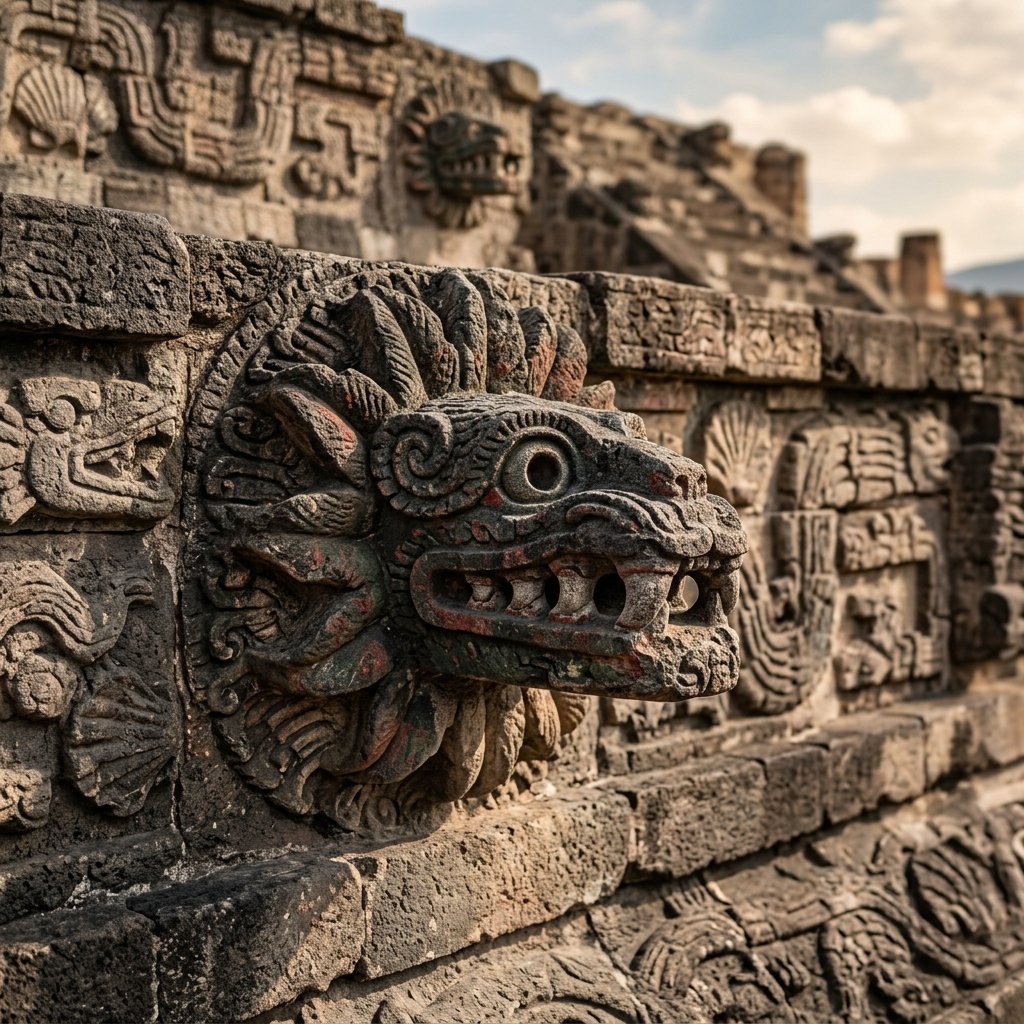
A carved feathered serpent head on the facade of the Temple of the Feathered Serpent (Templo de la Serpiente Emplumada) at Teotihuacan, Mexico. This massive pyramid, built c. 200 AD, features over 360 carved serpent heads — making it the earliest monumental expression of feathered serpent worship. Teotihuacan's influence on Maya civilization was profound, and the feathered serpent motif traveled south with it.
The concept's most dramatic pre-Maya expression occurs at Teotihuacan — the enormous metropolis in central Mexico that dominated Mesoamerican politics and trade between approximately 100 BC and 550 AD. The Temple of the Feathered Serpent (Templo de la Serpiente Emplumada), built c. 200 AD, features over 360 carved serpent heads projecting from its facades — each surrounded by a ruff of carved feathers. Beneath the temple, archaeologists discovered the remains of over 200 sacrificial victims, suggesting that the feathered serpent cult was already associated with massive state-level ceremony (Sugiyama, S., Human Sacrifice, Militarism, and Rulership: Materialization of State Ideology at the Feathered Serpent Pyramid, Teotihuacan, Cambridge University Press, 2005).
Teotihuacan's influence on the Maya world was profound. The city maintained active trade and possibly political connections with major Maya centers including Tikal and Copán. David Stuart's epigraphy has confirmed that a specific historical event — the arrival of Teotihuacan-associated warriors at Tikal in 378 AD (the so-called entrada) — fundamentally altered the political landscape of the Maya lowlands (Stuart, D., "'The Arrival of Strangers': Teotihuacan and Tollan in Classic Maya History," in Mesoamerica's Classic Heritage, University Press of Colorado, 2000, pp. 465–513). With these connections came the feathered serpent iconography, which Maya artists then adapted and transformed within their own theological framework.
The Light Serpent: Kukulkán at the Equinox
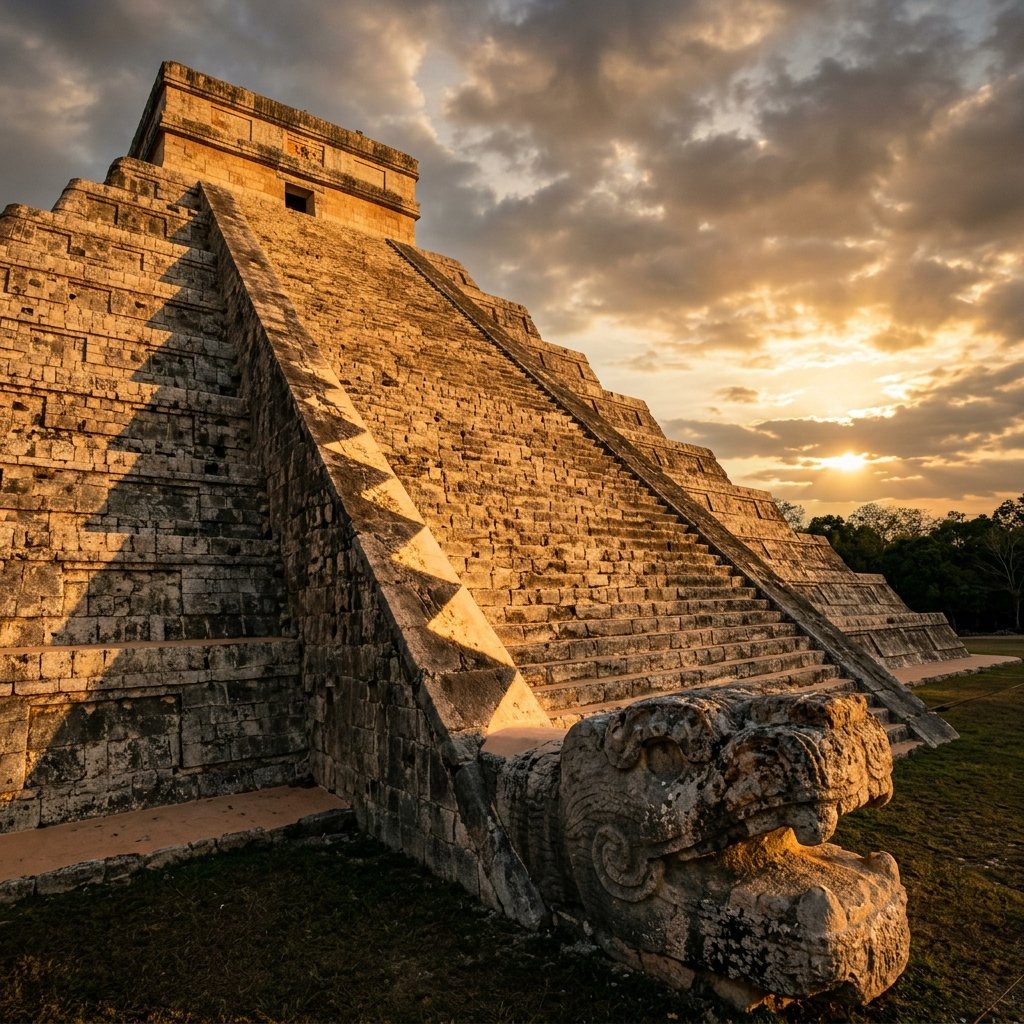
The equinox light-serpent phenomenon at El Castillo, Chichén Itzá. During the spring and autumn equinoxes, the late afternoon sun creates a pattern of triangular shadows along the north balustrade that appears to form the undulating body of a serpent descending the pyramid — connecting with the carved serpent head at the base. Whether this alignment was intentionally engineered or partially fortuitous remains debated among archaeoastronomers.
Kukulkán's most spectacular manifestation occurs at his temple — El Castillo (the "Temple of Kukulkán") at Chichén Itzá. Twice each year, during the spring and autumn equinoxes (approximately March 20 and September 22), the late afternoon sun creates a pattern of seven triangular shadows along the northern stairway balustrade. These shadows connect visually with the carved serpent head at the base of the stairway, producing the stunning illusion of a massive feathered serpent descending from the heavens to the earth.
The effect lasts approximately 45 minutes and requires precise atmospheric conditions. The question of whether this alignment was intentionally engineered by Maya architects or is a fortuitous coincidence has generated considerable scholarly debate. The archaeoastronomer Anthony Aveni, who has studied the alignment extensively, concludes that while the pyramid's orientation was certainly deliberate, the specific shadow phenomenon may have been "discovered rather than designed," and subsequently incorporated into the site's ritual calendar — a pragmatic position that acknowledges both Maya astronomical sophistication and the complexity of architectural intention (Aveni, A.F., Skywatchers of Ancient Mexico, University of Texas Press, 2001, pp. 303–308).
What is not debatable is the effect's continuing power. Over 30,000 visitors gather at Chichén Itzá each equinox to witness the light serpent — making it the single most attended astronomical event at any archaeological site in the world.
Kukulkán in the Popol Vuh
In the Popol Vuh, the K'iche' Maya creation epic, the Feathered Serpent appears under the name Q'uq'umatz — one of the primordial creator deities who exists before the world is made. The text describes him floating on the dark primordial waters, "covered in green and blue feathers," contemplating creation alongside Tepeu (the Sovereign Plumed Serpent):
"There was only immobility and silence in the darkness, in the night. Only the Creator, the Maker, Tepeu, Gukumatz, the Forefathers, were in the water surrounded with light. They were hidden under green and blue feathers, and were therefore called Gukumatz."
— Popol Vuh, Part I, Chapter 1 (Tedlock translation, 1996)
In this cosmogonic role, Q'uq'umatz is not merely a nature god but a creative intelligence — a being who thinks, plans, and speaks the world into existence. Together with Tepeu, he creates the earth, the mountains, the rivers, and the animals. When the first three attempts to create humans fail (from mud, then from wood), it is the Feathered Serpent who persists until the gods succeed with maize dough — the substance from which true humanity is finally shaped.
The Sacred Cenote: Offerings to the Serpent
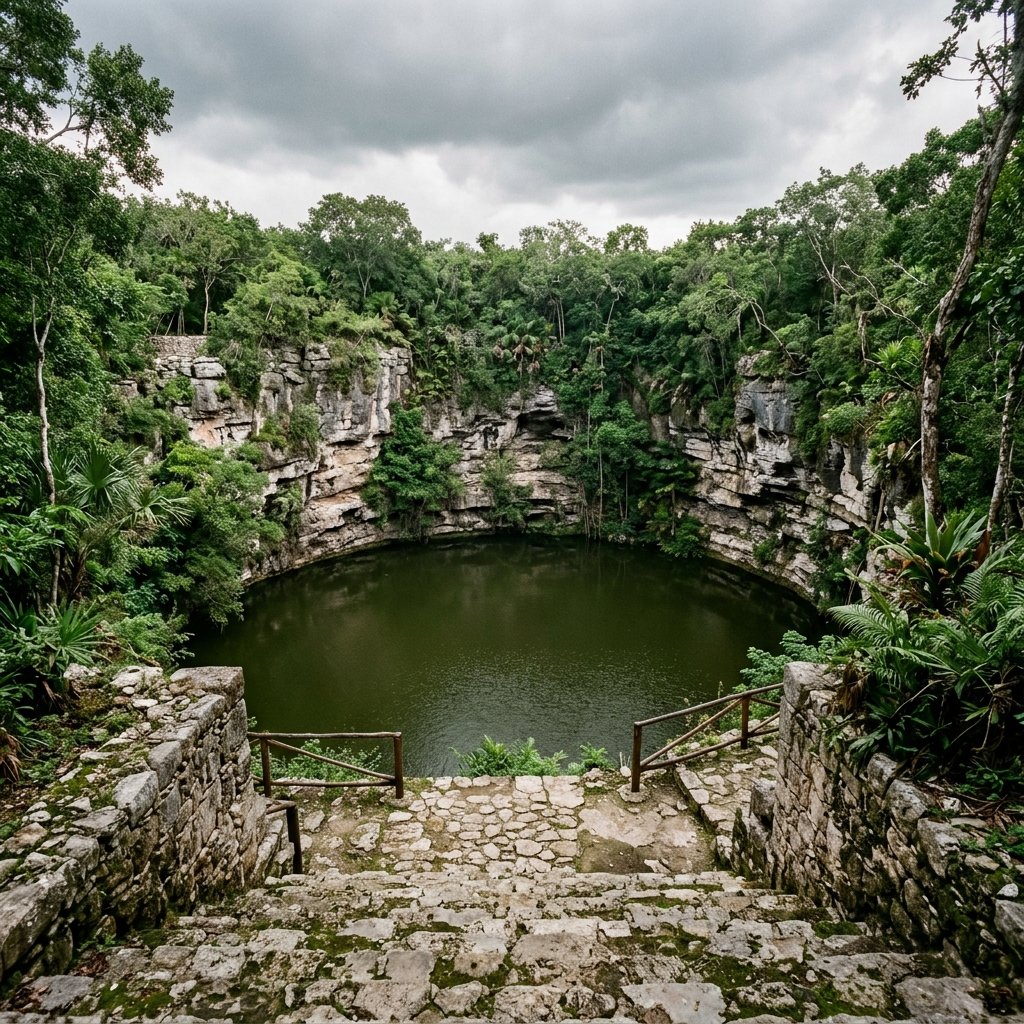
The Sacred Cenote (Cenote Sagrado) at Chichén Itzá. This natural limestone sinkhole, connected to the Temple of Kukulkán by a 300-meter processional causeway, was a major destination for ritual offerings. Archaeological dredging has recovered jade, gold, obsidian, ceramic vessels, rubber, copal incense, and human remains — confirming colonial accounts of its use as a sacrificial site.
The Sacred Cenote at Chichén Itzá — a massive natural limestone sinkhole approximately 60 meters in diameter — was connected to the Temple of Kukulkán by a 300-meter raised stone causeway (sacbe), marking it as an integral part of the Feathered Serpent cult complex. Colonial sources, most notably Bishop Diego de Landa, describe pilgrimages to the cenote where "in times of drought... they were accustomed to throw in living men as a sacrifice to the gods" along with "precious stones and things which they prized" (de Landa, D., Relación de las cosas de Yucatán, c. 1566; Tozzer translation, 1941, p. 179).
Modern archaeological study, beginning with Edward Herbert Thompson's controversial dredging operations between 1904 and 1911, has recovered a remarkable assemblage of artifacts: gold discs (many depicting scenes of warfare and sacrifice), jade ornaments, obsidian blades, ceramic vessels, rubber balls, copal incense, wooden effigies, and — as de Landa described — human skeletal remains. Analysis of the gold artifacts revealed that many were manufactured outside the Maya region, confirming Chichén Itzá's role as a hub of long-distance trade and pilgrimage (Coggins, C. & Shane, O.C., eds., Cenote of Sacrifice: Maya Treasures from the Sacred Well at Chichén Itzá, University of Texas Press, 1984).
Kukulkán's Path Through Mesoamerican History
The Feathered Serpent is not merely a Maya deity — it is the most widely distributed religious concept in the ancient Americas, spanning more than two thousand years and at least six major civilizations:
The earliest feathered serpent imagery. Carved monuments from La Venta and San Lorenzo show serpentine figures with avian attributes — the prototype for all subsequent iterations.
The first monumental expression. The Temple of the Feathered Serpent features 360+ carved serpent heads and evidence of mass sacrifice — a state-level cult with enormous political power.
Known as Waxaklahun Ubah Kan ("War Serpent" or "Eighteen Images of the Snake"). David Stuart's decipherment of this Classic Maya name revealed that the feathered serpent was associated with warfare, royal authority, and cosmic vision (Stuart, 2000).
Kukulkán becomes the patron deity of Chichén Itzá and later Mayapán. His cult merges political authority with religious devotion — the Feathered Serpent as both god and king.
As Quetzalcoatl — god of wind, learning, and priestly knowledge. The Aztec version emphasizes the culture-hero narrative: a divine king who brought civilization before departing across the eastern sea.
The equinox phenomenon at Chichén Itzá draws 30,000+ visitors annually. The Feathered Serpent remains a living symbol of Mesoamerican identity and spiritual continuity.
Symbolism: What the Feathered Serpent Means
Kukulkán embodies several of the most profound ideas in Mesoamerican philosophy:
The Union of Opposites
Earth (serpent) + Sky (bird) = the unity of the cosmos. The Feathered Serpent declares that matter and spirit, the terrestrial and the celestial, are not enemies but partners. This is perhaps the single most characteristic feature of Mesoamerican thought: a refusal to separate the world into irreconcilable dualisms.
Wind and Breath
Kukulkán is associated with the calendar day sign Ik' (Wind) — the divine breath that animates all living things. Wind is invisible but powerful; it moves clouds and brings rain; it is the breath of the cosmos itself. A serpent that flies is, in essence, wind — the air made visible as a moving, living form.
Cyclical Renewal
Serpents shed their skin and are "reborn" — one of the most universal symbols of renewal in world culture. The Feathered Serpent's periodic descent at the equinox (appearing, then vanishing) mirrors the agricultural cycle of planting and harvest, death and resurrection, the eternal return.
Knowledge and Civilization
In both Maya and Aztec traditions, the Feathered Serpent is associated with writing, the arts, the calendar, and priestly learning. He is the bringer of civilization — not through force, but through knowledge. His cult was patronized by scribes, astronomers, and the learned class across Mesoamerica.
Was Kukulkán a Real Person?
Several colonial-era Yucatec Maya sources — including the Books of Chilam Balam (prophetic texts preserved in the Latin alphabet after the conquest) — describe Kukulkán as a historical figure: a great leader who arrived in the Yucatan from the west, founded the city of Chichén Itzá, established its political and religious institutions, and then departed across the sea, promising to return.
This narrative raises a question that scholars have debated for over a century: was there a historical person behind the Kukulkán mythology? The archaeologist William Ringle has proposed that the Postclassic "Kukulkán" may reflect a real political figure or dynasty that consolidated power at Chichén Itzá around the 10th century AD, using the ancient feathered serpent religious tradition as a tool of political legitimation (Ringle, W.M., "On the Political Organization of Chichen Itza," Ancient Mesoamerica, 15, 2004, pp. 167–218). In this reading, "Kukulkán" is simultaneously a god, a title, and perhaps a historical person — all fused together in the characteristically Maya blending of the mythological and the political.
Legacy: The Serpent That Never Dies
The Feathered Serpent has proven to be the most durable religious symbol in the Americas. From its Olmec origins three thousand years ago to the equinox spectacle that draws tens of thousands to Chichén Itzá each March and September, the image continues to exert an almost gravitational pull on the human imagination.
For contemporary Maya and Mexican communities, the Feathered Serpent is far more than a tourist attraction. It is a symbol of cultural continuity — proof that indigenous Mesoamerican civilization produced ideas and images powerful enough to survive conquest, colonialism, and globalization. The quetzal — the bird whose feathers adorn the divine serpent — remains the national bird of Guatemala and appears on the country's flag and currency. Its name is the name of the currency itself: the quetzal.
Every equinox, when the light serpent descends the pyramid at Chichén Itzá, it is not merely a shadow effect. It is a three-thousand-year conversation between a civilization and its cosmos — a conversation that, against all odds, continues.
References
- Aveni, A.F. Skywatchers of Ancient Mexico. University of Texas Press, 2001.
- Coggins, C. & Shane, O.C. (eds.). Cenote of Sacrifice: Maya Treasures from the Sacred Well at Chichén Itzá. University of Texas Press, 1984.
- de Landa, D. Relación de las cosas de Yucatán. c. 1566. Translated by A. Tozzer. Peabody Museum Papers, Vol. 18. Harvard University, 1941.
- Ringle, W.M. "On the Political Organization of Chichen Itza." Ancient Mesoamerica, 15, 2004, pp. 167–218.
- Stuart, D. The Order of Days: The Maya World and the Truth About 2012. Harmony Books, 2011.
- Stuart, D. "'The Arrival of Strangers': Teotihuacan and Tollan in Classic Maya History." In Mesoamerica's Classic Heritage. University Press of Colorado, 2000.
- Sugiyama, S. Human Sacrifice, Militarism, and Rulership: Materialization of State Ideology at the Feathered Serpent Pyramid, Teotihuacan. Cambridge University Press, 2005.
- Taube, K. "The Olmec Maize God: The Face of Corn in Formative Mesoamerica." RES: Anthropology and Aesthetics, Nos. 29/30, 1996.
- Tedlock, D. Popol Vuh: The Definitive Edition of the Mayan Book of the Dawn of Life. Simon & Schuster, 1996.
Frequently Asked Questions
Is Kukulkán the same as Quetzalcoatl?
They are closely related but not identical. Both are "feathered serpent" deities sharing a common ancestry that predates both Maya and Aztec civilizations, traceable to Olmec prototypes from c. 900 BC. However, Kukulkán is the Maya version (Yucatec Maya) and Quetzalcoatl is the Aztec/Nahuatl version, each embedded within distinct mythological traditions, ritual practices, and political contexts. The K'iche' Maya knew the same concept as Q'uq'umatz. Scholars treat them as regional expressions of a pan-Mesoamerican religious tradition rather than as identical deities.
What happens at the equinox at Chichén Itzá?
During the spring (March 20) and autumn (September 22) equinoxes, the late afternoon sun creates seven triangular shadows on the northern balustrade of El Castillo pyramid. These shadows form an undulating pattern that connects visually with the carved serpent head at the base of the stairway, producing the illusion of a feathered serpent descending from the heavens. The effect lasts approximately 45 minutes. Whether this alignment was intentionally designed by Maya architects or discovered and subsequently ritualized is debated, but the phenomenon draws over 30,000 visitors each equinox.
Was Kukulkán a real person?
Colonial-era Maya texts describe Kukulkán as a historical leader who arrived in the Yucatan, founded Chichén Itzá, and departed across the sea. Some scholars interpret this as reflecting a real 10th-century political figure who used the ancient feathered serpent tradition to legitimize his authority. Others view it as the mythologization of a deity into a human narrative. The most balanced view, proposed by William Ringle, is that "Kukulkán" may be simultaneously a god, a royal title, and perhaps a historical personage — all fused together in the characteristically Mesoamerican blending of the sacred and the political.
Why were quetzal feathers so valuable?
The resplendent quetzal (Pharomachrus mocinno) produces brilliant iridescent green tail feathers that can exceed 60 cm in length. These feathers were considered more precious than gold or jade in Mesoamerica — they were reserved for royalty, used in elite headdresses and ceremonial regalia, and traded as currency. Killing a quetzal was punishable by death in some Maya polities; instead, birds were captured, their tail feathers carefully harvested, and the birds released. The quetzal remains the national bird of Guatemala and appears on the country's flag and currency.