The Postclassic at a Glance
The Maya Didn't Disappear — They Transformed
One of the most persistent myths in popular culture is that Maya civilization "collapsed" and the Maya "disappeared." This is profoundly wrong. The Classic Maya Collapse (c. 800–1000 AD) devastated the great southern lowland cities — Tikal, Copán, Palenque, and Calakmul were abandoned over a span of two centuries. But Maya civilization did not end.
Instead, power shifted — northward to the Yucatán Peninsula and southward to the highlands of Guatemala. The Postclassic period (c. 900–1500 AD) produced some of the most impressive achievements in Maya history: the cosmopolitan city of Chichén Itzá, a maritime trade network stretching from Honduras to the Gulf Coast, the introduction of metallurgy, and new forms of political organization. The Maya world was alive, dynamic, and powerful right up to the moment the Spanish arrived.
The Rise of Chichén Itzá
The most spectacular Postclassic city was Chichén Itzá, which flourished from approximately 800 to 1100 AD. Chichén Itzá is architecturally distinctive — its buildings blend Classic Maya and Central Mexican ("Toltec") styles, with feathered serpent columns, chacmool sculptures, skull racks (tzompantli), and warrior imagery that have no parallel in earlier Maya art.
The city's centerpiece — El Castillo (the Temple of Kukulkán) — is an 80-foot pyramid designed as a calendrical machine: 365 steps total, 4 staircases of 91 steps plus the temple platform (91 × 4 + 1 = 365). At the spring and autumn equinoxes, a shadow pattern creates the illusion of a serpent descending the north staircase — a phenomenon that attracts tens of thousands of visitors twice yearly.
Maritime Trade: The Maya on the Sea
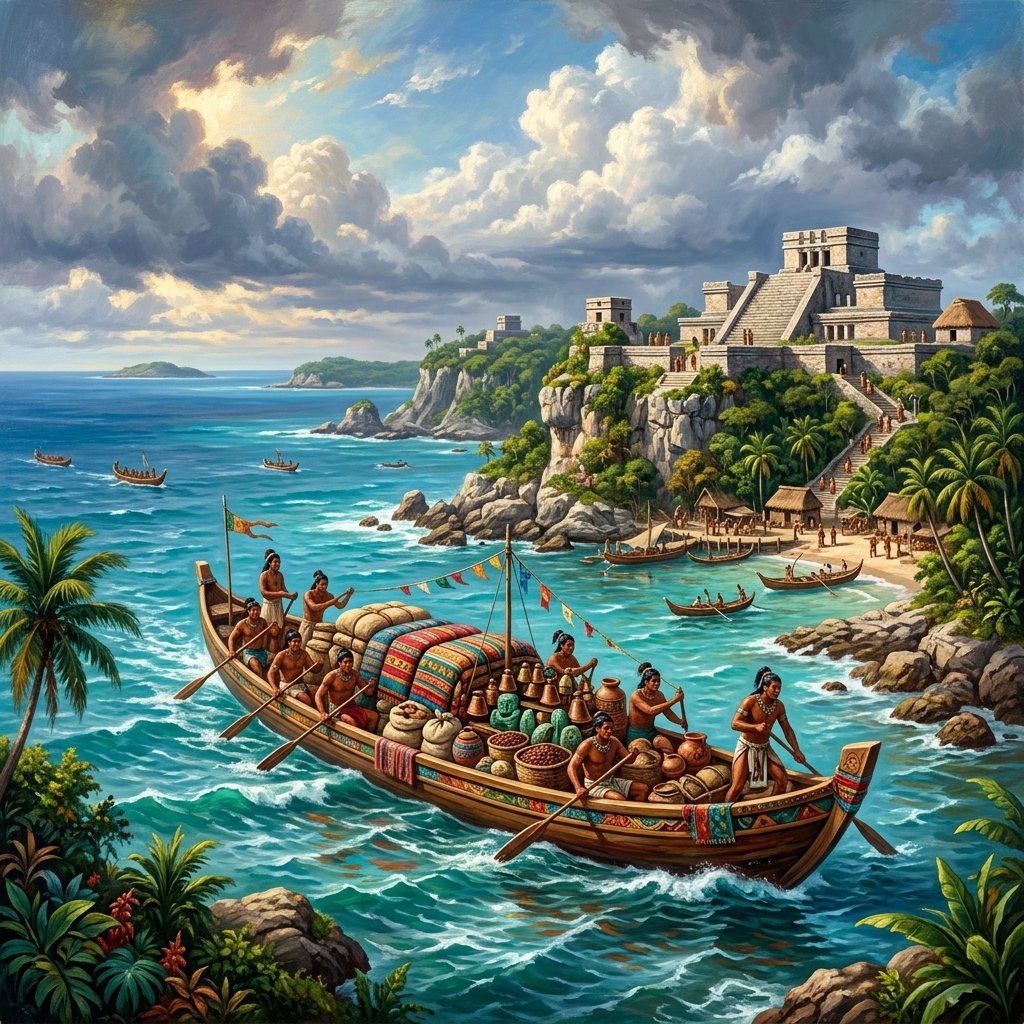
The Postclassic Maya developed extensive maritime trade networks — a dramatic shift from the overland trade routes of the Classic period. Large trading canoes, some carrying up to 40 people and tons of goods, traveled the coastline from Honduras through Belize, around the Yucatán Peninsula, and along the Gulf Coast to ports in Tabasco and Veracruz.
When Christopher Columbus encountered a Maya trading canoe off the coast of Honduras in 1502 during his fourth voyage, he described it as being "as long as a galley," carrying cacao, cotton textiles, copper bells, obsidian blades, and ceramics. The Maya were merchants as much as they were warriors and priests (Sharer, R. & Traxler, L., The Ancient Maya, 2006, pp. 601–612).
Tulum, perched on a Caribbean cliff, served as a major Postclassic trading port. Its watchtower and coastal location made it the "dock" of a trading system that connected inland cities to maritime routes.
The Highland Kingdoms
While the northern Yucatán developed its own trajectory, the highlands of Guatemala saw the rise of powerful K'iche' and Kaqchikel Maya states in the Late Postclassic (1200–1524 AD). The K'iche' capital of Q'umarkaj (also called Utatlán) near modern Chichicastenango was a fortified hilltop city that ruled over tens of thousands of subjects.
It was the K'iche' who produced the Popol Vuh — the greatest surviving Maya literary work — transcribing their sacred oral traditions into the Latin alphabet in the mid-16th century. The Kaqchikel produced their own historical chronicle, the Annals of the Kaqchikels. These texts are invaluable because they preserve the Maya voice — their own account of their history, in their own language, rather than through Spanish colonial filters.
Mayapán: The Last Great Capital
After Chichén Itzá's decline (c. 1100 AD), the political center of the northern Yucatán shifted to Mayapán (c. 1220–1440 AD). Mayapán was a walled city of approximately 12,000 inhabitants, governed by a confederate council (multepal) of noble houses rather than a single divine king. This represented a fundamental shift in Maya political philosophy — from sacred monarchy to aristocratic republic.
Mayapán's main pyramid is a smaller replica of El Castillo at Chichén Itzá — a conscious architectural quotation linking the new capital to its prestigious predecessor. Around 1440, the city was destroyed by internal revolt — the Xiu lineage attacked the ruling Cocom family, killing all but one son. The surviving Cocom descendant swore eternal vengeance, setting the stage for the inter-lineage feuds that the Spanish would later exploit to divide and conquer the Yucatán.
The Spanish Conquest — and Beyond
The Spanish conquest of the Maya was not a single event but a prolonged, violent, and incomplete process spanning nearly 200 years:
- 1524: Pedro de Alvarado conquers the K'iche' and Kaqchikel highlands.
- 1527–1546: Francisco de Montejo and his son conquer the northern Yucatan, encountering fierce resistance.
- 1562: Diego de Landa burns Maya books at Maní.
- 1697: The last independent Maya kingdom — the Itzá at Nojpetén (modern Flores, Guatemala) — falls to Spanish forces. This is nearly 200 years after Columbus's first contact.
And even after 1697, Maya resistance continued. The Caste War of Yucatán (1847–1901) was a massive Maya uprising that nearly drove the Europeans out of the peninsula entirely. Maya communities today — over 6 million strong — continue to speak Maya languages, practice traditional agriculture, and maintain the 260-day Tzolk'in calendar.
Frequently Asked Questions
What is the Postclassic Maya period?
The Postclassic (c. 900–1500 AD) followed the Classic Collapse. Far from decline, it saw the rise of Chichén Itzá, maritime trade empires, metallurgy, and the powerful K'iche' and Kaqchikel kingdoms of highland Guatemala. The Maya adapted and transformed, maintaining civilization until — and beyond — the Spanish conquest.
Did the Maya civilization end in the Classic Collapse?
No. The Classic Collapse affected the southern lowlands. Northern cities thrived, highland kingdoms grew powerful, and maritime trade expanded. Over 6 million Maya people live today across Mexico, Guatemala, Belize, and Honduras, speaking 30+ Mayan languages and maintaining ancient traditions.
What was Mayapán?
Mayapán (c. 1220–1440 AD) was the last great northern Yucatán capital. It governed through a council of nobles rather than a single king — a major political innovation. Its destruction by internal revolt fragmented the Yucatán into rival provinces, which the Spanish exploited during their conquest.
Scholarly References
- Sharer, R. & Traxler, L. The Ancient Maya. Stanford University Press, 6th edition, 2006.
- Restall, M. Maya Conquistador. Beacon Press, 1998.
- Cobos, R. "The Settlement Patterns of Chichén Itzá." Latin American Antiquity, vol. 18, 2007, pp. 419–441.
- Smith, M.E. The Aztecs. Blackwell, 3rd edition, 2012. (Chapter on Postclassic Mesoamerican trade networks.)
- Christenson, A. Popol Vuh: The Sacred Book of the Maya. University of Oklahoma Press, 2007.