Key Takeaway
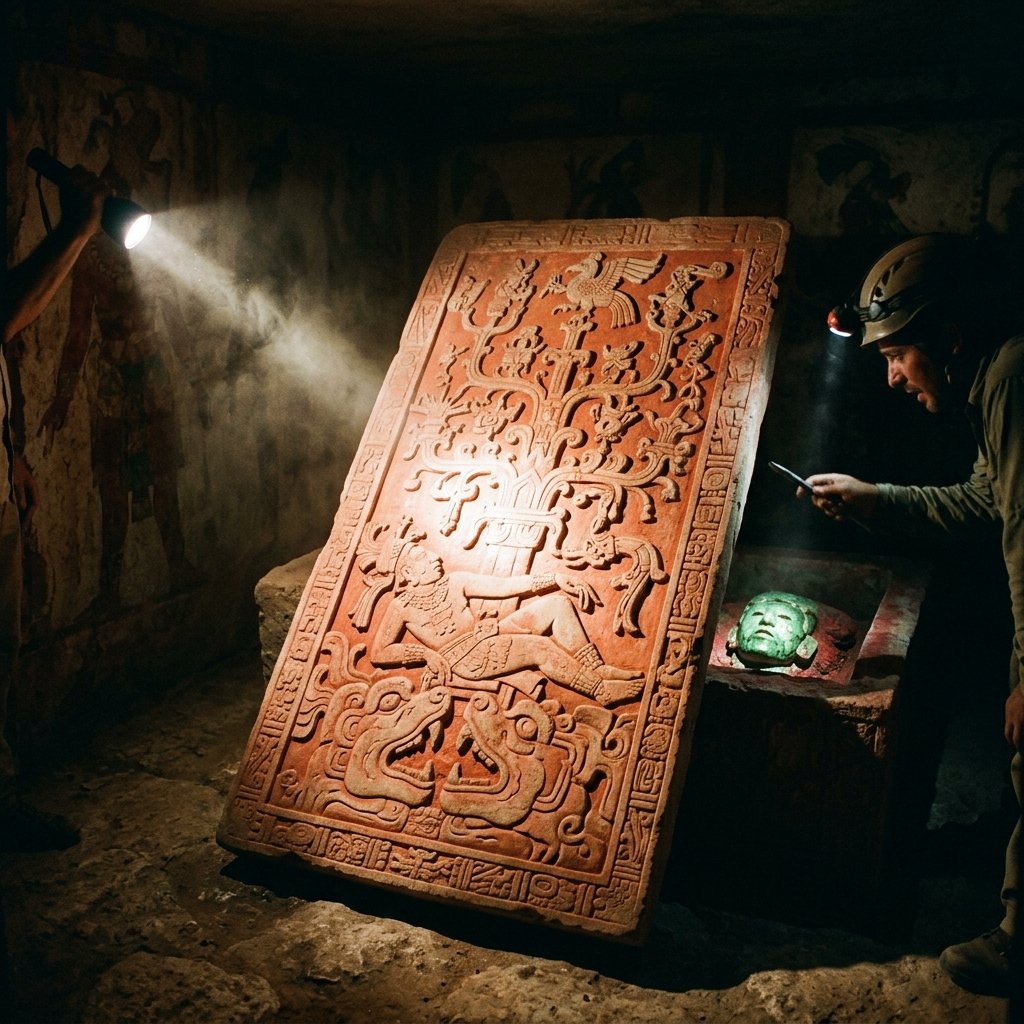
On June 15, 1952, Alberto Ruz Lhuillier lifted a massive stone slab in a chamber 25 meters below the summit of the Temple of the Inscriptions and became the first person in 1,300 years to see the burial of K'inich Janaab' Pakal ("Great Sun Shield"). The king lay inside a monolithic limestone sarcophagus, his face covered by a jade mosaic mask, his body draped in jade jewelry totaling over 200 pieces. The discovery proved — for the first time — that Maya pyramids could function as royal mausoleums, not merely as temple platforms.
The King: K'inich Janaab' Pakal
Pakal (603–683 AD) ruled the city-state of Palenque (ancient name: Lakamha', "Big Water") for an extraordinary 68 years — ascending to the throne at age 12 in 615 AD and ruling until his death at approximately 80. Under his reign, Palenque transformed from a war-ravaged minor city into one of the most architecturally and artistically sophisticated centers of the Maya world.
Reign Stats
- Born: 8 Ahau 13 Pop (March 26, 603 AD)
- Accession: July 29, 615 AD (age 12)
- Death: August 31, 683 AD (age ~80)
- Reign: 68 years — longest of any known Maya king
- Tomb discovered: June 15, 1952
Burial Contents
- Jade mask: ~200 mosaic jadeite pieces
- Jade suit: collar, earspools, rings, belt
- Red cinnabar: covering the entire sarcophagus interior
- Jade bead in mouth: to capture the departing soul
- Stucco portrait heads: on the sarcophagus floor
- 6 sacrificial attendants: in the chamber anteroom
The Discovery
In 1948, archaeologist Alberto Ruz Lhuillier noticed that one floor slab in the temple atop the pyramid had a double row of stone plugs — as if it were designed to be lifted. He began excavating downward, revealing a monumental internal staircase deliberately filled with rubble. It took four seasons of excavation (1948–1952) to clear the 25-meter descent.
At the bottom, Ruz found a triangular stone slab sealed with lime mortar. Behind it: a small anteroom containing the remains of six sacrificial attendants. Beyond that: the burial chamber itself — a vaulted room 9 meters long, 4 meters wide, and 7 meters high, dominated by a massive carved sarcophagus.
"Out of the dim shadows emerged a vision from a fairy tale, a fantastic, ethereal sight from another world. It seemed a huge magic grotto carved out of ice."
— Alberto Ruz Lhuillier, describing his first view of the tomb, 1952
The Sarcophagus Lid
The carved sarcophagus lid — weighing approximately 5 tonnes and measuring 3.8 × 2.2 meters — is one of the most famous works of art from the ancient Americas. It depicts Pakal at the moment of death, falling into the open maws of the earth (depicted as the skeletal jaws of a supernatural creature). Above him rises the World Tree (Wakah Kan), its branches reaching into the celestial realm, crowned by a celestial bird.
The iconography has been extensively analyzed by Linda Schele, David Stuart, and others. The consensus interpretation is that the lid depicts Pakal's journey from death through the underworld to rebirth as the Maize God — paralleling the mythic cycle of the Hero Twins in the Popol Vuh (Robertson, The Sculpture of Palenque, 1983).
The "Ancient Astronaut" Myth
In 1968, Erich von Däniken published Chariots of the Gods?, in which he claimed the sarcophagus lid depicted Pakal piloting a spacecraft — sitting in a capsule, hands on controls, with exhaust flames behind him. This claim has been comprehensively refuted by epigraphers and iconographers who have demonstrated that every element of the carving corresponds to well-documented Maya cosmological symbols:
- The "spacecraft" is the jaws of the earth monster — a standard Maya representation of the underworld entrance
- The "exhaust" is the roots of the World Tree descending into Xibalba
- The "controls" are ritual objects — a jade bead and a mirror — associated with royal burial
- The "seat" is the sun glyph (k'in), marking the transition from life to death
The ancient astronaut interpretation, while popular in fringe media, is considered pseudoarchaeology by every credentialed Maya scholar. It also carries troubling colonial undertones — implying that Indigenous peoples could not have created sophisticated art without extraterrestrial assistance (Fagan, Archaeological Fantasies, 2006).
Legacy and Access
Pakal's tomb is no longer accessible to visitors due to conservation concerns — humidity from tourist breathing was damaging the stucco reliefs. However, a full-scale replica of the tomb and sarcophagus is displayed at the Palenque Site Museum adjacent to the ruins. The original jade mask is housed in the National Museum of Anthropology in Mexico City, where it is one of the museum's most prized exhibits.
Frequently Asked Questions
Is Pakal's sarcophagus lid really an astronaut?
No. This claim, popularized by Erich von Däniken in 1968, has been refuted by every Maya scholar. The carving depicts Pakal's death and journey through the underworld — standard Maya cosmological imagery that is well-understood through comparison with hundreds of similar carved scenes, painted pottery, and hieroglyphic texts.
Can you visit Pakal's tomb today?
The original tomb is sealed to protect it. However, visitors to Palenque can see the exterior of the Temple of the Inscriptions, and a replica tomb is displayed at the on-site museum. The jade mask is in Mexico City's National Museum of Anthropology.
References & Further Reading
- Ruz Lhuillier, A. (1973). El Templo de las Inscripciones: Palenque. INAH, Mexico.
- Robertson, M. G. (1983). The Sculpture of Palenque, Vol. 1: The Temple of the Inscriptions. Princeton UP.
- Schele, L. & Mathews, P. (1998). The Code of Kings: The Language of Seven Sacred Maya Temples and Tombs. Scribner's.
- Stuart, D. & Stuart, G. (2008). Palenque: Eternal City of the Maya. Thames & Hudson.
- Fagan, G. G., ed. (2006). Archaeological Fantasies: How Pseudoarchaeology Misrepresents the Past. Routledge.