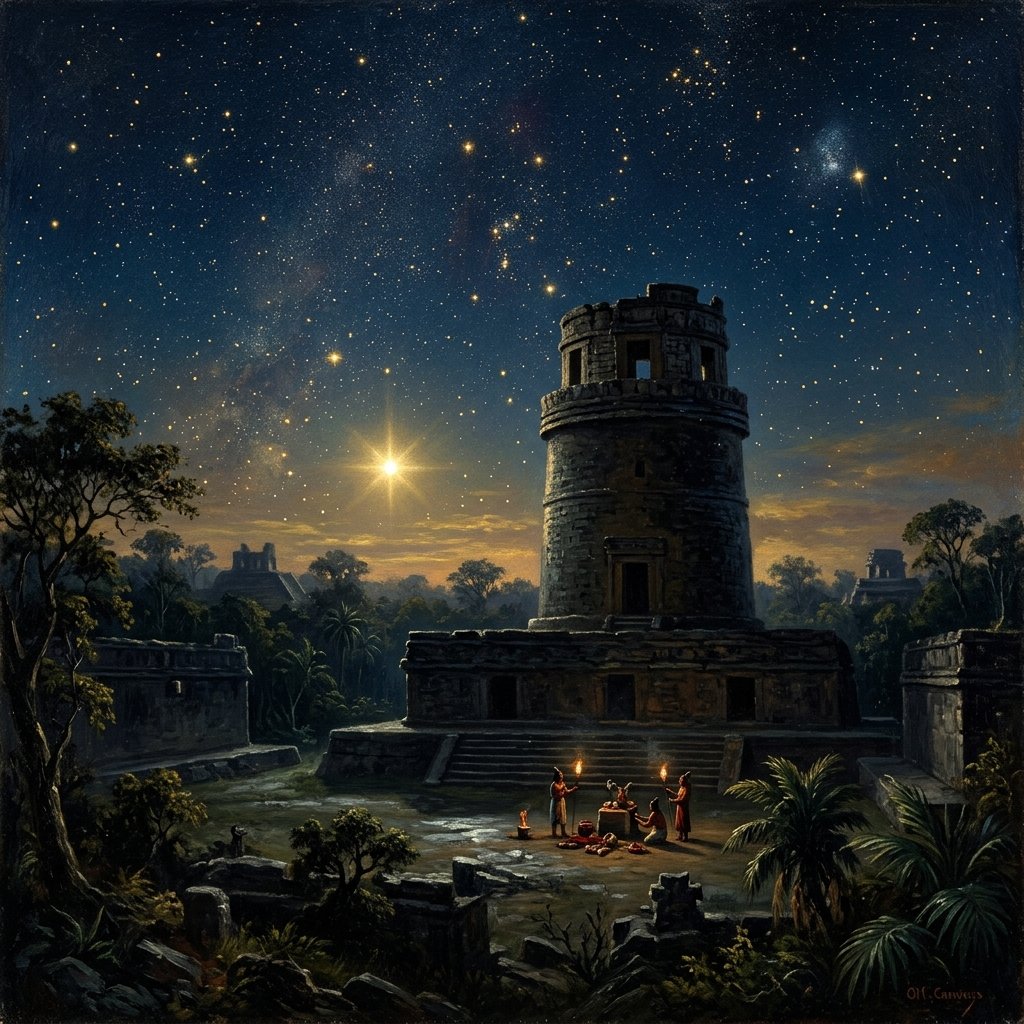
Venus in Maya Astronomy at a Glance
The Most Feared Star in the Maya Sky
For the ancient Maya, Venus was not merely a planet — it was a weapon. While Western tradition associates Venus with love and beauty (from the Roman goddess), the Maya saw something far more dangerous: a war god whose risings and settings dictated when kings launched their most devastating military campaigns.
Venus was the brightest object in the sky after the Sun and Moon, and its dramatic disappearances and reappearances made it a natural symbol of death and resurrection. The Maya called it Chak Ek' ("Great Star") or Noh Ek ("Big Star") and tracked its movements with the kind of obsessive precision that modern astronomers reserve for asteroid trajectories — because for the Maya, getting Venus wrong could mean losing a war.
The Four Phases of Venus
The Maya recognized that Venus cycles through four distinct phases during its 584-day synodic period. Each phase carried different cosmological meaning:
The most dangerous phase. Venus rises before the Sun, appearing as a brilliant point of light in the pre-dawn sky. The heliacal rising — the first morning Venus becomes visible after inferior conjunction — was the moment Maya kings launched Star Wars. The Morning Star was depicted as a warrior with a spear, hurling darts of light at the earth.
Venus disappears behind the Sun, invisible for approximately 50 days. The Maya understood this as Venus traveling through the underworld (Xibalba), gathering supernatural power before re-emerging.
Venus follows the Sun below the western horizon, visible in the evening sky. Less feared than the Morning Star but still cosmologically significant. Some scholars associate the Evening Star with Kukulkán in his benevolent aspect.
Venus passes between the Earth and the Sun, disappearing for about 8 days. This brief but critical disappearance was the most anxious period — the moment Venus "died" before its terrifying resurrection as the Morning Star warrior. The Dresden Codex gives this period special attention.
The Venus Tables of the Dresden Codex
The Dresden Codex — the most elaborate surviving Maya manuscript — contains five pages (pp. 46–50) devoted entirely to Venus. These Venus tables are among the most remarkable achievements in pre-telescopic astronomy:
- Coverage: The tables track 65 complete Venus synodic cycles — a span of 37,960 days (approximately 104 years).
- Accuracy: The Maya calculated the Venus synodic period at 584 days. The actual mean is 583.92 days. Over 65 cycles, this produces an accumulated error of only ~5 days — which the Maya corrected with built-in adjustment mechanisms.
- Correction factors: The tables include four correction dates where 8 days are subtracted at specific intervals, keeping the tables aligned with observation over centuries. This is functionally equivalent to the leap-year corrections in the Gregorian calendar.
- Deity associations: Each Venus cycle is associated with a specific Venus war god (Lahun Chan) who attacks different targets — directional deities associated with the four cardinal directions.
The astronomer Anthony Aveni has called the Venus tables "one of the great intellectual achievements of the ancient world" (Aveni, A., Skywatchers of Ancient Mexico, 2001, p. 184). The Maya achieved this precision without telescopes, mathematical notation as we know it, or metal instruments — relying solely on naked-eye observation from stone-and-plaster platforms, recording their data in a complex vigesimal (base-20) numerical system.
Star Wars: How Venus Dictated Warfare
The most dramatic consequence of Maya Venus observation was its connection to warfare. Maya hieroglyphic texts record a specific type of conflict indicated by a "star-over-earth" glyph — a shower of stars raining down on a place name. These events, which scholars call Star Wars, were total wars of conquest timed to the heliacal rising of Venus.
The logic was theological: the Morning Star's first appearance was a moment of maximum cosmic danger and power. Venus, having traveled through the underworld, returned loaded with supernatural energy — energy that a king could harness by launching his attack at precisely that moment. The Venus war god Lahun Chan was depicted hurling spears of light, and the attacking army became his earthly instrument.
The most famous Star War occurred on April 29, 562 AD, when the Snake Kingdom of Calakmul, under lord Sky Witness, launched a devastating attack on Tikal. The star-war glyph appears on Caracol Altar 21, recording that Tikal's king, Wak Chan K'awiil, was defeated. The consequences were catastrophic: Tikal entered a 130-year "hiatus" during which no major monuments were erected — a dark age from which it took generations to recover (Martin, S. & Grube, N., Chronicle of the Maya Kings and Queens, 2008, pp. 39–44).
El Caracol: The Venus Observatory
At Chichén Itzá, a circular tower known as El Caracol ("The Snail," for its interior spiral staircase) served as a Venus observatory. Three narrow windows in the upper tower are aligned with key Venus positions:
- The northernmost Venus setting point on the horizon.
- The southernmost Venus setting point.
- The equinox sunset position.
These sightlines allowed astronomers to track Venus's movement across the western horizon with great precision, refining their tables and predicting future risings. El Caracol is not the only Venus observatory — alignment studies at Uxmal, Copán, and other sites suggest that Venus observation was a widespread practice among elite Maya astronomers (Aveni, 2001, pp. 259–282).
Venus and the Hero Twins
The mythological dimension of Venus connects to the Hero Twins of the Popol Vuh. After defeating the Lords of Xibalba, the twins Hunahpu and Xbalanque rise into the sky to become celestial bodies. Many scholars interpret this as the twins becoming the Sun and Venus — with Venus, the Morning Star, forever accompanying the Sun across the sky.
This interpretation links Venus's astronomical behavior to the myth: Venus "dies" (inferior conjunction), descends to the underworld (invisibility), defeats death (passage), and is reborn as the Morning Star warrior — exactly mirroring the Hero Twins' journey through Xibalba (Tedlock, D., Popol Vuh, 1996, p. 159).
References
- Aveni, A. Skywatchers of Ancient Mexico. University of Texas Press, revised edition, 2001.
- Bricker, H.M. & Bricker, V.R. Astronomy in the Maya Codices. American Philosophical Society, 2011.
- Martin, S. & Grube, N. Chronicle of the Maya Kings and Queens. Thames & Hudson, 2nd edition, 2008.
- Tedlock, D. Popol Vuh: The Definitive Edition. Simon & Schuster, 1996.
- Lounsbury, F. "Maya Numeration, Computation, and Calendrical Astronomy." In Dictionary of Scientific Biography, vol. 15, 1978, pp. 759–818.
Frequently Asked Questions
Why was Venus important to the ancient Maya?
Venus was the most feared celestial body in the Maya sky. Its cycles were tracked with extraordinary precision in the Dresden Codex, and its heliacal risings were used to time devastating military campaigns called Star Wars. The Morning Star was seen as a war god hurling spears of light, making its first appearance the most dangerous moment in the Maya cosmos.
What are the Venus tables in the Dresden Codex?
The Venus tables (pages 46–50 of the Dresden Codex) track 65 complete Venus synodic cycles spanning 37,960 days (~104 years). They record the planet's four phases — Morning Star, superior conjunction, Evening Star, and inferior conjunction — with built-in correction mechanisms that maintained accuracy over centuries. The Maya calculated Venus's cycle at 584 days; the true value is 583.92 days.
What is a Maya Star War?
A Star War was a total war of conquest timed to the heliacal rising of Venus as the Morning Star. Indicated by the "star-over-earth" glyph in Maya inscriptions, these were the most devastating conflicts in Maya warfare. The most famous was Calakmul's destruction of Tikal in 562 AD, which led to a 130-year dark age at Tikal.
How accurate were the Maya Venus observations?
The Maya calculated Venus's synodic cycle with an accuracy of 99.98%. Their 584-day estimate differs from the modern value (583.92 days) by only 0.08 days per cycle. Over 481 years, the accumulated error would be only ~2 hours. They achieved this without telescopes — through naked-eye observation from platforms like El Caracol at Chichén Itzá.