Maya Scribes at a Glance
Writing and Painting Were the Same Art
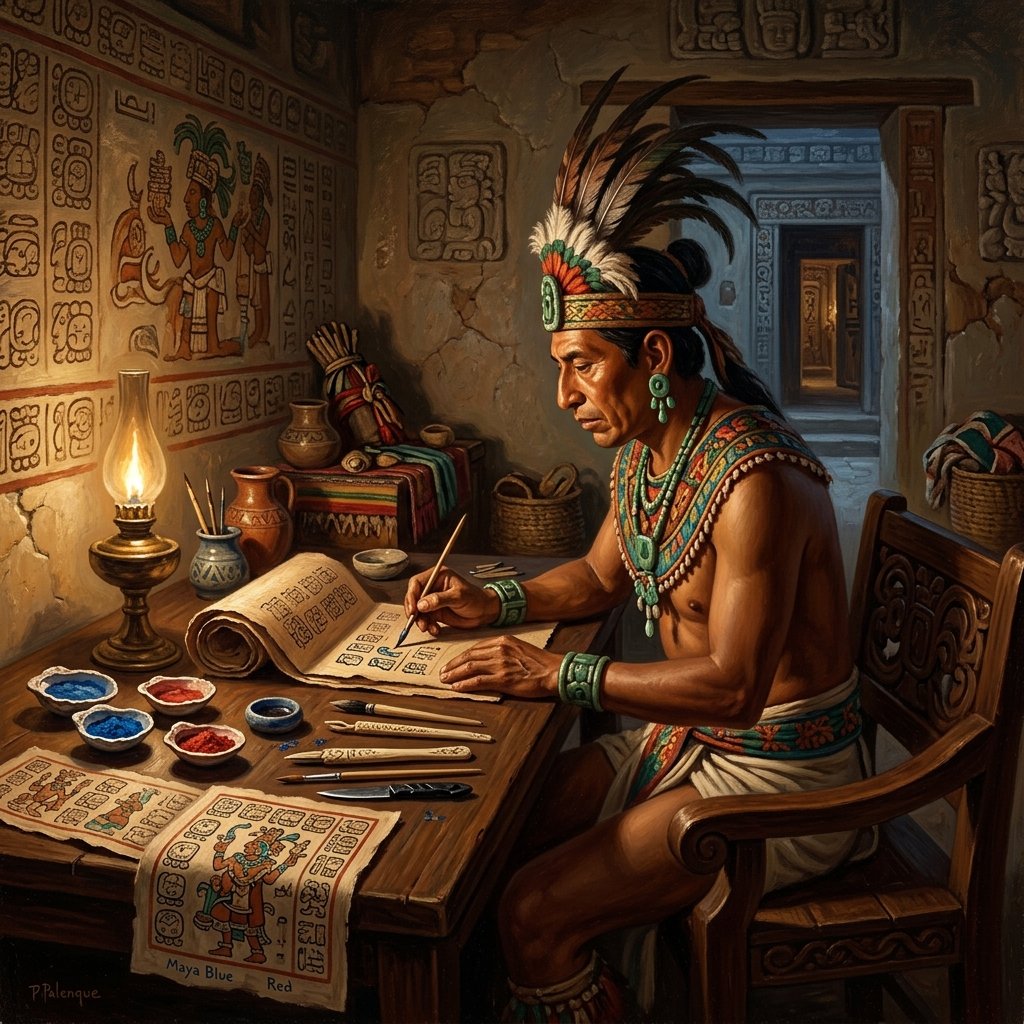
In the Maya world, there was no distinction between writing and painting. The Classic Maya word tz'ib means both — because to the Maya, composing a hieroglyphic text was painting, and painting a scene on a ceramic vessel was writing. Every brushstroke carried both visual and linguistic meaning. A scribe painting a mythological scene on a chocolate cup was simultaneously creating literature, art, and sacred text.
This fusion makes Maya scribes unique among ancient writers. An Egyptian scribe and an Egyptian painter were different people. A Maya aj tz'ib was both — and also a mathematician, astronomer, calendar specialist, and ritual expert. The breadth of their training rivals that of Renaissance masters (Coe, M.D. & Kerr, J., The Art of the Maya Scribe, 1998, pp. 88–92).
Who Could Become a Scribe?
Scribal literacy was not widespread. Maya writing was a specialized skill restricted to the elite — primarily members of the royal family and the highest nobility. Hieroglyphic texts on ceramics sometimes include the notation "y-uxul" ("his/her carving"), followed by a name and the title aj tz'ib, indicating that scribes were proud enough of their identity to sign their work.
Several signed works reveal that scribes were often royal princes. At Copán, the sculptor of the famous Rosalila temple facade was a member of the ruling dynasty. At Palenque, the artists who carved the sarcophagus panels were titled nobles. The implication is clear: writing was a royal prerogative, not a craft practiced by commoners (Houston, S. & Stuart, D., "Of Gods, Glyphs, and Kings," Antiquity, vol. 70, 1996, pp. 289–312).
The Monkey Scribes
In Maya mythology, the patron spirits of scribes and artists were the Monkey Twins — Hun Batz and Hun Chowen, the older half-brothers of the Hero Twins. According to the Popol Vuh, the Monkey Twins were "flautists, singers, painters, and sculptors" who were transformed into spider monkeys by the Hero Twins as punishment for their jealousy and cruelty.
In Maya art, monkey scribes appear frequently — depicted holding brushes and codices, painting with exaggerated care. These images are simultaneously humorous and respectful: the monkey represents the creative impulse in its raw, untamed form. The transition from monkey to human scribe symbolizes the refinement of creative talent through discipline and training. The 20th-day sign in some Maya day-name series is actually named Batz' ("Monkey/Thread"), the patron of arts and crafts.
Tools of the Trade
Maya scribes used a sophisticated toolkit:
- Brushes: Made from animal hair (possibly deer or peccary) attached to bone, wood, or quill handles. The finest brushwork on Late Classic ceramics shows lines less than 0.5mm thick.
- Pigments: The primary palette included Maya Blue (the famous synthetic pigment), hematite red, carbon black, kaolin white, and various organic yellows and oranges.
- Bark paper (huun): Made from the inner bark of the fig tree (Ficus), beaten flat and coated with a layer of white lime plaster to create a smooth writing surface. This is the material of the surviving codices.
- Shell inkpots: Conch shell containers held prepared pigments. Several have been found in royal burials alongside bone styluses and paint-mixing palettes.
- Chisels and hammerstones: For carving stone inscriptions. Monuments like the Hieroglyphic Stairway at Copán required not just literacy but extraordinary sculptural skill.
The Greatest Scribal Masterworks
Several masterpieces of Maya scribal art survive:
- The Dresden Codex: The most elaborate surviving Maya book — 3.5 meters long when unfolded, containing Venus tables, eclipse predictions, and almanacs painted with microscopic precision.
- The Bonampak murals: A three-room mural cycle depicting battle, sacrifice, and celebration — the largest surviving example of Maya wall painting. The scribe-painters used over a dozen distinct pigments.
- The Yaxchilán lintels: Carved limestone panels depicting bloodletting rituals and Vision Serpent conjurations — relief sculpture of astonishing technical mastery. Several are signed.
- The "Princeton Vase" (K511): A Late Classic cylinder vessel depicting a throne room scene in the underworld with hieroglyphic text — one of the finest examples of Maya narrative painting. Now in the Princeton University Art Museum.
The Destruction and Survival of Maya Literature
When the Spanish arrived, the Maya had produced thousands of codices — a vast literature that had been accumulating for over a millennium. In 1562, Franciscan friar Diego de Landa ordered a mass burning of Maya books at Maní in the Yucatán, destroying what he described as works of "superstition and lies of the devil."
Only four Maya codices survive today: the Dresden, Madrid, Paris, and Grolier codices. The loss is incalculable. Imagine if only four books survived from all of ancient Greece. Yet the stone inscriptions, the painted ceramics, and the four surviving codices have been enough for modern epigraphers to achieve near-complete decipherment of the script — a testament to the extraordinary density and precision of Maya scribal work.
Frequently Asked Questions
Who were the ancient Maya scribes?
Maya scribes (aj tz'ib) were elite members of the royal court — often princes and nobles — trained in hieroglyphic writing, painting, sculpture, and calendar calculations. They mastered a complex script of 800+ signs. Their patron deity was Itzamná, credited with inventing writing itself.
What did Maya scribes write on?
Scribes worked on stone (stelae, lintels, altars), ceramics (painted narrative vessels), bark paper (folding codices made from fig-bark coated with lime plaster), and stucco walls (murals like those at Bonampak). Their pigments included Maya Blue, hematite red, and carbon black, applied with fine animal-hair brushes.
Could ancient Maya scribes actually read and write?
Absolutely. Maya scribes composed original texts, recorded history, calculated astronomical tables, and created literary narratives. Some scribes "signed" their work — we know specific artists by name, including the painters of the Bonampak murals and carvers of the Yaxchilán lintels. Maya literacy was real, sophisticated, and comparable to that of ancient Egyptian or Chinese scribes.
Scholarly References
- Coe, M.D. & Kerr, J. The Art of the Maya Scribe. Harry N. Abrams, 1998.
- Houston, S. & Stuart, D. "Of Gods, Glyphs, and Kings: Divinity and Rulership among the Classic Maya." Antiquity, vol. 70, 1996, pp. 289–312.
- Schele, L. & Miller, M.E. The Blood of Kings: Dynasty and Ritual in Maya Art. Kimbell Art Museum, 1986.
- Montgomery, J. Dictionary of Maya Hieroglyphs. Hippocrene Books, 2006.
- Miller, M.E. & Martin, S. Courtly Art of the Ancient Maya. Thames & Hudson, 2004.