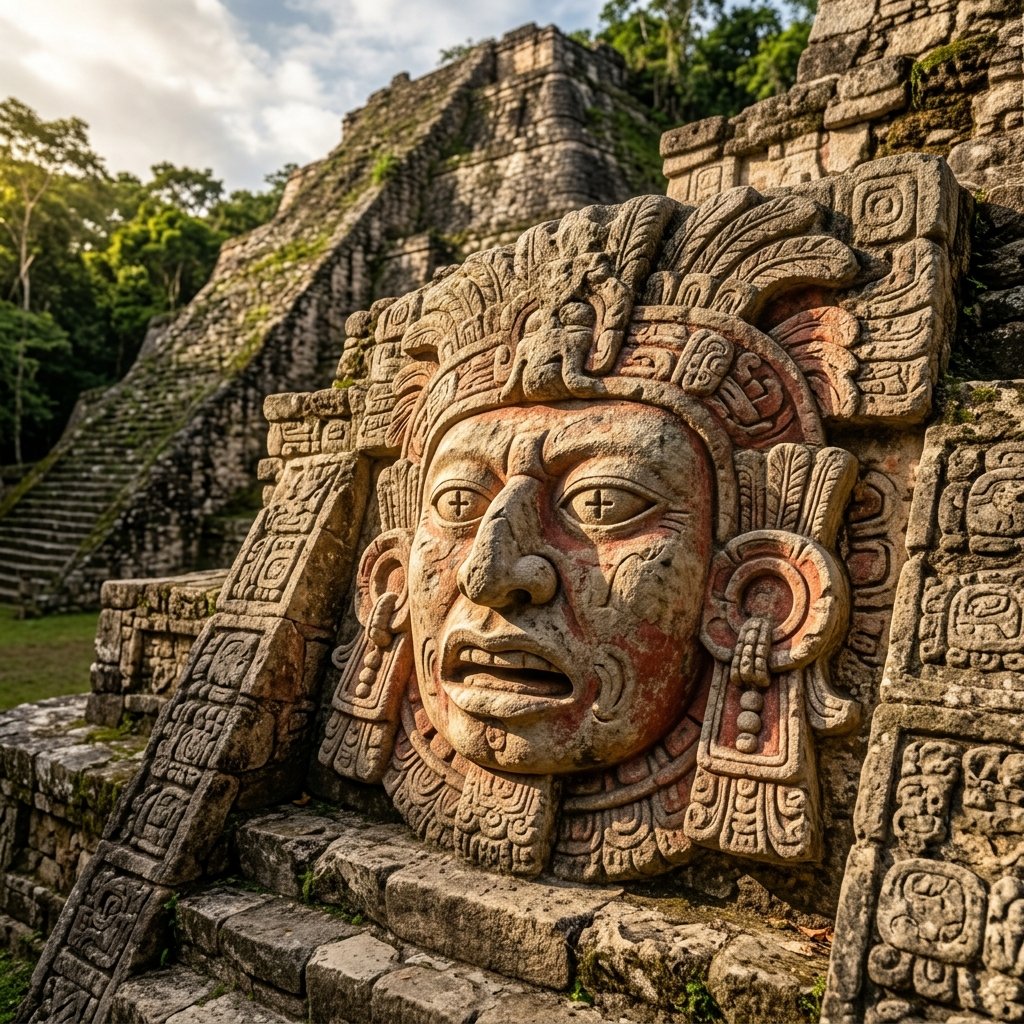
Kinich Ahau at a Glance
"Every morning the sun is born. Every evening it dies. Every night it travels through the underworld as a jaguar, fighting its way through nine levels of darkness. And every dawn, it wins — it returns, blazing, unconquered, alive. For a Maya king, there was no more powerful metaphor for his own authority."
The Lord Whose Face Is the Sun
Kinich Ahau (K'inich Ajaw, pronounced "k'EE-neech ah-HOW") — literally "Sun-Faced Lord" — is the Maya manifestation of solar power: the god who illuminates the world, measures time, and provides the fundamental template for royal authority. His name is built from k'in (sun, day, time) + ich (face, eye) + ajaw (lord, ruler) — making him "the lord whose face is the sun."
In the Schellhas classification, he is designated God G. Unlike some Maya deities whose names required decades of epigraphic work to decipher, Kinich Ahau was identifiable from the earliest years of Maya studies because his diagnostic iconography — the four-petaled k'in ("sun") glyph, the large Roman nose, the cross-eyes, and the filed shark-like teeth — is among the most consistent and unmistakable in the entire Maya artistic repertoire (Taube, K., The Major Gods of Ancient Yucatan, Dumbarton Oaks, 1992, pp. 50–56).
But Kinich Ahau is not merely a "sun god" in the simple sense of a deity who controls sunlight. He is a cosmic model — a divine template for understanding how power works, how time moves, and how transformation operates. His daily journey encodes the Maya understanding of the most fundamental cycle in the universe: creation, destruction, and renewal.
The Daily Journey: Birth, Power, Death, Rebirth
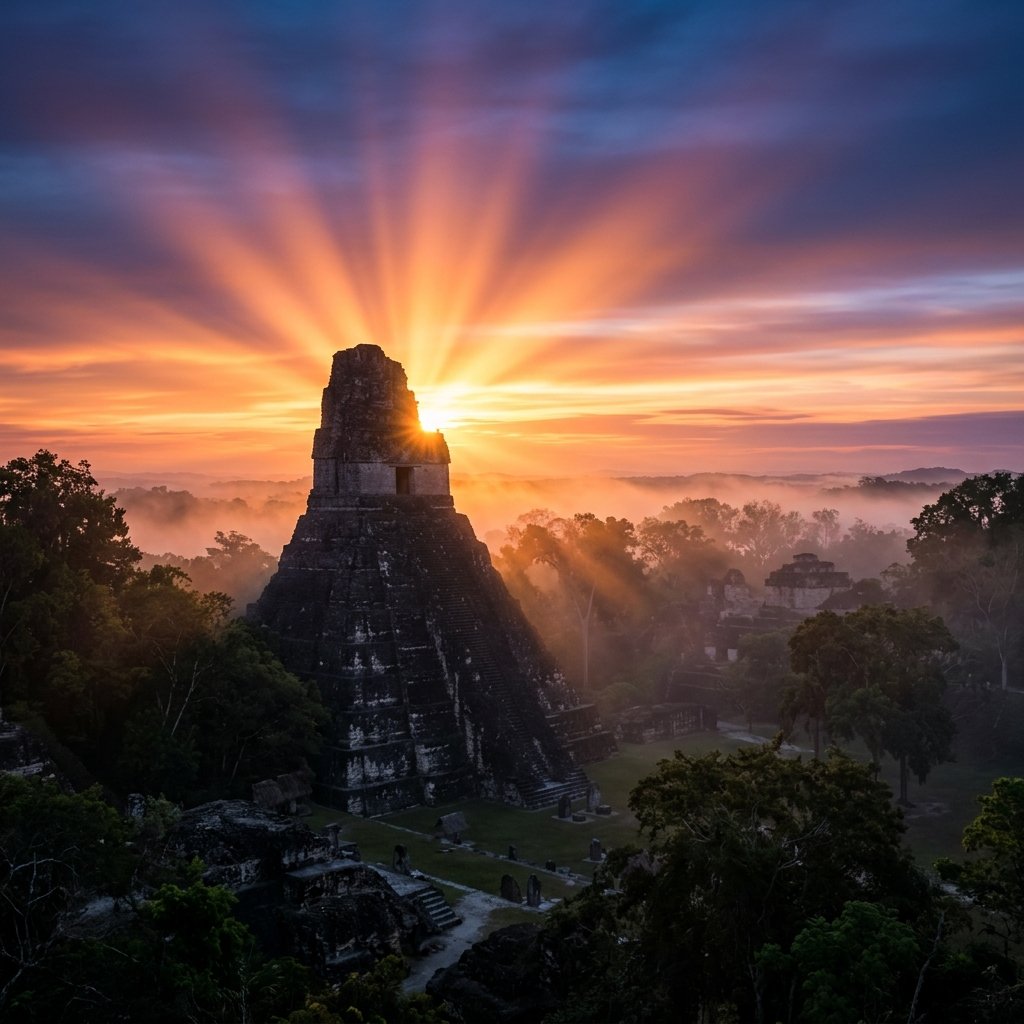
Sunrise over a Maya temple pyramid. The daily appearance of the sun above the temple summit was not merely an astronomical event but a theological one — the rebirth of Kinich Ahau after his nightly journey through the underworld. Maya temples were deliberately oriented to frame solar alignments, making architecture itself a cosmic calendar.
The sun's daily cycle was not mere astronomy for the Maya — it was the master narrative of the cosmos, the template against which all other cycles were measured. Each phase of the sun's journey corresponded to a phase of life:
Dawn — Birth
The sun emerges from the eastern horizon — reborn after its passage through Xibalba. Dawn is the moment of triumph: the sun has defeated the lords of the underworld and returns to illuminate the world. In royal rhetoric, the accession of a new king was frequently compared to dawn — a new sun rising.
Zenith — Full Power
The sun at its zenith — directly overhead, casting no shadow — was the moment of maximum divine power. In the Maya tropics, the sun passes directly overhead twice annually (the zenithal passages), and these events were marked with ceremony. The zenith sun was associated with the height of a king's reign.
Dusk — Death
As the sun descends below the western horizon, it "dies" — sinking into the earth, into the jaws of the underworld. This is not a defeat but a necessary transition. The sun must enter Xibalba in order to be reborn. David Stuart's decipherment of Classic Maya death expressions reveals that royal deaths were frequently described with solar metaphors — the king "enters the road" just as the sun enters the earth (Stuart & Stuart, 2008).
Night — The Jaguar Journey
During the night, the sun transforms into the Jaguar God of the Underworld — traveling through the nine levels of Xibalba in animal form. The jaguar was chosen because it is the supreme nocturnal predator of the Maya lowlands: powerful, fearless, seeing in the dark. The night sun is not diminished — it is transformed.
The Night Sun: The Jaguar God of the Underworld
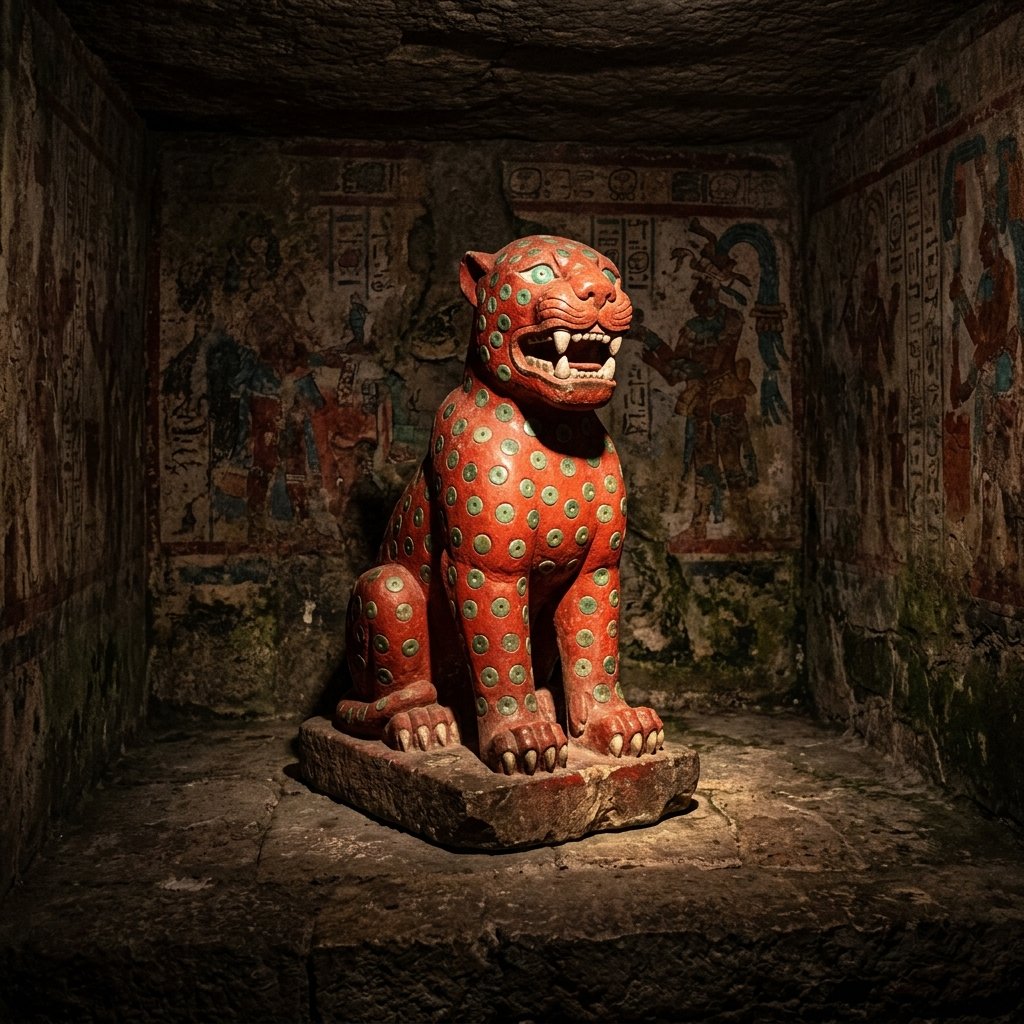
A red-painted jaguar throne from a Maya temple interior. The jaguar — nocturnal hunter, apex predator, dweller of darkness — embodied the sun's night form as it traveled through the nine levels of the underworld. The red paint and jade inlays signal both royal authority and the fire that the night sun carries even through darkness.
Kinich Ahau's night form — the Jaguar God of the Underworld (sometimes designated GIII in the Palenque Triad of patron deities) — is one of the most important theological concepts in Maya religion. The transformation is not merely a narrative device — it encodes a fundamental Maya insight: power does not disappear in darkness; it changes form.
The jaguar (balam) was the most powerful animal in the Maya cosmos. As a nocturnal predator capable of seeing in complete darkness, it was the natural avatar for the sun's night journey. Classic Maya art frequently depicts the Jaguar God with the sun's diagnostic k'in glyph embedded in his body — confirming the identity between the daytime solar deity and the night jaguar. The archaeologist Linda Schele traced this transformation in detail, noting that "the night sun does not die — it descends, transforms, fights, and returns" (Schele, L. & Miller, M.E., The Blood of Kings: Dynasty and Ritual in Maya Art, Kimbell Art Museum, 1986, p. 48).
Maya kings incorporated jaguar imagery into their thrones, their war regalia, and their names precisely to claim the night sun's power. The red jaguar throne discovered inside the earlier sub-structure of El Castillo at Chichén Itzá — with jade-inlaid eyes and spots — is one of the most spectacular physical embodiments of this concept: a royal seat designed to invoke the night sun's transformative authority.
K'inich: The Sun in Royal Names
The epithet K'inich ("Sun-Faced") was one of the most prestigious royal titles in the Maya world. Kings throughout the Classic period — from the fifth century through the ninth — incorporated it into their official name strings, directly identifying their political authority with the sun's cosmic journey. The most famous bearers include:
- K'inich Janaab Pakal ("Sun-Faced Great Shield") of Palenque — the most celebrated of all Maya kings, whose jade-filled tomb beneath the Temple of the Inscriptions is one of the great archaeological discoveries of the 20th century.
- K'inich Kan Bahlam ("Sun-Faced Snake Jaguar") of Palenque — Pakal's son and successor, who built the Group of the Cross temple complex.
- K'inich Yax K'uk' Mo' ("Sun-Faced First Quetzal Macaw") — the legendary founder of the Copán dynasty in modern Honduras.
David Stuart's work on Maya royal titulary has shown that the K'inich epithet was not merely decorative but constituted a theological claim: by taking the sun's name, a king asserted that he participated in the sun's cosmic cycle — that his reign was a period of "solar" illumination, and that his death would not be an ending but a transformation, a passage through darkness leading to eventual rebirth (Stuart, D., The Inscriptions from Temple XIX at Palenque, The Pre-Columbian Art Research Institute, 2005, p. 72).
The Macaw: The Sun's Bird Form
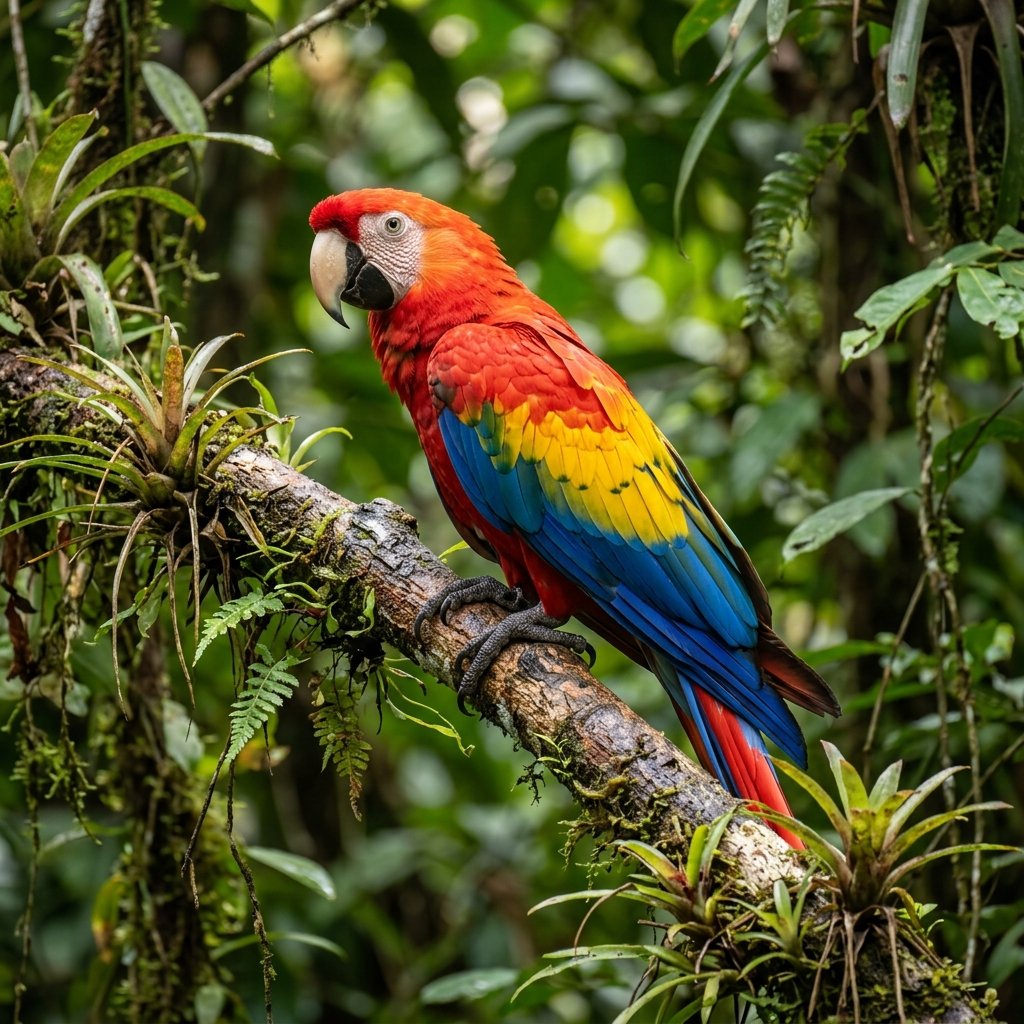
The scarlet macaw (Ara macao) — the bird that embodied the sun's daytime form. The macaw's blazing red, yellow, and blue plumage was directly associated with solar fire and celestial radiance. In the Popol Vuh, the vain bird-deity Seven Macaw (Vucub Caquix) claims to be the sun before the Hero Twins defeat him — a myth that distinguishes between the false, prideful sun and the true, sacrificial one.
While the jaguar embodied the night sun, the scarlet macaw (Ara macao) embodied the day sun. The macaw's blazing red, yellow, and blue plumage — among the most vivid colors in the natural world — was directly equated with solar fire. In the Popol Vuh, the vain bird-deity Seven Macaw (Vucub Caquix) claims to be the sun and the light of the world. The Hero Twins must defeat this false sun before the true sun can rise — a myth that encodes the distinction between prideful, destructive solar power and the legitimate, sacrificial solar authority that sustains the cosmos (Christenson, A.J., Popol Vuh: The Sacred Book of the Maya, University of Oklahoma Press, 2007, pp. 90–108).
Iconography: Reading the Sun's Face
Kinich Ahau is instantly recognizable in Maya art through a cluster of diagnostic features:
- Cross-eyes or squinting: The Maya considered crossed eyes a mark of divine beauty — parents dangled a bead between an infant's eyes to encourage the trait. For Kinich Ahau, the cross-eyes represent the overwhelming brilliance of the sun: one cannot look directly at it.
- Filed or shark-like teeth: The sun god's teeth are often pointed and predatory — representing the sun's fierce, consuming power. Just as the sun "devours" the night, the filed teeth signal destructive majesty.
- K'in glyph: The four-petaled flower glyph meaning "sun," "day," or "time" appears on or near the deity's body — the most direct marker of solar identity.
- Large Roman nose: Shared with his father Itzamná (God D), this profile feature links the sun to the supreme creator in a father-son relationship.
- Solar disc or halo: In some depictions, Kinich Ahau is framed by a radiating solar disc, emphasizing his identity as the physical sun incarnate.
References
- Christenson, A.J. Popol Vuh: The Sacred Book of the Maya. University of Oklahoma Press, 2007.
- Schele, L. & Miller, M.E. The Blood of Kings: Dynasty and Ritual in Maya Art. Kimbell Art Museum, 1986.
- Stuart, D. The Inscriptions from Temple XIX at Palenque. The Pre-Columbian Art Research Institute, 2005.
- Stuart, D. & Stuart, G. Palenque: Eternal City of the Maya. Thames & Hudson, 2008.
- Taube, K. The Major Gods of Ancient Yucatan. Dumbarton Oaks, 1992.
Frequently Asked Questions
Is Kinich Ahau the same as the Hero Twins?
In some versions of Maya mythology, the Hero Twin Hunahpú becomes the Sun after defeating the lords of Xibalba. This suggests the Hero Twins' narrative may be an origin story for the sun's daily cycle — explaining why the sun journeys through the underworld (because the Hero Twin, having defeated death, repeats his triumph each dawn). However, Kinich Ahau is primarily understood as a deity in his own right — the solar aspect of divine power — and his worship predates and extends beyond the Popol Vuh narrative.
Why did the Maya think cross-eyes were beautiful?
Maya beauty standards were modeled on the gods — particularly the Maize God and the Sun God, both of whom are depicted with cross-eyes. Parents would dangle a small ball of pitch or a bead from a string between an infant's eyes to encourage the trait. The association was divine rather than aesthetic: cross-eyes linked the individual to Kinich Ahau's overwhelming brilliance. The practice was painless and harmless — a cosmetic adaptation, not a deformity.
Why is the jaguar associated with the night sun?
The jaguar (balam) was the apex predator of the Maya lowlands — an animal that hunts primarily at night, sees in darkness, and commands fear and respect. For the Maya, this made the jaguar the ideal avatar for the sun during its nocturnal journey through the underworld: powerful even in darkness, fearless in hostile territory, and guaranteed to emerge victorious. The night sun does not diminish — it transforms into the most dangerous creature in the forest.