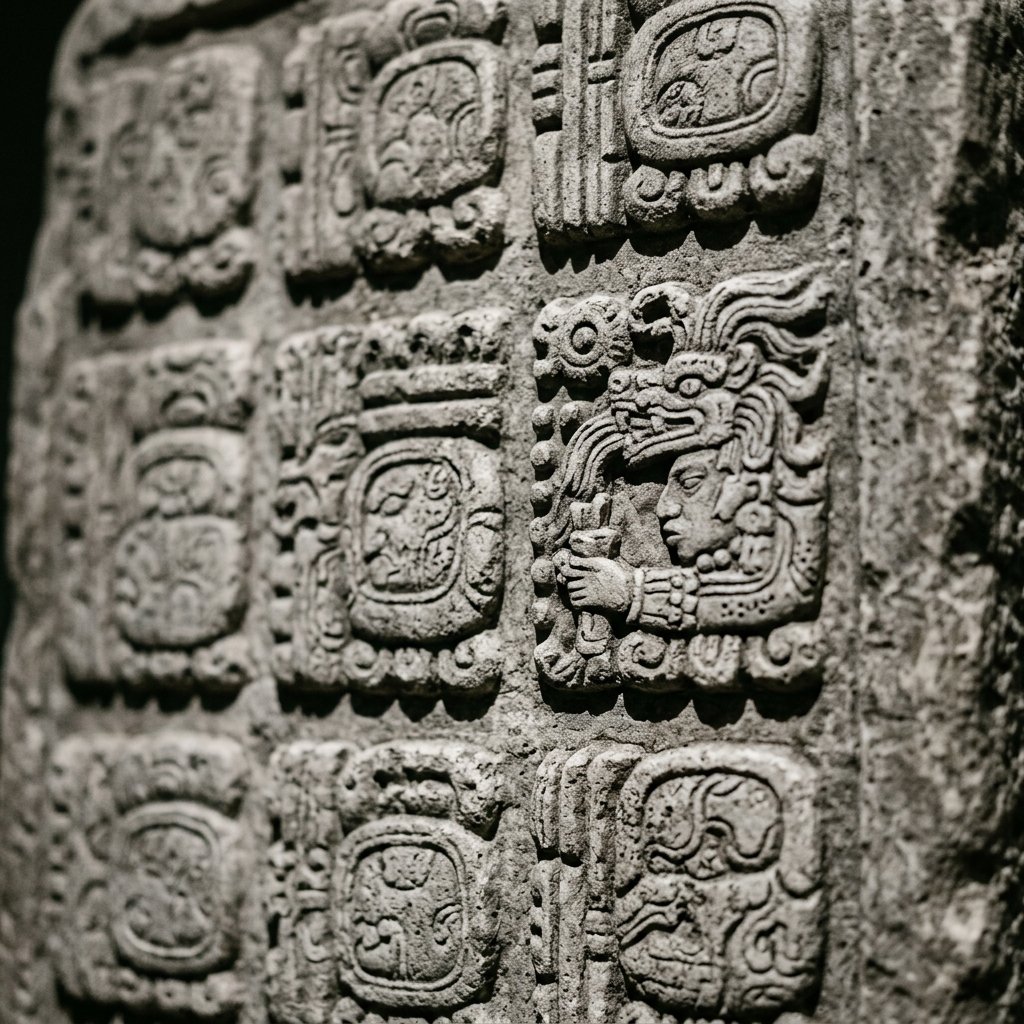
The Writing System at a Glance
The Voice of the Ancients
Of all the great civilizations of the pre-Columbian Americas—from the Inca in the Andes to the Cahokians of the Mississippi—only the Maya developed a fully capable, phonetic writing system. This means the Maya script could express perfectly whatever could be spoken. It was not merely a system of mathematical record-keeping or simple picture-prompts; it was a flexible tool capable of recording royal propaganda, profound poetry, complex grammar, and political history.
When we read a Classic Maya stela today, we are not guessing at the meaning of symbols. We are reading the exact ancient words—the specific nouns, verbs, and phonetic sounds—spoken by Maya kings and scribes 1,500 years ago (Coe, M.D., Breaking the Maya Code, 1992).
How It Works: The Logo-Syllabic Mechanics
For centuries, early European scholars were paralyzed by the script because they assumed it was either purely alphabetic (like English) or purely ideographic (like Chinese characters). It is neither. It is logo-syllabic.
A Maya scribe writing a word had two different types of signs they could use:
- Logograms: A single sign that represents an entire word or concept. For example, to write the word "jaguar" (B'alam), the scribe could simply draw the head of a jaguar. Logograms are usually the largest, central part of a glyph block (the Main Sign).
- Syllabograms: A sign that represents a specific phonetic syllable, usually a consonant and a vowel (CV). For example, there is a sign for ba, a sign for la, and a sign for ma.
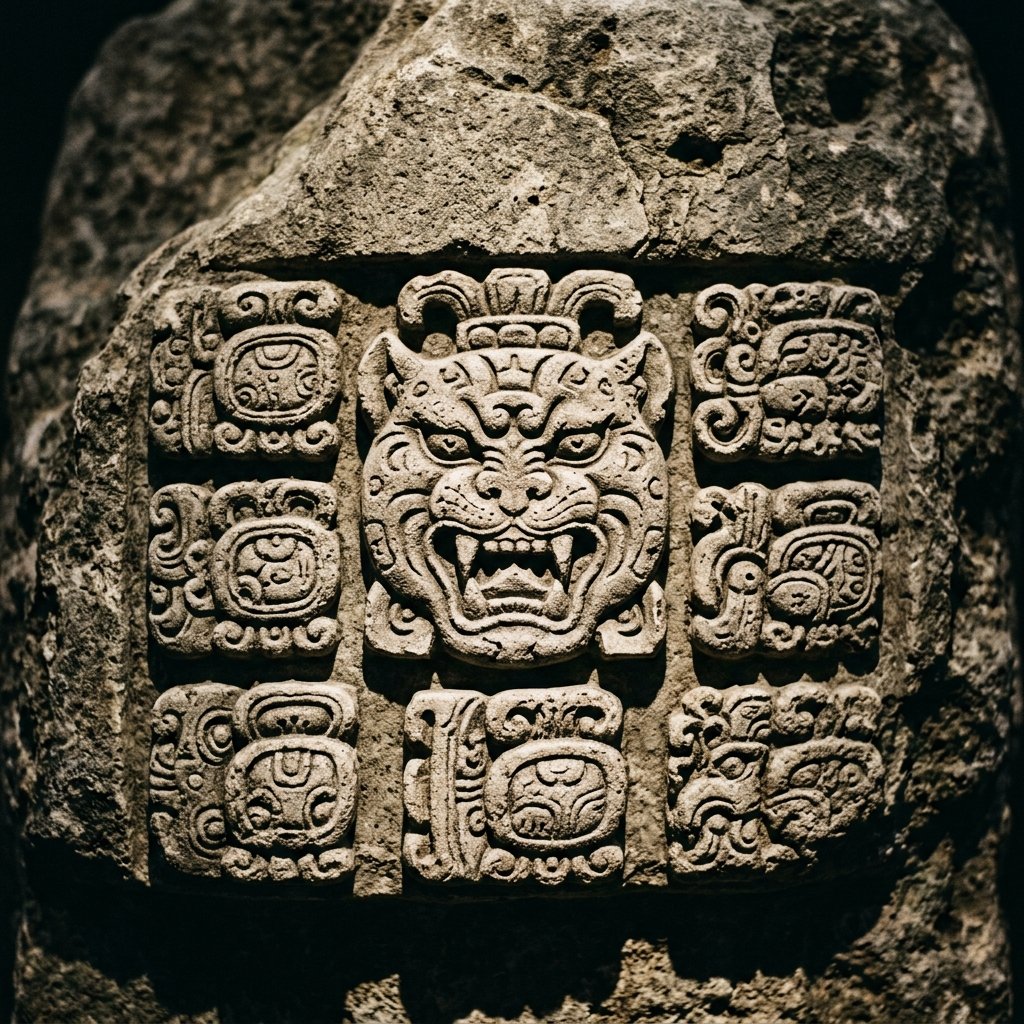
Phonetic Complementation
Because a jaguar head logogram could theoretically be read in different ways depending on the specific Maya language being spoken, scribes used a genius trick called phonetic complementation to remove all ambiguity.
To ensure the reader pronounced the jaguar logogram specifically as B'alam, the scribe would attach the syllable ba to the front of the logogram, and the syllable ma to the end. The reader knows they don't pronounce the word "ba-jaguar-ma". The syllables act as phonetic hints: "Read this jaguar head as the word that starts with ba and ends with ma."
Alternatively, the scribe could just ignore the logogram entirely and spell the word out purely phonetically using only the three syllables: ba-la-ma. The final vowel of the last syllable is almost always dropped in reading, producing b'alam (Kettunen, H. & Helmke, C., Introduction to Maya Hieroglyphs, 2020).
Reading Order and Polyvalence
If you attempt to read a Maya monument straight across like an English book, it will produce gibberish. The Maya invented a highly specific reading order. Texts are arranged in columns two blocks wide. You read the top-left block (A1), then the top-right block (B1), then drop down to the left block in the second row (A2), then right (B2). This double-column zig-zag continues until the bottom of the column pair, at which point the reader moves to the top of the next double-column.
To complicate matters further, the system embraces polyvalence (or allography). In English, the letter "A" always looks relatively the same. In Maya writing, a single syllable like u could be drawn using ten completely different signs—a fish fin, a bracket, a bead, or a bird's head. Scribes hated redundancy. If they had to write the syllable u three times in a sentence, they would proudly use three different signs to do it, showcasing their artistic virtuosity.
The Scribes: The Aj Tz'ib and their Gods
Because the writing system required the memorization of nearly 800 distinct signs, literacy in the Classic Maya world was the exclusive domain of the extreme elite.
The scribes were known as the Aj Tz'ib ("He who writes/paints"). They were often the younger sons, brothers, or uncles of the king. To be an Aj Tz'ib was to hold immense political power, as they controlled the narrative of history, the taxation records, and the astronomical calendars.
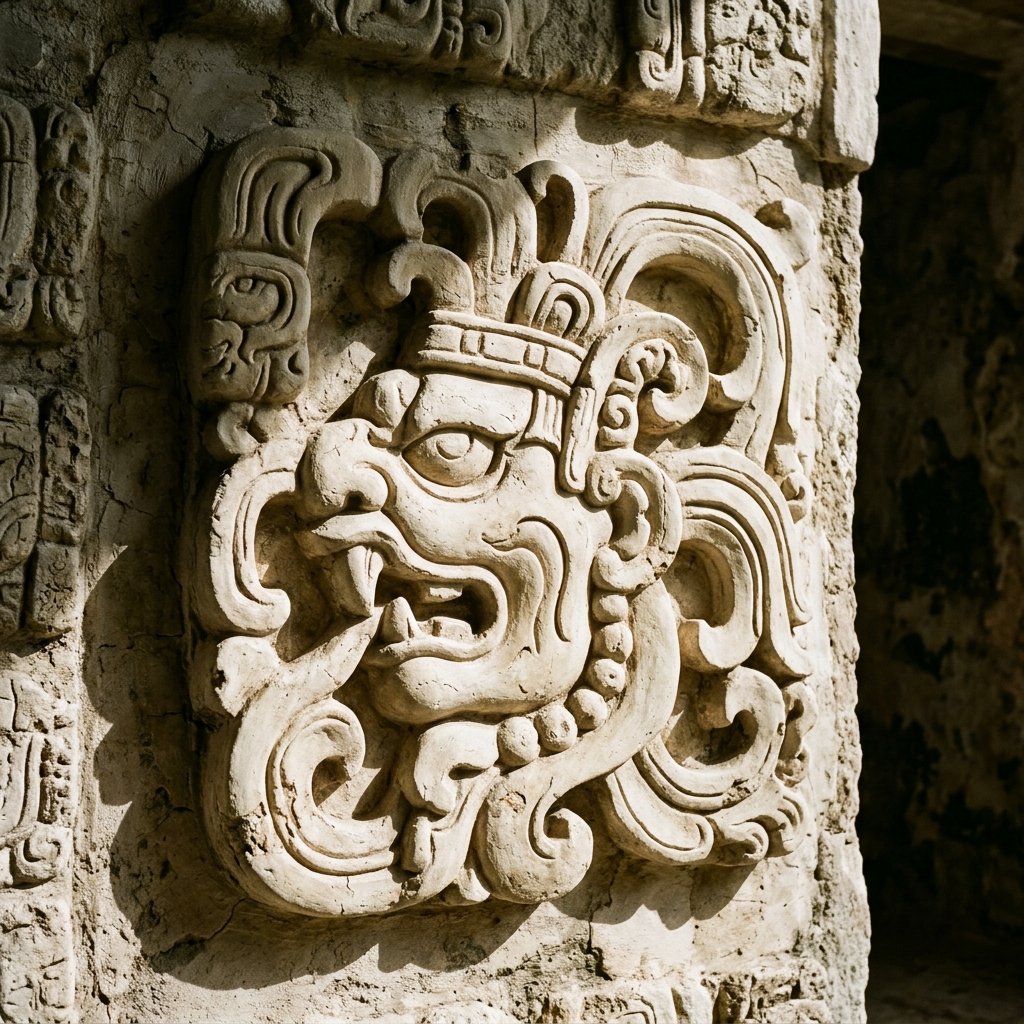
The patron deity of the scribes was the Howler Monkey God. In Maya mythology, the original scribes were the jealous older half-brothers of the Hero Twins. As punishment for their cruelty, the twins magically transformed them into howler monkeys. Despite this, the monkeys retained their incredible artistic and intellectual skills and were venerated by human scribes.
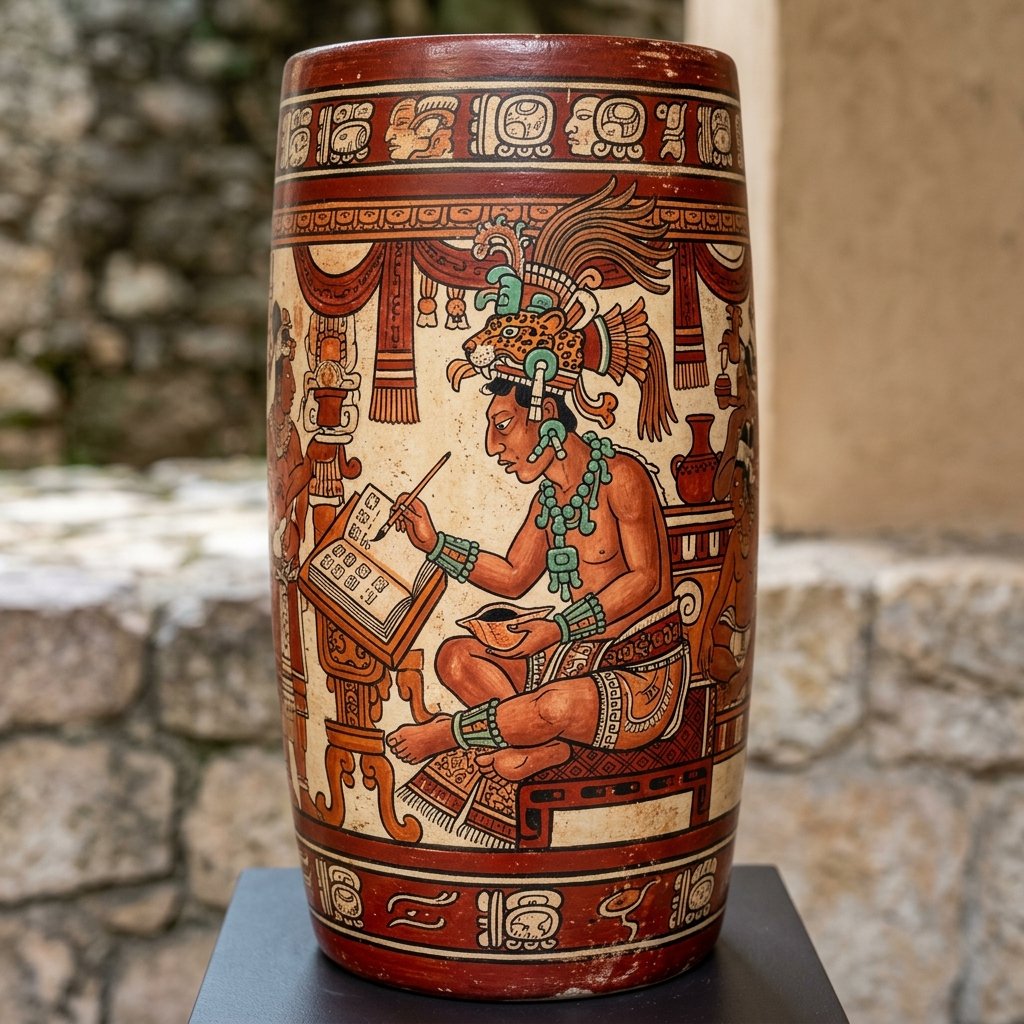
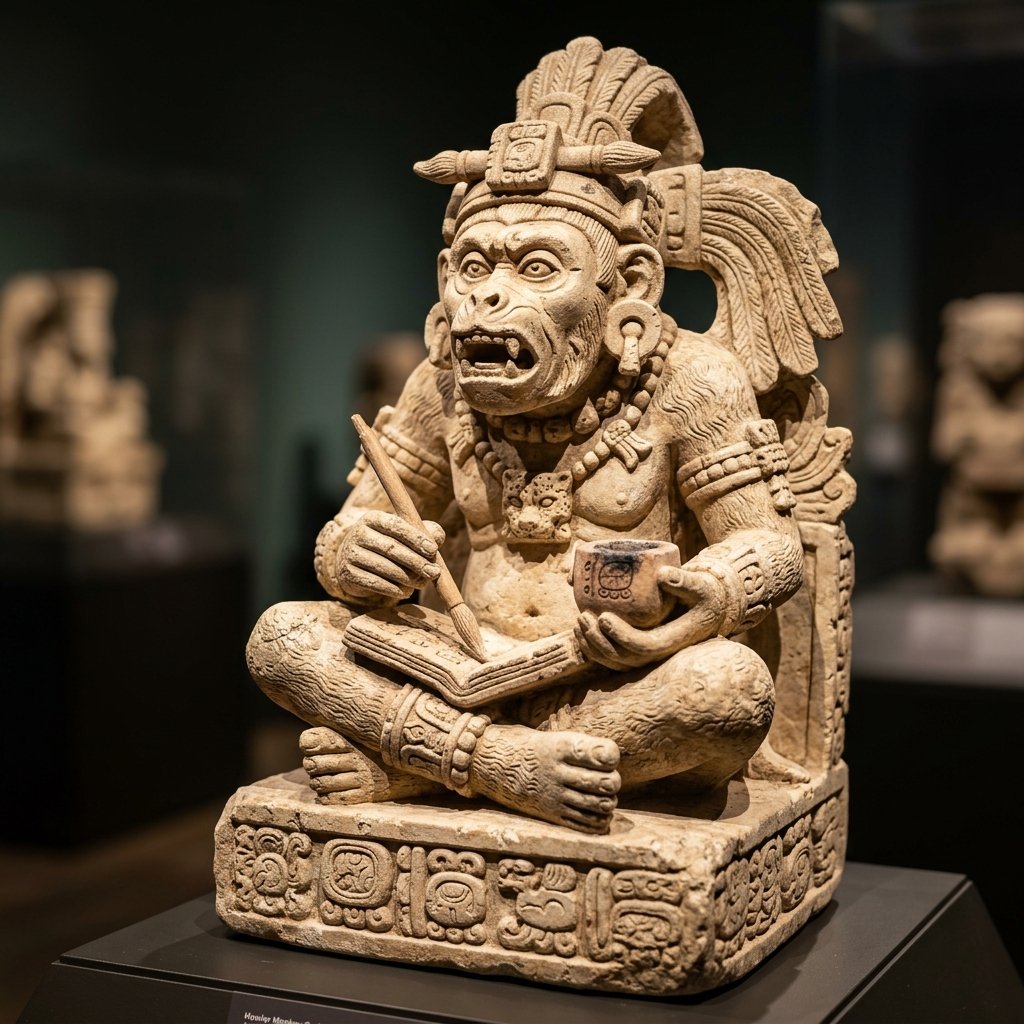
Left: A human Aj Tz'ib (scribe) holding a bisected conch shell used as an inkwell for red and black pigments. Right: The supernatural patron of writing, the Howler Monkey God, holding a stylus.
The Long Road to Decipherment
In the 16th century, the Spanish Franciscan friar Diego de Landa ordered the burning of thousands of Maya books to eradicate "paganism." Yet, ironically, he also documented a "Maya Alphabet" in his manuscripts. He had asked a Maya scribe to translate the Spanish alphabet (A, B, C) into glyphs. Because the Maya script is syllabic, not alphabetic, the scribe gave Landa the signs for the syllables "a", "be", "se". For centuries, Western scholars thought Landa's alphabet was nonsense.
During the mid-20th century, the dominant figure in Maya archaeology, J. Eric S. Thompson, fiercely insisted that Maya writing was purely ideographic and mystical, arguing it contained no history and no phonetics. He actively ruined the careers of anyone who disagreed.
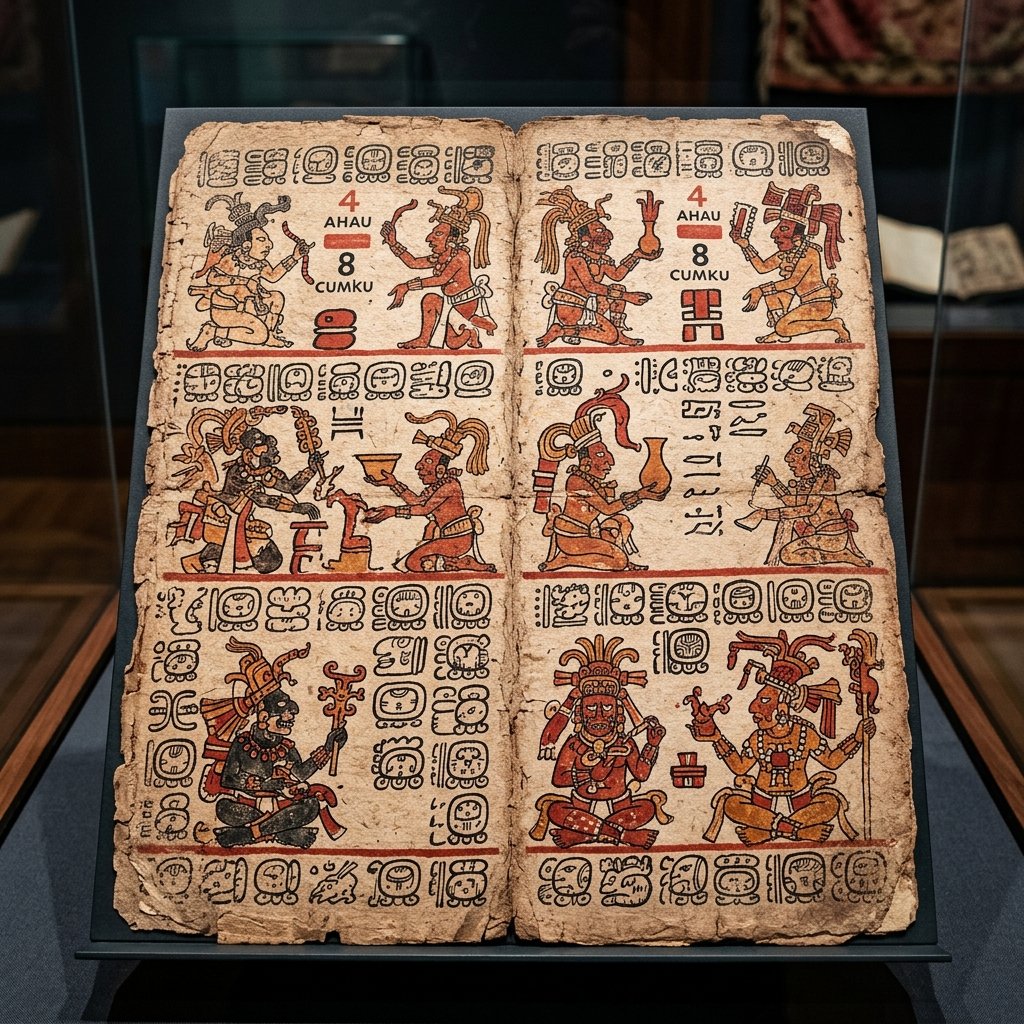
The breakthrough came in 1952 from behind the Iron Curtain. A young Russian linguist named Yuri Knorozov, who had rescued a copy of Landa's manuscript from the burning ruins of Berlin during WWII, proved that Landa's "Alphabet" was actually a phonetic syllabary. Knorozov used it to correctly read words in the surviving Dresden Codex.
Following Knorozov's phonetic breakthrough, architect Tatiana Proskouriakoff proved that the dates on the stelae at Piedras Negras corresponded to human lifespans (births, accessions, and deaths), finally proving the monuments recorded historical kings, not just gods. Today, thanks to the collaborative efforts of epigraphers worldwide, over 85% of the Maya script can be read fluently.
References
- Coe, M.D. Breaking the Maya Code. Thames & Hudson, revised edition, 1992. (The definitive history of the decipherment).
- Houston, S., Baines, J., & Cooper, J. Last Writing: Script Obsolescence in Egypt, Mesopotamia, and Mesoamerica. Equinox, 2003.
- Kettunen, H. & Helmke, C. Introduction to Maya Hieroglyphs. 17th Edition, Wayeb, 2020. (The standard epigraphy textbook).
- Martin, S. & Grube, N. Chronicle of the Maya Kings and Queens. Thames & Hudson, 2nd edition, 2008.
- Montgomery, J. How to Read Maya Hieroglyphs. Hippocrene Books, 2002.
- Stuart, D. The Order of Days: Unlocking the Secrets of the Ancient Maya. Harmony Books, 2011.
Frequently Asked Questions
Is the Maya alphabet like English?
No. The Maya did not use an alphabet (where one sign equals one isolated consonant or vowel). They used a logo-syllabic system. Some signs represent whole words (logograms), while other signs represent syllables consisting of a consonant and a vowel together (like ba, ka, na).
How do you read a Maya monument?
Maya inscriptions are generally read in double columns. You start at the top left block, read the block immediately to its right, then drop down a row and read the left block, then the right block, continuing in a zig-zag pattern until the bottom of the column pair.
Who finally deciphered Maya writing?
It was a team effort over decades, but the most critical breakthrough was made by the Russian linguist Yuri Knorozov in 1952. He recognized that the script was phonetic and that Diego de Landa's 16th-century manuscript contained a partial syllabary, not an alphabet.