Key Takeaway
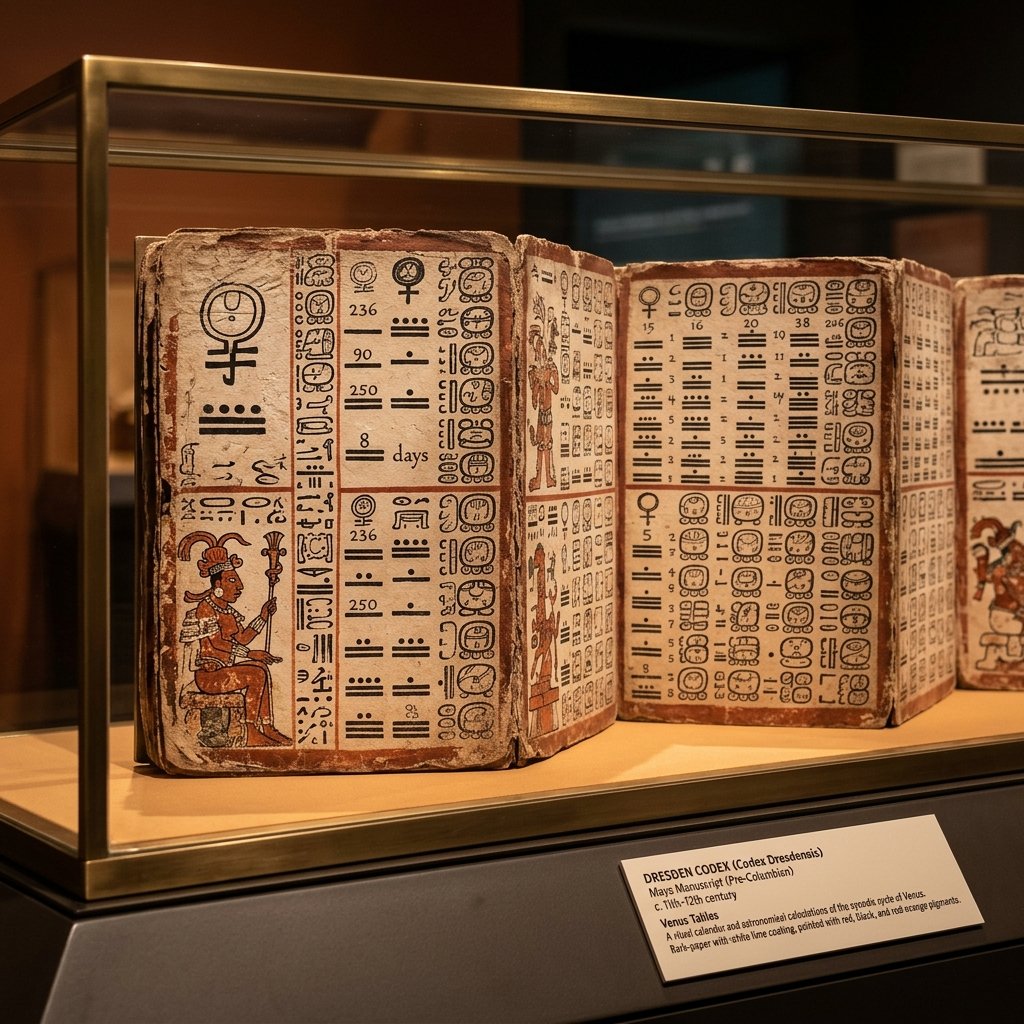
The Dresden Codex is a 78-page folding manuscript made from beaten fig-bark paper (huun) coated in white lime plaster, painted on both sides with hieroglyphic text, numerical tables, and deity images in red, black, blue, and brown inks. It contains the most accurate pre-telescopic astronomical tables ever created — Venus calculations accurate to within 2 hours over 481 years — along with eclipse prediction tables, almanacs, and prophecies. It is, by any measure, one of the most important documents in human intellectual history.
History of the Manuscript
The journey of the Dresden Codex from Maya creation to modern scholarship is one of the most improbable survival stories in the history of knowledge.
Contents of the Codex
The 78 pages of the Dresden Codex contain several distinct sections, each serving different divinatory, astronomical, or ritualpurposes:
Venus Tables (pp. 24, 46–50)
Track Venus's 584-day synodic cycle through its four phases. Cover 5 complete Venus rounds (5 × 584 = 2,920 days = exactly 8 solar years). Include correction factors for long-term drift. Accuracy: within 2 hours over 481 years (Aveni, 2001).
Eclipse Tables (pp. 51a–58b)
A 405-lunation (≈33-year) cycle of eclipse warning dates. Identify intervals of 148 and 177 days when eclipses are possible. Include a commensurate cycle allowing extension over multiple centuries. See our full eclipse prediction article.
Rain & Agriculture Almanacs
260-day almanacs correlating Tzolk'in dates with rainfall predictions, agricultural activities, and associated deities — particularly Chaac (rain) and Yum Kaax (maize). Practical guides for ceremonial timing.
The Great Flood Scene (p. 74)
The codex's most dramatic image: a deluge pouring from the mouth of a sky serpent while a goddess empties a water jar. Often interpreted as a depiction of world-ending flood or as a calendrical metaphor for the end of a cosmic cycle.
Mathematical Sophistication
The astronomical tables in the Dresden Codex reveal a mathematical sophistication that goes beyond mere observation. The Maya scribe-astronomers who created these tables were performing what modern mathematicians would recognize as continued-fraction approximation — finding the simplest ratios that best approximate incommensurate cycles.
For example, the eclipse table's 11,960-day period satisfies the near-equation:
This triple commensuration — linking the lunar, sacred, and eclipse cycles — allowed the Maya to embed eclipse predictions within their existing calendrical framework, an elegant mathematical solution documented by Justeson (American Antiquity, 1989).
The Other Surviving Codices
While the Dresden Codex is the finest and most scientifically important Maya manuscript, three others survive (see our Maya Writing article for details on all four). Their combined content represents a fraction of what once existed — Bishop Diego de Landa's mass burning of Maya books in 1562 destroyed thousands of manuscripts containing centuries of accumulated knowledge.
Modern Conservation
The Dresden Codex is maintained by the Saxon State and University Library (SLUB) in Dresden, Germany, in climate-controlled conditions. It is not currently on permanent public display due to its fragility, but high-resolution digitizations are freely available online through SLUB's digital collections — making this 700-year-old document accessible to anyone in the world.
Frequently Asked Questions
Can I see the Dresden Codex online?
Yes. The Saxon State and University Library (SLUB) in Dresden has published high-resolution scans of the entire codex as part of their digital collections. Several academic sites also host annotated versions with commentary. The full codex is freely accessible for research and study.
How accurate are the Venus tables really?
The Venus tables track Venus's 583.92-day synodic period (modern value: 583.93 days) over five complete rounds (2,920 days = 8 solar years exactly). Over the 481-year span that the correction mechanisms cover, the accumulated error is approximately 2 hours — a level of precision that was not matched in Europe until the work of Copernicus and Tycho Brahe in the 16th century.
Was the codex nearly destroyed in World War II?
The codex survived the firebombing of Dresden on February 13–15, 1945, but sustained water damage when it was stored in a vault that was partially flooded during firefighting. Some pages were stained or obscured. Modern multispectral imaging has partially recovered content from the damaged sections.
References & Further Reading
- Förstemann, E. W. (1906). Commentary on the Maya Manuscript in the Royal Public Library of Dresden. Papers of the Peabody Museum, Vol. IV, No. 2.
- Aveni, A. F. (2001). Skywatchers: A Revised and Updated Version of Skywatchers of Ancient Mexico. UT Austin Press.
- Bricker, H. M. & Bricker, V. R. (2011). Astronomy in the Maya Codices. American Philosophical Society.
- Justeson, J. S. (1989). "Ancient Maya Ethnoastronomy: An Overview of Hieroglyphic Sources." In World Archaeoastronomy, ed. A. F. Aveni. Cambridge UP.
- Aimers, J. J. & Rice, P. M. (2006). "Astronomy, ritual, and the interpretation of Maya 'E-Group' architectural assemblages." Ancient Mesoamerica, 17(1), 79–96.
- Thompson, J. E. S. (1972). A Commentary on the Dresden Codex: A Maya Hieroglyphic Book. American Philosophical Society.