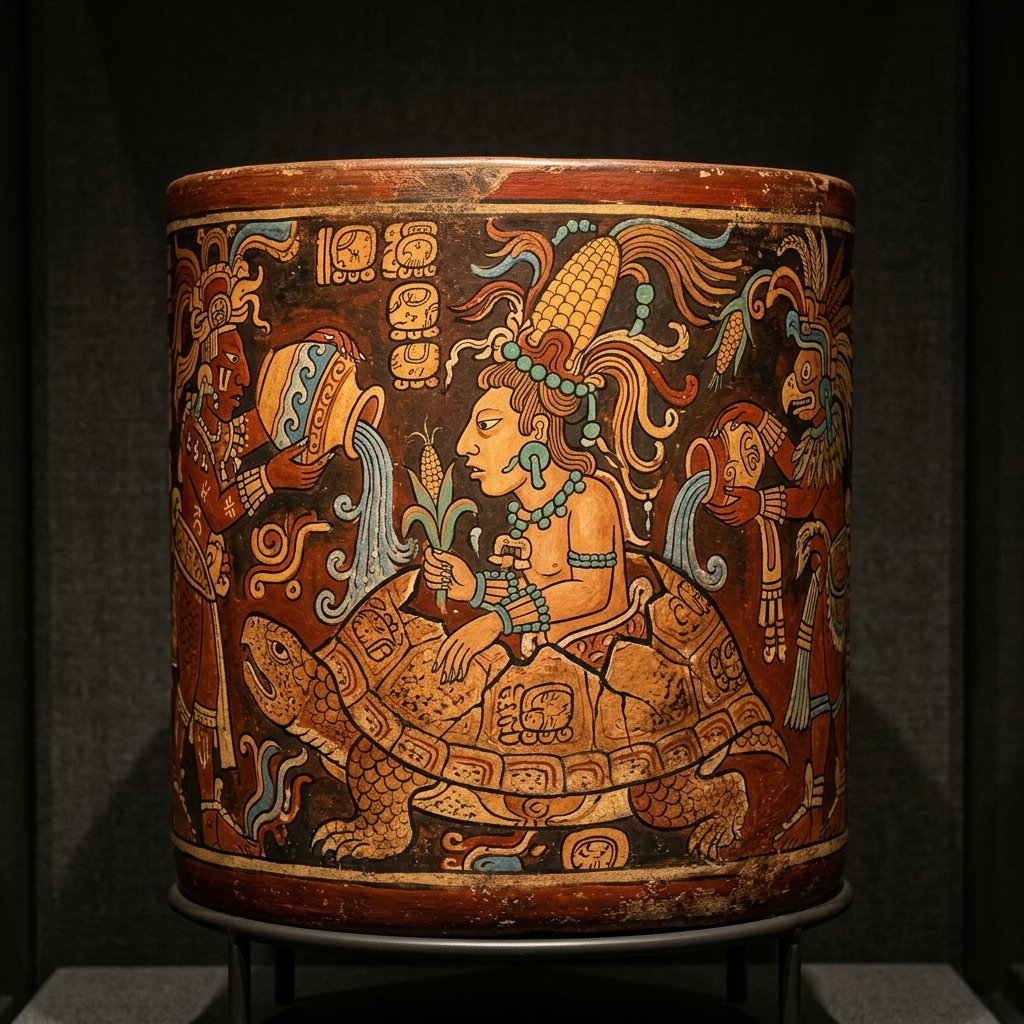
The Maize God at a Glance
The Most Important God in Maya Civilization
If you could choose only one deity to understand the entirety of Maya religion, it would be the Maize God. He is not the most powerful god in the Maya pantheon — that distinction belongs to Itzamná — but he is the most essential. Human beings are made from maize. The Maize God's death and resurrection makes human life possible. Every act of planting, harvesting, and eating corn is a re-enactment of his cosmic drama.
The Maize God appears across more than two thousand years of Maya art, from the earliest Preclassic murals at San Bartolo (c. 100 BC) to Colonial-era K'iche' narratives. His image is unmistakable: an eternally youthful, beautiful male figure with an elongated, flattened head — shaped like a maize cob — often with a foliated headdress of corn leaves. He represents not just agriculture but beauty, civilization, and the triumph of life over death (Taube, K., "The Classic Maya Maize God," in Fifth Palenque Round Table, 1983).
The Story: Death and Resurrection
The Maize God's story is told most fully in the Popol Vuh, the sacred book of the K'iche' Maya. In this narrative, his name is Hun Hunahpu ("One Hunahpu"):
The Descent
Hun Hunahpu and his twin brother Vucub Hunahpu were summoned to Xibalba (the underworld) by the Lords of Death, who were angered by the noise of their ball-playing. In the underworld, the brothers were subjected to a series of tests in the Houses of Terror. They failed. The Lords of Death killed Hun Hunahpu and buried his body in the ballcourt.
But death could not fully contain the Maize God. His severed head was hung in a calabash tree, where it spat into the hand of a curious underworld maiden named Xquic (Blood Moon). She became pregnant with the Hero Twins.
The Resurrection
The Hero Twins — Hunahpu and Xbalanque — grew up, discovered their father's fate, and journeyed to Xibalba to avenge him. Through cleverness, trickery, and supernatural ball-playing skill, they defeated the Lords of Death. They then found their father's buried remains in the ballcourt and resurrected him.
The resurrection scene is one of the most frequently depicted events in Classic Maya art. On painted ceramics, the Maize God emerges from a crack in the earth — sometimes depicted as a turtle shell (the earth-turtle) or as the split surface of a ballcourt. He is attended by his sons, who pour water over him and dress him in jade ornaments. He rises, youthful and beautiful, like a maize plant growing from the seed.
This is the foundational metaphor of Maya civilization: death is planting. The seed is buried (death), it lies dormant underground (the underworld), and it bursts forth as new life (resurrection). Every corn harvest re-enacts the Maize God's triumph (Freidel, D., Schele, L. & Parker, J., Maya Cosmos, 1993, pp. 59–122).
The Maize God in Art
The Maize God is depicted more frequently than any other deity in Classic Maya art. Key representations include:
- San Bartolo murals (c. 100 BC): The earliest known depiction of the Maya creation narrative, including the Maize God's resurrection. These Preclassic paintings, discovered in 2001 in northeastern Guatemala, pushed the known date of the Maize God iconography back by centuries.
- Palenque sarcophagus lid: K'inich Janaab Pakal is depicted falling into the underworld in the guise of the Maize God — signaling that the king, like the Maize God, will be reborn.
- Copán Stela H: A full-figure portrait of King Waxaklajun Ubah K'awiil (18 Rabbit) dressed as the youthful Maize God, complete with foliated corn headdress.
- Painted ceramics: Hundreds of Late Classic vessels depict the resurrection sequence — the Maize God emerging from the earth-turtle, being dressed by the Hero Twins, and dancing in his new finery. These ceramics were placed in royal tombs as guides for the deceased king's own resurrection.
Kings as the Maize God
Maya kings deliberately modeled themselves after the Maize God. The practice of cranial modification (binding an infant's head to produce an elongated skull) imitates the corn-cob shape of the Maize God's head. The tonsured hairstyle worn by royals mimics the way maize silk emerges from the top of an ear of corn. Jade ornaments — the Maize God's signature adornment — were placed on the bodies of deceased kings to transform them into the deity for their journey through the underworld.
In the Temple of the Inscriptions at Palenque, Pakal's sarcophagus shows the king falling into the jaws of the earth, merging with the Maize God. The message is explicit: the king will die, descend to Xibalba, and be reborn — just as the Maize God did, and just as the maize plant does every year (Schele, L. & Miller, M.E., The Blood of Kings, 1986, pp. 266–288).
The Living Legacy
Among contemporary Maya communities in Guatemala and southern Mexico, maize remains sacred. The milpa (corn field) is not just an agricultural space — it is a sacred landscape. Farmers perform ceremonies before planting, asking permission of the earth spirits. The first ears of corn are offered to the gods before the family eats. Wasting maize is considered deeply disrespectful — because discarding corn is, in a theological sense, discarding human flesh.
The Maize God's legacy extends into food science: the process of nixtamalization (treating corn with lime to release niacin) was developed by ancient Mesoamerican peoples and is essential for making tortillas, tamales, and atole. Without this process, a diet dependent on corn leads to pellagra — a potentially fatal nutritional deficiency. The Maya's mastery of maize processing was thus both a culinary and a survival achievement.
Frequently Asked Questions
Who is the Maya Maize God?
The Maize God (Hun Hunahpu in the Popol Vuh, God E in the Schellhas classification) is the deity who personifies maize — the sacred crop from which humans were literally created. He is depicted as an eternally youthful figure whose elongated head resembles a corn cob. His death and resurrection mirror the agricultural cycle and form the theological foundation of Maya civilization.
How is the Maize God connected to the Hero Twins?
The Maize God is the father of the Hero Twins. He was killed by the Lords of Xibalba and buried in the ballcourt. His sons, Hunahpu and Xbalanque, descended to the underworld, defeated the death gods, and resurrected him. This resurrection made the final creation of humanity from maize possible.
Why was maize sacred to the Maya?
In the Popol Vuh, humans are literally made from maize dough. This made corn far more than food — it was the substance of human life. Growing maize was sacred duty, eating it was communion with the divine, and the agricultural cycle of planting and harvest mirrored the cosmic cycle of death and resurrection embodied by the Maize God.
Scholarly References
- Taube, K.A. "The Classic Maya Maize God: A Reappraisal." In Fifth Palenque Round Table, 1983, pp. 171–181.
- Freidel, D., Schele, L. & Parker, J. Maya Cosmos: Three Thousand Years on the Shaman's Path. William Morrow, 1993.
- Schele, L. & Miller, M.E. The Blood of Kings: Dynasty and Ritual in Maya Art. Kimbell Art Museum, 1986.
- Tedlock, D. Popol Vuh: The Definitive Edition. Simon & Schuster, 1996.
- Saturno, W.A., Taube, K.A. & Stuart, D. The Murals of San Bartolo, El Petén, Guatemala. Center for Ancient American Studies, 2005.