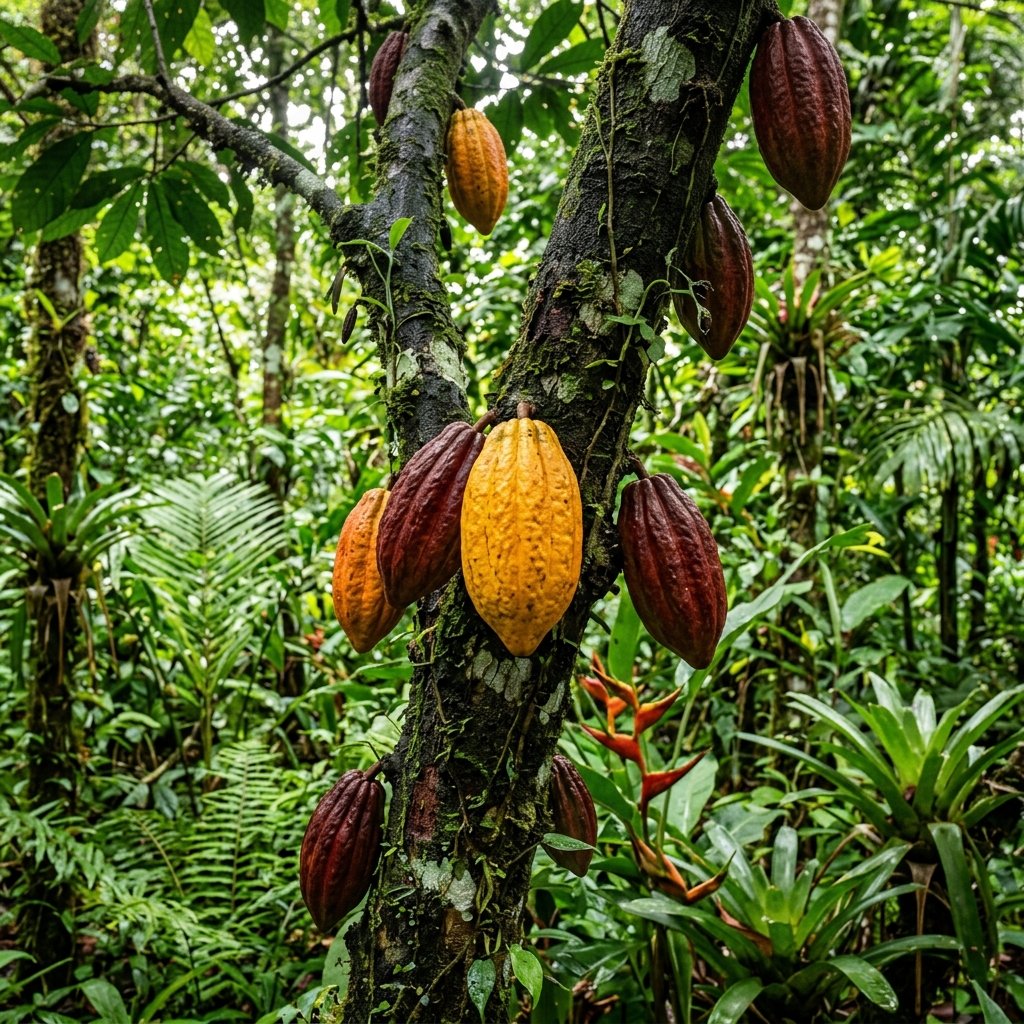
The Gift of Cacao
"Before Belgium, before Switzerland, before Hershey — there were the Maya. Every time you eat chocolate, you are participating in a tradition that began in the Maya lowlands over two thousand years ago. The Maya didn't just discover chocolate. They invented the entire process — fermentation, roasting, grinding, flavoring — that makes the cacao bean edible. Without the Maya, there would be no chocolate."
The Sacred Drink of Kings
Maya chocolate was nothing like a modern candy bar. It was a frothy, bitter, spiced drink served warm or at room temperature — flavored with chili peppers, vanilla, achiote (for a deep red color), honey, and sometimes cornmeal for body. The Maya word for it was kakaw — the linguistic ancestor of "cacao" and "cocoa" in European languages.
Drinking chocolate was a prestige act — a marker of social status as unmistakable as wearing jade. In Classic Maya art, cacao vessels appear in royal court scenes: the king and his nobles sipping chocolate during ceremonies, diplomatic audiences, and feasts. The painted texts on these vessels often include the phrase u-kakaw-a ("his/her cacao") followed by the name and title of the owner — making chocolate drinking cups among the most personalized luxury objects in the Maya world.
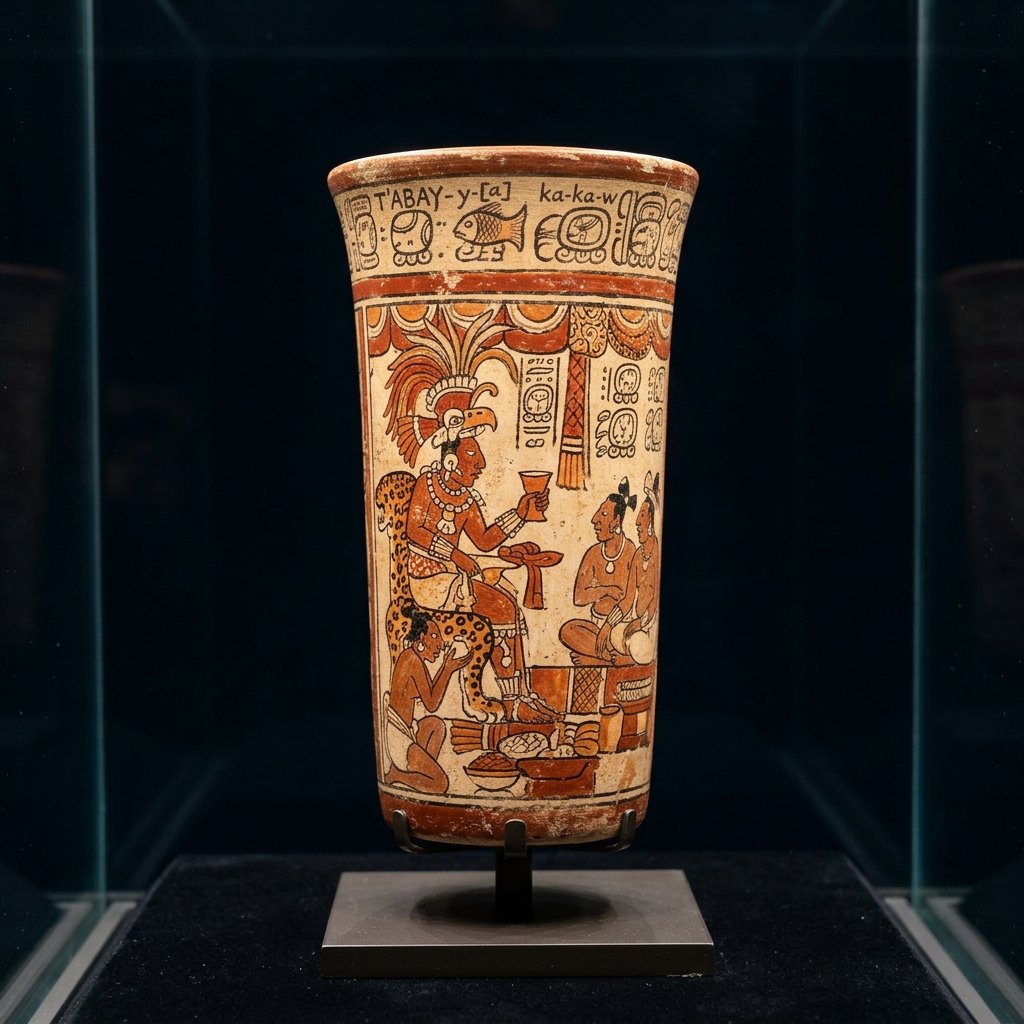
A Maya cacao drinking vessel — a polychrome painted cylinder vase of the type used by Maya elites for consuming frothy chocolate. The painted scene depicts a royal court event, and the hieroglyphic text around the rim includes a "Primary Standard Sequence" that identifies the vessel's function: "this is the drinking cup for fresh cacao of [owner's name and title]." Hundreds of such vessels have been recovered from elite tombs, confirming that cacao drinking was central to Maya court culture. Chemical analysis of residue inside these vessels has confirmed the presence of theobromine — the signature compound of chocolate (Hurst, W.J. et al., Nature, 2002).
How the Maya Made Chocolate
The transformation of bitter cacao beans into chocolate is a complex, multi-stage process — and every step was invented by the ancient Maya. No other civilization independently developed this technique:
- Harvest: Cacao pods were cut from the tree (Theobroma cacao — literally "food of the gods") and split open to reveal 30–50 beans surrounded by sweet white pulp.
- Ferment: Beans were piled in banana leaves for 3–7 days. Fermentation is the critical step that develops chocolate flavor — without it, cacao beans are astringent and unpleasant. The Maya discovered this process empirically.
- Dry: Fermented beans were sun-dried for several days, reducing moisture and stabilizing the flavor compounds.
- Roast: Dried beans were roasted over fire to deepen flavor — the Maillard reaction that produces chocolate's characteristic aroma.
- Grind: Roasted beans were ground on a metate (stone grinding surface) into a thick paste — essentially unsweetened chocolate liquor.
- Mix: The paste was dissolved in water with spices — chili, vanilla, achiote, honey, and sometimes ground maize.
- Froth: The drink was poured repeatedly between vessels from height to create a thick, prized foam. The froth was the most valued part — a chocolate drink without foam was considered incomplete.
Cacao in Maya Mythology
Cacao was a divine substance. The Maya believed it was discovered by the gods inside the "Mountain of Sustenance" (Paxil) — the same sacred mountain that contained maize, the other pillar of Maya civilization. The Maize God himself is sometimes depicted emerging from a cacao pod in Classic Maya art, connecting the two most sacred plants in Maya agriculture through a shared mythological origin.
Ek Chuaj, the Maya god of merchants and trade, was also the patron deity of cacao — reflecting its dual role as a luxury food and a medium of exchange. Cacao pods appear frequently in Maya iconography as offerings to the gods, in scenes of divine feasting, and as symbols of abundance and fertility.
Cacao as Currency
Cacao beans functioned as actual money throughout Mesoamerica — one of the few examples in history of a currency that is simultaneously edible. The standardized bean size made them practical units of exchange, and their value was high enough that counterfeiting existed: archaeological evidence shows that some merchants filled empty cacao shells with mud to create fake beans.
| Item | Cost (Cacao Beans) |
|---|---|
| A tomato | 1 bean |
| An avocado | 3 beans |
| A rabbit | 10 beans |
| A turkey | 100 beans |
| A cotton mantle (cloak) | 65–300 beans |
| A jade bead | Variable (extremely high) |
From the Maya to the World
When the Spanish arrived in the 16th century, they initially found cacao bitter and unpleasant. But they quickly adopted the drink, sweetening it with cane sugar and bringing it to Europe, where it became one of the most coveted luxury commodities of the colonial era — rivaling tea, coffee, and spices. The word "chocolate" itself comes from the Nahuatl (Aztec) word xocolātl ("bitter water"), but the original drink — and the millennia of cultivation, fermentation, and processing knowledge — was entirely Maya.
The earliest known chemical evidence of cacao processing comes from ceramic vessels at the Maya site of Colha, Belize — dated to approximately 600 BC — and even older residues (c. 1900 BC) have been identified at sites in the Ulúa Valley of Honduras (Henderson, J.S. et al., "Chemical and Archaeological Evidence for the Earliest Cacao Beverages," PNAS, 104(48), 2007, pp. 18937–18940).
Scholarly References
- Coe, S.D. & Coe, M.D. (2013). The True History of Chocolate (3rd edition). Thames & Hudson.
- Henderson, J.S. et al. (2007). "Chemical and Archaeological Evidence for the Earliest Cacao Beverages." PNAS, 104(48), pp. 18937–18940.
- Hurst, W.J. et al. (2002). "Cacao Usage by the Earliest Maya Civilization." Nature, 418, pp. 289–290.
- McNeil, C.L. (ed.). (2006). Chocolate in Mesoamerica: A Cultural History of Cacao. University Press of Florida.
Frequently Asked Questions
Did the Maya eat chocolate bars?
No — Maya chocolate was exclusively a drink. Solid chocolate wasn't invented until the 19th century in Europe (Joseph Fry created the first chocolate bar in 1847). The Maya drink was frothy, bitter, spiced with chili and vanilla, and served warm or at room temperature. It bore little resemblance to modern candy — but the fundamental flavor compounds are the same, because the Maya invented the fermentation and roasting process that creates them.
Where does the word "chocolate" come from?
Most likely from the Nahuatl (Aztec) word xocolātl, meaning "bitter water." The Maya word for cacao was kakaw, which became "cacao" in Spanish and "cocoa" in English. The scientific name Theobroma cacao — assigned by Linnaeus in 1753 — means "food of the gods" in Greek, a nod to the divine status the Maya and Aztec both accorded to this plant.
Can I try Maya-style chocolate?
Yes! In the Yucatan and Guatemala, traditional Maya-style hot chocolate is still prepared — ground cacao with chili, vanilla, and spices, whisked to a froth. Artisan chocolate makers worldwide also produce historically inspired Maya chocolate drinks. The experience is startlingly different from modern chocolate: complex, earthy, slightly bitter, with a warmth from the chili that builds gradually. It's a revelatory reminder of where chocolate actually comes from.