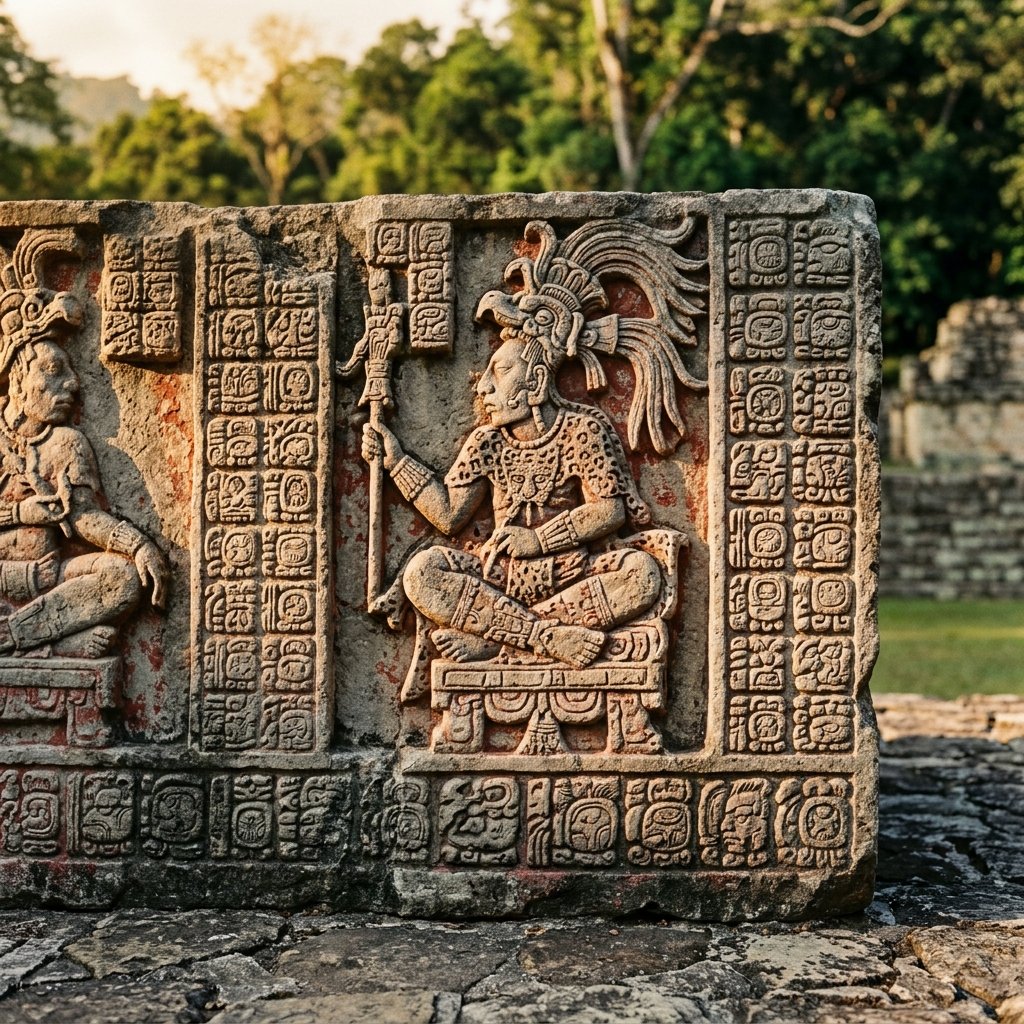
Maya Altars at a Glance
More Than Stone: The Altar as Cosmic Stage
A Maya altar was not mere furniture. It was a portal — a horizontal surface where the human world met the supernatural. When a Maya king knelt before an altar to draw blood from his tongue with a stingray spine, he was performing the most sacred act in Maya religion: opening a channel to the gods and ancestors. The blood, collected on bark paper and burned, produced smoke through which the Vision Serpent appeared, carrying messages from the spirit world.
Altars were placed in the most sacred spaces: at the base of temple pyramids, in the center of plazas, and before the entrances to royal tombs. Their position was deliberate — they marked the cosmic center of the ceremonial precinct, the point where the king's ritual action connected the three tiers of the Maya cosmos: the Upper World (sky), the Middle World (earth), and Xibalba (the underworld) (Schele, L. & Miller, M.E., The Blood of Kings, 1986, pp. 175–192).
Altar Q: The Masterpiece
The most famous Maya altar is Altar Q at Copán, Honduras. Commissioned by the 16th king, Yax Pasaj Chan Yopaat, in 776 AD, it is a rectangular block carved on all four sides with portraits of all 16 rulers of the Copán dynasty, each seated on his name glyph.
The composition is remarkable: the dynastic founder, K'inich Yax K'uk' Mo', sits on the front face holding a flaming torch — the symbol of dynastic authority — which he passes to the 16th king seated beside him. The message is explicit: power flows directly from founder to current king, unbroken across 350 years and 16 generations. It is a dynastic photograph carved in stone — and a masterpiece of political propaganda.
Altar Q also contains one of the most important historical texts at Copán, recording the founding date of the dynasty (426 AD) and establishing the genealogical legitimacy of each successive ruler (Fash, W.L., Scribes, Warriors and Kings, 2001, pp. 139–162).
Types of Maya Altars
- Round altars: Common at Tikal and other Petén sites. Often carved with bound captive figures or cosmological scenes. The round form may represent the earth-turtle from which the Maize God is reborn.
- Rectangular altars: Typical of Copán and Quiriguá. Often contain lengthy hieroglyphic texts and dynastic records.
- Zoomorphic altars: At Quiriguá, several altars take the form of massive full-round sculptures of fantastic creatures — crocodiles, turtles, and composite monsters. Zoomorph P, carved in 795 AD, is the largest carved boulder in the Maya world, weighing approximately 20 tons.
- Platform altars: Low, uncarved stone platforms used for placing offerings — copal incense, food, blood-soaked paper, jade, and sacrificial victims.
Altars and the Stela Complex
Most Maya altars were paired with stelae — tall, upright carved stone slabs. Together, the stela-altar pair formed a ritual complex that was the standard monument type of Classic Maya cities. The stela typically bore the king's portrait and a historical text (accession dates, war victories, period completions), while the altar at its base served as the offering surface.
This pairing was not arbitrary. The vertical stela represented the World Tree (Wakah-Chan), the cosmic axis connecting sky and earth. The horizontal altar represented the earth surface. Together, they recreated the cosmic geography in miniature — the king, depicted on the stela, stood at the center of the universe, and the altar below him was the stage for his most powerful ritual acts.
Altars of Captive Display
Some of the most dramatic Maya altars depict bound war captives — defeated enemy kings shown in postures of humiliation before being sacrificed. At Toniná, captured lords are shown trussed like animals, their bodies forming the surface of the altar itself. At Yaxchilán, altar panels show captives with their arms bound behind their backs, awaiting sacrifice.
These captive altars served a dual purpose: they documented military victories (proving the king's power) and they functioned as actual sacrificial platforms where captive kings were ritually killed — often through decapitation or heart extraction. The altar literally became the stage of death, transforming military triumph into cosmic ritual (Martin, S. & Grube, N., Chronicle of the Maya Kings and Queens, 2008, pp. 16–19).
Frequently Asked Questions
What were Maya altars used for?
Maya altars served as ritual platforms for bloodletting, offerings, and sacrifice. They were cosmic stages where kings performed ceremonies to communicate with gods and ancestors. They were typically paired with stelae and placed in the most sacred spaces of the city — in front of temples, in plazas, and at tomb entrances.
What is the most famous Maya altar?
Altar Q at Copán — a rectangular monument depicting all 16 rulers of the Copán dynasty seated on their name glyphs. Carved in 776 AD, it's a masterpiece of political record-keeping and the single most important monument for understanding Copán's 350-year dynastic history.
What is the difference between a Maya altar and a stela?
A stela is vertical (upright carved slab); an altar is horizontal (flat or rounded stone). Together they form a ritual pair — the stela representing the World Tree and bearing the king's image, the altar representing the earth surface and serving as the offering platform.
Scholarly References
- Fash, W.L. Scribes, Warriors and Kings: The City of Copán and the Ancient Maya. Thames & Hudson, 2001.
- Schele, L. & Miller, M.E. The Blood of Kings. Kimbell Art Museum, 1986.
- Martin, S. & Grube, N. Chronicle of the Maya Kings and Queens. Thames & Hudson, 2nd edition, 2008.
- Looper, M.G. Lightning Warrior: Maya Art and Kingship at Quiriguá. University of Texas Press, 2003.