Key Takeaway
Maya writing is one of only five writing systems in human history that was independently invented (alongside Sumerian cuneiform, Egyptian hieroglyphs, Chinese characters, and the Indus Valley script). Unlike any other pre-Columbian system, the Maya script could record any spoken word — making it, as epigrapher Michael Coe wrote, "a fully developed writing system in every sense of the term" (Coe, Breaking the Maya Code, 1992). Its decipherment, fought over decades amid Cold War politics and scholarly egos, transformed our understanding of Maya civilization from a mysterious theocracy of peaceful stargazers into a world of warring dynasties, royal bloodletting, and staggering intellectual achievement.
How Maya Writing Works
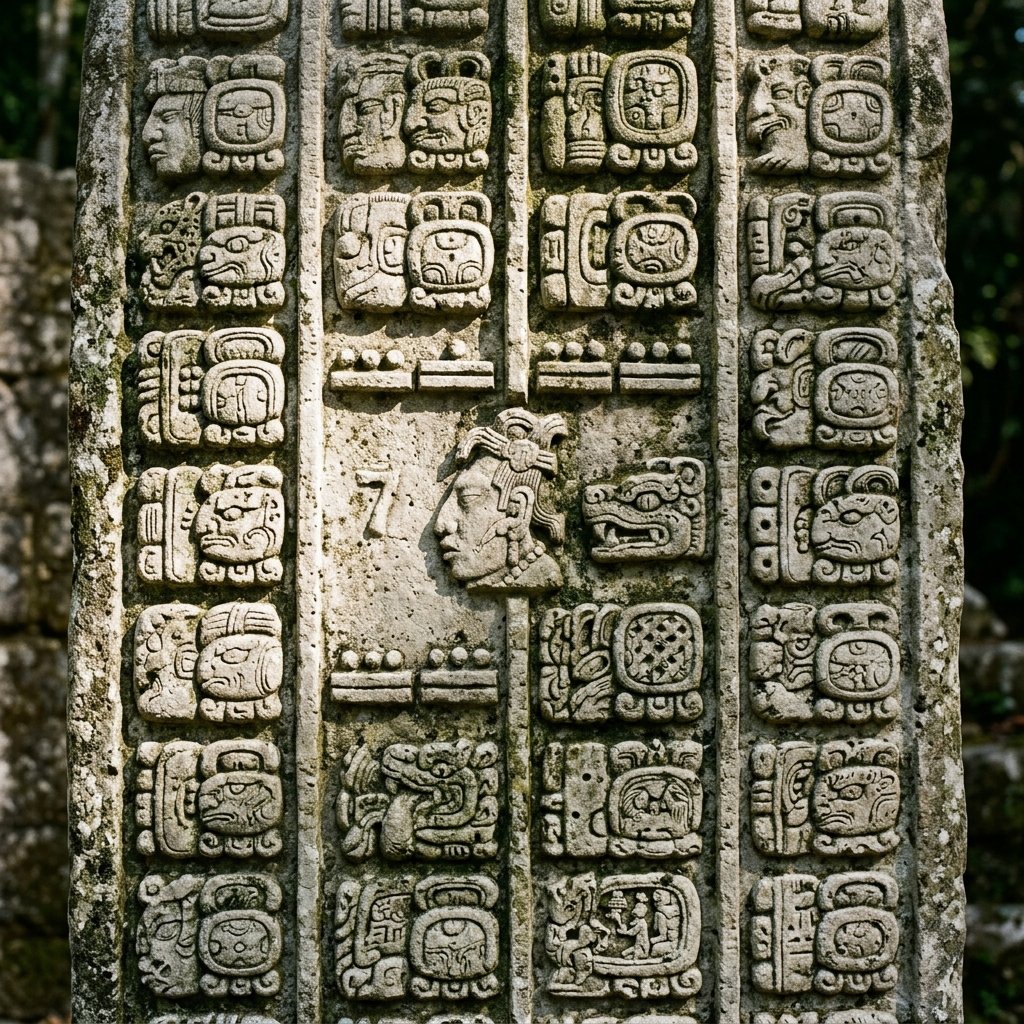
Maya hieroglyphs are a logo-syllabic writing system — the same structural category as Sumerian cuneiform, Egyptian hieroglyphs, and modern Japanese. This means glyphs function in two fundamentally different ways:
- Logograms: A single glyph represents an entire word. For example, the "jaguar" glyph represents the word b'alam. Approximately 200 logograms have been identified (Houston, Stuart & Robertson, 2004).
- Syllabograms: A glyph represents a consonant-vowel (CV) syllable — "ba," "la," "ma." Roughly 100 syllabic signs are confirmed, enabling scribes to spell out any spoken word phonetically.
The system is remarkably flexible — the same word could often be written in multiple ways: entirely with logograms, entirely with syllabograms, or with any combination of both. A scribe writing the word b'alam (jaguar) could use the single jaguar logogram, or spell it phonetically: b'a-la-ma (three syllabograms), or use the logogram with a phonetic complement BALAM-ma to confirm the reading. This gave Maya scribes enormous creative freedom — and means that no two inscriptions look exactly alike.
The Glyph Block: Architecture of a Sign
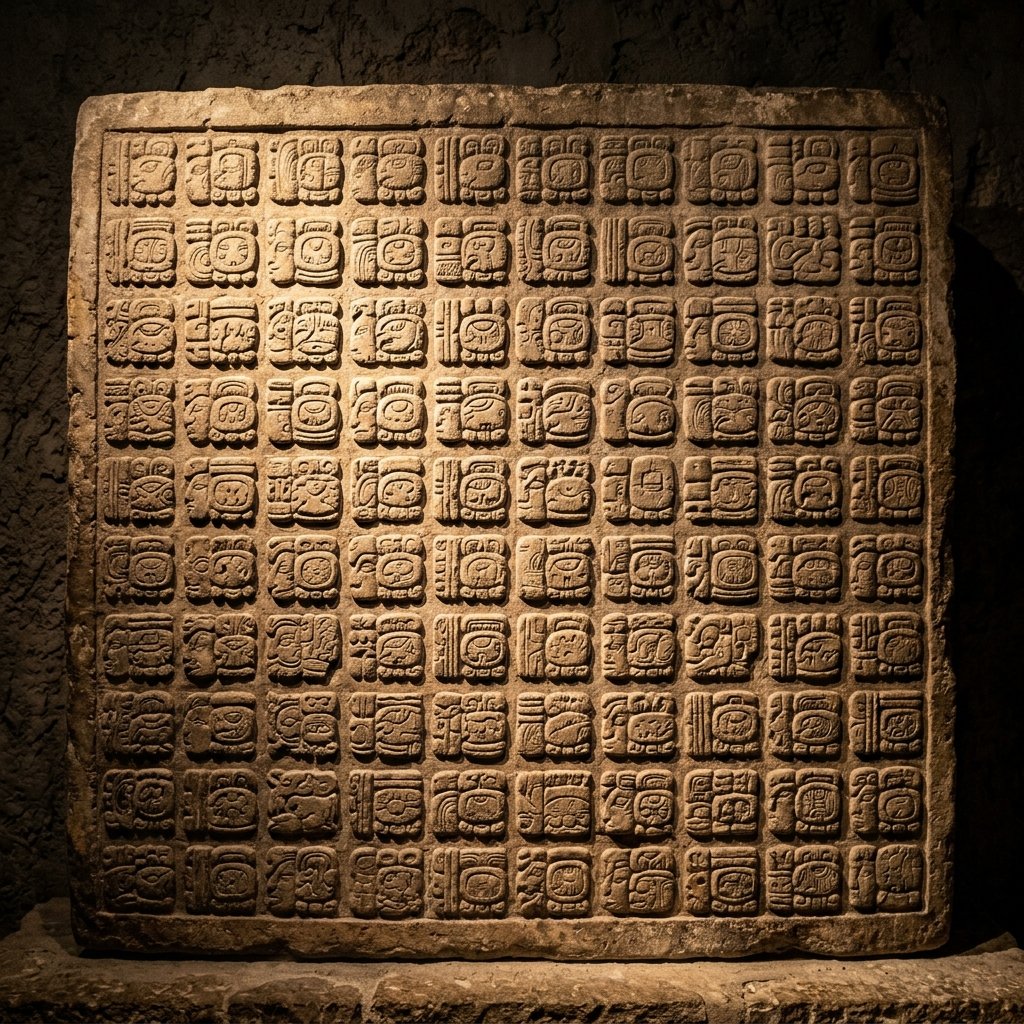
Maya text is organized into glyph blocks — roughly square units arranged in a grid and read in paired columns from left to right, top to bottom. Each glyph block is a miniature composition containing:
Block Structure
- Main sign — the central, largest element (logogram or primary syllabogram)
- Prefix — attached to the left, often grammatical markers
- Suffix — attached to the right or bottom, often phonetic complements
- Superfix — attached above, modifying the main sign's reading
- Subfix — attached below the main sign
- Infix — inserted inside the main sign, a uniquely Maya compositional technique
Reading Order
Maya text reads in paired columns — left column of a pair first, then right column, then down one row. This creates a zigzag pattern: A1→B1, A2→B2, A3→B3. This reading order was established by Yuri Knorosov in 1952 and confirmed by subsequent analysis of calendar sequences (Knorosov, Soviet Ethnography, 1952).
Individual glyph blocks are read from top to bottom, left to right within the block. The ordering within blocks is consistent enough that trained epigraphers can identify the main sign, affixes, and phonetic complements on sight.
What the Maya Wrote — And Where
Maya writing appears on virtually every medium available to the ancient Maya. Far from being confined to royal monuments, text permeated Maya life — from the massive carved stelae of kings to the delicate painted surfaces of drinking cups used at elite banquets.

Monumental Inscriptions
- Stelae: Tall carved stone slabs — often 3+ meters high — recording royal histories, conquests, accession dates, period-ending ceremonies, and astronomical events. Cities like Copán erected stelae every 20 years (one k'atun) for centuries.
- Temple walls and lintels: Narrative scenes with accompanying text at sites like Yaxchilán and Palenque — often recording specific rituals performed by named individuals on precise dates.
- Stairways: The Hieroglyphic Stairway at Copán contains over 2,200 individual glyph blocks — the longest known Maya text — recording 400 years of dynastic history.
Portable Objects
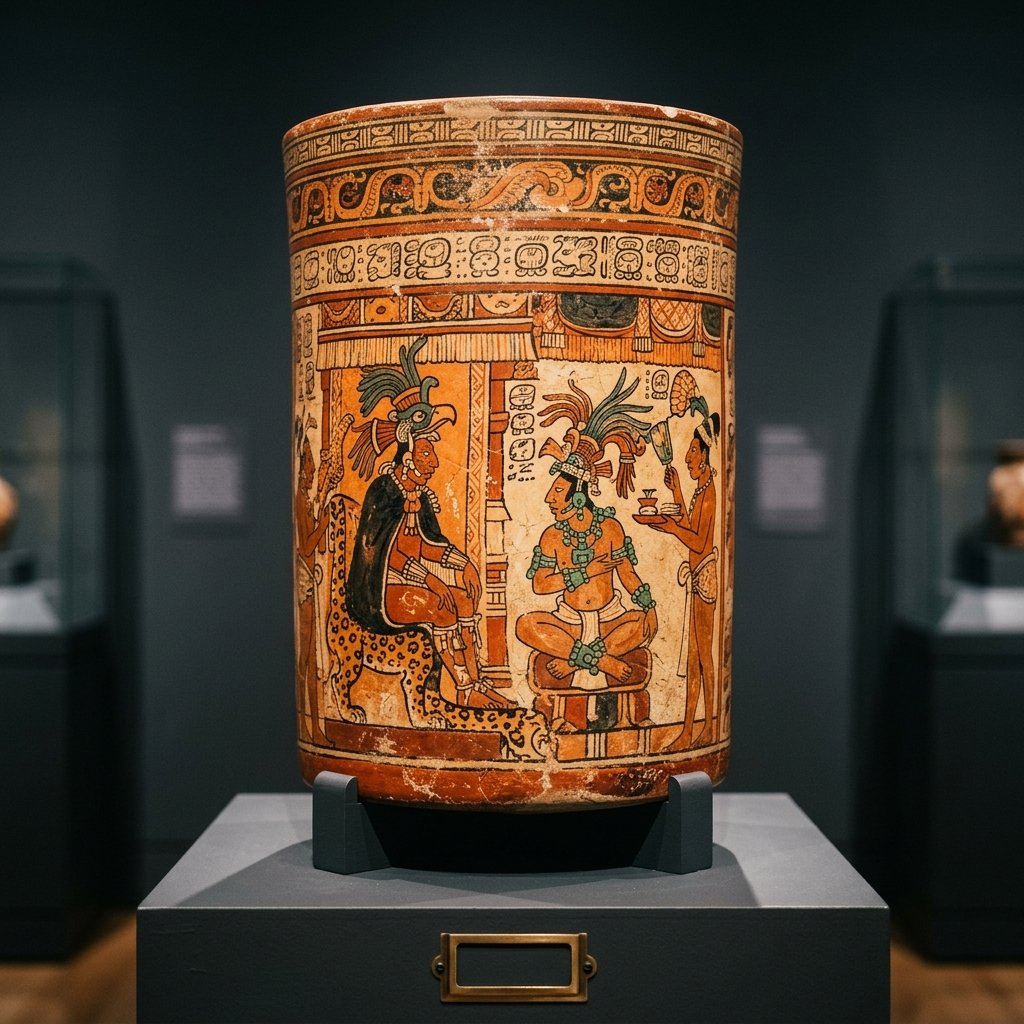
- Painted pottery: Cylindrical vessels with mythological scenes, court presentations, and elaborate rim texts — the largest surviving corpus of Classic Period Maya narrative art (Reents-Budet, Painting the Maya Universe, 1994).
- Bark-paper codices: Folding books made from huun (beaten fig bark) coated with white lime plaster, painted in vivid color. Only four survive.
- Jade, bone, and shell: Precious objects inscribed with the names and titles of kings — often found in royal tombs.
- Stucco and mural painting: Architectural decoration combining text and imagery — the murals at Bonampak are the most famous surviving examples.
The Surviving Codices: What We Almost Lost
The Maya produced thousands of books — vast libraries of astronomical tables, historical records, ritual instructions, medical knowledge, genealogies, and mythology. In the 16th century, Spanish colonial priests — most notoriously Bishop Diego de Landa in 1562 — burned nearly all of them as "works of the devil."
This deliberate destruction ranks among the greatest losses of human knowledge in history. Historian Matthew Restall has compared it to the burning of the Library of Alexandria — with the critical difference that the Maya destruction was intentional (Restall, When Montezuma Met Cortés, 2018).
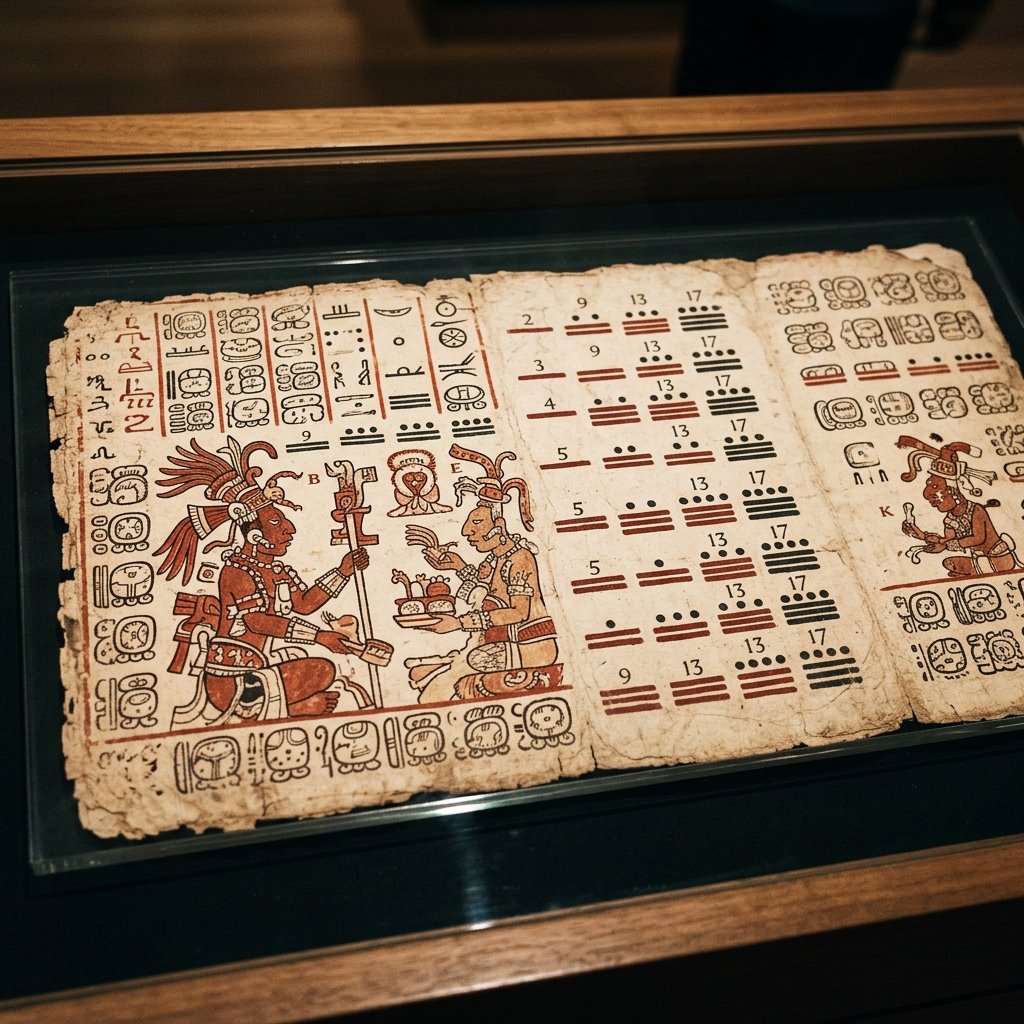
Only four codices survive:
The Dresden Codex
The masterpiece. 74 pages of astronomical tables, prophecies, and ritual almanacs. Its Venus calculations achieve a precision of 0.08 days per 584-day Venus cycle — an error rate of 0.014% over half a millennium. Ernst Förstemann's landmark analysis in the 1880s was the first successful reading of any Maya text.
Location: Saxon State Library, Dresden, Germany.
The Madrid Codex
The longest surviving codex at 112 pages. Contains almanacs for agriculture, hunting, rain-making ceremonies, and beekeeping — a practical handbook for priests managing the agricultural calendar. Its rougher artistic style suggests it was produced for provincial use rather than royal courts (Vail & Aveni, The Madrid Codex, 2004).
Location: Museo de América, Madrid, Spain.
The Paris Codex
Badly deteriorated but priceless. Contains a unique Maya zodiac — 13 constellations associated with the ecliptic — and katun prophecies for 20-year periods. It was rediscovered in 1859 in a basket of old papers at the Bibliothèque nationale de France, having been filed there and forgotten for decades.
Location: Bibliothèque nationale de France, Paris.
The Grolier Codex (Codex Maya de México)
The most controversial. Surfaced in the 1970s via the antiquities market, its authenticity was debated for decades. In 2016, a multidisciplinary team at Brown University — using radiocarbon dating, pigment analysis, and iconographic study — confirmed it as genuine and the oldest known surviving Maya manuscript (~AD 1230). Officially renamed Códice Maya de México in 2018.
Location: Museo Nacional de Antropología, Mexico City.
"We found a large number of books in these characters and, as they contained nothing in which were not to be seen as superstition and lies of the devil, we burned them all, which they regretted to an amazing degree, and which caused them much affliction."
— Bishop Diego de Landa, Relación de las cosas de Yucatán, 1566
The Decipherment: Cold War, Controversy, and Genius
The story of Maya decipherment is one of the most dramatic intellectual detective stories of the modern era. It spans 170 years, two continents, a Cold War divide, and some of the most bitter personal rivalries in the history of science.
The Scribes: Aj Tz'ib
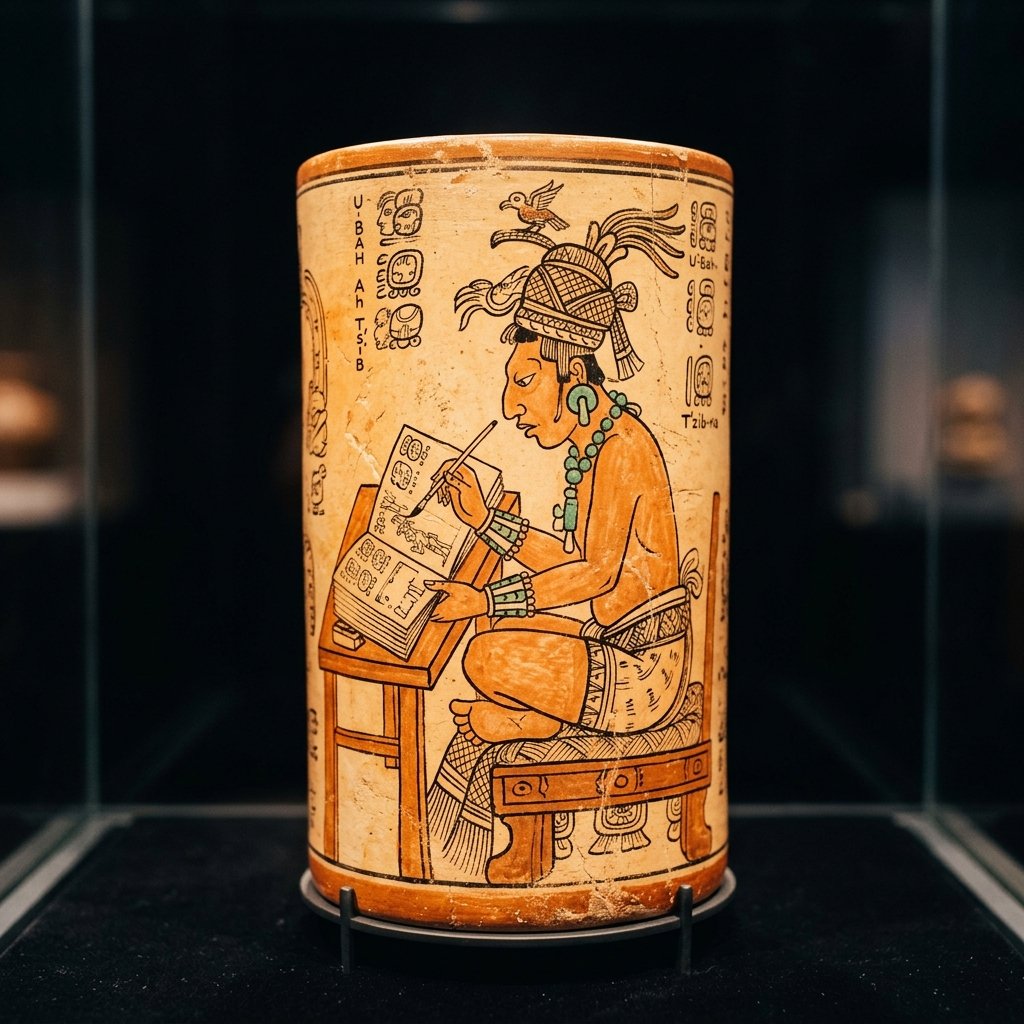
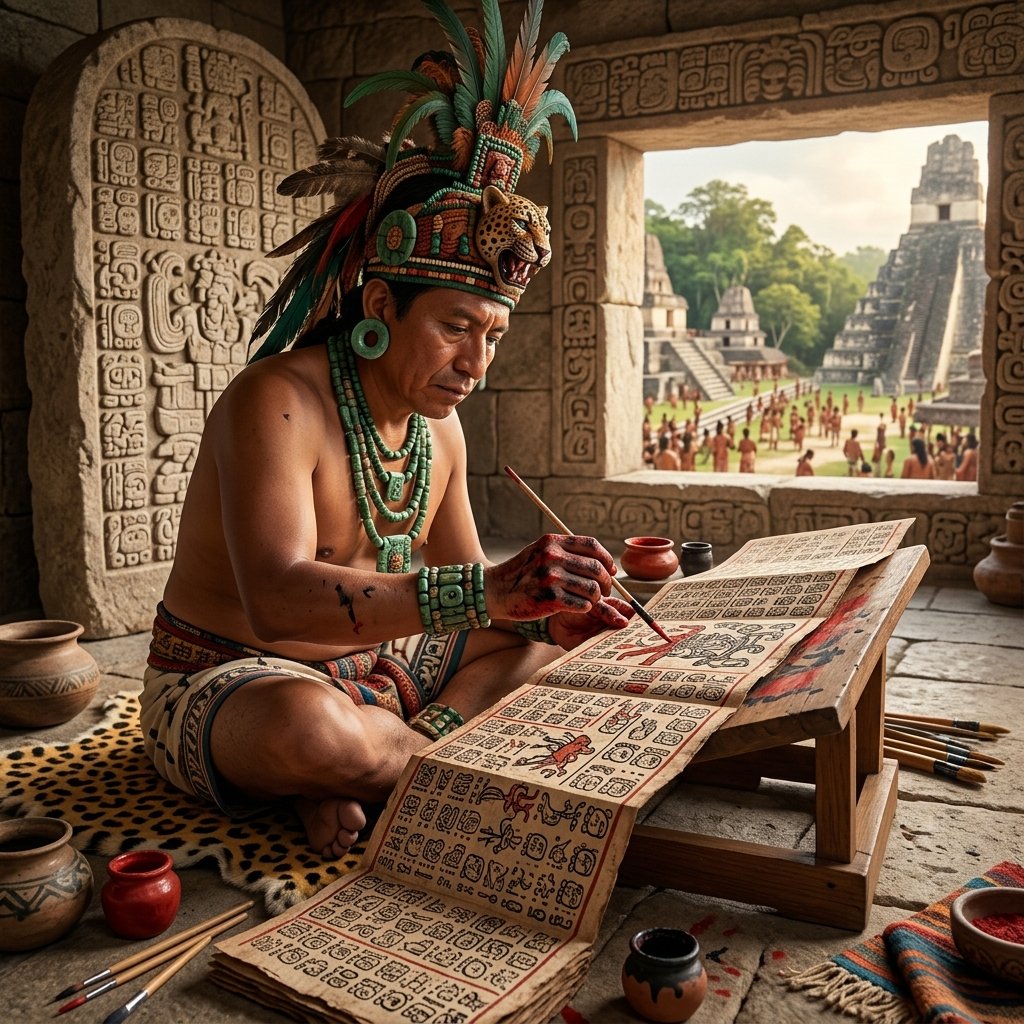
Maya scribes (aj tz'ib, "the one who writes/paints") were members of the highest elite class — often second-sons of kings, royal siblings, or high-ranking nobles. The Classic Maya made no distinction between writing and painting: the same word, tz'ib, covered both activities, and the finest scribes were simultaneously calligraphers, artists, historians, astronomers, and ritual specialists.
Archaeological evidence from special-purpose buildings at Copán and Calakmul suggests that scribes trained in dedicated workshops. Analysis of individual "hands" on painted ceramics has allowed scholars to identify the work of specific master artists across multiple vessels — revealing that some scribes' work was so valued that vessels were traded across hundreds of kilometers (Reents-Budet, 1994).
The social status of scribes is confirmed by their prominent burial treatment. At Aguateca, Guatemala — a site abandoned suddenly during warfare — archaeologists discovered a scribe's workshop complete with paint pots, brushes, and partially finished vessels, preserved in situ like a Maya Pompeii (Inomata, Journal of Field Archaeology, 2003).
The Earliest Known Maya Writing
When did Maya writing begin? The answer keeps getting pushed earlier:
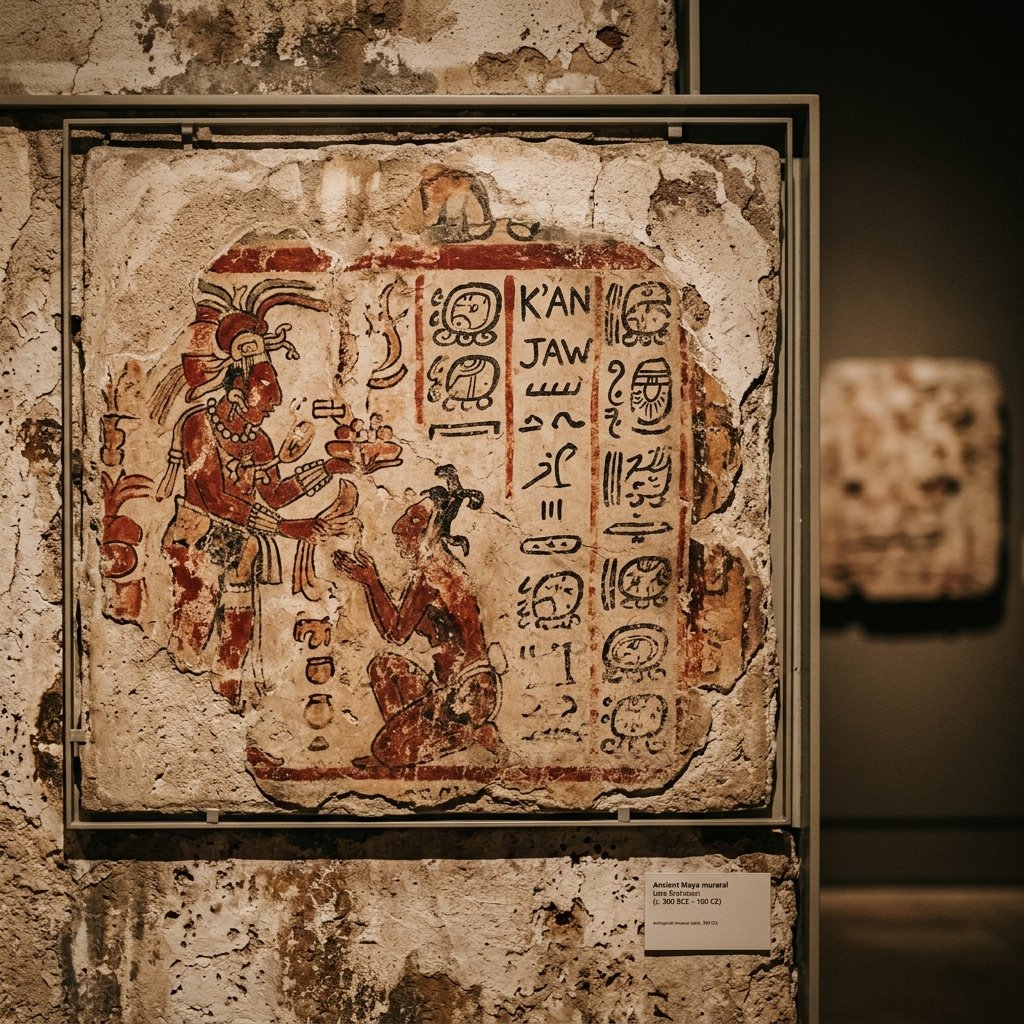
- San Bartolo, Guatemala (~300 BC): The earliest confirmed painted Maya text, discovered by William Saturno in 2001 on the walls of a buried Preclassic pyramid. The text accompanies elaborate mythological murals depicting the Maize God and the Hero Twins (Saturno et al., Science, 2006).
- Kaminaljuyú (~400 BC): Fragmentary inscriptions on stone monuments in the Guatemala highlands suggest earlier writing traditions, though their reading remains contested.
- Cascajal Block (~900 BC): An Olmec inscription from Veracruz — if accepted as writing — would push the origin of Mesoamerican script back to the Early Preclassic, predating any confirmed Maya text by 500+ years (Rodríguez Martínez et al., Science, 2006).
The relationship between Olmec, Zapotec, and Maya writing systems remains one of the great open questions in Mesoamerican epigraphy. Whether the Maya invented their script independently or adapted an earlier tradition — and if so, which one — is actively debated (Houston, 2004).
Numbers & Calendar Glyphs
A special category of Maya writing is the number system — dots (1), bars (5), and shells (zero) — along with the elaborate glyphs for the 20 day signs and 19 months of the calendar system. Calendar glyphs are among the most frequently encountered and visually distinctive Maya signs, and their early decipherment by Förstemann (1880s) and Goodman (1897) provided the foundation for all subsequent epigraphic work.
The Long Count system — which records dates as a count of days from a mythological creation date of August 11, 3114 BC — represents a unique intellectual achievement. No other ancient civilization developed a dating system of comparable precision, range, and consistency. A Maya Long Count date can specify any day within a span of over 5,000 years to a precision of ±0 days.
Frequently Asked Questions
Can anyone learn to read Maya hieroglyphs?
Yes — and the field welcomes new students. The Maya Meetings at the University of Texas at Austin (founded by Linda Schele), the Tulane Maya Symposium, and European Maya Conferences offer workshops for beginners. Mark Pitts's Writing in Maya Glyphs (free online) and John Montgomery's Dictionary of Maya Hieroglyphs are excellent starting points. The key prerequisite is patience: Maya epigraphy rewards sustained study rather than quick memorization.
How many Maya glyphs have been deciphered?
Approximately 80% of the known ~800 signs can now be read with confidence. Some signs have multiple provisional readings that are still debated. The remaining undeciphered signs tend to be rare or appear only in damaged contexts. New glyph readings are published regularly in journals like The PARI Journal and Ancient Mesoamerica.
Why did the Spanish burn Maya books?
Spanish colonial priests, particularly Bishop Diego de Landa in 1562, viewed Maya books as instruments of idolatry — the persistence of pre-Christian religious practice. The auto-da-fé at Maní destroyed an unknown number of codices. Ironically, de Landa's own manuscript — Relación de las cosas de Yucatán — became one of the most important sources for understanding Maya writing, because he recorded (imperfectly) a "Maya alphabet" that Knorosov later used as the key to phonetic decipherment.
Is Maya hieroglyphic writing related to Egyptian hieroglyphs?
No. Despite superficial visual similarities (both are "hieroglyphic" — meaning they use pictorial signs), the two systems are entirely independent inventions separated by thousands of years, thousands of miles, and fundamentally different structural principles. They share the logo-syllabic category, but this reflects convergent evolution in writing systems rather than historical connection. The Maya script's closest relatives, if any, are the earlier Mesoamerican systems (Olmec, Zapotec, Epi-Olmec).
References & Further Reading
- Coe, M. D. (1992). Breaking the Maya Code. Thames & Hudson. (The definitive history of decipherment.)
- Houston, S. D., Stuart, D., & Robertson, J. (2004). "The Language of Classic Maya Inscriptions." Current Anthropology, 45(3), 321–356.
- Stuart, D. (2005). The Inscriptions from Temple XIX at Palenque. Pre-Columbian Art Research Institute.
- Martin, S. & Grube, N. (2000). Chronicle of the Maya Kings and Queens. Thames & Hudson.
- Reents-Budet, D. (1994). Painting the Maya Universe: Royal Ceramics of the Classic Period. Duke University Press.
- Saturno, W. A., Stuart, D., & Beltrán, B. (2006). "Early Maya Writing at San Bartolo, Guatemala." Science, 311(5765), 1281–1283.
- Bricker, H. M. & Bricker, V. R. (2011). Astronomy in the Maya Codices. American Philosophical Society.
- Knorosov, Y. V. (1952). "Ancient Writing of Central America." Sovetskaya Etnografiya, 3, 100–118.
- Rodríguez Martínez, M. C., et al. (2006). "Oldest Writing in the New World." Science, 313(5793), 1610–1614.
- Restall, M. (2018). When Montezuma Met Cortés. Ecco/HarperCollins.
- Vail, G. & Aveni, A. (2004). The Madrid Codex: New Approaches to Understanding an Ancient Maya Manuscript. U Press of Colorado.
- Inomata, T. (2003). "War, Destruction, and Abandonment: The Fall of the Classic Maya Center of Aguateca." Journal of Field Archaeology, 28(3/4), 261–276.