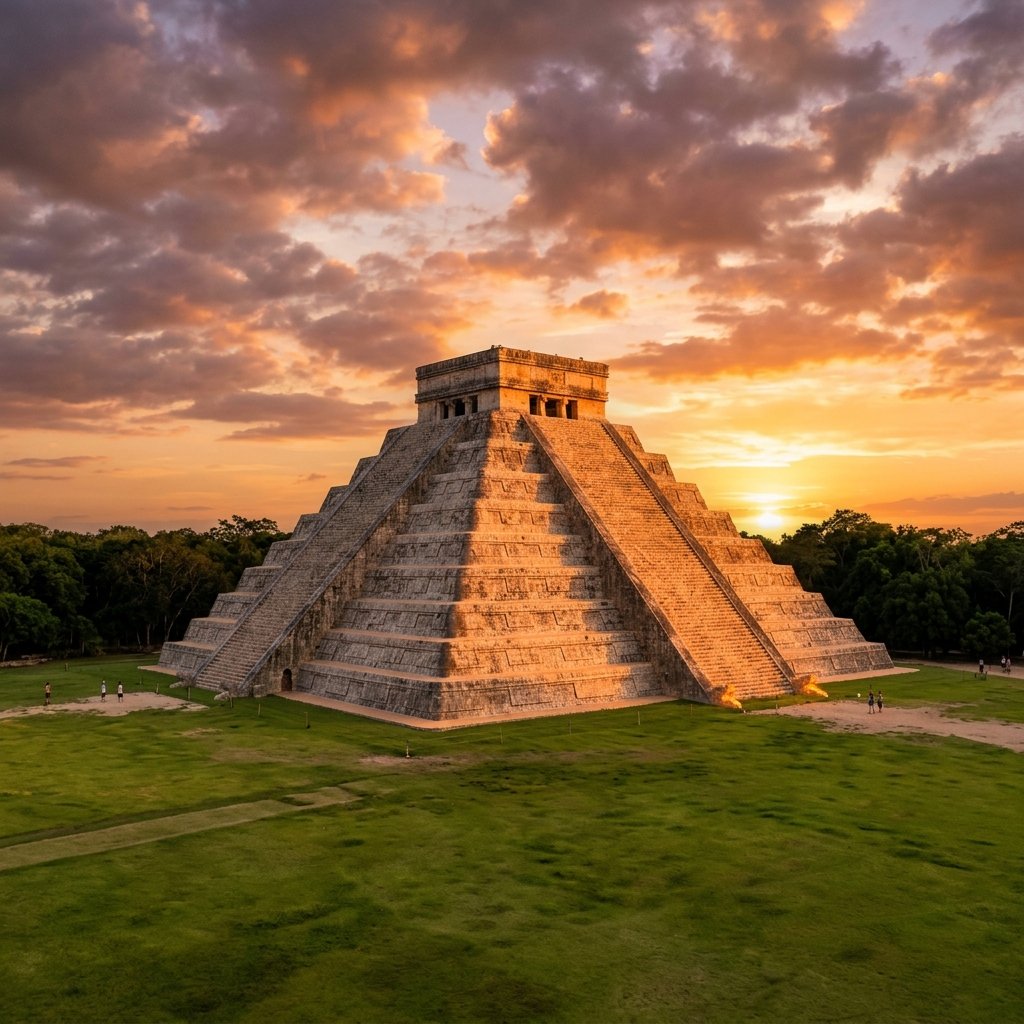
Chichén Itzá at a Glance
Why Chichén Itzá Matters
Chichén Itzá is not merely the most famous Maya ruin — it is one of the most significant archaeological sites on Earth. At its peak between 900 and 1100 AD, the city was among the largest urban centers in the pre-Columbian Americas, dominating the political and economic landscape of the northern Yucatán Peninsula. Estimates suggest that the greater Chichén Itzá metropolitan area may have supported 35,000 to 50,000 people at its height — roughly comparable to contemporaneous London (Cobos, Arqueología Mexicana, 2004).
What makes Chichén Itzá extraordinary is not just its scale but its integration. The city's architects didn't simply build monuments — they encoded astronomical observations, mathematical relationships, and cosmological meaning into every stone. The result is a city that functions simultaneously as a calendar, an observatory, a political statement, and a sacred landscape. There is nothing else quite like it in the ancient world.
The site also represents one of the great cultural puzzles of Mesoamerica. Its architecture blends traditional Maya Puuc-style design with elements long attributed to the Toltec civilization of central Mexico — feathered serpent columns, chacmool figures, skull racks (tzompantli). For decades, scholars assumed Toltec invaders had conquered the city. More recent research, however, suggests a more nuanced reality: a cosmopolitan city that absorbed influences from across Mesoamerica through trade, pilgrimage, and political alliance rather than conquest (Ringle, Gallareta Negrón & Bey, Latin American Antiquity, 1998).
The Architecture: A City Built to Encode the Cosmos
El Castillo (Temple of Kukulkán)
The iconic step pyramid stands 24 meters tall — nine terraced platforms topped by a temple reached by four staircases, one on each face. The numerical symbolism is deliberate and widely documented:
- 91 steps × 4 sides + 1 top platform = 365 — the days of the solar year (Haab')
- 9 terraces, split by stairways into 18 — the months of the Maya solar calendar
- 52 panels on each face — the years in the Maya Calendar Round
Recent ground-penetrating radar and LiDAR surveys have revealed that El Castillo is actually a Russian nesting doll of pyramids. Beneath the visible outer structure lies an earlier, smaller pyramid (discovered in 1931), and beneath that, a third even older structure was identified in 2016 by researchers from the Universidad Nacional Autónoma de México (UNAM) using electrical resistivity tomography. This innermost pyramid, approximately 10 meters tall, may date to the earliest phase of the city's construction — perhaps 550–800 AD (Barrera & Campillo, UNAM Geophysics Institute, 2016).
One of the more astonishing acoustic properties was documented by acoustician David Lubman: when you clap your hands at the base of El Castillo, the echo that returns is not a simple reflection but a chirped frequency response that mimics the call of the quetzal bird — the sacred animal of Mesoamerica. Whether this was intentional or a fortunate acoustic accident remains debated, but the mathematical precision of the staircase geometry makes coincidence seem unlikely (Lubman, Journal of the Acoustical Society of America, 1998).
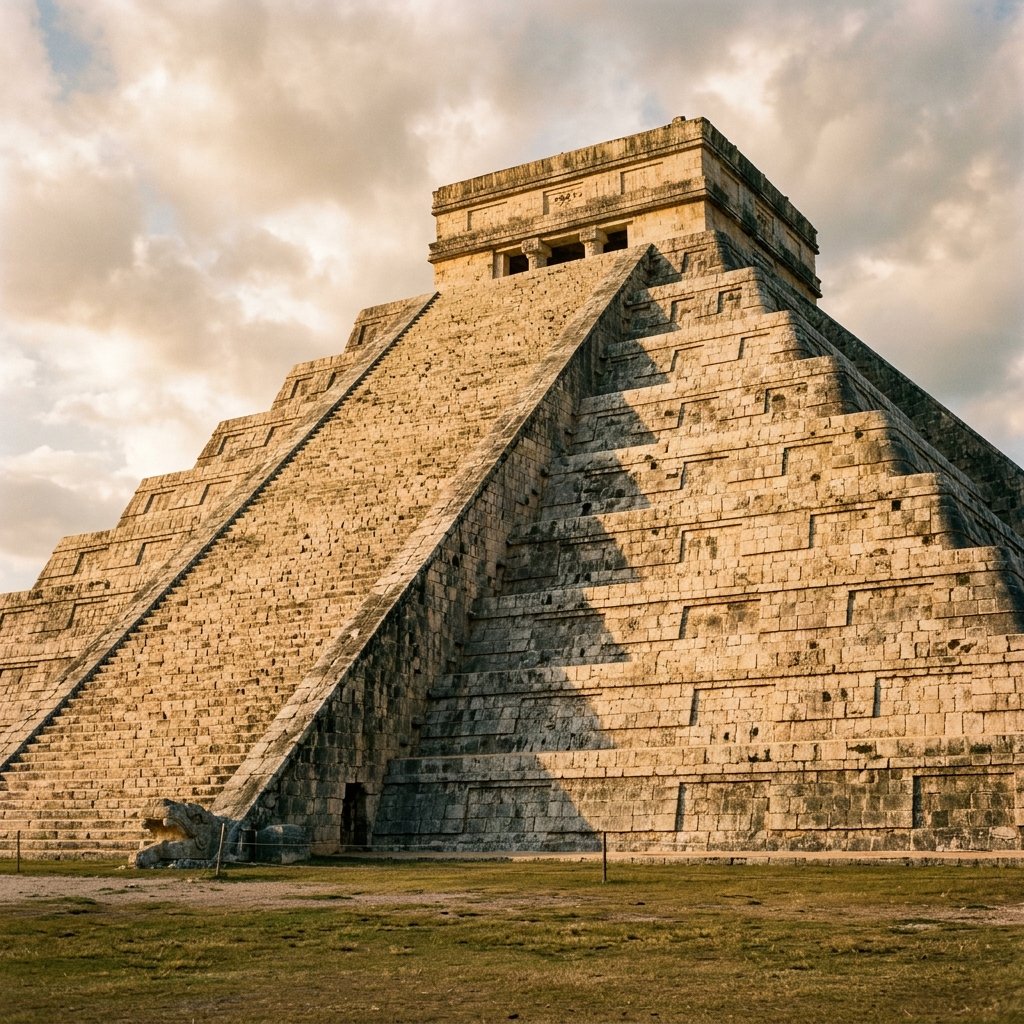
The equinox light serpent — seven triangular shadows descend the northern balustrade to meet the carved serpent head, creating the illusion of Kukulkán descending from the heavens. This astronomical alignment is achieved only twice per year.
The Great Ball Court
The juego de pelota at Chichén Itzá is the largest ball court ever built in the ancient Americas — 168 meters long and 70 meters wide, with vertical walls rising 8 meters on each side. The stone scoring rings mounted 6 meters up the walls presented an almost impossibly difficult target for the heavy rubber ball, which players could strike only with their hips, forearms, and knees (Taladoire, The Architectural Background of the Pre-Hispanic Ballgame, 2001).
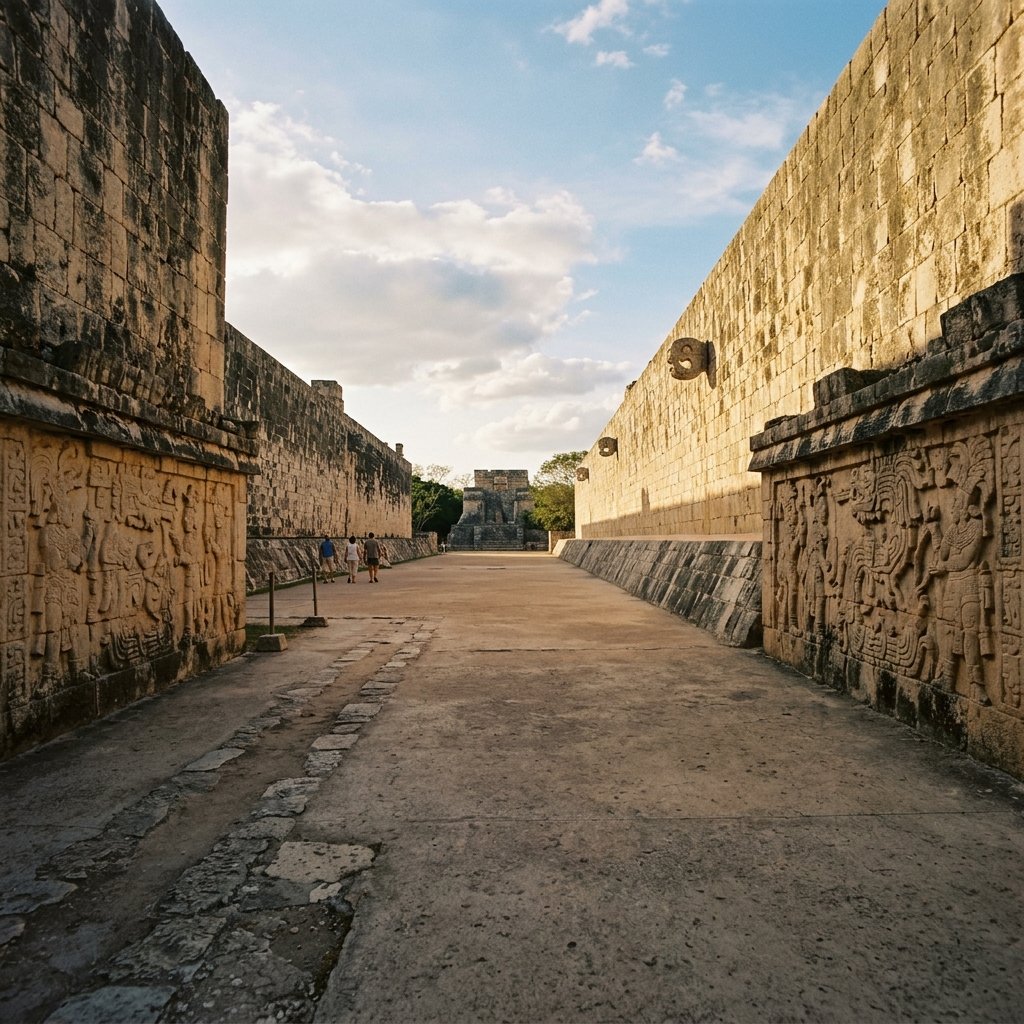
The Great Ball Court — 168 meters long with 8-meter walls. The carved panels at the base depict the ritual decapitation of a ball player, with serpents of blood sprouting from the severed neck as fertility symbols. The acoustics allow a whisper to carry the full length.
The court's acoustic properties are legendary and scientifically documented. A person speaking in a normal voice at one end can be clearly heard 150 meters away at the other — an effect created by the parallel limestone walls and their particular curvature. Acoustic engineers have confirmed that the court functions as a massive whispering gallery, and the effect appears to be deliberate rather than incidental (Declercq & Dekeyser, Journal of the Acoustical Society of America, 2004).
The carved relief panels running along the lower walls are among the finest examples of Maya sculptural art anywhere. They depict elaborately costumed players in the midst of the ritual ball game, including the famous scene of decapitation — a defeated player kneels while serpents of blood erupt from his severed neck, transforming into vines bearing flowers and fruit. This is not gratuitous violence; it is sacrifice as regeneration — death feeding life — a concept central to Maya cosmology (Miller & Houston, Maya Art and Architecture, 2015).
The Sacred Cenote
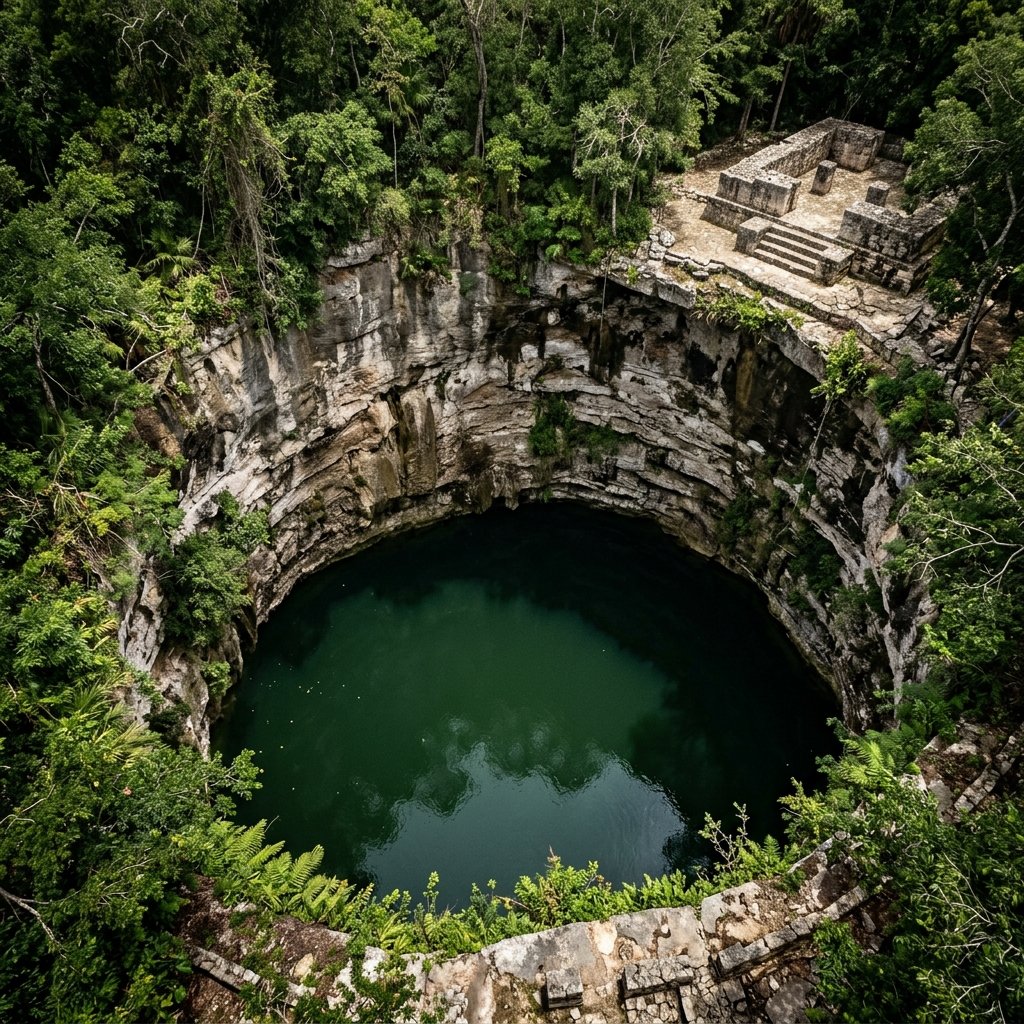
The Sacred Cenote — 60 meters in diameter, with sheer limestone walls dropping to dark waters below. For centuries, the Maya cast offerings of gold, jade, incense, and human sacrifice into this portal to Xibalba, the underworld.
The Cenote Sagrado is a massive natural sinkhole — roughly 60 meters in diameter with vertical limestone walls plunging approximately 27 meters to the dark green water below. A processional sacbé (raised white road) 300 meters long connects the cenote directly to El Castillo, confirming its central role in the city's ritual geography.
Between 1904 and 1911, American consul and amateur archaeologist Edward Herbert Thompson dredged the cenote, recovering an extraordinary collection of offerings: gold discs with repoussé scenes of warfare, jade ornaments, carved bone, copal incense, pottery, obsidian blades, rubber figurines, and human skeletal remains — including those of children, adults, and several individuals with evidence of blunt-force trauma consistent with ritual sacrifice (Coggins & Shane, Cenote of Sacrifice, Peabody Museum Press, 1984).
Later investigations by the National Geographic Society and INAH (Mexico's National Institute of Anthropology and History) recovered additional objects and confirmed that offerings spanned several centuries, from approximately 800 AD to well after the Spanish contact period. Gold objects traced to Colombia, Costa Rica, and Panama attest to the long-distance trade networks that connected Chichén Itzá to cultures across Central America and beyond (Lothrop, Metals from the Cenote of Sacrifice, 1952).
El Caracol (The Observatory)
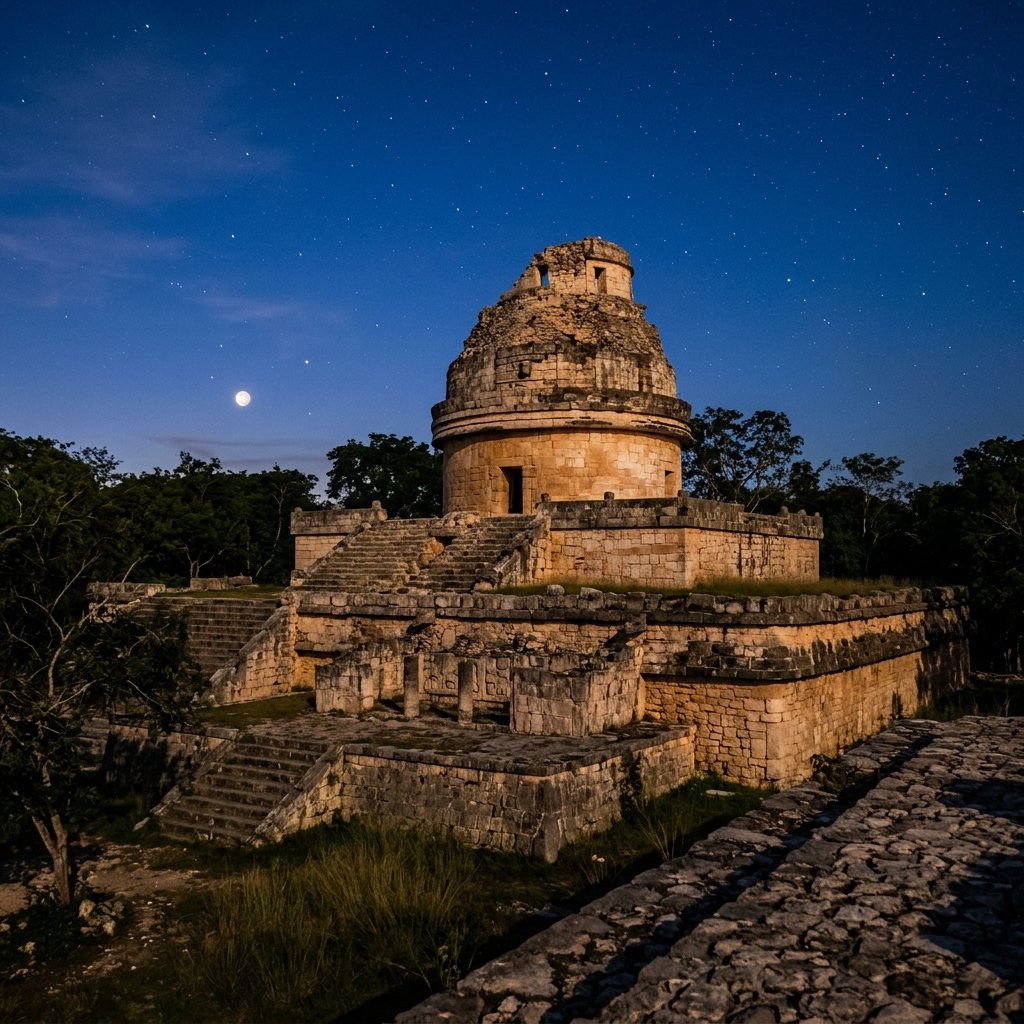
El Caracol — "The Snail" — named for its internal spiral staircase. The tower's window slits are precisely aligned with the extreme positions of Venus on the horizon, allowing Maya astronomers to track the planet's 584-day cycle with extraordinary accuracy.
El Caracol — named for its internal spiral staircase (caracol means "snail" in Spanish) — is architecturally unique in the Maya world. Its circular tower set atop rectangular platforms looks startlingly like a modern observatory, and that is precisely what it was.
Archaeoastronomer Anthony Aveni demonstrated that the surviving window openings in the upper tower are aligned with specific astronomical events — most importantly the extreme northerly and southerly settings of Venus on the horizon. The Maya tracked Venus obsessively: their calculation of its 584-day synodic cycle was accurate to within 2 hours over a 481-year period (Aveni, Skywatchers of Ancient Mexico, University of Texas Press, 2001). The tables in the Dresden Codex record Venus data that rival anything achieved before the invention of the telescope.
Venus was not merely an academic curiosity. The Maya associated Venus with warfare — its first appearance as the Morning Star after inferior conjunction was considered an omen of cosmic aggression, and military campaigns were explicitly timed to coincide with Venus events. The carvings at Chichén Itzá include numerous depictions of warriors associated with Venus iconography, suggesting the city's military power was ideologically linked to its astronomical expertise (Schele & Freidel, A Forest of Kings, 1990).
The Equinox Light Serpent: Architecture as Astronomy
Twice a year — on the spring equinox (around March 20) and the autumn equinox (around September 22) — the setting sun creates a pattern of seven triangular shadows along the northern balustrade of El Castillo. These shadows connect with the carved serpent head at the base to create the breathtaking illusion of a massive feathered serpent undulating down the pyramid's stairway — Kukulkán descending from heaven to earth.
This is not an accident. The Maya architects calculated the exact angle, orientation, and dimensions of every terrace to produce this specific light effect on these specific days. Archaeoastronomer E.C. Krupp has noted that the alignment demonstrates "an intentional and sophisticated understanding of the geometry of light and shadow" — the pyramid is, in effect, a massive sundial calibrated to the solar year (Krupp, Echoes of the Ancient Skies, Dover, 2003).
The equinox events draw tens of thousands of visitors. What fewer visitors know is that a similar (though less dramatic) serpent effect occurs for several days before and after the actual equinox, making the quieter surrounding days an ideal time to witness the phenomenon without crushing crowds.
The Toltec Question: Conquest or Collaboration?
Chichén Itzá's architecture presents a puzzle that has occupied Mesoamerican scholars for over a century. The site's northern sector — including El Castillo, the Great Ball Court, the Temple of the Warriors, and the Tzompantli (Skull Rack) — features iconography and architectural elements traditionally associated with the Toltec civilization of central Mexico (centered at Tula, Hidalgo): feathered serpent columns, chacmool reclining figures, atlantean warrior columns, and militaristic imagery emphasizing eagles and jaguars devouring human hearts.
The traditional interpretation, championed by ethnohistorian Alfred Tozzer, proposed that Toltec warriors conquered Chichén Itzá around 987 AD and imposed their architectural style on the city (Tozzer, Chichen Itza and Its Cenote of Sacrifice, Peabody Museum, 1957). This narrative aligned conveniently with Aztec legends of the god-king Quetzalcoatl/Kukulkán being exiled from Tula and traveling east.
However, modern radiocarbon dating and epigraphic evidence have complicated this picture considerably. Ceramic chronologies now suggest that many "Toltec" features at Chichén Itzá may actually predate their counterparts at Tula — meaning the influence may have flowed from the Maya to the Toltecs, not the other way around (Lincoln, Ethnicity and Social Organization at Chichen Itza, 1994). Other scholars propose a more complex model: a shared international style spread through trade and religious networks rather than military conquest, similar to how Gothic architecture spread across medieval Europe without requiring armies (Ringle et al., Latin American Antiquity, 1998).
The debate remains one of the most fascinating unresolved questions in Mesoamerican archaeology.
What Lies Beneath: Recent Discoveries
In 2015, investigators discovered a massive subterranean cenote directly beneath El Castillo using electrical resistivity tomography. The natural sinkhole — approximately 20 meters in diameter — sits under the pyramid's foundation, suggesting the Maya deliberately built the pyramid over a sacred water source. This discovery, announced by UNAM geophysicist René Chávez Segura, reframed El Castillo not merely as a temple-pyramid but as a cosmological axis — a structure literally connecting the underworld (the cenote), the earth (the plaza), and the heavens (the temple) (Chávez Segura et al., Geophysics Institute UNAM, 2015).
In 2018, the Gran Acuífero Maya project discovered the longest underwater cave system in the world — the Sac Actun system at 347 kilometers — in the aquifer beneath the Yucatán. This subterranean water network connected cenotes across the peninsula, and likely played a role in the Maya's understanding of the underworld Xibalba as an interconnected aquatic realm beneath their feet.
Practical Travel Tips
Best Time to Visit
Arrive at 8:00 AM when gates open to beat the heat and cruise-ship crowds. November–February offers the most comfortable weather. The equinoxes (March/September) are magical but extremely crowded — consider visiting a day or two either side for the same effect with far fewer people.
Getting There
2 hours from Cancún, 1.5 hours from Mérida, 2.5 hours from Tulum by car. ADO buses run frequently from all major Yucatán cities. Renting a car gives you the freedom to arrive at opening and combine with nearby Cenote Ik Kil or the colonial town of Valladolid.
Pro Tips
Bring water, sunscreen, and a hat — shade is limited on the main plaza. Hire a licensed local guide (available at the entrance for ~800 MXN) for historical context that signs cannot provide. Allow 3–4 hours minimum. The UNESCO bookshop near the exit has excellent scholarly publications.
Night Show
Chichén Itzá offers a light-and-sound show several evenings per week, projecting imagery and narration onto El Castillo. It's spectacular and worth seeing if you're staying in nearby Valladolid or Pisté. Tickets are sold separately from daytime admission.
Visitor Comparison
| Feature | Chichén Itzá | Ek Balam | Cobá |
|---|---|---|---|
| Can climb pyramids? | ❌ No | ✅ Yes (to the top) | ✅ Yes (Nohoch Mul) |
| Crowd Level | Very High | Low | Moderate |
| From Cancún | 2 hrs | 2.5 hrs | 2.5 hrs |
| Best Feature | El Castillo / Equinox | Stucco Frieze / Views | Tallest Pyramid / Sacbé |
| Time Needed | 3–5 hrs | 2–3 hrs | 2–4 hrs |
Key Academic References
- Aveni, Anthony F. Skywatchers of Ancient Mexico. University of Texas Press, 2001.
- Cobos, Rafael. "Chichén Itzá: Settlement and Hegemony During the Terminal Classic Period." Arqueología Mexicana, 2004.
- Coggins, Clemency & Shane, Orrin C. Cenote of Sacrifice: Maya Treasures from the Sacred Well at Chichén Itzá. Peabody Museum Press, 1984.
- Declercq, N.F. & Dekeyser, C.S.A. "Acoustic diffraction effects at the Hellenistic amphitheatre of Epidaurus." Journal of the Acoustical Society of America, 2004.
- Krupp, E.C. Echoes of the Ancient Skies: The Astronomy of Lost Civilizations. Dover, 2003.
- Lincoln, Charles E. Ethnicity and Social Organization at Chichen Itza. Harvard University, 1994.
- Lothrop, Samuel K. Metals from the Cenote of Sacrifice, Chichen Itza, Yucatan. Peabody Museum, 1952.
- Lubman, David. "Archaeological acoustic study of chirped echo from the Mayan pyramid at Chichén Itzá." JASA, 1998.
- Miller, Mary Ellen & Houston, Stephen D. Maya Art and Architecture. Thames & Hudson, 2015.
- Ringle, W., Gallareta Negrón, T. & Bey, G. "The Return of Quetzalcoatl." Latin American Antiquity, 9(3), 1998.
- Schele, Linda & Freidel, David. A Forest of Kings: The Untold Story of the Ancient Maya. William Morrow, 1990.
- Tozzer, Alfred M. Chichen Itza and Its Cenote of Sacrifice. Peabody Museum of Archaeology and Ethnology, 1957.
Frequently Asked Questions
Can you climb El Castillo?
No. Climbing has been prohibited since 2006 to protect the structure and for visitor safety after a tourist fell to her death. However, you can walk around the pyramid's entire base and get remarkably close. If climbing is important to you, visit Ek Balam or Cobá — both allow climbing and are within 2 hours.
Is Chichén Itzá worth visiting despite the crowds?
Absolutely. The architectural precision, astronomical alignments, and sheer ambition of this city are genuinely awe-inspiring regardless of crowd size. The key is timing: arrive at 8 AM to have the first hour nearly to yourself before tour buses arrive from Cancún around 10 AM. Late afternoon (after 3 PM) is also quieter.
What is the quetzal chirp at El Castillo?
When you clap your hands at the base of El Castillo, the echo returns as a distinctive chirping sound that closely resembles the call of the resplendent quetzal bird — the most sacred animal in Mesoamerica. Acoustician David Lubman documented this phenomenon and the debate continues over whether it was deliberately engineered by Maya architects or a fortuitous acoustic coincidence.
How much time do I need?
Minimum 3 hours, but 4–5 hours is ideal to see the full site including El Caracol, the Sacred Cenote, the Nunnery quadrangle, and the Ossuary. Rush visits of 1–2 hours (common with Cancún bus tours) don't do the site justice. Consider combining with nearby Cenote Ik Kil (15 min) or the colonial town of Valladolid (40 min).
Is there a pyramid inside El Castillo?
Yes — two of them. An earlier, smaller pyramid was discovered inside El Castillo in 1931, complete with a jade-studded jaguar throne and a Chaac Mool figure. In 2016, UNAM researchers discovered a third, even older structure at the core, likely dating to the city's earliest period. The pyramid also sits directly above a natural cenote, connecting the underworld to the heavens.