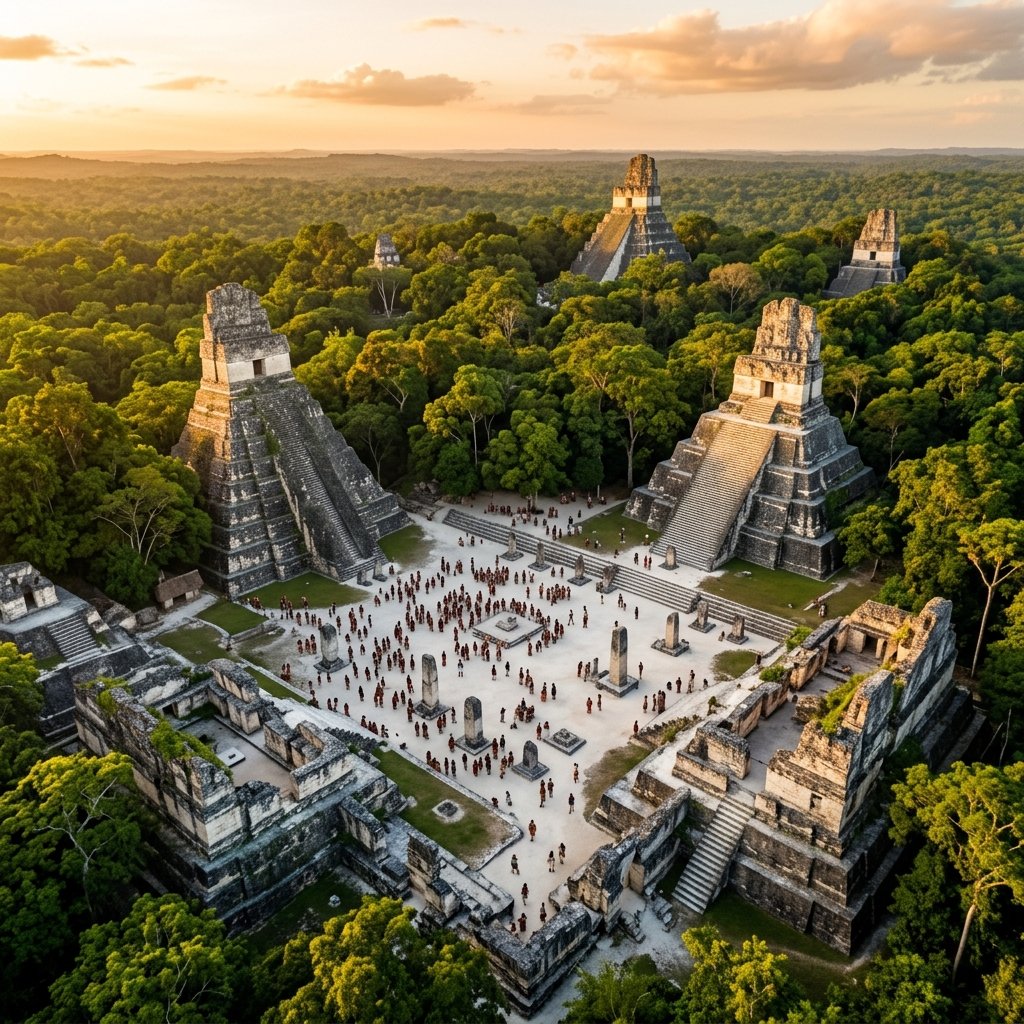
The Maya Plaza at a Glance
The Heart of the Maya City
Every Maya city, from the smallest village to the greatest metropolis, was organized around its plaza — an open, flat, white-plastered space that served as the stage for all public life. The plaza was where kings were crowned, where captives were sacrificed, where markets operated, where the ball game was played, and where the entire community gathered for ceremonies tied to the Maya calendar.
To walk into a Maya plaza was to enter the most carefully designed space in the city. The surrounding buildings were not randomly placed — they were arranged according to cosmological principles. Temple pyramids marked the cardinal directions. The royal palace typically occupied the most prominent position. Stelae and altars dotted the plaza floor at specific points, each marking a ritual station. The entire complex was a three-dimensional map of the Maya cosmos (Ashmore, W. & Sabloff, J., "Spatial Orders in Maya Civic Plans," Latin American Antiquity, vol. 13, 2002, pp. 201–215).
The Great Plaza at Tikal
The most iconic Maya plaza is the Great Plaza at Tikal, Guatemala. Flanked by Temple I (Temple of the Great Jaguar, 47 meters) on the east and Temple II (Temple of the Masks, 38 meters) on the west, with the North Acropolis (a complex of royal tombs spanning 1,500 years) along the northern edge, the Great Plaza is one of the most photographed archaeological spaces on earth.
The plaza was paved with thick limestone plaster that would have been brilliantly white under the tropical sun — a blinding, reflective surface designed to amplify the visual impact of ceremonies. Dozens of carved stelae and altars line the plaza, recording the histories of Tikal's kings across centuries. Standing in the Great Plaza today, even in its weathered state, conveys a visceral sense of the power and ambition of Classic Maya rulers.
How Plazas Were Built
Maya plazas were not simply cleared patches of ground. They were engineered landscapes:
- Leveling: The natural terrain was excavated and filled to create a perfectly flat surface — sometimes raising the plaza several meters above the surrounding ground.
- Paving: Multiple layers of limestone plaster (sascab) were applied, creating a hard, smooth, white surface 10–30 cm thick. This plaster was made by burning limestone in kilns and mixing the quickite with water — the same basic process used to make Portland cement.
- Drainage: Sophisticated drainage systems channeled rainwater from the plaza surface into underground cisterns (chultunes) — critical for water storage in the porous limestone terrain of the lowlands.
- Resurfacing: Plazas were periodically re-plastered, with each new layer sealed over the previous one. At Tikal, excavations have revealed up to eight successive plaza floors, spanning centuries of use.
The Plaza as Stage
The ritual function of the plaza was fundamentally theatrical. Maya ceremonies were spectacles designed to be witnessed by the entire community:
- Royal accessions: When a new king ascended the throne, the ceremony took place in the main plaza, visible to thousands. The king received the royal headband, the jade regalia, and the scepter of authority while standing atop a pyramid or platform at the plaza's edge.
- Captive sacrifice: Defeated enemy lords were publicly humiliated and sacrificed in the plaza — their deaths witnessed by the population as proof of the king's power and the gods' favor.
- Period endings: The completion of major calendar periods (K'atun and Bak'tun endings) were marked by elaborate plaza ceremonies including the erection of new stelae, fire-drilling rituals, and mass offerings.
- Dance: Royal dances — performed in elaborate costumes depicting gods, ancestors, and supernatural creatures — were plaza spectacles of extraordinary visual complexity. The dancers' movements re-enacted mythological events, literally bringing the gods into the human world through performance.
Markets and Daily Life
Not all plaza activity was ritual. Recent archaeological evidence — including chemical residue analysis and artifact distribution studies — confirms that plazas served as marketplaces. At Chichén Itzá, a large structure adjacent to the main plaza has been identified as a market hall. At Tikal, studies of soil chemistry in plaza areas revealed concentrations of trace elements consistent with food preparation and exchange.
Plazas were where ordinary Maya people experienced their city. While royal rituals on the pyramids above were visible, the plaza floor was where community life happened: trading goods, exchanging news, and participating in public ceremonies that bound the population to their king and to the cosmic order.
Frequently Asked Questions
What was the Maya plaza?
The central public space of every Maya city — a white-plastered, flat, open area surrounded by temple pyramids, palaces, and administrative buildings. It served as the stage for royal rituals, markets, political assemblies, and public spectacles including sacrifice. The Great Plaza at Tikal is the most famous example.
Why were Maya plazas painted white?
Plazas were surfaced with white limestone plaster (sascab), creating a brilliantly reflective surface. The whiteness emphasized purity, sacredness, and visual impact — ceremonies against this backdrop would have been dramatic spectacles. The plaster also served practical purposes, channeling rainwater into underground cisterns.
How big were Maya plazas?
They varied widely. The Great Plaza at Tikal covers approximately 13,000 square meters. El Mirador's Preclassic plazas are even larger. Even small Maya settlements had formal plazas, reflecting the universal importance of communal public space in Maya urban design.
Scholarly References
- Ashmore, W. & Sabloff, J. "Spatial Orders in Maya Civic Plans." Latin American Antiquity, vol. 13, 2002, pp. 201–215.
- Coe, W.R. Tikal: A Handbook of the Ancient Maya Ruins. University of Pennsylvania Museum, 1988.
- Inomata, T. "The Power and Ideology of Artistic Creation: Elite Craft Specialists in Classic Maya Society." Current Anthropology, vol. 42, 2001, pp. 321–349.
- Chase, A.F. & Chase, D.Z. "Ancient Maya Markets and the Economic Integration of Caracol, Belize." Ancient Mesoamerica, vol. 25, 2014, pp. 239–250.