Key Takeaway
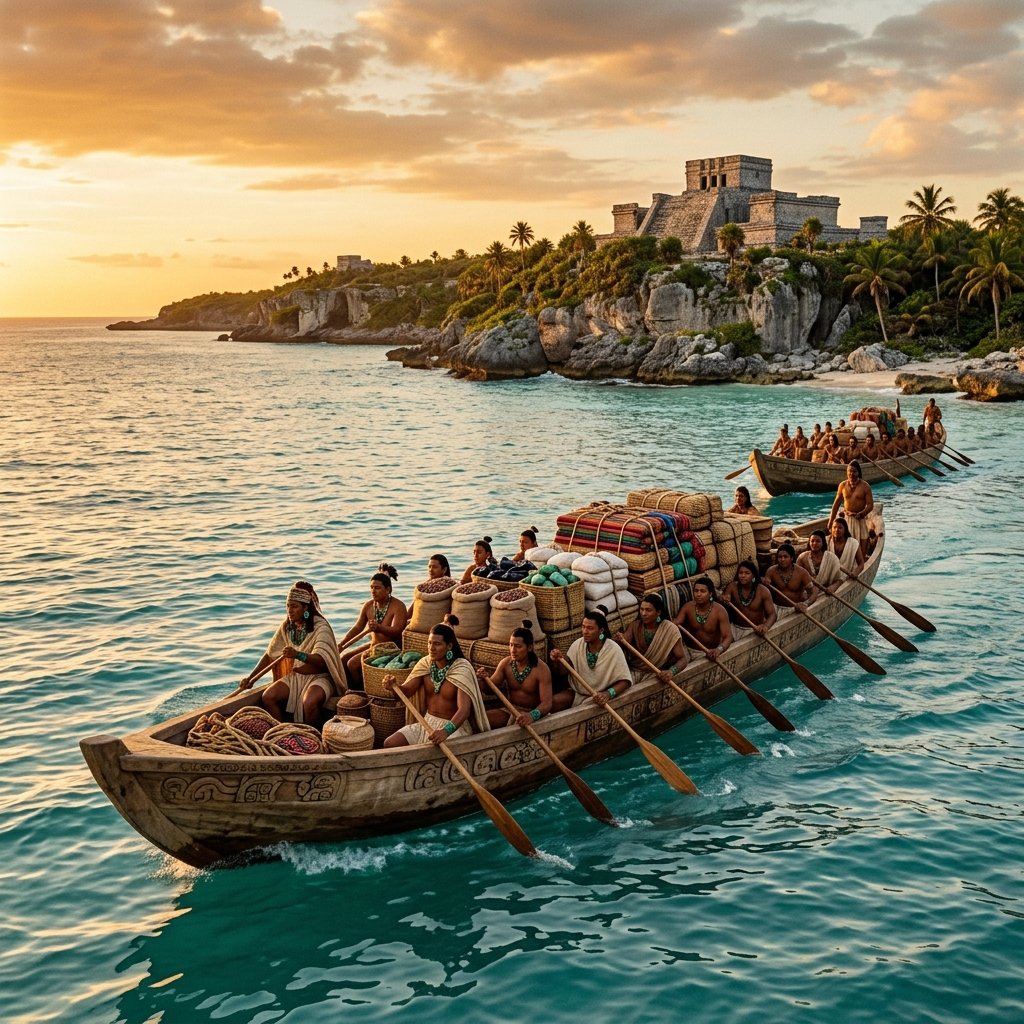
Maya trade was not simple barter between villages. It was a multi-tiered commercial system involving long-distance luxury goods networks (jade, obsidian, quetzal feathers), regional market exchange (pottery, salt, cotton), and local household provisioning — all operating without wheeled vehicles, draft animals, or metal currency. The scale of Maya maritime commerce in particular surprised researchers: Columbus encountered a Maya trading canoe in 1502 carrying 25 people and tonnes of merchandise.
Columbus Meets the Maya Traders
On his fourth voyage in 1502, Christopher Columbus encountered a massive Maya trading canoe near the Bay Islands of Honduras. His son Ferdinand recorded the encounter: a vessel "as long as a galley and eight feet wide," propelled by 25 paddlers, with an amidships cabin shading the cargo from sun and rain. The merchandise included cacao beans, copper bells, obsidian-edged weapons, cotton mantles, and a fermented drink called balché.
Columbus was apparently so preoccupied with finding a passage to Asia that he failed to grasp the significance of what he was seeing — an organized, large-scale commercial network operating across hundreds of kilometers of open water. As ethnohistorian Anthony Andrews noted, this was the first and last time a European personally witnessed the Maya maritime trade system in full operation (Andrews, The Salt Trade of the Ancient Maya, 1983).
Major Trade Goods
| Commodity | Source Region | Trade Distance | Significance |
|---|---|---|---|
| Obsidian | Guatemala & Mexico highlands | 500–1,200 km | Razor-sharp tools and weapons; chemically traceable to specific volcanic sources |
| Jade | Motagua Valley, Guatemala | 300–1,000 km | Most valued luxury material; royal regalia and burial goods |
| Cacao | Soconusco, Tabasco, Belize | 200–800 km | Currency, elite beverage, and tribute commodity |
| Salt | Northern Yucatán coast | 100–600 km | Dietary necessity; industrial-scale salt works at coastal sites |
| Quetzal feathers | Guatemala cloud forests | 200–500 km | Royal headdresses; worth more than gold by weight |
| Marine shell | Caribbean & Pacific coasts | 50–400 km | Spondylus shell for elite ornaments; conch trumpets |
Obsidian: The Traceable Commodity
Obsidian is the archaeologist's ideal trade good — each volcanic source produces obsidian with a unique chemical "fingerprint" detectable through neutron activation analysis (NAA) or X-ray fluorescence (XRF). This allows researchers to match artifacts found at consumer sites to their exact volcanic source, mapping trade routes with scientific precision.
Analysis of obsidian distribution across the Maya lowlands has revealed that the city controlling access to the major obsidian source at El Chayal, Guatemala, held enormous economic leverage. Research by Braswell and colleagues demonstrated that shifts in obsidian sourcing patterns at Copán and Tikal correlate with political events recorded in hieroglyphic inscriptions — wars, alliance shifts, and dynastic changes (Braswell, J. Archaeological Science, 2003).
Maritime Routes
The Maya operated an extensive circumpeninsular maritime trade route encircling the Yucatán Peninsula — from the Gulf Coast of Tabasco, around the northern Yucatán, and down the Caribbean coast to Honduras. Key ports included:
- Isla Cerritos — Chichén Itzá's port of entry on the north coast, handling obsidian, gold, and turquoise imports
- Tulum — a walled trading post on the Caribbean coast, likely a transshipment point for goods moving between maritime and overland routes
- Wild Cane Cay, Belize — a small island trading station where excavations found cacao, obsidian, and pottery from multiple regions (McKillop, In Search of Maya Sea Traders, 2005)
Cacao as Currency
Cacao beans functioned as a form of currency throughout the Maya world. Spanish colonial sources record specific exchange rates: a rabbit was worth 10 cacao beans, a slave approximately 100, and a turkey egg could be had for 3. Counterfeiting was a known problem — hollowed-out cacao shells refilled with mud were documented by early colonial observers (Coe & Coe, The True History of Chocolate, 2013).
Political Economy
Trade was not separate from politics — it was the engine of political power. Maya kings derived much of their authority from controlling access to prestige goods. The ability to distribute jade, obsidian, and quetzal feathers to subordinate nobles cemented loyalty and legitimized rule. When trade networks were disrupted — by war, drought, or political collapse — the political systems they supported often collapsed as well.
Archaeologist Marilyn Masson has argued that the transition from the Classic to Postclassic period (circa 800–1000 AD) involved a fundamental restructuring of Maya trade — from royal-controlled prestige networks to more market-oriented, commercially driven exchange systems centered on coastal ports rather than inland ceremonial cities (Masson, Ancient Mesoamerica, 2002).
Frequently Asked Questions
Did the Maya use money?
Not coined money, but cacao beans served as a widely accepted medium of exchange with established values. Other standardized trade goods — jade beads, salt cakes, cotton mantles — also functioned as stores of value. Whether the Maya had formal "markets" in the modern sense remains debated, but archaeological evidence increasingly supports the existence of marketplace exchange alongside royal redistribution systems.
How far did Maya traders travel?
Maritime trade routes extended over 2,000 km around the Yucatán Peninsula. Overland networks connected the Maya lowlands to highland Guatemala, central Mexico (Teotihuacan), and as far south as Panama and Colombia. Gold and copper artifacts found at Maya sites originated as far away as Costa Rica and the Panamanian isthmus.
References & Further Reading
- Andrews, A. P. (1983). Maya Salt: Production and Trade. University of Arizona Press.
- Braswell, G. E. (2003). "Obsidian Exchange Spheres." In The Postclassic Mesoamerican World. Cambridge UP.
- McKillop, H. (2005). In Search of Maya Sea Traders. Texas A&M University Press.
- Coe, S. D. & Coe, M. D. (2013). The True History of Chocolate. 3rd ed. Thames & Hudson.
- Masson, M. A. (2002). "Community Economy and the Mercantile Transformation in Postclassic Northern Belize." Ancient Mesoamerica, 13(2), 267–284.
- Hirth, K. G. (1998). "The Distributional Approach: A New Way to Identify Marketplace Exchange." Current Anthropology, 39(4), 451–476.