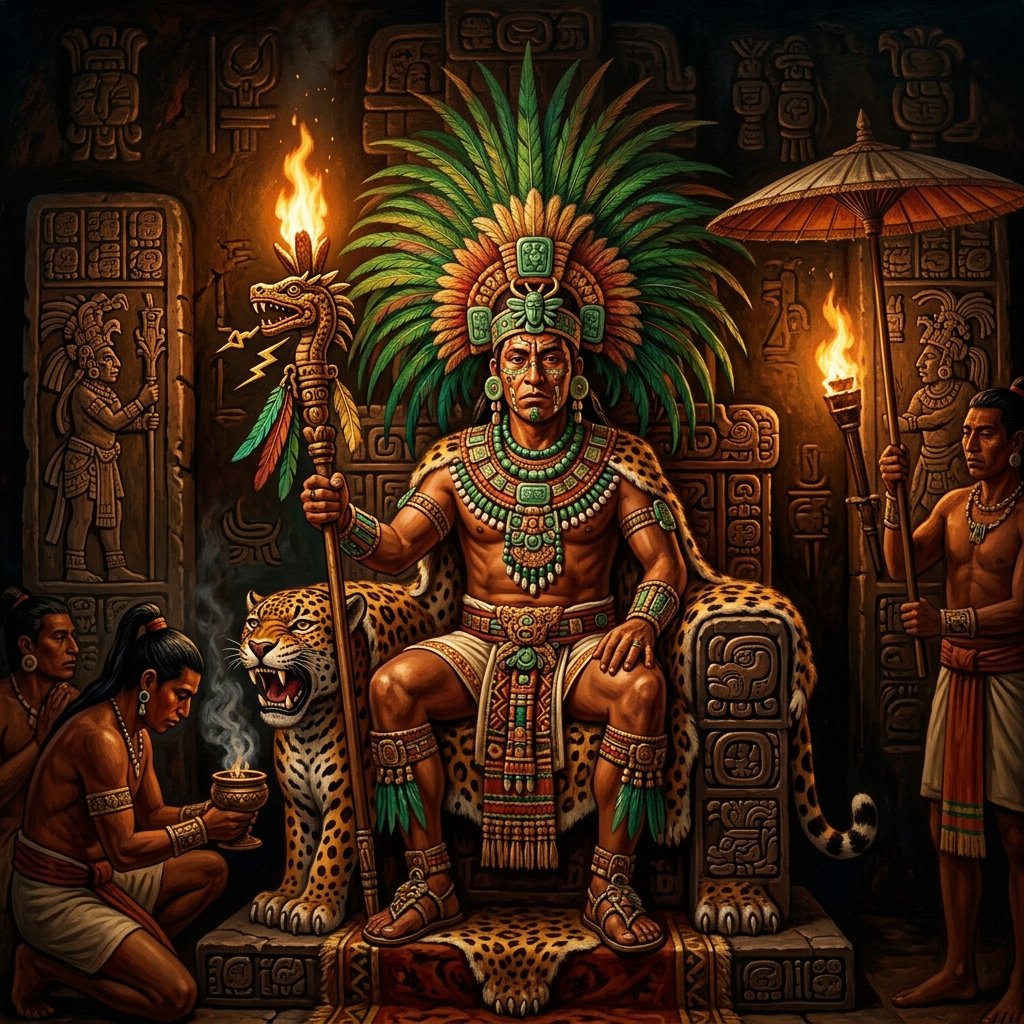
Maya Divine Kingship at a Glance
Not a Politician — A Sacred Being
The Maya king was not merely a political leader. He was a K'uhul Ajaw — a "Holy Lord" — whose body and bloodline were sacred. His most important function was not governance in the modern sense but ritual performance: through bloodletting, dance, and vision quests, the king became a conduit between the human world and the supernatural realm. He summoned gods, communicated with ancestors, and maintained the cosmic order that kept the world functioning.
If a king could not perform effective ritual — if the rain did not come, if the crops failed, if military campaigns ended in defeat — then the gods had withdrawn their favor, and the king's sacred legitimacy was in question. This is why Maya warfare often targeted enemy kings for capture rather than simple territorial conquest: capturing a rival K'uhul Ajaw and sacrificing him destroyed his kingdom's connection to the divine (Martin, S. & Grube, N., Chronicle of the Maya Kings and Queens, 2008, pp. 14–21).
The Accession
Becoming a Maya king involved a formal accession ceremony recorded in inscriptions with the phrase "he sat" or "he took the Kawil scepter." Key elements included:
- Receiving the hunal jewel — a jade diadem worn on the forehead, the single most important item of royal regalia.
- Sitting on a jaguar throne — the physical seat of divine authority.
- Performing an initial bloodletting — drawing blood from the tongue, earlobes, or genitals using obsidian lancets or stingray spines.
- Taking a throne name that incorporated the names of gods, ancestors, or powerful symbols.
The new king inherited not just political power but an entire cosmological role. He became the living embodiment of the World Tree — the axis mundi connecting sky, earth, and underworld. His body, his blood, and his ritual actions held the universe together.
The King's Obligations
Maya kingship was not comfortable. The K'uhul Ajaw was expected to:
- Perform regular bloodletting rituals — painfully drawing blood to nourish the gods and summon Vision Serpents.
- Lead military campaigns — personally commanding armies and, ideally, capturing enemy lords.
- Dedicate monuments — erecting stelae and altars at calendar period endings.
- Build — constructing temples, plazas, and palaces that demonstrated his power and piety.
- Dance — performing elaborate ritual dances in costume as gods, ancestors, and supernatural creatures.
- Maintain the calendar — ensuring that the sacred days were properly observed.
Queens and Female Power
While Maya kingship was overwhelmingly male, several women achieved extraordinary political power. Lady Six Sky of Naranjo arrived from Dos Pilas in 682 AD and effectively refounded the Naranjo dynasty, appearing on monuments in warrior poses traditionally reserved for kings. At Palenque, Lady Yohl Ik'nal ruled as queen from 583 to 604 AD — one of the only women to hold the K'uhul Ajaw title outright.
Frequently Asked Questions
What does K'uhul Ajaw mean?
"Holy Lord" or "Divine King" — the highest royal title in Classic Maya. It signified that the king was a sacred intermediary between humans and gods, not just a political ruler.
Were Maya kings considered gods?
Not gods themselves, but "god-bearers" — sacred beings who could communicate with deities through bloodletting and ritual. If a king failed at ritual, his divine legitimacy was questioned — which is why capturing and sacrificing enemy kings was the ultimate act of war.
How did someone become a Maya king?
Patrilineal succession (father to son), confirmed by an accession ceremony: receiving the jade hunal jewel, sitting on a jaguar throne, performing bloodletting, and taking a throne name. In rare cases, women ruled — Lady Six Sky and Lady Yohl Ik'nal are notable examples.
Scholarly References
- Martin, S. & Grube, N. Chronicle of the Maya Kings and Queens. Thames & Hudson, 2nd ed., 2008.
- Schele, L. & Miller, M.E. The Blood of Kings. Kimbell Art Museum, 1986.
- Houston, S. & Stuart, D. "The Ancient Maya Self." RES, vols. 33/34, 1998.
- Miller, M.E. & Martin, S. Courtly Art of the Ancient Maya. Thames & Hudson, 2004.