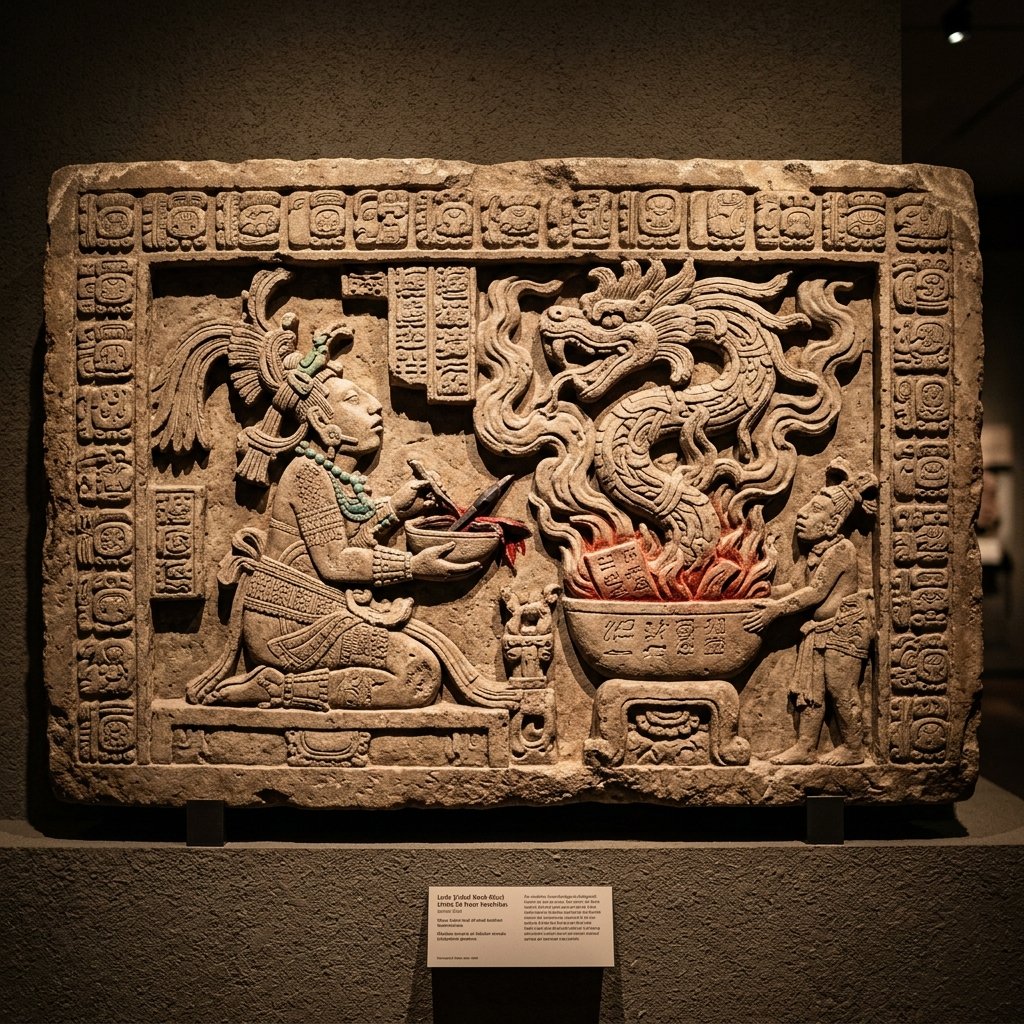
Maya Bloodletting at a Glance
The Most Sacred Act
If you could understand only one thing about Maya religion, it should be this: blood was food. Not metaphorically, not symbolically — literally. The gods had created humanity from maize, and in return, humans owed the gods the most precious substance they could offer: their own blood. Without regular blood offerings, the gods would starve, the cosmic order would crumble, and the world would end.
This is why bloodletting was not seen as punishment, masochism, or brutality. It was the highest form of prayer — the most powerful act a human being could perform. And it was the primary obligation of the K'uhul Ajaw (Divine King): a ruler who could not offer blood was a ruler who could not rule (Schele, L. & Miller, M.E., The Blood of Kings, 1986, pp. 175–208).
The Ritual
A bloodletting ceremony typically followed this sequence:
- Preparation: Fasting, abstinence, and purification — often lasting several days before the ritual itself.
- Piercing: Using a stingray spine, obsidian lancet, or bone awl, the king or queen pierced their tongue, earlobes, or genitals. In some depictions, Lady Xook of Yaxchilán is shown drawing a rope studded with thorns through a hole in her tongue.
- Collection: Blood dripped onto strips of bark paper (huun) placed in a ceramic or stone bowl.
- Burning: The blood-soaked paper was burned, producing thick, fragrant smoke (often mixed with copal incense).
- Vision: From the smoke, the Vision Serpent manifested — a great feathered snake through whose open jaws an ancestor or deity appeared, delivering messages from the supernatural world.
The Vision Serpent
The ultimate purpose of bloodletting was to conjure the Vision Serpent — a supernatural creature that served as a living conduit between the human and divine worlds. The Vision Serpent appears in some of the most important surviving works of Maya art:
- Yaxchilán Lintel 25: Lady Xook gazes upward at an enormous Vision Serpent rising from a bowl of blood-soaked paper. From the serpent's open jaws emerges a warrior ancestor — the founder of the Yaxchilán dynasty — brandishing a spear and shield.
- Various painted ceramics: The Vision Serpent is depicted as a feathered, double-headed serpent with curling body and open maw, from which ancestors and deities emerge.
The physiological mechanism is straightforward: pain, blood loss, and incense inhalation combined to induce altered states of consciousness. What the Maya saw in those altered states they understood as genuine supernatural communication. The Vision Serpent was not a hallucination — it was the gods answering the offering of blood (Freidel, D., Schele, L. & Parker, J., Maya Cosmos, 1993, pp. 201–231).
Why Blood?
The theological logic was circular and self-reinforcing:
- The gods created humans from maize.
- Maize requires water (rain) and fertile soil to grow.
- The gods provide rain — but in return, they require sustenance.
- The most precious sustenance humans can offer is their own blood — the life-force within their maize-flesh bodies.
- Without blood, the gods weaken. Without the gods, the rain stops. Without rain, the maize dies. Without maize, humans die.
Bloodletting was therefore not optional but existentially necessary. The king's blood kept the universe running.
Frequently Asked Questions
What was Maya bloodletting?
The most sacred Maya ritual — deliberately drawing one's own blood using stingray spines or obsidian lancets, collecting it on bark paper, and burning it. The smoke manifested the Vision Serpent, through which gods and ancestors communicated.
Why did the Maya practice bloodletting?
The Maya believed blood was food for the gods. Without regular offerings, the cosmic order would collapse — crops would fail, rain would stop, and the world would end. Bloodletting was not self-harm but cosmic maintenance and the king's primary obligation.
Did women perform bloodletting?
Yes. Royal women were essential participants. The most famous depiction is Yaxchilán Lintel 24, showing Lady Xook drawing a thorn rope through her tongue while King Shield Jaguar holds a torch above. Women's bloodletting was integral to the ritual complex.
Scholarly References
- Schele, L. & Miller, M.E. The Blood of Kings. Kimbell Art Museum, 1986.
- Freidel, D., Schele, L. & Parker, J. Maya Cosmos. William Morrow, 1993.
- Houston, S. & Stuart, D. "Of Gods, Glyphs, and Kings." Antiquity, vol. 70, 1996.
- Miller, M.E. & Martin, S. Courtly Art of the Ancient Maya. Thames & Hudson, 2004.