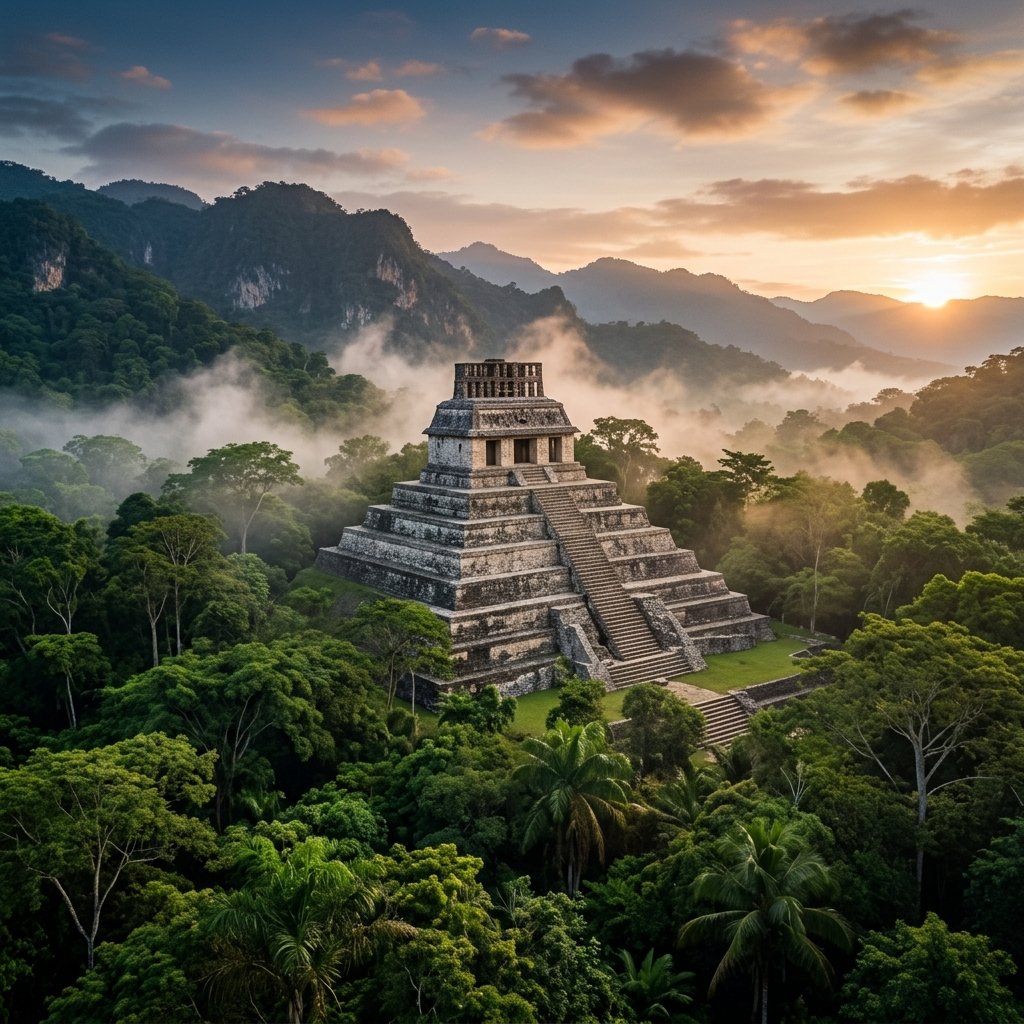
Palenque at a Glance
Why Palenque Is Considered the Most Beautiful Maya City
If Tikal is the most powerful Maya city and Chichén Itzá the most famous, Palenque is — by scholarly consensus and popular acclaim — the most beautiful. The ancient Maya called it Lakamha' ("Big Water"), and the city's integration with its dramatic landscape of jungle-covered mountains, cascading streams, and misty valleys produces an atmosphere that no other Maya site can quite match.
What distinguishes Palenque architecturally is a quality best described as refinement. Where Tikal built for sheer vertical dominance and Chichén Itzá for mathematical precision, Palenque's architects achieved something subtler: proportional elegance. The buildings are smaller than those at other great Maya cities, but their proportions — the ratio of wall height to roof comb, the spacing of doorways, the delicacy of the stucco modeling — create a sense of architectural grace that has drawn comparisons to classical Greek design (Robertson, The Sculpture of Palenque, Princeton University Press, 1983).
Palenque was also an intellectual powerhouse. Its inscriptions contain some of the longest and most sophisticated Maya texts ever discovered — reaching back through mythological history to events dated millions of years in the past. No other Maya city embedded its political theology in such elaborate cosmological frameworks. Understanding Palenque's inscriptions was central to the modern decipherment of Maya hieroglyphic writing, and the city remains essential reading for any serious student of Maya civilization (Schele & Freidel, A Forest of Kings, 1990).
The Architecture: Intimacy at the Scale of Kingdoms
The Temple of the Inscriptions
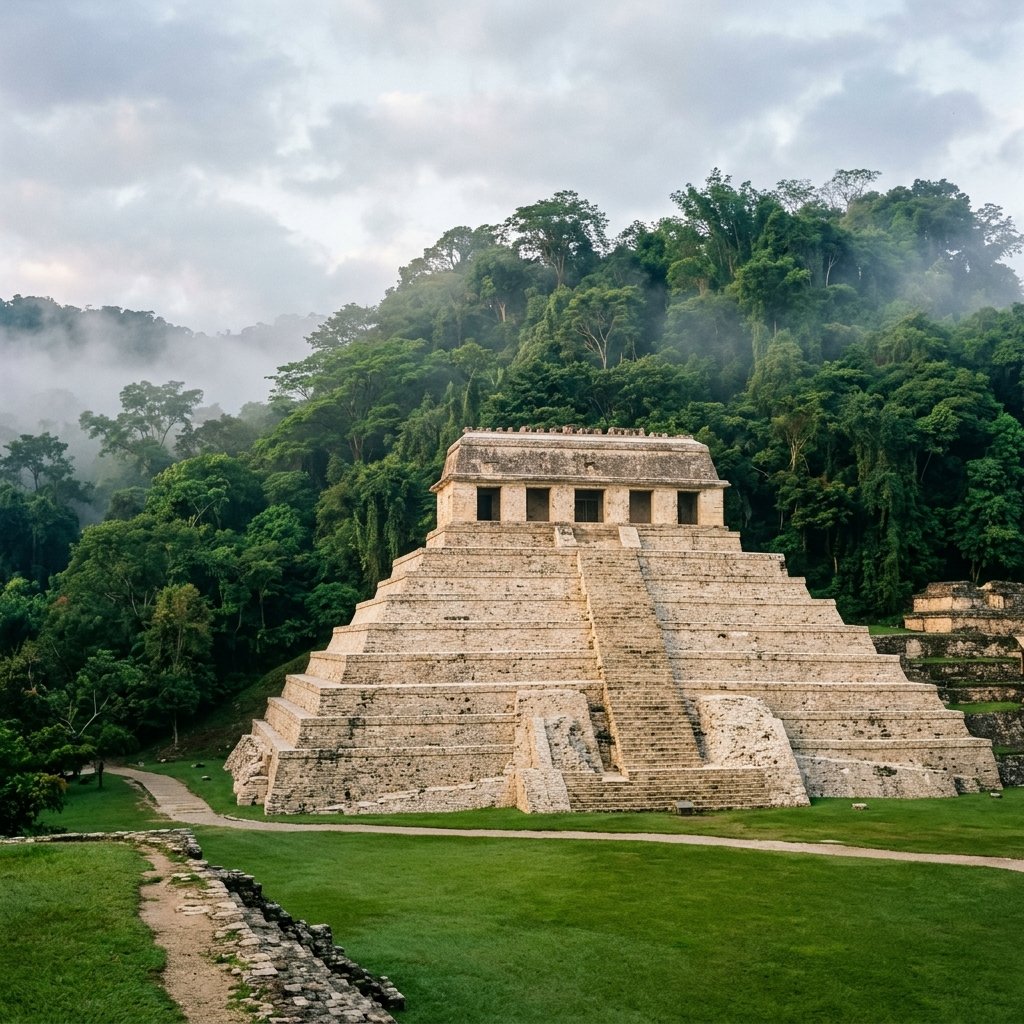
The Temple of the Inscriptions — Palenque's most famous structure. This graceful nine-level pyramid houses the tomb of K'inich Janaab Pakal deep within its core. The temple at the summit contains the second-longest Maya hieroglyphic inscription known, spanning 617 glyphs across three enormous limestone panels.
The Temple of the Inscriptions is Palenque's crown jewel — a stately 25-meter stepped pyramid that serves as both monument and mausoleum. The temple at its summit contains the second-longest continuous Maya hieroglyphic text known — 617 individual glyphs carved across three massive limestone panels, recording 180 years of Palenque's dynastic history from 431 to 611 AD (Stuart & Stuart, Palenque: Eternal City of the Maya, 2008).
But the temple's most extraordinary secret lay hidden for over a thousand years. In 1948, Mexican archaeologist Alberto Ruz Lhuillier noticed that one floor slab in the summit temple had unusual stone plugs in its edges. When he lifted it, he found the beginning of a rubble-filled internal stairway. It took four years of painstaking excavation — clearing thousands of stones one by one — before Ruz reached the bottom in June 1952. There, behind a massive triangular stone door, he found what is arguably the most spectacular archaeological discovery ever made in the Americas.
Pakal's Tomb: A King's Journey to the Underworld
The burial chamber measures roughly 9 × 4 meters, with a ceiling height of 7 meters and walls covered in nine stucco figures representing Pakal's ancestors emerging from the earth as fruit-bearing trees — a statement that the dead king nourishes the living through his eternal sacrifice. At the center of the chamber rests the monolithic limestone sarcophagus, the largest carved stone object in the pre-Columbian Americas (Ruz Lhuillier, El Templo de las Inscripciones, INAH, 1973).
The sarcophagus lid is one of the most famous works of art from the ancient world. Measuring 3.6 × 2.2 meters, it depicts Pakal at the moment of death — falling backward into the open jaws of the skeletal earth monster, while the great Wakah-Kan (World Tree) rises from his body toward the celestial bird perched at its summit. The composition maps the entire Maya cosmos: underworld below, earth at center, heavens above — with the king as the axis connecting all three realms.
Pakal himself was adorned with a jade mosaic death mask, jade and obsidian jewelry, and a collar of jade beads totaling over 200 pieces. His fingers bore jade rings; jade figurines were placed in each hand and in his mouth. A jade counterweight hung behind his head. Red cinnabar covered everything — the deep vermilion pigment the Maya associated with the east, sunrise, and rebirth (Tiesler & Cucina, Janaab' Pakal of Palenque, University of Arizona Press, 2006).
The discovery was electrifying. Until 1952, Mesoamerican pyramids were believed to be purely temples — platforms for religious ceremonies atop. Ruz proved they could also be royal mausoleums, drawing direct parallels with Egypt. The jade death mask of Pakal has since become one of the defining images of pre-Columbian civilization, on par with Tutankhamun's gold mask as an icon of archaeological discovery.
The Palace
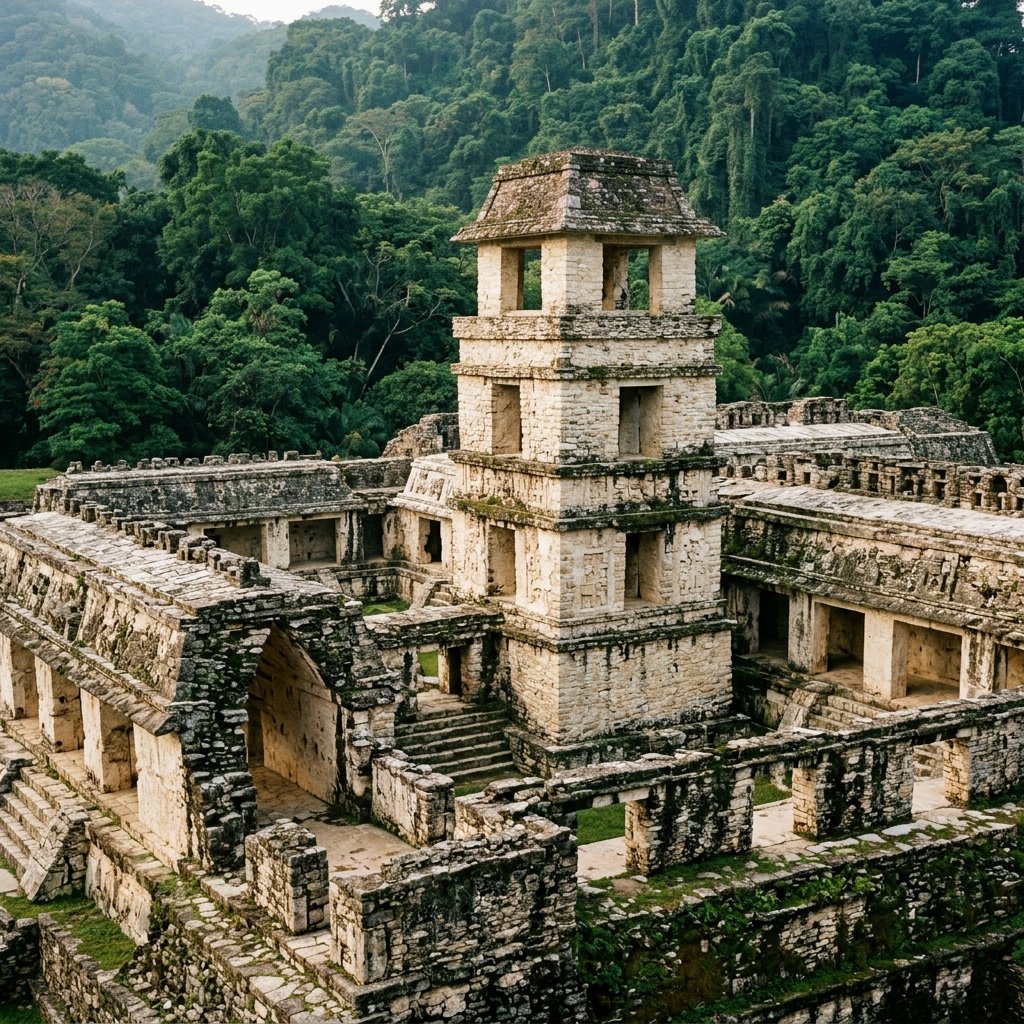
The Palace tower — the only multi-story tower in all of Maya architecture. Rising four stories from a sprawling complex of courtyards and galleries, the tower may have served as an astronomical observatory, a watchtower, or a symbol of royal authority. Its T-shaped windows are a hallmark of Palenque's distinctive architectural style.
The Palace (El Palacio) is a sprawling labyrinth of courtyards, galleries, vaulted corridors, and subterranean passages that served as the administrative and residential heart of Palenque for over four centuries. Built and rebuilt by successive rulers from roughly 500 to 750 AD, the complex covers an area of approximately 100 × 80 meters atop a massive artificial platform 10 meters high.
The most striking feature is the four-story tower — architecturally unique in the entire Maya world. No other Maya city built anything comparable. Archaeoastronomer Anthony Aveni demonstrated that the tower's windows align with the winter solstice sunset, when the sun appears to set directly into the Temple of the Inscriptions — possibly a deliberate alignment connecting the living royal court with the tomb of its greatest ancestor (Aveni, Skywatchers of Ancient Mexico, 2001).
The Palace walls preserve some of the finest stucco sculpture surviving from the ancient Americas. Unlike the carved stone reliefs at other Maya sites, Palenque's artists worked primarily in modeled stucco — a medium that allowed extraordinary delicacy of expression. The portraits of rulers and captives on the Palace walls display an almost Renaissance-like attention to individual personality, with subtly differentiated facial expressions, naturalistic body proportions, and remarkably fluid compositional arrangements.
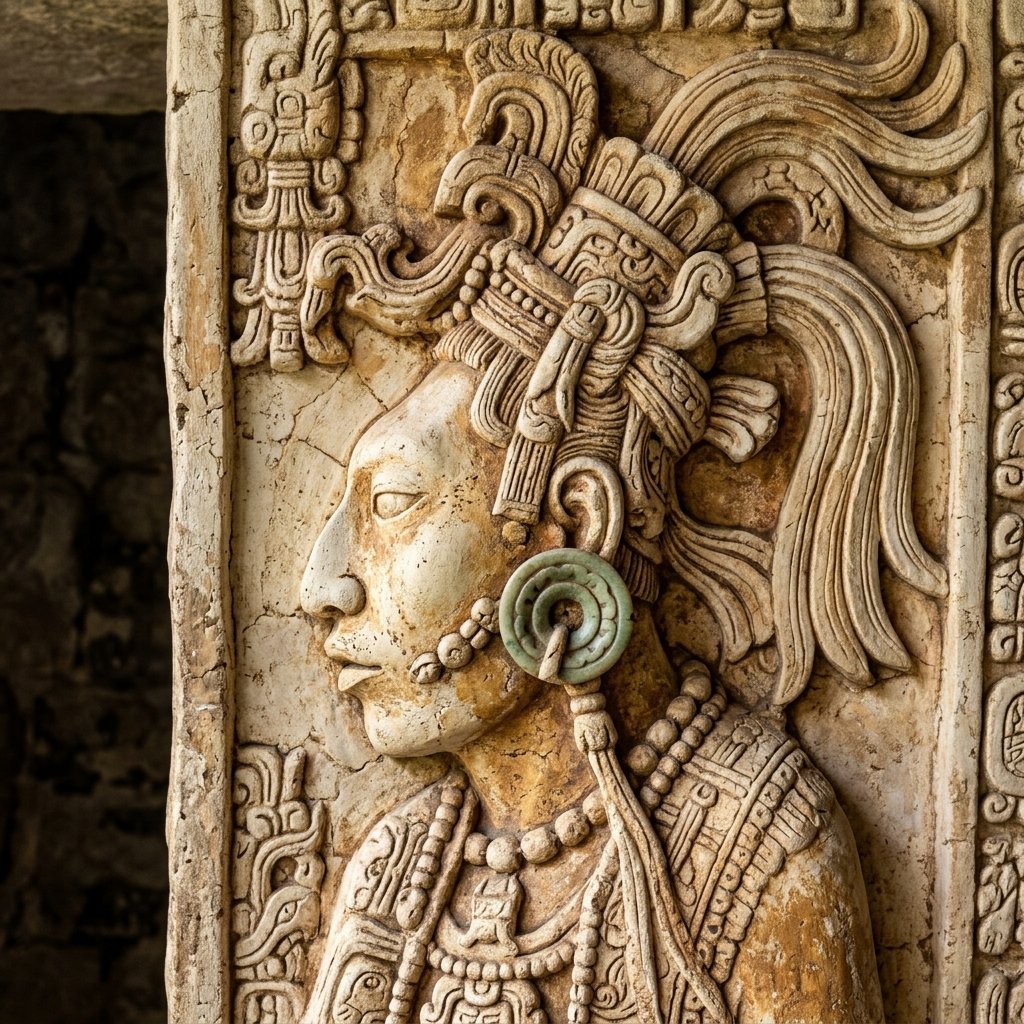
A stucco portrait head from Palenque — among the finest examples of Maya sculptural art. The delicacy of the modeling, the serene expression, and the naturalistic proportions reflect an artistic tradition that scholars have compared to classical Greek sculpture. Palenque's stucco artists achieved a subtlety of expression unmatched elsewhere in the Maya world.
The Cross Group: A Cosmic Theology in Stone
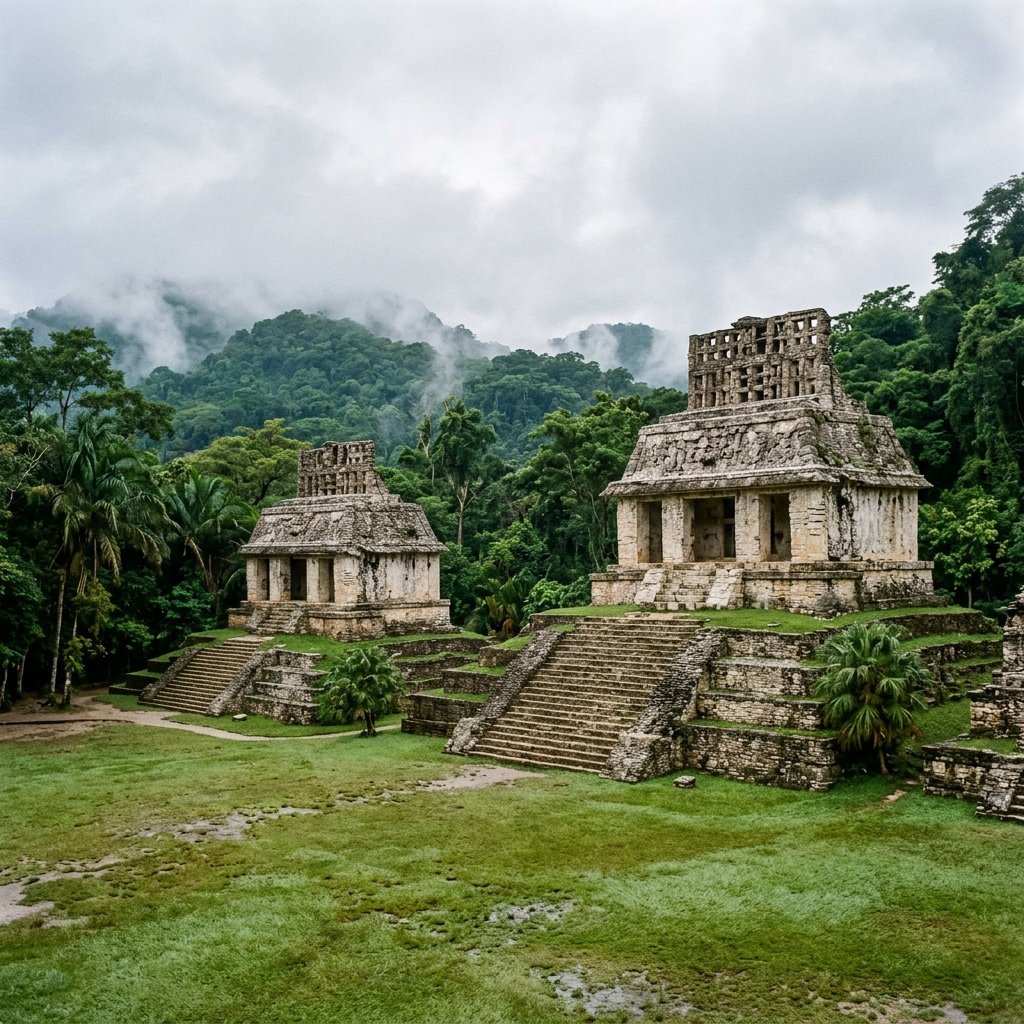
The Cross Group — three temples commissioned by K'an Bahlam II to assert his divine right to rule. Each temple contains a masterwork carved panel depicting the creation of the cosmos and the king's role within it. Together, they form the most complete and ambitious cosmological program in all of Maya art.
The Cross Group — the Temple of the Cross, Temple of the Foliated Cross, and Temple of the Sun — was commissioned by K'an Bahlam II (also known as Chan Bahlum, "Serpent Jaguar"), Pakal's eldest son and successor, who ruled from 684 to 702 AD. The three temples were dedicated in 692 AD in a single coordinated ceremony — one of the most ambitious architectural and intellectual programs in Ancient American history.
Each temple contains a carved limestone panel of extraordinary complexity. Taken together, the three panels narrate nothing less than the complete Maya creation story — beginning with events dated to 3122 BC (and in some passages, millions of years before that) and extending through the birth of the gods, the creation of the current world, and the king's legitimate descent from the divine beings who set the universe in motion (Freidel, Schele & Parker, Maya Cosmos, William Morrow, 1993).
The Temple of the Cross panel features the great Wakah-Kan (World Tree), crowned by the celestial bird — the same cosmological image found on Pakal's sarcophagus. The Temple of the Foliated Cross depicts the tree as a maize plant, connecting agricultural fertility with cosmic order. The Temple of the Sun shows a war shield backed by two crossed spears, representing the jaguar sun of the underworld — war and the darkness beneath the earth. Together, they map the entire structure of Maya reality: heavens, earth, and underworld, each presided over by a patron deity, each requiring the king's ritual action to sustain (Stuart, The Inscriptions from Temple XIX at Palenque, Pre-Columbian Art Research Institute, 2005).
The "Ancient Astronaut" Myth — and the Truth
Palenque's sarcophagus lid became famous worldwide thanks to Erich von Däniken's 1968 book Chariots of the Gods?, which claimed the image depicted an astronaut at the controls of a rocket ship. The interpretation was compelling to millions of readers — but it is comprehensively wrong.
What von Däniken identified as "controls" are the open jaws of the earth monster — a standard Maya iconographic convention. The "rocket exhaust" is the roots of the World Tree descending into the underworld. The "oxygen mask" is a jade pectoral ornament. The "cockpit" is the skeletal maw of death itself. Every element on the lid is well-established Maya iconography documented at dozens of other sites — the only unusual thing about Palenque's version is its extraordinary size and artistic quality (Robertson, The Sculpture of Palenque, 1983).
The irony is profound: the actual truth about Pakal's tomb — that a 7th-century Maya civilization possessed the engineering skill to build a hidden crypt inside a pyramid, the artistic genius to create one of the world's great sculptural masterpieces, and the intellectual sophistication to map the entire cosmos onto a single stone surface — is far more extraordinary than the alien hypothesis. The Maya don't need extraterrestrial help to be astonishing. They already are.
What Remains Undiscovered
Only approximately 10% of Palenque's known structures have been excavated. The jungle surrounding the cleared ceremonial core conceals hundreds of unexcavated mounds — temples, residences, workshops, and likely additional tombs. Recent LiDAR surveys have revealed the true extent of the city: the urban zone covers an estimated 2.5 km², far larger than the area visible to visitors today (Barnhart, The Palenque Mapping Project, FAMSI, 2001).
In 1994, archaeologists discovered the tomb of the Red Queen (La Reina Roja) in a temple adjacent to the Temple of the Inscriptions. The female skeleton was entirely coated in brilliant red cinnabar, adorned with a jade mask, and accompanied by rich grave goods. DNA analysis and isotopic studies have identified her as likely Tz'akbu Ajaw, Pakal's principal wife — making Palenque the only Maya site where we have identified the tombs of both a king and his queen (Tiesler & Cucina, 2006).
Practical Travel Guide
Getting There
Fly to Villahermosa (VSA), then 2.5 hours by car or bus. From San Cristóbal de las Casas, it's 5 hours through spectacular mountain scenery. The town of Palenque has excellent budget and mid-range accommodation within 15 minutes of the ruins.
Best Strategy
Arrive at 8 AM opening. Morning mist rising through the jungle canopy is magical and the light is perfect for photography. Allow 3–4 hours. The site is hilly with stone staircases — bring water, good shoes, and insect repellent. Humidity is intense year-round.
Don't Miss the Museum
The Palenque Site Museum (separate entrance, near the lower entrance) houses a replica of Pakal's tomb chamber, original carved panels, stucco sculptures, and jade objects. It's essential context for understanding what you see at the ruins. Allow an extra hour.
Combine With
Misol-Ha waterfall (a 35m curtain of water you can walk behind) and the stunning turquoise cascades of Agua Azul are both en route from San Cristóbal. Together with Palenque, they form one of Mexico's most spectacular day-trip itineraries.
Visitor Comparison
| Feature | Palenque | Chichén Itzá | Tikal |
|---|---|---|---|
| Best Feature | Pakal's Tomb / Sculpture | El Castillo / Equinox | Temple IV Sunrise |
| Artistic Quality | Unmatched | Very High | High |
| Crowd Level | Moderate | Very High | Low–Moderate |
| Setting | Mountain jungle | Flat scrubland | Lowland jungle |
| Time Needed | 3–5 hours | 3–5 hours | 1–2 days |
Key Academic References
- Aveni, Anthony F. Skywatchers of Ancient Mexico. University of Texas Press, 2001.
- Barnhart, Edwin L. The Palenque Mapping Project: Settlement and Urbanism at an Ancient Maya City. FAMSI, 2001.
- Freidel, David, Schele, Linda & Parker, Joy. Maya Cosmos: Three Thousand Years on the Shaman's Path. William Morrow, 1993.
- Robertson, Merle Greene. The Sculpture of Palenque (4 vols). Princeton University Press, 1983–1991.
- Ruz Lhuillier, Alberto. El Templo de las Inscripciones, Palenque. INAH, 1973.
- Schele, Linda & Freidel, David. A Forest of Kings: The Untold Story of the Ancient Maya. William Morrow, 1990.
- Stuart, David. The Inscriptions from Temple XIX at Palenque. Pre-Columbian Art Research Institute, 2005.
- Stuart, David & Stuart, George. Palenque: Eternal City of the Maya. Thames & Hudson, 2008.
- Tiesler, Vera & Cucina, Andrea (eds). Janaab' Pakal of Palenque: Reconstructing the Life and Death of a Maya Ruler. University of Arizona Press, 2006.
Frequently Asked Questions
Can you enter Pakal's tomb?
No — the tomb chamber has been sealed since 1994 to protect it from humidity damage caused by visitor breath and body heat. However, a superb full-scale replica of the tomb is displayed in the on-site museum, and the original jade burial mask is exhibited at the National Museum of Anthropology in Mexico City.
Does Pakal's sarcophagus show an astronaut?
No. Every element on the sarcophagus lid corresponds to well-documented Maya iconographic conventions found at dozens of other sites. The "controls" are the jaws of the earth monster, the "rocket exhaust" is the roots of the World Tree, and the "cockpit" is the skeletal maw of death. The actual achievement — a 7th-century civilization creating one of the world's greatest sculptures and engineering a hidden crypt inside a pyramid — is far more extraordinary than the alien hypothesis.
Who was the Red Queen?
In 1994, archaeologists found a female burial entirely coated in red cinnabar in a temple next to the Temple of the Inscriptions. DNA and isotopic analysis strongly suggest she was Tz'akbu Ajaw — Pakal's principal wife. Her jade death mask and rich burial goods confirm her extraordinary status. Palenque is the only Maya site where we have identified the tombs of both a king and his queen.
How does Palenque compare to Chichén Itzá?
Very different experiences. Chichén Itzá is grander in scale and more geometrically precise. Palenque is more intimate, more artistically refined, and set in dramatically more beautiful jungle scenery. Scholars and experienced travelers consistently rate Palenque's sculpture and architecture as the finest in the Maya world. If you love art and history, Palenque may be the most rewarding Maya site of all.
How much of Palenque has been excavated?
Only about 10%. The jungle surrounding the cleared core conceals hundreds of unexcavated structures. LiDAR mapping has revealed the true extent of the city — roughly 2.5 km² of urban development, far larger than what visitors see. Future excavations will almost certainly yield additional tombs, inscriptions, and artistic treasures.