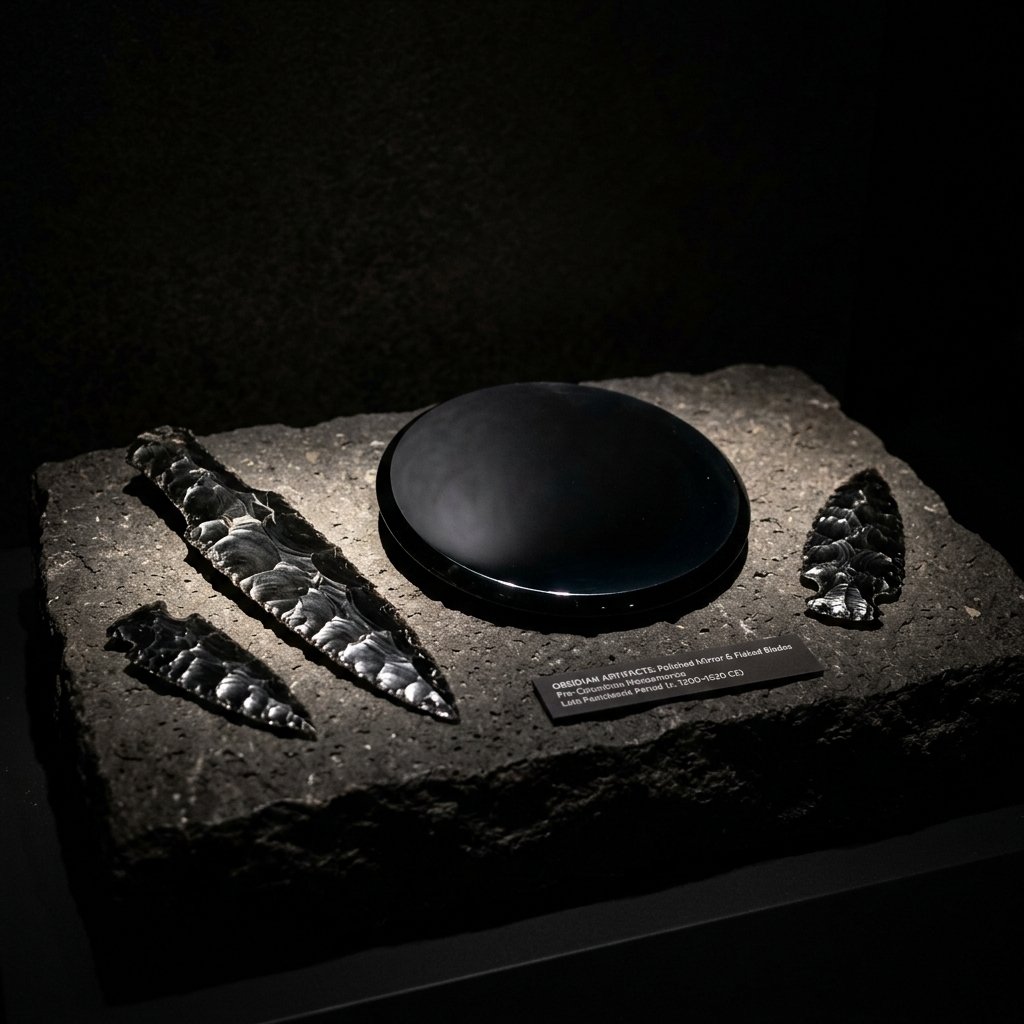
Maya Obsidian at a Glance
The Sharpest Edge in the Ancient World
In a civilization without metal tools, obsidian was steel. This volcanic glass — formed when silica-rich lava cools rapidly without crystallizing — can be fractured to produce edges of extraordinary sharpness. Modern electron microscope studies have shown that a well-knapped obsidian blade can achieve an edge 3 nanometers thick — roughly 500 times thinner than the best steel surgical scalpel. The Maya lived in a Stone Age civilization that had access to a material sharper than anything the Iron Age would ever produce.
The practical applications were immediate: obsidian blades cut flesh, fabric, wood, and leather with effortless precision. But for the Maya, obsidian was far more than a practical material. It was sacred — the substance used for the most important ritual act in Maya religion: bloodletting (Coe, M.D. & Kerr, J., The Art of the Maya Scribe, 1998, pp. 201–203).
Prismatic Blades: A Master Craft
The most technically impressive obsidian artifacts are prismatic blades — long (10–15 cm), thin, parallel-sided flakes struck from a carefully prepared cylindrical core through pressure flaking. This technique required:
- A prepared obsidian core shaped into a cylinder with a flat top.
- A chest crutch or similar tool to apply controlled downward pressure.
- Extreme precision — the angle, pressure, and position had to be exact, or the core shattered.
- Years of training. Experimental archaeologists report that consistent prismatic blade production requires 2–5 years of practice.
A single core could yield dozens of identical blades — a remarkably efficient use of raw material. Prismatic blades were used for everything from shaving to harvesting to scribing fine lines on ceramics.
Obsidian Mirrors
Polished obsidian mirrors were used for divination and ritual. Ground and polished to a high reflective sheen, these mirrors could produce clear reflections — and were believed to reveal supernatural truths. The Maya god Tezcatlipoca ("Smoking Mirror," shared with Aztec tradition) was associated with obsidian mirrors that revealed hidden knowledge.
Trade and Power
The Maya lowlands have no volcanic rock. Every piece of obsidian had to be imported from the highlands — primarily from El Chayal and Ixtepeque in Guatemala, with some high-status green obsidian coming from Pachuca in central Mexico. This geographic imbalance made obsidian trade one of the most economically and politically significant activities in the Maya world.
Cities that controlled obsidian trade routes wielded enormous power. Tikal and Calakmul competed partly for access to highland obsidian sources. The presence of obsidian in archaeological contexts is used by scholars to trace ancient trade networks — each source produces chemically distinct obsidian identifiable through X-ray fluorescence analysis (Sharer, R. & Traxler, L., The Ancient Maya, 2006, pp. 85–88).
Frequently Asked Questions
Why was obsidian important to the Maya?
Obsidian was the sharpest cutting material available — volcanic glass used for blades, ritual lancets, weapons, divination mirrors, and luxury trade goods. Since all obsidian had to be imported from volcanic highlands, controlling trade routes was a major source of political power.
How sharp is obsidian compared to steel?
Obsidian edges can be ~3 nanometers thick — about 500 times thinner than a steel surgical scalpel. Modern surgeons have experimented with obsidian scalpels for certain procedures because they cause less tissue damage than steel.
Where did the Maya get obsidian?
Primarily from El Chayal and Ixtepeque (Guatemala highlands) and Pachuca (central Mexico, source of green obsidian). Since the Maya lowlands lack volcanic rock, obsidian was one of the most important long-distance trade commodities.
Scholarly References
- Sharer, R. & Traxler, L. The Ancient Maya. Stanford University Press, 6th ed., 2006.
- Clark, J.E. & Bryant, D.D. "A Technological Typology of Prismatic Blades." Journal of Field Archaeology, vol. 24, 1997, pp. 111–136.
- Coe, M.D. The Maya. Thames & Hudson, 8th ed., 2011.