Kabah at a Glance
250 Faces of the Rain God
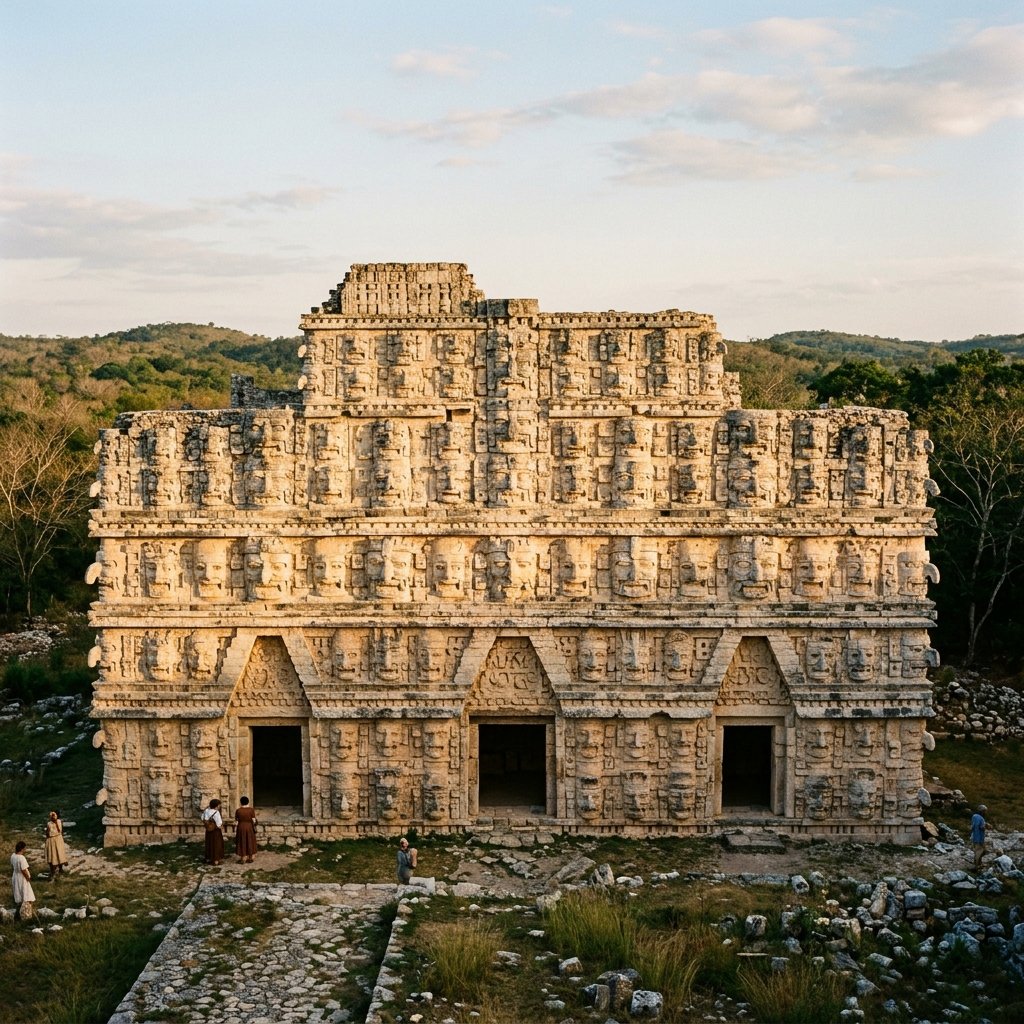
The Codz Poop — "Palace of the Masks" — is one of the most extraordinary buildings in the ancient Americas. Its entire western facade, stretching approximately 45 meters, is covered with an estimated 250 stone masks of the rain god Chaak. Each mask is composed of individually carved stone elements — hooked noses, goggle eyes, spiral earflares — assembled like a three-dimensional mosaic across the building's surface.
The effect is hypnotic and overwhelming. Where most Maya buildings use Chaak masks as decorative accents — a pair flanking a doorway, a stack at a corner — the Codz Poop takes the concept to its logical extreme. Every available surface is covered. The building doesn't have a Chaak facade; it is a Chaak facade. Standing before it is like standing before a wall of prayer — each mask an individual invocation for rain in one of the driest regions of the Maya lowlands (Kowalski, J.K., The Art of Uxmal, 1994, pp. 180–195).
The Puuc Tradition
Kabah is one of the finest examples of the Puuc architectural style — a Late Classic tradition centered in the low hills (puuc) of the western Yucatán. Puuc architecture is distinguished by:
- Plain lower walls: Smooth, precisely cut veneer stones on the lower half of buildings.
- Ornate upper facades: Elaborately carved stone mosaic decoration on the upper half — geometric fretwork, stacked Chaak masks, lattice patterns, and serpent motifs.
- Concrete cores: Rubble-and-mortar cores faced with thin cut-stone veneer — lighter and more efficient than the solid masonry of Petén sites.
- Corbel vaults: Sophisticated use of the corbeled arch, often with boot-shaped capstones unique to the Puuc style.
Other major Puuc sites include Uxmal (the regional capital), Sayil, Labná, and Xlapak. Together they represent one of the most refined architectural traditions in pre-Columbian America.
The Great Arch
At Kabah's entrance stands a freestanding corbeled arch — the terminus of the sacbe connecting Kabah to Uxmal, 18 kilometers to the northwest. This monumental gateway marks the formal entrance to the city and is one of the most photographed structures in the Puuc region. The arch's placement at the road terminus suggests that arrivals from Uxmal were greeted by this imposing portal — a deliberate statement of Kabah's importance and its political relationship with the greater Uxmal polity.
Visiting Kabah
- Access: Located on Highway 261, 23 km south of Uxmal. Easily combined with Uxmal in a single day trip from Mérida.
- Best time: Morning for cooler temperatures and fewer visitors. The afternoon sun creates dramatic shadows on the Codz Poop facade.
- Time needed: 1–2 hours for the main group. The site is compact compared to Uxmal.
- Combine with: The Puuc Route — Kabah, Sayil, Labná, and Xlapak can all be visited in a single day from Uxmal.
Frequently Asked Questions
What is Kabah famous for?
The Codz Poop (Palace of the Masks) — a building whose entire 45-meter facade is covered with approximately 250 stone masks of the rain god Chaak. Each mask is assembled from individually carved stone elements, creating the most visually overwhelming facade in the Maya world.
How is Kabah connected to Uxmal?
By an 18-kilometer sacbe (raised white road) that terminates at a monumental freestanding arch at Kabah's entrance. This connection suggests Kabah was an allied or satellite city of Uxmal, the dominant Puuc power.
Where is Kabah located?
In the Puuc hills of Yucatán, Mexico, 23 km southeast of Uxmal and about 110 km from Mérida. Part of the Puuc Route circuit and the Uxmal UNESCO World Heritage Zone.
Scholarly References
- Kowalski, J.K. The Art of Uxmal and the Puuc Region. University of Oklahoma Press, 1994.
- Andrews, G.F. Architecture of the Puuc Region and the Northern Plains. Labyrinthos, 1995.
- Sharer, R. & Traxler, L. The Ancient Maya. Stanford University Press, 6th ed., 2006.