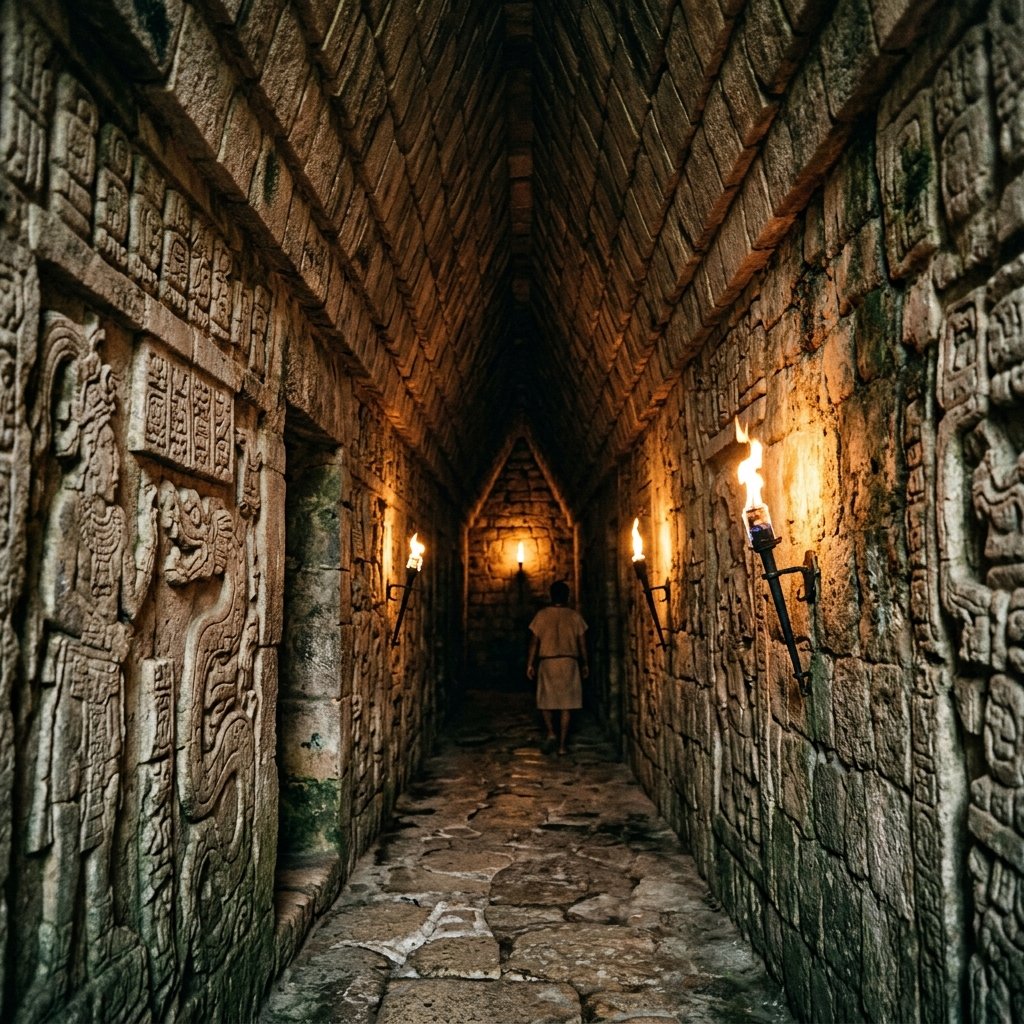
The Corbel Vault at a Glance
Building Without the Arch
Every Maya temple room, every palace corridor, every tomb chamber was built using the same fundamental technique: the corbel vault. The Romans had the true arch. The Maya did not. Instead, they developed a method that — while structurally inferior to the true arch — produced some of the most breathtaking architectural interiors in the ancient Americas.
The principle is simple: two walls rise vertically to a certain height, then each successive course of stone projects slightly inward (typically 5–10 cm per course) from the one below. Eventually the two walls approach each other closely enough to be bridged by capstones laid flat across the remaining gap. The result is a triangular or trapezoidal interior space — narrow, tall, and unmistakably Maya.
The corbel vault works because gravitational force keeps each cantilevered stone in place — the weight of the rubble fill and the courses above counterbalances the inward projection. No mortar alone could hold it; it is gravity engineering (Coe, M.D., The Maya, 2011, pp. 170–174).
The Limitation: Narrow Rooms
The corbel vault's fundamental constraint is span width. Because each stone must support its own weight plus the weight above without collapsing inward, the practical maximum interior width is approximately 3–4 meters (10–13 feet). Compare this to the Roman Pantheon's dome spanning 43 meters, and the architectural gap becomes clear.
This is why Maya temple interiors are characteristically narrow and dark — long, corridor-like rooms rather than the vast open halls of Roman, Gothic, or "true arch" architecture. A Maya palace might cover a huge area, but its interior consists of many small rooms connected by doorways, not one grand space.
The Maya compensated with several strategies:
- Multiple parallel rooms: Instead of one wide room, buildings like the Nunnery Quadrangle at Uxmal use dozens of adjacent narrow rooms.
- Interior buttressing: Cross-walls and internal piers provided additional support, allowing slightly wider spans.
- Lighter roof material: At Palenque, engineers used thinner wall sections and mansard-style roofcombs to reduce the load on corbeled ceilings, achieving more spacious interiors than any other Maya site.
- Exterior grandeur: The Maya directed their architectural ambition outward — enormous facades, monumental staircases, and towering roofcombs compensated for modest interiors.
Palenque: The Masters of the Vault
Palenque represents the pinnacle of Maya corbel vault engineering. The architects of Palenque achieved several innovations:
- Thinner walls: Palenque's walls are dramatically thinner than at other sites, increasing usable interior space. The builders compensated with higher-quality cut stone and more precise fitting.
- The Tower: The Palace at Palenque contains the only known Maya tower — a four-story structure with interior stairs, made possible by careful load distribution through corbeled vaults at each level.
- Subterranean vaults: The tomb of K'inich Janaab Pakal beneath the Temple of the Inscriptions uses a large corbeled chamber deep within the pyramid — one of the most ambitious enclosed spaces in Maya architecture.
The Puuc Innovation
In the Puuc region of the northern Yucatán (Uxmal, Kabah, Sayil, Labná), architects developed a revolutionary approach: concrete cores with thin stone veneer. Instead of solid stone walls, Puuc buildings used rubble-and-morite concrete for the core, faced with precisely cut thin stone sheets. This reduced weight, allowed taller vaults, and freed resources for the elaborate mosaic facades that define the Puuc style (Kowalski, J.K., The Art of Uxmal, 1994).
Frequently Asked Questions
What is a corbel vault?
A construction technique where successive stone courses project slightly inward from each side until they meet at the top. Unlike a true arch, it relies on the weight of overlying material to keep each course in place. The Maya used this method exclusively — they never developed the true arch.
Why didn't the Maya use true arches?
The Maya developed corveled architecture independently, without contact with Old World building traditions. The corbel vault was adequate for their needs but limited interior room width to about 3–4 meters, which is why Maya temple interiors are characteristically narrow compared to Roman or Gothic buildings.
Where can you see the best Maya corbel vaults?
The finest examples are at Palenque (the Palace and Temple of the Inscriptions), Uxmal (Governor's Palace), and Tikal (temple interiors). Palenque features the most sophisticated engineering, including the only known Maya tower.