Sacbeob at a Glance
An Ancient Highway System
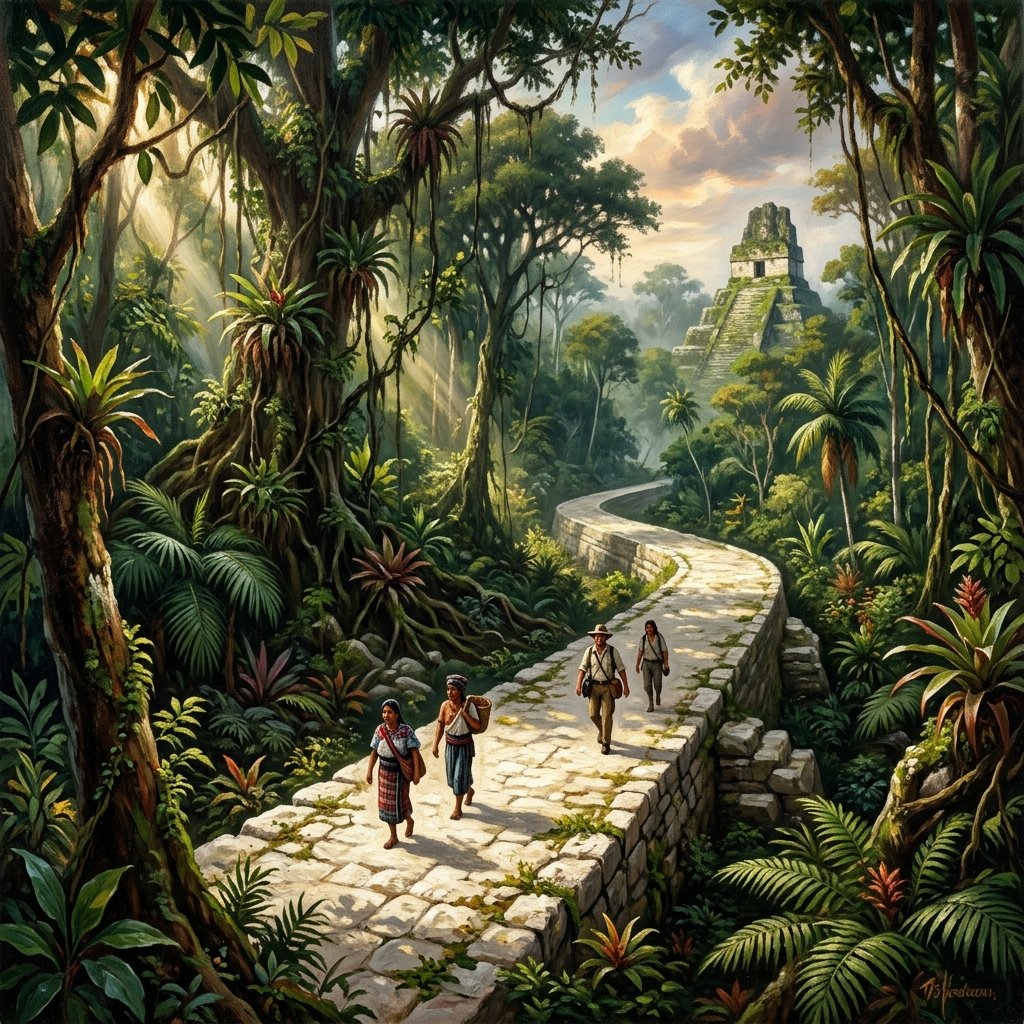
The Maya built an extensive network of raised, paved roads called sacbeob that connected buildings within cities, linked neighboring towns, and in some cases stretched across vast distances through the jungle. These are not trails — they are engineered infrastructure: laboriously constructed causeways with rubble fills, retaining walls, and limestone-plaster surfaces that gleamed white under the tropical sun.
The word sacbe means "white road" in Yucatec Maya — and they were literally white. The sascab (limestone plaster) surface reflected sunlight so intensely that sacbeob would have been visible from considerable distance, cutting bright white paths through the green jungle. At night, they may have been navigable by moonlight — their pale surfaces glowing in the darkness like terrestrial reflections of the Milky Way, which the Maya also called Sak Beh (the White Road in the sky).
The Cobá Road Network
The city of Cobá in the northeastern Yucatán was the hub of the most extensive sacbe network known. Over 50 sacbeob radiate from Cobá, including the astonishing Cobá–Yaxuná sacbe — a road approximately 100 kilometers long, 10 meters wide, and raised over a meter above the ground.
Building this road required quarrying thousands of tons of limestone rubble, constructing retaining walls along both edges, filling the interior with compacted stone, and surfacing the entire length with white plaster. The labor involved was enormous — comparable to building a modern highway, but with stone tools and human muscle. The road's existence demonstrates that Cobá had the political power to command labor on a massive scale and the strategic interest to maintain a physical connection to Yaxuná, over 100 kilometers to the west (Folan, W.J., Cobá: A Classic Maya Metropolis, 1983, pp. 49–67).
Types of Sacbeob
- Intra-site sacbeob: Short roads connecting building groups within a single city. Tikal, Chichén Itzá, and Cobá all have internal sacbeob linking temples, plazas, and elite residential complexes.
- Inter-site sacbeob: Long-distance roads connecting separate cities. These are the most impressive — engineering feats on a landscape scale.
- Ceremonial causeways: Some sacbeob led to sacred features like cenotes, caves, or isolated shrine platforms, suggesting they served primarily ritual processional functions.
The Cosmic Road
The Maya conception of the sacbe extended beyond the physical. The Milky Way was called the Sak Beh — the White Road in the sky — and was understood as the path that souls traveled after death, journeying from the earthly world to Xibalba. The terrestrial sacbeob were thus mirrors of a cosmic original: walking a sacbe was walking a reflection of the celestial road.
This dual nature — practical and cosmological — is characteristic of Maya engineering. Nothing was merely functional. Every road, every building, every plaza was simultaneously a practical structure and a cosmological statement (Freidel, D., Schele, L. & Parker, J., Maya Cosmos, 1993, pp. 75–84).
Frequently Asked Questions
What is a sacbe?
A raised, white-plastered Maya road connecting buildings, plazas, or cities. Built with a rubble core and limestone surface, ranging from a few hundred meters to over 100 km. The word means "white road" in Yucatec Maya.
What was the longest Maya sacbe?
The Cobá–Yaxuná sacbe — approximately 100 km (62 miles) long, 10 meters wide, raised over a meter above the ground. It represents one of the greatest engineering feats of the ancient Americas.
Were sacbeob used for trade or ritual?
Both. They facilitated trade, troop movement, and communication. But the Maya also associated white roads with the Milky Way — walking a sacbe was simultaneously a practical journey and a ritual re-enactment of the cosmic road to the underworld.
Scholarly References
- Folan, W.J. Cobá: A Classic Maya Metropolis. Academic Press, 1983.
- Freidel, D., Schele, L. & Parker, J. Maya Cosmos. William Morrow, 1993.
- Shaw, J. "Maya Sacbeob: Form and Function." Ancient Mesoamerica, vol. 12, 2001, pp. 261–272.