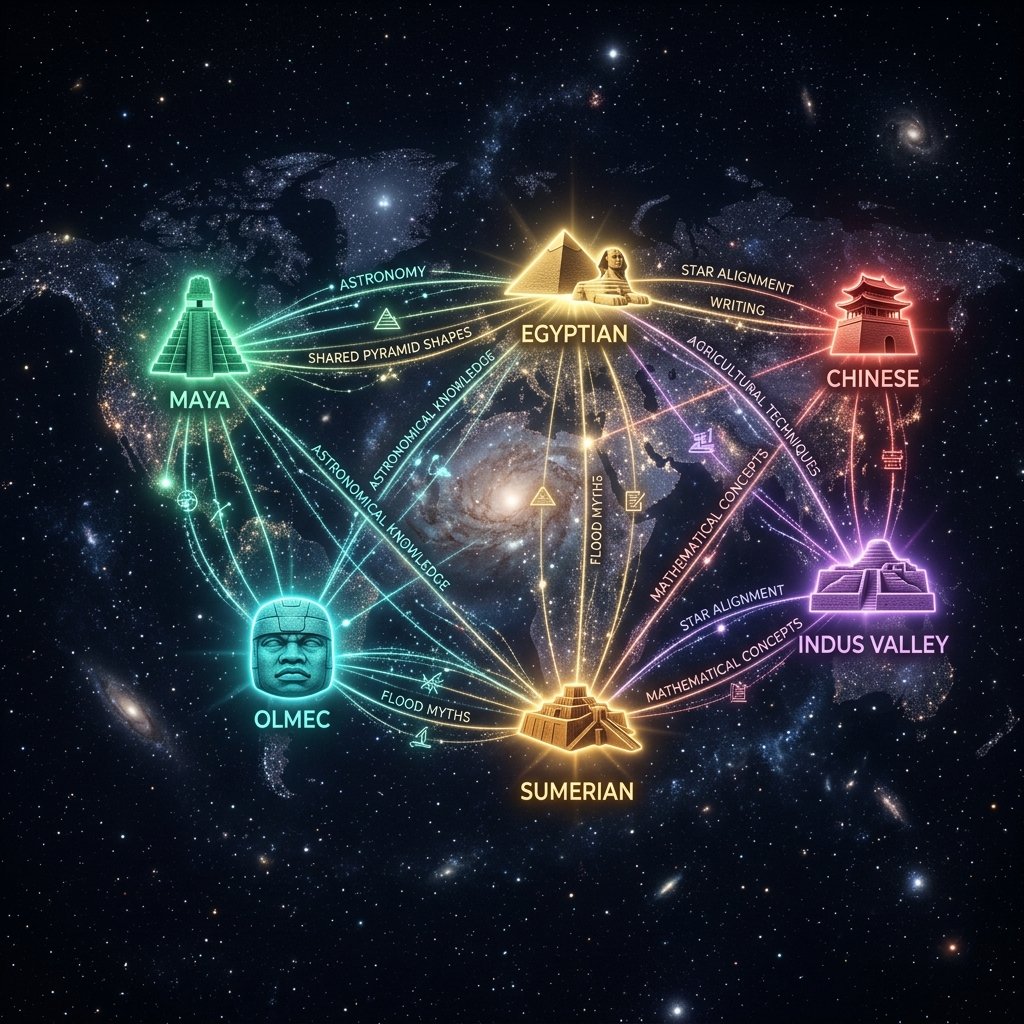
The Pattern That Won't Go Away
Comparative mythologist Joseph Campbell called it "the monomyth." Archaeologist V. Gordon Childe called it "convergent evolution." Theologians call it "common revelation." Whatever you call it, the pattern is real: unconnected civilizations on different continents independently produced strikingly similar cultures — and the question of why is one of the deepest and most unsettled in the humanities.
The Documented Parallels
These are not cherry-picked oddities — they are systematic parallels documented by mainstream scholars:
| Feature | Maya | Old World Parallel |
|---|---|---|
| Stepped pyramids | Temple-pyramids at every city | Egyptian pyramids, Mesopotamian ziggurats, Indonesian candi |
| Flood myths | Popol Vuh flood, Dresden Codex p.74 | Genesis, Gilgamesh, Deucalion, Manu, Nüwa |
| Zero | Shell glyph, by 36 BC | Babylonian placeholder, Indian numeral |
| Logo-syllabic writing | ~800 signs, logo-syllabic | Sumerian cuneiform, Egyptian hieroglyphs |
| Tree of Life | Wakah Kan / World Tree | Genesis, Norse Yggdrasil, Hindu Kalpavriksha |
| Eclipse prediction | Dresden Codex tables | Babylonian Saros cycle, Chinese Shih Chi |
| Dying-and-rising god | Maize God / Hero Twins | Osiris, Tammuz, Dionysus, Christ |
Four Explanations (All Contested)
1. Convergent Evolution
Humans face the same problems everywhere — gravity demands pyramidal shapes for tall structures, rivers flood, brains need place-value systems, death demands mythological explanation. Similar solutions emerge independently because the problems are identical (Trigger, Understanding Early Civilizations, 2003).
2. Diffusion
Ideas spread through trade, migration, and maritime contact. Sweet potato DNA proves pre-Columbian Polynesia-South America contact (Roullier et al., PNAS, 2013). If sweet potatoes crossed the Pacific, could ideas? Diffusionism was mainstream before the 1960s and is making a cautious scholarly comeback.
3. Common Source
A pre-existing tradition — whether a lost civilization, an ancestral shared culture, or (for believers) divine instruction — distributed the same foundational knowledge to different populations before they dispersed. Göbekli Tepe shows that monumental traditions extend far earlier than we assumed.
4. Universal Archetypes
Jung, Campbell, and Eliade argued that certain symbols — the flood, the world tree, the hero's descent into the underworld — are hardwired into the human psyche. They emerge everywhere because they reflect universal structures of consciousness, not historical connection (Campbell, The Hero with a Thousand Faces, 1949).
The Real Question
Perhaps the most productive framing isn't "were they connected?" but rather: what does the pattern tell us about being human?
Whether the parallels arise from contact, convergence, divine design, or deep psychology, they demonstrate something profound: that the human mind, when confronted with the mystery of existence, consistently produces the same answers. Pyramids rise. Floods destroy. Heroes descend and return. Gods die and are reborn. Nothing becomes everything.
The Maya participated in this universal human project — and they did so with a brilliance that stands alongside any civilization in history.
Frequently Asked Questions
Do the parallels prove ancient civilizations were connected?
No single parallel constitutes proof of contact. But the density of parallels — across mathematics, architecture, mythology, astronomy, and writing — is higher between Mesoamerica and the ancient Near East than between most other unrelated civilizations. Whether this reflects contact, shared human nature, or something else entirely remains an open and fascinating question.
References & Further Reading
- Trigger, B. G. (2003). Understanding Early Civilizations: A Comparative Study. Cambridge UP.
- Campbell, J. (1949). The Hero with a Thousand Faces. Pantheon Books.
- Roullier, C., et al. (2013). "Sweet potato diffusion in Oceania." PNAS, 110(6), 2205–2210.
- Eliade, M. (1959). The Sacred and the Profane. Harcourt Brace.