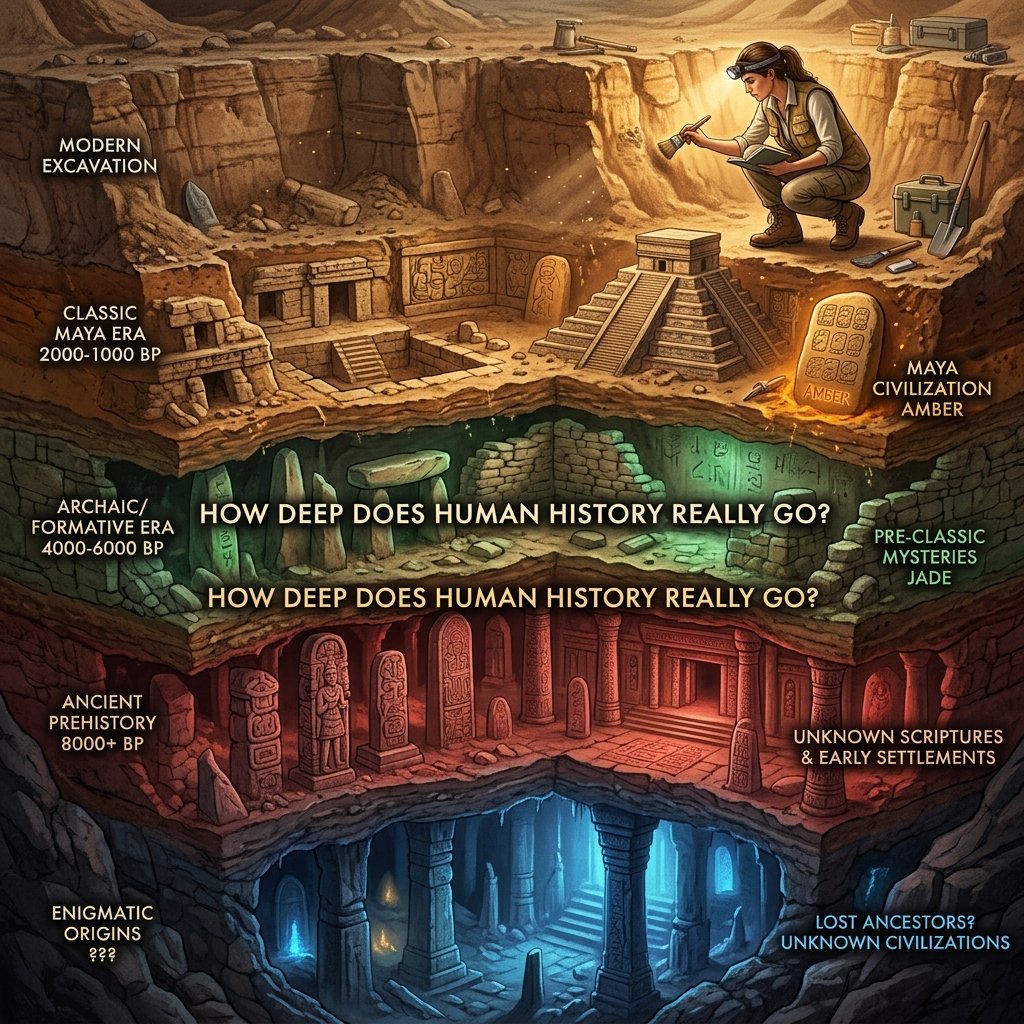
What This Article Explores
This article examines the "lost civilizations" question across four domains: mainstream archaeology (Göbekli Tepe, LiDAR), geological evidence (Younger Dryas impact hypothesis), classical mythology (Atlantis), and religious tradition (Book of Mormon, Biblical chronology). Our goal is to separate responsible speculation from pseudoscience — and to identify the genuinely unresolved questions that make this topic endlessly fascinating.
The Question That Won't Go Away
Every few years, a discovery arrives that forces archaeologists to push the timeline of complex human civilization further back than previously believed. Each time, the same question resurfaces: what else might we be missing?
The mainstream position is clear: complex civilizations (cities, writing, agriculture) emerged independently in several regions starting around 3500–3000 BC, and the archaeological record — though incomplete — captures the broad outlines of this process. But several recent findings have made this timeline feel less settled than it did a generation ago.
The Evidence That Changed the Conversation
Göbekli Tepe: 11,600 Years Old
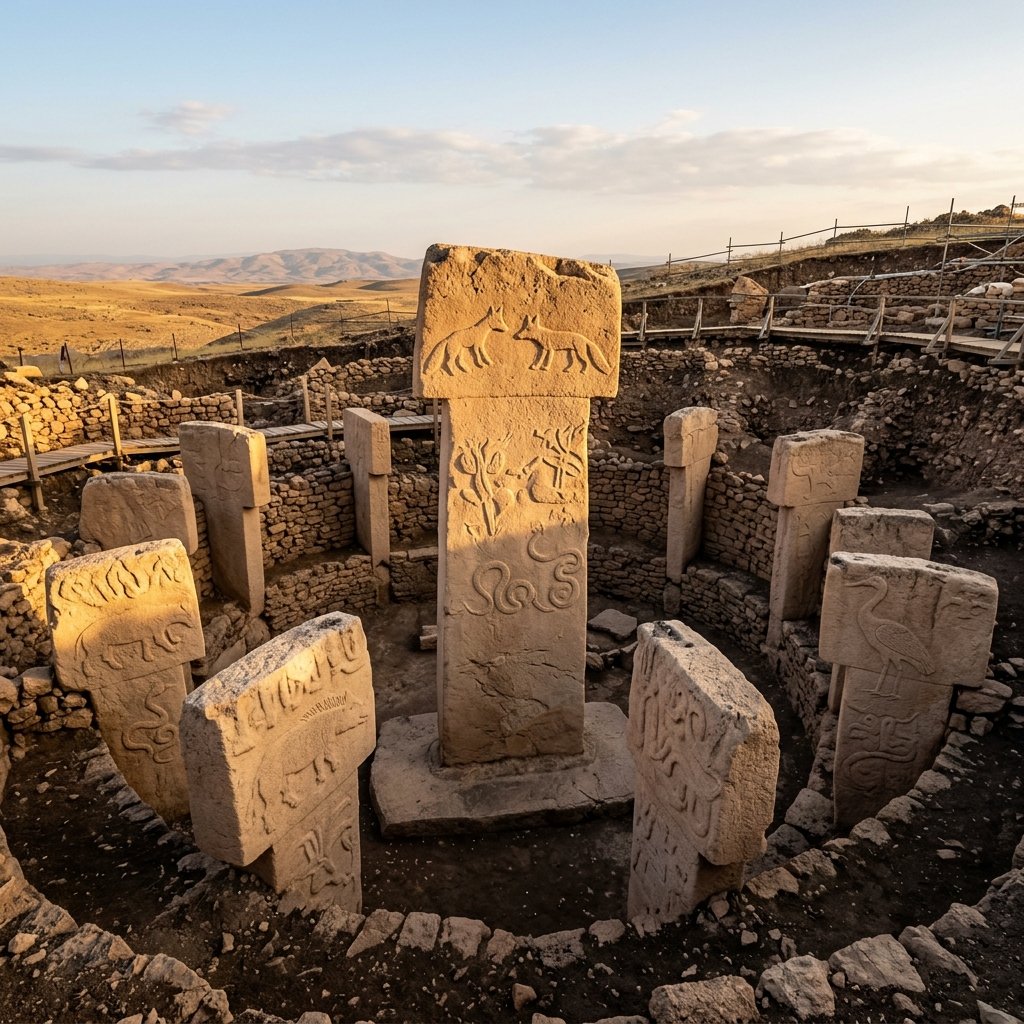
When German archaeologist Klaus Schmidt began excavating Göbekli Tepe in southeastern Turkey in 1994, what he uncovered defied all expectations: a massive complex of carved stone pillars, arranged in circles, decorated with sophisticated animal reliefs — dating to approximately 9600 BC. That's 6,000 years before Stonehenge and 7,000 years before the Egyptian pyramids.
Göbekli Tepe was built by hunter-gatherers — people who, according to the standard model, should not have been capable of organizing the labor, logistics, and artistic skill required for monumental construction. As Schmidt himself noted, the discovery "changes everything we thought we knew about the origins of civilization" (Schmidt, Göbekli Tepe: A Stone Age Sanctuary, 2012).
The Younger Dryas Impact Hypothesis

In 2007, a team led by Richard Firestone proposed that a comet or asteroid impact (or airburst) approximately 12,800 years ago triggered the Younger Dryas cooling event — a sudden return to ice-age conditions lasting 1,200 years. The evidence includes a continent-wide layer of nanodiamonds, microspherules, and platinum-group elements at the Younger Dryas boundary (Firestone et al., PNAS, 2007).
The hypothesis remains controversial but has gained significant support since 2007. A 2018 platinum anomaly study across North America, Europe, and the Middle East strengthened the impact case (Moore et al., Scientific Reports, 2020). If confirmed, it raises a profound question: could a catastrophic event have destroyed early complex societies, resetting the timeline?
LiDAR: Revealing What We Couldn't See
The LiDAR revolution in Maya archaeology demonstrated that an entire civilization — millions of structures, thousands of kilometers of roads — can remain hidden beneath forest for centuries. The Maya case is a proven example of a well-documented civilization whose true scale was invisible until the right technology was applied.
This raises an uncomfortable methodological question: if we missed the full extent of Maya civilization until 2018 — a civilization we already knew about — what else might we be missing in regions that haven't been surveyed?
The Mythological Traditions
Atlantis
First described by Plato in the Timaeus and Critias (circa 360 BC) as a powerful island civilization destroyed by divine punishment "in a single day and night." Most classical scholars regard Atlantis as a philosophical allegory, not historical reportage. However, some researchers have proposed connections to real events — the Thera eruption and destruction of Minoan civilization, submerged neolithic settlements on the European continental shelf, or the Younger Dryas catastrophe (Papamarinopoulos, Atlantis 2005 Conference Proceedings).
Book of Mormon
The Book of Mormon describes the Jaredites — a civilization that migrated to the Americas at the time of the Tower of Babel, built a complex society, and was ultimately destroyed by internal warfare. A separate group (the Nephites/Lamanites) arrived around 600 BC and followed a similar arc. Whether these represent historical events in Mesoamerica or inspired religious literature is the central question of Book of Mormon historicity.
Popol Vuh
The Maya's own creation narrative describes multiple previous worlds — created and destroyed by the gods — before the current age of humanity. Each previous creation reached a level of sophistication before being annihilated. The idea that civilization is cyclical, not linear, is deeply embedded in the Maya worldview.
Global Flood Traditions
Over 200 cultures worldwide preserve flood narratives describing the destruction of a previous civilization. While many scholars attribute this to post-glacial sea-level rise (120+ meters over 10,000 years — which genuinely drowned millions of square kilometers of inhabited coastal land), the near-universality of the motif remains striking.
Where Science and Mystery Overlap
The most intellectually honest position on "lost civilizations" may be this: the strong version (Atlantis-like high-tech civilizations with no archaeological trace) lacks evidence and contradicts what we know about material preservation. But the weak version — that complex societies existed earlier than our current timeline suggests, in locations and forms we haven't detected — is not only plausible but is being progressively validated by discoveries like Göbekli Tepe, LiDAR surveys, and underwater archaeology.
As archaeologist Graham Hancock — whose work falls between mainstream and fringe — has argued, the question is not whether we know everything about the human past, but whether we are humble enough to acknowledge how much we might be missing. The mainstream response, articulated by archaeologist John Hoopes and others, is that humility about gaps is not the same as license to fill those gaps with unfounded speculation (Hoopes, Archaeological Fantasies, 2006).
Frequently Asked Questions
Is the "lost civilization" idea pseudoscience?
The strong version — technologically advanced civilizations equivalent to our own, leaving no trace — is not supported by evidence and is generally classified as pseudoarchaeology. The weak version — that complex societies may have existed earlier than currently documented, particularly in now-submerged coastal areas — is a legitimate area of inquiry. The distinction matters: Göbekli Tepe was a "lost civilization" until 1994.
Could a catastrophe have erased an ancient civilization?
In principle, yes — the Younger Dryas impact hypothesis proposes exactly this. Sea-level rise since the last glacial maximum has drowned over 25 million km² of formerly habitable land. If early complex societies existed in coastal zones (as most civilizations do), their remains would now be underwater. Underwater archaeology has confirmed the existence of submerged neolithic settlements in the Mediterranean, Black Sea, and Indian Ocean.
References & Further Reading
- Schmidt, K. (2012). Göbekli Tepe: A Stone Age Sanctuary in South-Eastern Anatolia. ex oriente.
- Firestone, R. B., et al. (2007). "Evidence for an extraterrestrial impact 12,900 years ago." PNAS, 104(41), 16016–16021.
- Moore, C. R., et al. (2020). "Sediment cores from White Pond, South Carolina, contain a platinum anomaly, pyrogenic carbon peak, and coprophilous spore decline at 12.8 ka." Scientific Reports, 10, 15121.
- Fagan, G. G., ed. (2006). Archaeological Fantasies: How Pseudoarchaeology Misrepresents the Past. Routledge.
- Inomata, T., et al. (2020). "Monumental architecture at Aguada Fénix." Nature, 582, 530–533.