Key Takeaway
The Maya eclipse tables in the Dresden Codex — pages 51a–58b — represent a 405-lunation (approximately 33-year) cycle of eclipse predictions. The tables account for the complex interaction between the lunar synodic period, the lunar nodal cycle, and the solar year — and they include correction mechanisms to maintain accuracy over centuries. The Maya calculated the lunar synodic month at 29.53086 days — the modern value is 29.53059 days, a difference of less than 23 seconds per month.
The Challenge of Eclipse Prediction
Predicting eclipses is one of the hardest problems in naked-eye astronomy. It requires understanding the interaction of three separate cycles:
- The synodic month (new moon to new moon): 29.53059 days — eclipses can only occur at new moon (solar) or full moon (lunar)
- The draconic month (node to node): 27.21222 days — the moon must be near a node (where its orbit crosses the ecliptic) for an eclipse to occur
- The eclipse semester: approximately 173.31 days — the interval between successive passages of the sun through a lunar node
The fact that these three cycles have incommensurate periods — they don't divide evenly into each other — makes eclipse prediction fundamentally a problem of identifying and calibrating long-period patterns in what appears to be irregular data. That the Maya solved this without written algebra, without trigonometry, and without instrumentation beyond sighting devices is remarkable.
The Dresden Codex Eclipse Table
The primary record of Maya eclipse knowledge is found in pages 51a–58b of the Dresden Codex — a pre-Columbian Maya manuscript now held at the Saxon State and University Library in Dresden, Germany. The eclipse table spans 11,960 days (approximately 32.75 years), during which 405 lunations occur. This period corresponds closely to 69 eclipse semesters of 173.31 days — a relationship that allows eclipses to be predicted at regular intervals within the cycle.
The table organizes eclipses into groups separated by intervals of either 148 or 177 days (corresponding to 5 or 6 synodic months) — the durations within which eclipses cluster. Supplementary tables provide correction factors to extend the predictions beyond a single 33-year run (Lounsbury, Archaeoastronomy in the New World, 1978).
| Parameter | Maya Value | Modern Value | Difference |
|---|---|---|---|
| Lunar synodic month | 29.53086 days | 29.53059 days | ~23 seconds |
| Venus synodic period | 583.92 days | 583.93 days | ~14 minutes |
| Solar year | 365.2420 days | 365.2422 days | ~17 seconds |
| Eclipse semester | ~173.31 days (implied) | 173.31 days | < 1 minute |
Maya values derived from analysis of the Dresden Codex by Lounsbury (1978) and Aveni (2001).
Observational Methods
Maya astronomers conducted their observations from specialized structures:
- El Caracol at Chichén Itzá — a cylindrical tower with windows aligned to Venus's extreme positions on the horizon (Aveni et al., Journal for the History of Astronomy, 1975)
- The E-Group complexes — arrangements of buildings allowing a seated observer to mark the exact point of sunrise on the equinoxes and solstices by sighting along architectural alignments
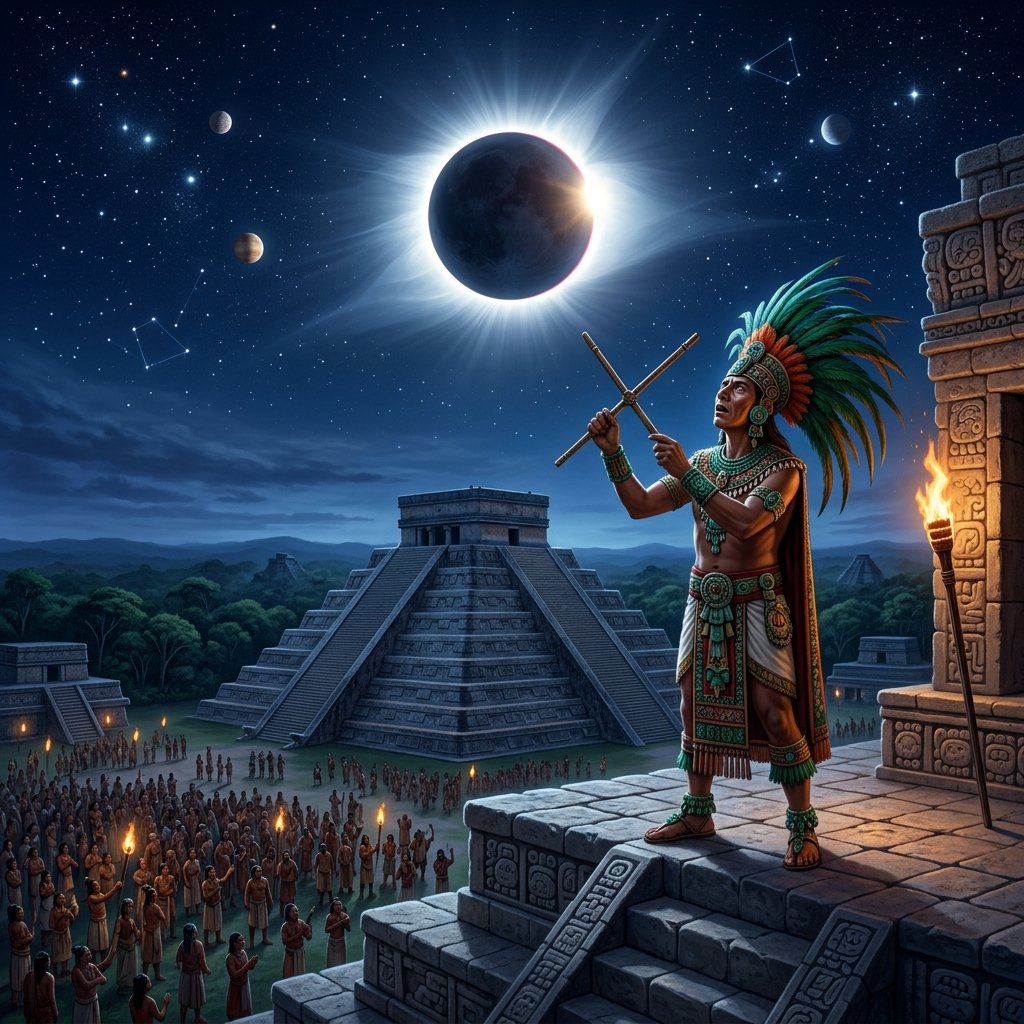
- Crossed-stick sighting devices — depicted in Maya iconography, similar in principle to a surveyor's transit, allowing precise angular measurements
The key insight is that Maya astronomy was positional and horological — it tracked exact positions and intervals — rather than structural in the Greek sense of building geometric models. The Maya didn't need to know why eclipses occurred to predict when they would. Their approach was empirical, mathematical, and extraordinarily effective.
Venus: The Most Dangerous Star
The Maya devoted even more attention to Venus than to the moon or sun. Venus was associated with warfare, danger, and the god Kukulkán. The Venus tables in the Dresden Codex (pages 24, 46–50) track the planet's 584-day synodic cycle through its four phases: morning star, superior conjunction (invisible), evening star, and inferior conjunction (invisible).
Maya kings timed military campaigns to coincide with Venus's first appearance as the morning star — a practice documented in hieroglyphic inscriptions at multiple sites. These "star war" events (chak ch'ahb') were considered cosmically ordained moments of maximum divine power (Schele & Freidel, A Forest of Kings, 1990).
Why It Matters Today
Maya astronomical achievements are relevant beyond historical curiosity. They demonstrate that sophisticated mathematical astronomy is not dependent on the Greek/European intellectual tradition. The Maya developed their methods independently, using entirely different mathematical frameworks (base-20 positional notation with zero), and achieved results comparable to — and in some cases exceeding — those of contemporary Old World civilizations.
As astronomer Anthony Aveni writes, this makes Maya astronomy "one of the great independent achievements of the human intellect" (Aveni, Skywatchers, 2001).
Frequently Asked Questions
Could the Maya predict eclipses visible from their location?
The Dresden Codex tables identify eclipse warning intervals — dates when eclipses are possible — rather than guaranteeing local visibility. Not every predicted eclipse would have been visible from Maya territory, but the tables reliably flagged every window in which an eclipse could occur. This conservative approach ensured that no eclipse went unwarned.
How did the Maya observe eclipses safely?
There is no direct evidence of specific eye-protection methods, but ethnohistoric accounts describe observing the sun's reflection in water — a technique that would have been safe. Solar eclipses are also observable with the naked eye during the partial phases in certain atmospheric conditions.
References & Further Reading
- Lounsbury, F. G. (1978). "Maya Numeration, Computation, and Calendrical Astronomy." In Dictionary of Scientific Biography, Vol. 15. Scribner's.
- Aveni, A. F. (2001). Skywatchers: A Revised and Updated Version of Skywatchers of Ancient Mexico. UT Austin Press.
- Aveni, A. F., Gibbs, S. L., & Hartung, H. (1975). "The Caracol Tower at Chichén Itzá: An ancient astronomical observatory?" Science, 188(4192), 977–985.
- Bricker, H. M. & Bricker, V. R. (2011). Astronomy in the Maya Codices. American Philosophical Society.
- Schele, L. & Freidel, D. (1990). A Forest of Kings: The Untold Story of the Ancient Maya. William Morrow.
- Milbrath, S. (1999). Star Gods of the Maya: Astronomy in Art, Folklore, and Calendars. UT Austin Press.