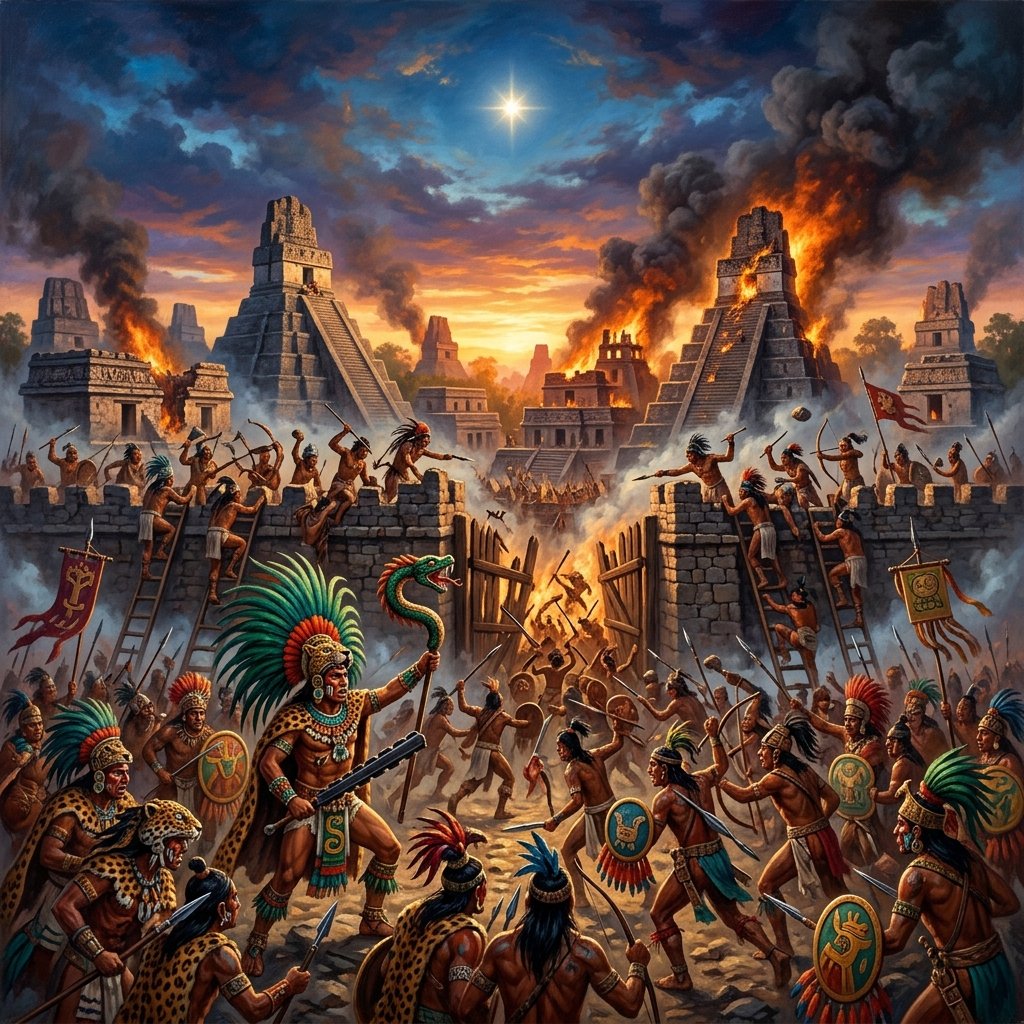
Maya Star Wars at a Glance
War by the Stars
Most Maya military conflicts were relatively limited affairs — border raids, tribute enforcement, or the capture of individual nobles for sacrifice. But some wars were different. Some carried the star-over-earth glyph — a catastrophic symbol showing a shower of stars raining down on a place name. These were Star Wars: total conflicts aimed at the complete destruction of an enemy dynasty.
What made Star Wars unique was their astronomical timing. These attacks were launched to coincide with the heliacal rising of Venus as the Morning Star — the first morning that Venus becomes visible in the pre-dawn sky after its period of invisibility. The Maya Venus war deity was depicted as a terrifying warrior hurling spears of light, and the king who attacked at this precise moment became the earthly instrument of cosmic destruction (Schele, L. & Freidel, D., A Forest of Kings, 1990, pp. 130–164).
The Most Famous Star War: Calakmul vs. Tikal (562 AD)
On April 29, 562 AD, the Snake Kingdom of Calakmul launched a devastating Star War against Tikal — the most powerful city in the Maya lowlands. Caracol Altar 21 records the star-war event, and the consequences were catastrophic:
- Tikal's king, Wak Chan K'awiil, was likely captured and sacrificed.
- Tikal entered a 130-year "hiatus" — a dark age during which no major monuments were erected and the city's political influence collapsed.
- Calakmul became the dominant power in the Maya lowlands, building a network of client states that encircled Tikal on all sides.
This was not a border skirmish. It was a civilizational catastrophe for Tikal — comparable to Rome's sack by the Visigoths in 410 AD. Tikal eventually recovered under the great king Jasaw Chan K'awiil I, who launched his own Star War against Calakmul in 695 AD, finally breaking the Snake Kingdom's power and ushering in Tikal's greatest architectural renaissance (Martin, S. & Grube, N., Chronicle of the Maya Kings and Queens, 2008, pp. 39–55).
Other Known Star Wars
- 378 AD — The "Entrada": A foreign warrior named Siyaj K'ahk' ("Fire Is Born") arrived at Tikal on January 15, 378, apparently from Teotihuacan. On that same day, Tikal's king Chak Tok Ich'aak I died. While not marked with the star-war glyph, this event reshaped Tikal's dynasty and established Mexican influence at the city.
- 695 AD — Tikal's revenge: Jasaw Chan K'awiil I defeated Calakmul's king Yich'aak K'ahk' in a Star War, capturing him for sacrifice. This ended Calakmul's century of dominance.
- 735 AD — Copán vs. Quiriguá: The vassal city of Quiriguá defeated its overlord Copán, capturing and beheading the great king Waxaklajun Ubah K'awiil (18 Rabbit) — one of the most dramatic political reversals in Maya history.
Astronomical Warfare: A Unique Concept
The Maya concept of astronomically timed warfare is virtually unique in world history. While many cultures have used astrology to select auspicious dates for battle (Alexander the Great consulted oracles), the Maya system was far more specific and integrated: the Venus tables in the Dresden Codex provided precise predictions of Venus risings, each associated with a specific war deity attacking a specific directional target. It was a military operations manual written in the stars.
Frequently Asked Questions
What were Maya Star Wars?
Total wars of dynastic destruction timed to Venus's heliacal rising as the Morning Star. Marked by the "star-over-earth" glyph, they aimed to capture and kill enemy kings. The most famous was Calakmul's defeat of Tikal in 562 AD.
Why did the Maya time wars to Venus?
Venus's Morning Star rising was a moment of maximum supernatural power. The Morning Star deity was a cosmic warrior hurling spears of light. Kings who attacked at this moment harnessed divine sanction — their armies became instruments of celestial destruction.
What is the star-over-earth glyph?
A hieroglyphic sign showing stars raining down on a place name. It indicates a devastating total war — not a skirmish but a war of dynastic destruction. Cities marked by this glyph typically experienced king-capture, major destruction, and prolonged decline.