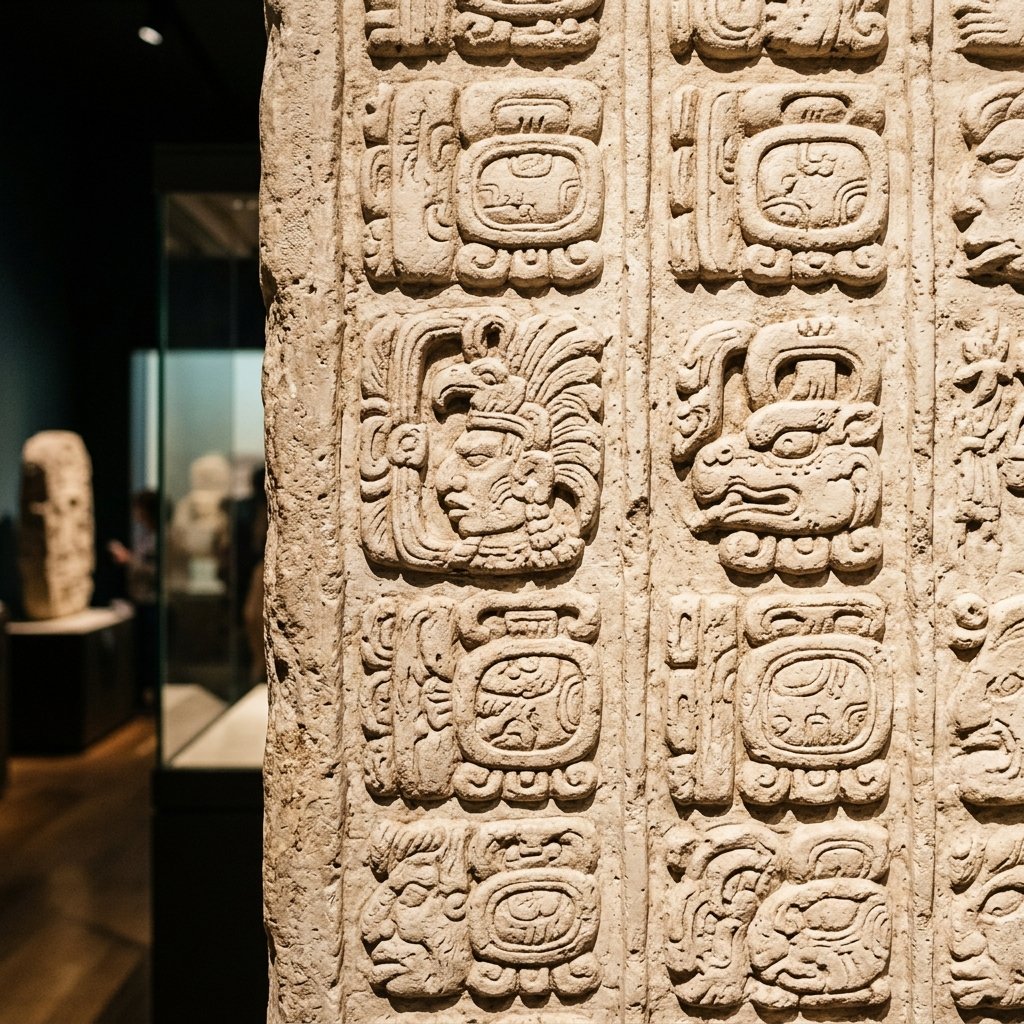
Emblem Glyphs at a Glance
The Discovery That Changed Everything
In 1958, the Guatemalan-German linguist Heinrich Berlin published a paper that would transform Maya studies forever. While examining hieroglyphic inscriptions from multiple sites, Berlin noticed a pattern: certain glyph compounds appeared consistently at specific cities. One compound recurred at Tikal, a different one at Palenque, another at Copán, yet another at Yaxchilán.
Berlin called these "emblem glyphs" — heraldic signs that identified specific polities. The implications were revolutionary: the Classic Maya were not a single unified civilization but a landscape of independent, named kingdoms, each with its own dynasty, political identity, and historical narrative. It was like discovering that ancient Greece wasn't one country but Athens, Sparta, Corinth, Thebes — each with its own name, ruler, and rivalries (Houston, S. & Stuart, D., Classic Maya Place Names, 1994).
The Structure of an Emblem Glyph
Every emblem glyph follows the same basic structure:
Together, they read: "K'uhul [Kingdom] Ajaw" — "Holy Lord of [Kingdom]." So a king of Tikal would carry the title K'uhul Mutal Ajaw — "Holy Lord of Mutal" (Tikal's ancient name). A king of Calakmul carried the title K'uhul Kaan Ajaw — "Holy Lord of the Snake."
The Major Kingdoms
Emblem Glyphs and Political History
Emblem glyphs do far more than identify cities — they reveal political relationships. When a king's inscription mentions another city's emblem glyph in the context of warfare, tribute, or alliance, scholars can reconstruct the diplomatic and military history of the Classic Maya world with remarkable specificity.
The great achievement of modern Maya epigraphy has been to use emblem glyphs (combined with royal names, dates, and event glyphs) to reconstruct the complete dynastic histories of dozens of Maya kingdoms — a level of historical detail that would be unimaginable without Berlin's 1958 discovery (Martin, S. & Grube, N., Chronicle of the Maya Kings and Queens, 2008).
Frequently Asked Questions
What is a Maya emblem glyph?
A hieroglyphic compound identifying a Maya kingdom — reading "K'uhul [Kingdom] Ajaw" ("Holy Lord of [Kingdom]"). Over 60 have been identified, revealing that the Classic Maya world was a landscape of named, rival kingdoms like ancient Greece.
How were emblem glyphs discovered?
Heinrich Berlin noticed in 1958 that specific glyph compounds appeared consistently at specific sites — one at Tikal, another at Palenque, etc. He called them "emblem glyphs." This discovery transformed Maya studies from studying an undifferentiated civilization to mapping a political landscape of rival kingdoms.
How many Maya kingdoms were there?
Over 60 distinct emblem glyphs have been identified, suggesting at least 60 polities. The actual number was likely higher. Major kingdoms included Tikal (Mutal), Calakmul (Kaan), Palenque (B'aakal), Copán, Yaxchilán, and Piedras Negras.
Scholarly References
- Berlin, H. "El glifo 'emblema' en las inscripciones mayas." Journal de la Société des Américanistes, vol. 47, 1958, pp. 111–119.
- Martin, S. & Grube, N. Chronicle of the Maya Kings and Queens. Thames & Hudson, 2nd ed., 2008.
- Houston, S. & Stuart, D. Classic Maya Place Names. Dumbarton Oaks, 1994.
- Stuart, D. & Houston, S. "Maya Writing." Scientific American, vol. 261, 1989, pp. 82–89.