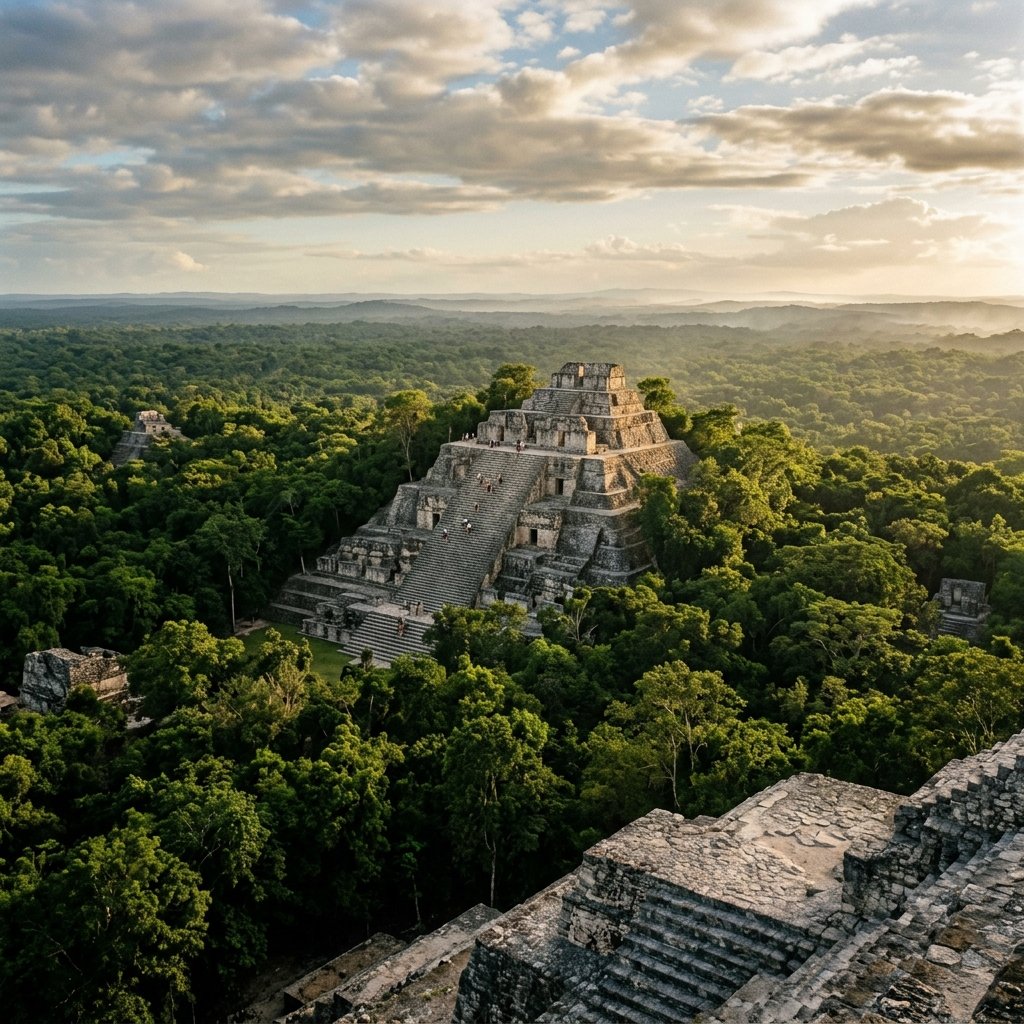
Calakmul at a Glance
The Snake Kingdom: Masters of Maya Geopolitics
For over a century, Tikal was considered the undisputed superpower of the Classic Maya lowlands. But as epigraphers learned to read the hieroglyphs in the 1990s, a different reality emerged: Tikal spent the 6th and 7th centuries locked in a brutal, multi-generational war for supremacy against an even larger adversary hidden deep in the jungles of Campeche. The Maya called this rival dynasty Kaan — the Snake Kingdom. Its capital was Calakmul.
The Tikal-Calakmul rivalry defined Maya geopolitics in the same way that Athens vs. Sparta or Rome vs. Carthage defined the classical Mediterranean (Martin & Grube, Chronicle of the Maya Kings and Queens, Thames & Hudson, 2000). But Calakmul rarely fought Tikal directly. Instead, the Snake Kings operated like a modern superpower, surrounding their rival through a brilliant strategic network of alliances, proxy wars, and vassal states stretching from Honduras to the Gulf of Mexico.
The Architecture of Power
Structure II: The Mountain in the Jungle
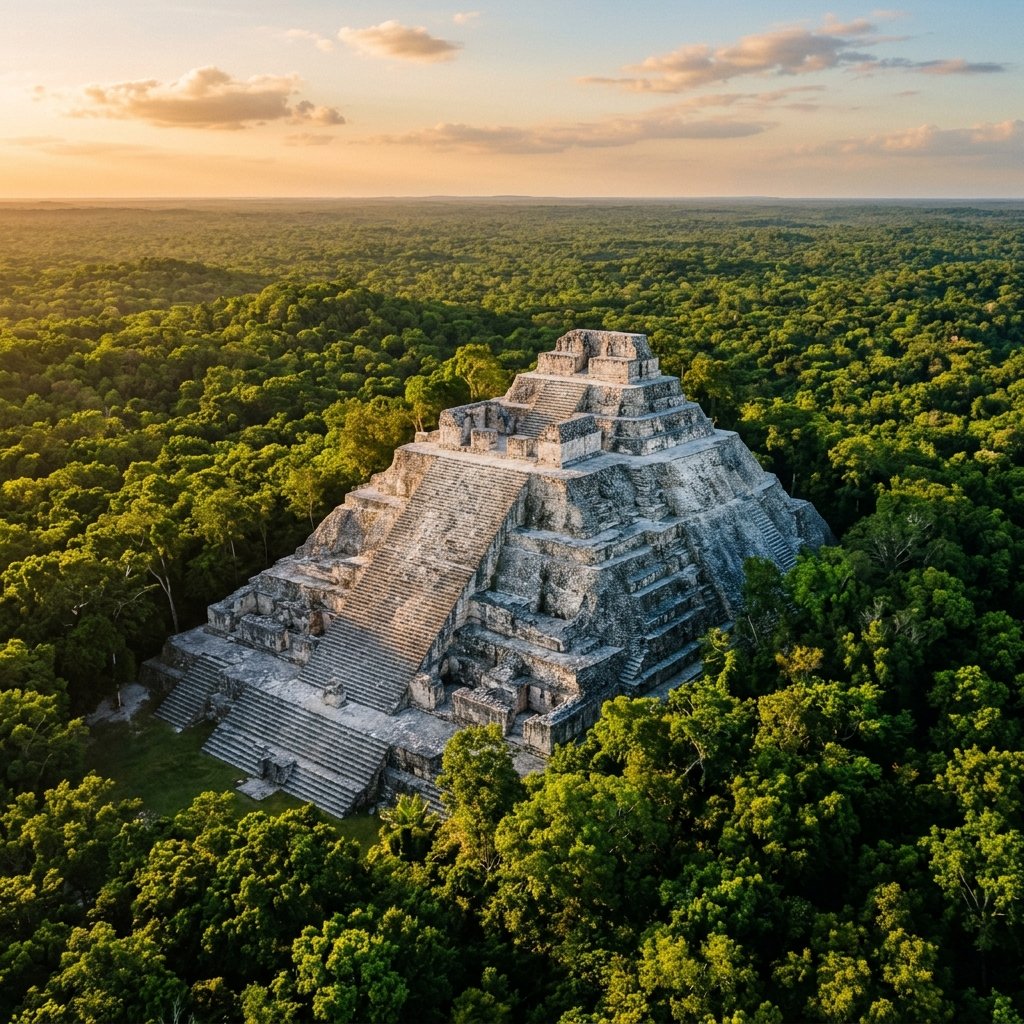
Structure II — the heart of the Snake Kingdom. Measuring over 120 meters at its base and rising 45 meters high, this is one of the most massive pyramids ever built by the ancient Maya. When climbed, the summit offers a staggering view of an unbroken sea of green jungle stretching in every direction to the horizon.
The sheer physical mass of Calakmul is staggering. The central monuments are among the largest ever constructed in the Maya world. The most dominant is Structure II, an immense stepped pyramid that measures 120 meters on a side at its base and rises 45 meters (nearly 150 feet) into the sky. Unlike the steep, narrow, elegant temples of Tikal, Calakmul's pyramids are broad, sprawling mountains of stone (Folan et al., "Calakmul: New Data from an Ancient Maya Capital in Campeche, Mexico," Latin American Antiquity, 1995).
Structure II is unique because it is effectively a "palace-pyramid" complex. The sprawling base supported administrative buildings, elite residences, and ceremonial spaces, while the summit housed the primary sanctuary. This architectural choice reflects Calakmul's governing philosophy: it was not merely a temple built to touch the sky, but a fortified acropolis of bureaucratic and political power. When visitors climb Structure II today, the reward is a 360-degree view of an emerald ocean: the canopy of the largest tropical forest in Mexico extending unbroken to the horizon.
The Central Plaza: 120 Stone Witnesses
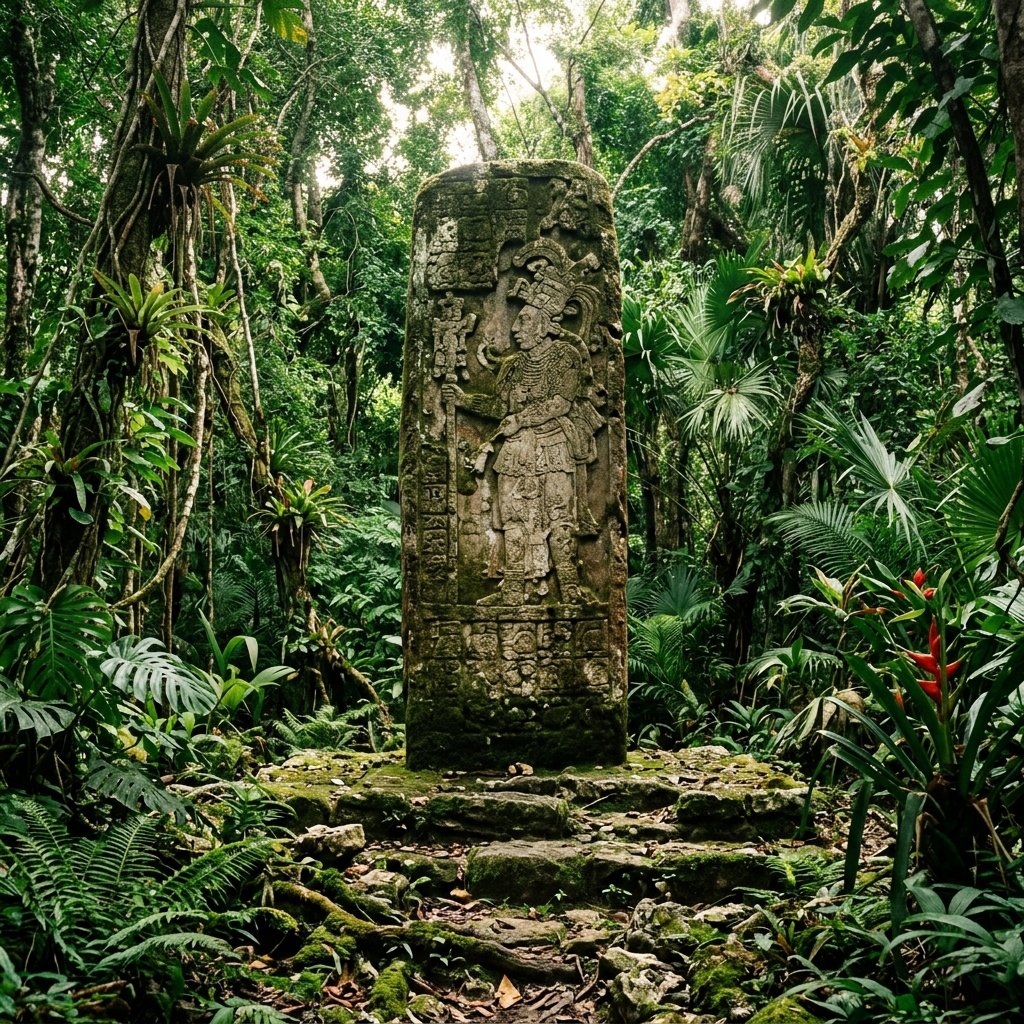
One of Calakmul's 120 stelae standing in the dense forest. No other Maya city erected as many stone monuments. Due to the soft, porous limestone of the region, most are heavily weathered today, but epigraphers have managed to extract crucial historical data from these stones, reconstructing the dramatic history of the Snake Kingdom's rise and fall.
Calakmul contains 120 stelae (carved stone monuments) — more than any other site in the Maya world. These stones were erected in the massive public plazas at the base of the pyramids, serving as public billboards announcing royal accessions, military victories, and cosmic rituals.
Unfortunately, the limestone available at Calakmul is highly porous. Two millennia of torrential jungle rain have eroded the carvings severely, leaving many of the stelae looking like blank slabs of mossy rock. Yet through sophisticated lighting techniques and meticulous study, epigraphers like Simon Martin and Nikolai Grube have deciphered enough text from these stones to reconstruct the complete dynastic sequence of the Snake Kings, rescuing Calakmul from obscurity and rewriting the history of the Classic Period (Martin, "In Line of the Founder: A View of Dynastic Politics at Tikal," 1996).
The Snake King Wars: A Timeline of Hegemony
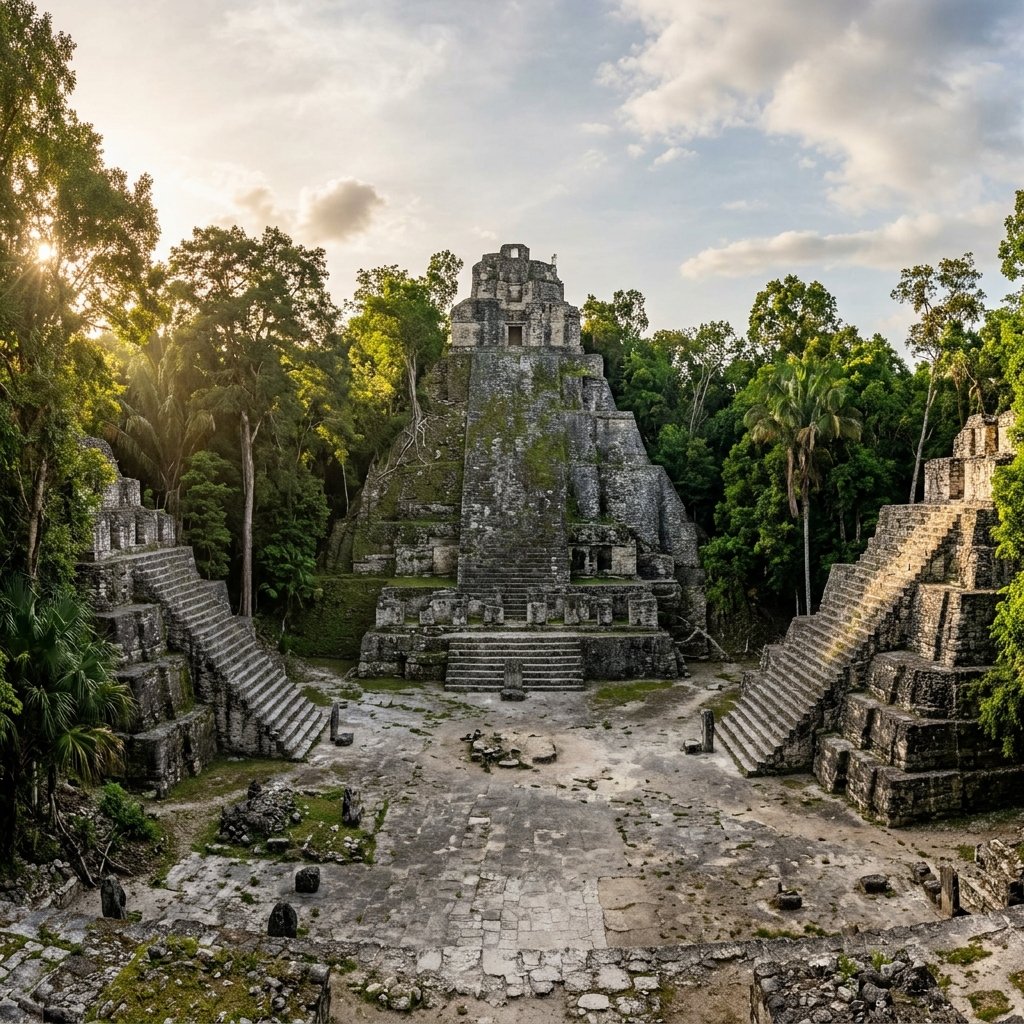
The Great Plaza of Calakmul. During the 7th century, under the rule of Yuknoom the Great, this was the diplomatic and military nerve center of the entire Maya lowlands. Vassal kings from across the Yucatán Peninsula journeyed to this exact plaza to pledge fealty to the Snake King.
The history of Calakmul is the history of its relentless effort to isolate and destroy Tikal. The geopolitical chess match spanned over 130 years and fundamentally shaped determining the fate of cities hundreds of kilometers away.
- 562 AD (The Devastating Blow): Calakmul forms an alliance with Caracol (in modern Belize) and orchestrates a catastrophic attack on Tikal. Tikal's king, "Double Bird," is captured and likely sacrificed. Tikal is utterly humiliated and enters a 130-year "Hiatus" during which no new monuments are erected. Calakmul achieves total regional hegemony.
- 599 & 611 AD (The Western Campaigns): Not content to dominate the east, the Snake Kings turn west, attacking Palenque twice. Calakmul's armies march hundreds of miles, sack Palenque, and slaughter its royal court, cementing their control over the western trade routes.
- 636–686 AD (The Golden Age): Under the legendary king Yuknoom Ch'een II ("Yuknoom the Great"), the Snake Kingdom reaches its absolute zenith. He rules for 50 years, brokering marriages, assassinating rivals, placing puppet kings on foreign thrones, and forging an alliance network that covers the entire Maya lowlands. When he dies at age 86, Calakmul is the undisputed master of the Maya world.
- 695 AD (The Collapse): Yuknoom's successor, Yich'aak K'ahk' (Claw of Fire), pushes too far. A resurgent Tikal, led by King Jasaw Chan K'awiil I, meets Calakmul in a massive pitched battle on August 5, 695 AD. Tikal wins a decisive, stunning victory. The Snake King's palanquin is captured, and Calakmul's hegemony is broken forever (Martin & Grube, 2000).
The Biosphere: The Wild Heart of the Jungle
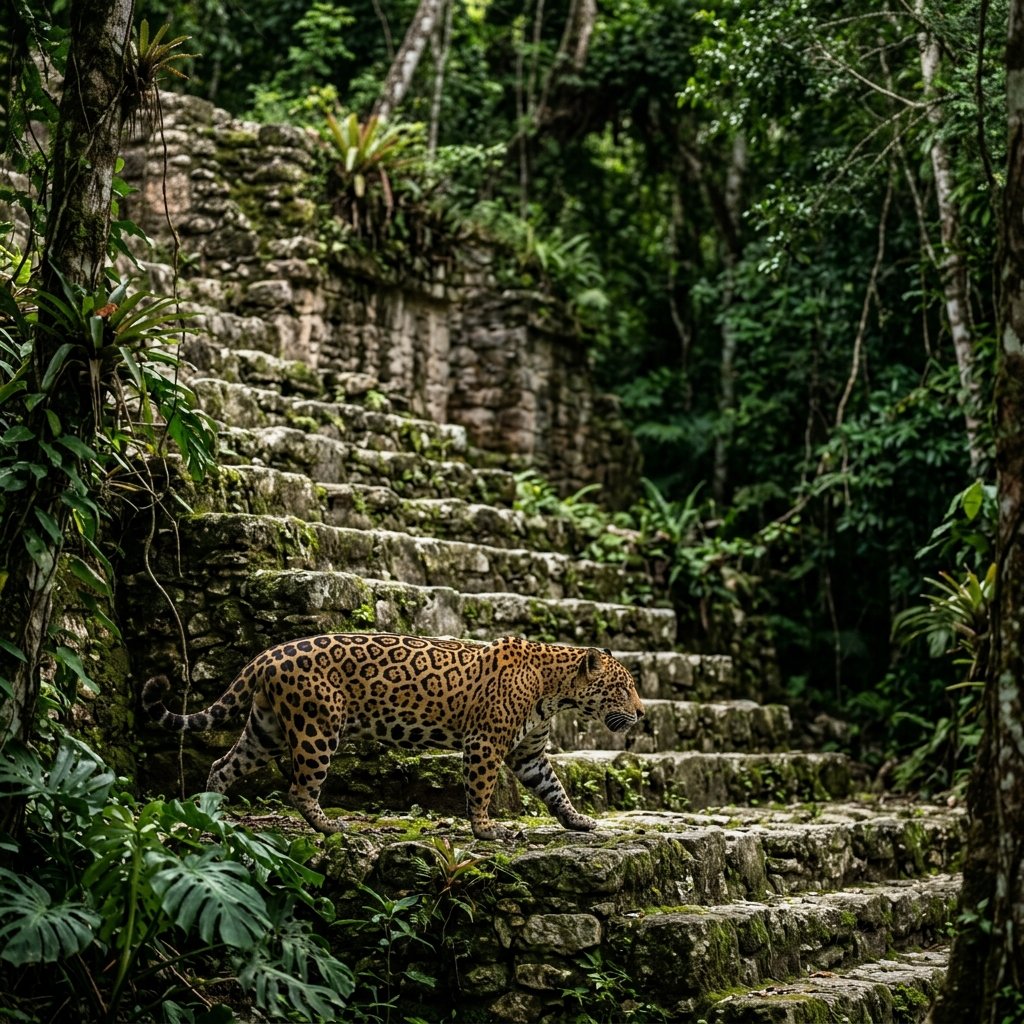
A jaguar in the Calakmul Biosphere Reserve. Calakmul is unique among major Maya sites because it sits in the heart of Mexico's largest protected tropical forest (7,200 sq km). The archaeological zone is entirely blended with the natural environment. While elusive, jaguars are regularly caught on camera traps near the ruins, alongside ocelots, tapirs, and hundreds of bird species.
Visiting Calakmul today is a profoundly different experience than visiting Chichén Itzá or Tulum. The site sits near the Guatemalan border in the center of the Calakmul Biosphere Reserve, a 7,200-square-kilometer swath of protected tropical forest. Because of its remote location, the site receives only a tiny fraction of the visitors that other major ruins see. You will often find yourself alone on top of a pyramid.
The Reserve is home to the largest population of jaguars in Central America, as well as pumas, ocelots, tapirs, howler monkeys, spider monkeys, and over 350 species of birds including the magnificent ocellated turkey and various toucan species (Valdez et al., "The Ancient Maya and their Forest: A Millennium of Sustainable Management," 2006). Driving the 60-kilometer single-lane access road into the reserve at dawn is one of the greatest wildlife viewing opportunities in Mexico.
This synthesis of monumental human history and raw natural power earned Calakmul its designation as Mexico's first UNESCO Mixed World Heritage Site (recognized for both cultural and natural value) in 2014. It is the ultimate "lost city in the jungle" experience.
Practical Travel Guide
Getting There
Calakmul requires commitment. The nearest town with hotels is Xpujil (approx. 1.5 hours from the park entrance). Once you enter the Biosphere Reserve from Highway 186, it is a narrow, potholed, 60km drive through dense jungle to reach the ruins (takes 1.5 to 2 hours). A rental car is essential. There is no public transit.
Best Strategy
Leave Xpujil at 5:30 AM to hit the park entrance when it opens at dawn. The early drive in offers the best chance of spotting elusive wildlife (cats, tapirs). Plan for 3–5 hours at the ruins themselves. The heat and humidity by midday are intense.
What to Bring
Everything. There are no stores, no cell service, and no restaurants within 60 kilometers. Bring abundant water (a gallon per person), snacks, strong insect repellent, good walking shoes, and binoculars for the canopy wildlife.
Combine With
The "Rio Bec Route" along Highway 186 near Xpujil features several fascinating and completely empty Maya sites characterized by ornamental false pyramid towers — Becán, Chicanná, and Xpujil. Balamkú, near the Calakmul turnoff, has an incredible preserved stucco frieze.
Visitor Comparison
| Feature | Calakmul | Tikal | Palenque |
|---|---|---|---|
| Setting | Deep, dense jungle | Deep jungle park | Jungle foothills |
| Architecture Style | Massive/Broad Pyramids | Towering/Steep Pyramids | Elegant Palaces/Stucco |
| Crowd Level | Very Low | Moderate–High | Moderate |
| Wildlife Spotting | Excellent | Excellent | Good |
| Effort to Visit | High (remote) | Moderate | Easy |
Key Academic References
- Folan, William J. et al. "Calakmul: New Data from an Ancient Maya Capital in Campeche, Mexico." Latin American Antiquity, 6(4), 1995.
- Martin, Simon. "In Line of the Founder: A View of Dynastic Politics at Tikal." Maya Stateward Beyond Tikal, 1996.
- Martin, Simon & Grube, Nikolai. Chronicle of the Maya Kings and Queens. Thames & Hudson, 2000.
- Schele, Linda & Freidel, David. A Forest of Kings: The Untold Story of the Ancient Maya. William Morrow, 1990.
- Valdez, Fred et al. "The Ancient Maya and their Forest: A Millennium of Sustainable Management." The Maya and their Forest, 2006.
Frequently Asked Questions
Was Calakmul larger than Tikal?
In terms of urban sprawl and total number of structures (over 6,750), they are very comparable, both being massive regional superpowers. However, Calakmul's political reach and alliance network during the 7th century under Yuknoom the Great was undeniably larger. For much of the Classic Period, Calakmul was the dominant geopolitical force in the Maya world, keeping Tikal contained through proxy wars and vassal states.
Why did Calakmul collapse?
Calakmul suffered a catastrophic military defeat to Tikal in 695 AD, from which its political hegemony never fully recovered. However, the city continued to be inhabited. Its final collapse, centuries later, was part of the broader Maya collapse (c. 800-1000 AD), likely driven by prolonged severe drought, overpopulation, deforestation, and the breakdown of regional trade networks.
Why are Calakmul's stelae in such bad condition?
While Calakmul erected more stelae (120) than any other Maya site, the local limestone in the Campeche area is soft and highly porous. Centuries of exposure to torrential rain and acidic jungle vegetation have eroded most of the carvings. Unlike sites like Copán (volcanic tuff) or Yaxchilán (harder limestone), Calakmul's public records literally washed away. Modern epigraphy has recovered the history through intense scrutiny of the faint remaining details.
Can you climb the pyramids at Calakmul?
Yes. Unlike many heavily visited sites like Chichén Itzá or Tulum, visitors are currently still allowed to climb the major structures at Calakmul, including the massive Structure II. The view from the top—a 360-degree panorama of unbroken green jungle—is one of the most spectacular sights in Mexico.
Is it safe to drive to Calakmul?
The drive is safe from a security standpoint, but requires severe logistical caution. The 60-kilometer access road from the highway is a narrow, paved but potholed single lane cutting through raw jungle. There is no cell service, no gas stations, and very little traffic. Ensure your rental car is in good condition, have a full tank of gas from Xpujil, and carry a spare tire and plenty of water.