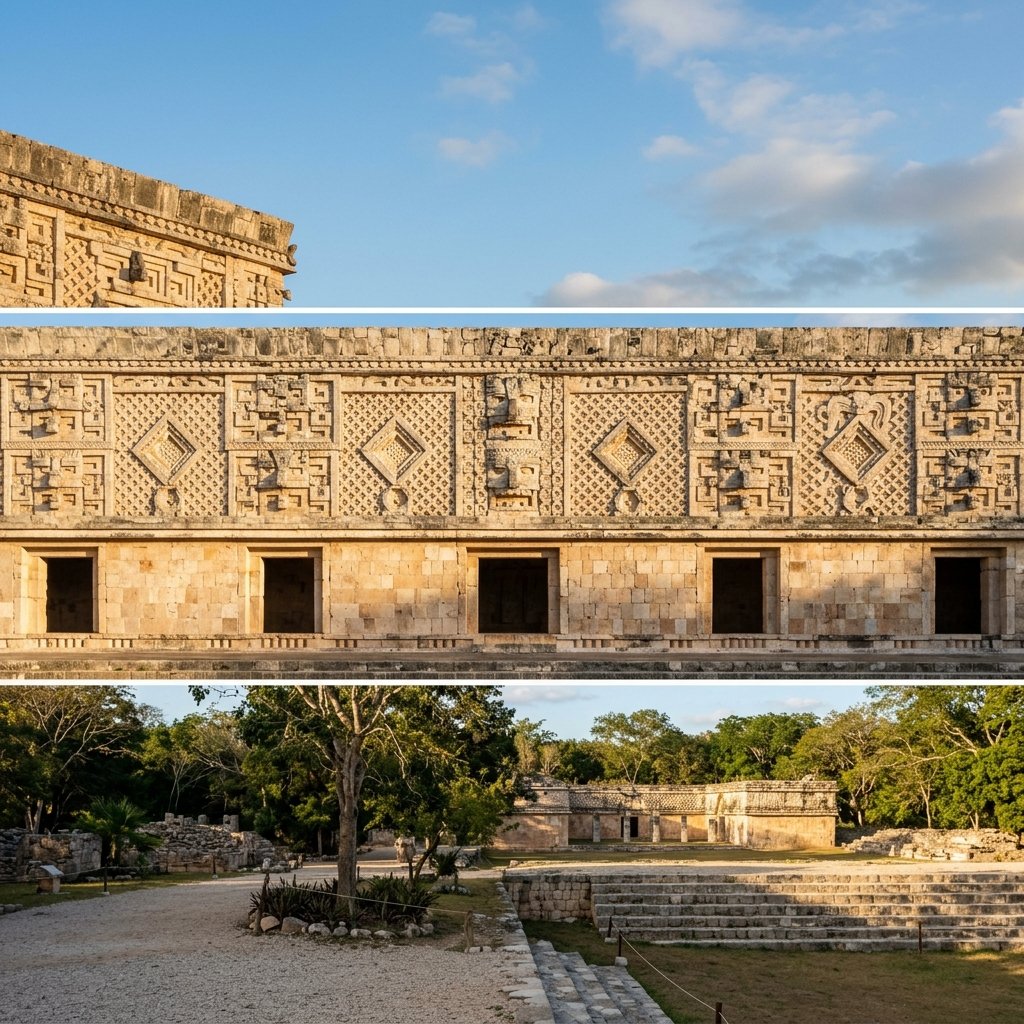
Mathematics as Worship
For the Maya, there was no separation between mathematics and spirituality. Numbers were divine — each carried cosmological meaning. Architecture was prayer expressed in stone. When they proportioned a pyramid using ratios derived from the calendar, they were literally building the cosmos in miniature. Sacred geometry wasn't decoration — it was theology.
"When a Maya king ordered the construction of a pyramid, he was not merely commissioning a building. He was commissioning a three-dimensional calendar — a structure whose proportions, alignments, and numerical elements encoded the entire cosmological order. You could walk through these buildings and literally inhabit time."
The Ratios in Maya Architecture
Architectural surveys using modern laser measurement and photogrammetry have identified several recurring proportional systems in Maya buildings — ratios that appear with a consistency across sites and centuries that cannot be attributed to coincidence. These proportional systems link Maya architecture to a broader human tradition of mathematical design, while also embedding uniquely Mesoamerican calendrical and cosmological values:
| Ratio | Value | Where It Appears in Maya Design | Cross-Cultural Parallels |
|---|---|---|---|
| √2 | 1.414... | Base-to-height ratios at Uxmal, Palenque | Parthenon, Vedic fire altars |
| √5 | 2.236... | Temple of the Inscriptions proportions at Palenque | Great Pyramid of Giza |
| φ (phi) | 1.618... | Facade proportions at El Castillo, Uxmal's Governor's Palace | DNA helix, nautilus shell, Gothic cathedrals |
| 52 / 73 | 0.712... | Calendar Round encoded in building layouts and panel counts | Unique to Mesoamerica |
Astronomical Alignment: Buildings as Celestial Instruments
Maya buildings were not oriented randomly — they were aligned to celestial events with extraordinary precision, transforming architecture into astronomical instruments:
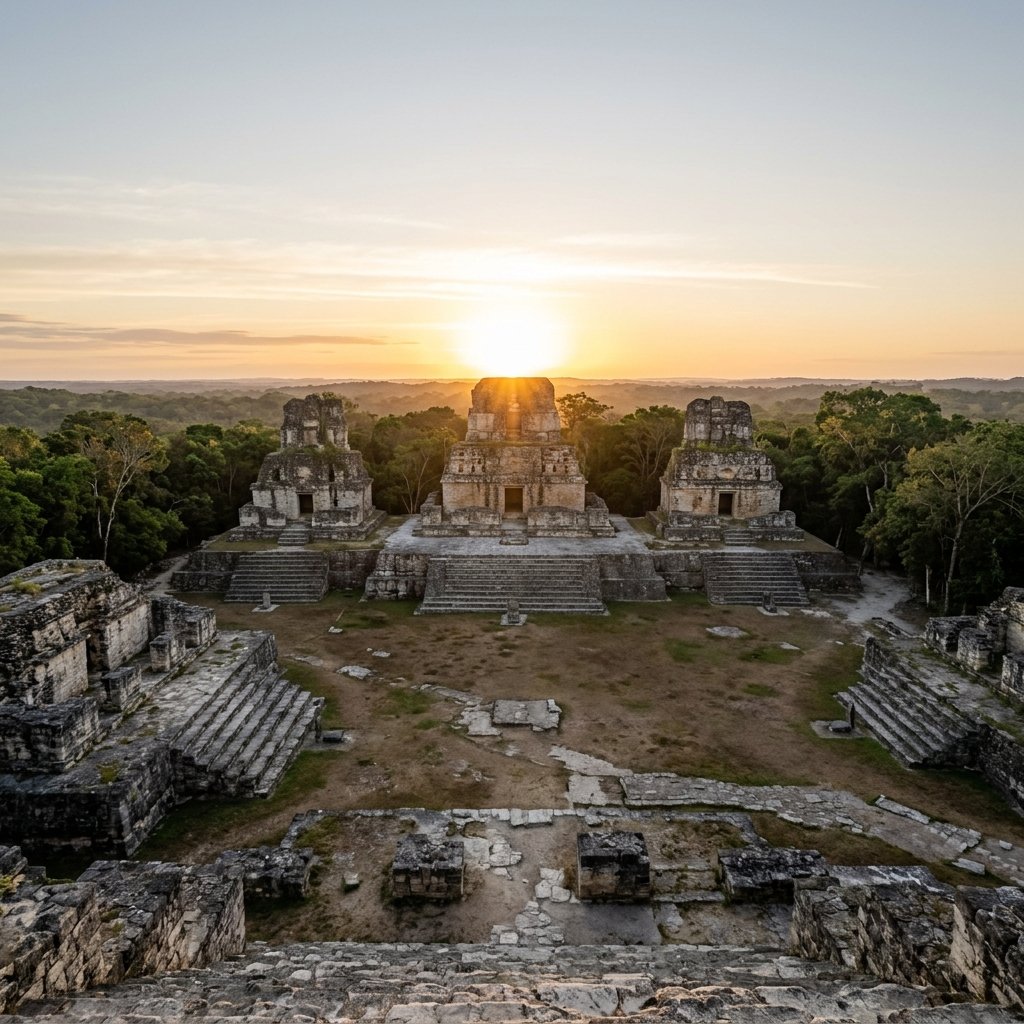
A Maya E-Group complex — the earliest known type of Maya astronomical architecture, appearing as early as 600 BC. The observer stands on a western pyramid and sights toward three eastern platforms that precisely mark the positions of sunrise at the summer solstice, the equinoxes, and the winter solstice. These architectural sighting instruments demonstrate that the Maya commitment to astronomical precision preceded their monumental building tradition — astronomy drove architecture, not the reverse.
- El Castillo: 91 steps per side × 4 sides + 1 top platform = 365, the days of the solar year. At the spring and fall equinoxes, the stepped pyramid's shadow creates the illusion of a feathered serpent (Kukulkán) descending the northern stairway — a phenomenon that attracts over 40,000 visitors annually.
- El Caracol: The round tower observatory at Chichén Itzá has windows aligned to Venus's extreme positions on the horizon — the northernmost and southernmost points of its 584-day cycle. Anthony Aveni's measurements confirmed alignments accurate to within 1° of arc (Aveni et al., Science, 1975).
- E-Group complexes: Among the earliest Maya architectural forms — platforms designed as sighting instruments for marking solstice and equinox sunrise positions. Found at dozens of sites from the Middle Preclassic period (600 BC) onward.
- City-scale orientation: Many Maya cities are oriented 14° east of north — corresponding to the azimuth of sunrise on the date of the sun's zenithal passage at 14.8° N latitude, the heart of the lowlands. This suggests that entire cities were oriented to a single astronomical event.
The Calendar in the Architecture
Perhaps the most remarkable aspect of Maya sacred geometry is the embedding of calendrical numbers in architectural form — numbers that transform buildings from mere structures into cosmological statements:
Pyramids with 9 stepped terraces reflect the 9 levels of Xibalba (the underworld). The Temple of the Inscriptions at Palenque — Pakal's burial monument — has exactly 9 levels.
Some temple-pyramids have 13 levels — the 13 layers of the celestial realm. A pyramid with 9 underworld levels + 1 earth plane + 13 sky levels = the full 23-level Maya cosmos.
Decorative programs featuring 52 elements encode the 52-year Calendar Round — the cycle at which the 260-day Tzolk'in and the 365-day Haab' realign.
Carved friezes with 260 decorative elements represent the days of the Tzolk'in sacred calendar — the most important ritual cycle in Maya religion.
When a Maya king built a pyramid, he was constructing a three-dimensional calendar — a building whose very proportions and numerical elements expressed the cosmic order. As Kowalski and Dunning observe, "Maya architecture was designed to be inhabited not merely physically but temporally — to live in these buildings was to inhabit time" (Kowalski & Dunning, Mesoamerican Architecture as a Cultural Symbol, Oxford University Press, 1999, p. 154).
Universal Ratios or Independent Discovery?
The presence of similar proportional ratios (φ, √2, √5) in Maya, Egyptian, Greek, and Indian architecture raises a profound question: is there a universal mathematical aesthetic hardwired into the human brain, or did these proportional systems travel between civilizations through unknown channels?
Mathematician Jay Kappraff has argued that certain proportional systems emerge naturally from simple geometric operations available to any civilization with rope, stakes, and careful observation — making independent invention the most parsimonious explanation. The √2 ratio, for example, is simply the diagonal of a square; φ emerges naturally from pentagonal geometry; and √5 appears in the relationship between the diagonal of a double square and its sides (Kappraff, J., Connections: The Geometric Bridge Between Art and Science, World Scientific, 2001, pp. 45–78).
But the specific way the Maya wove calendrical and cosmological numbers into their geometric systems has no exact parallel elsewhere — suggesting that while the mathematical tools may be universal, their application was uniquely Maya. No other civilization embedded a 260-day sacred calendar, a 365-day solar year, and a 52-year renewal cycle into the proportions of its buildings with such systematic consistency.
References
- Ashmore, W. "Site-Planning Principles and Concepts of Directionality among the Ancient Maya." Latin American Antiquity, 2(3), 1991, pp. 199–226.
- Aveni, A.F. et al. "The Caracol Tower at Chichén Itzá: An Ancient Astronomical Observatory?" Science, 188(4192), 1975, pp. 977–985.
- Kappraff, J. Connections: The Geometric Bridge Between Art and Science. 2nd ed. World Scientific, 2001.
- Kowalski, J.K. & Dunning, N.P. Mesoamerican Architecture as a Cultural Symbol. Oxford University Press, 1999.
Frequently Asked Questions
Did the Maya know about the golden ratio?
The Maya did not express the golden ratio algebraically (as the Greeks did with φ = (1+√5)/2), but architectural measurements at several sites — including El Castillo at Chichén Itzá and the Governor's Palace at Uxmal — show proportions consistent with φ (1.618...). Whether this reflects conscious mathematical use of the ratio, an intuitive aesthetic sense for harmonious proportions, or an artifact of construction geometry remains actively debated. What is certain is that Maya architects worked within sophisticated proportional systems that produced buildings of extraordinary visual harmony — systems that they clearly transmitted through training and tradition.
Why do Maya pyramids have specific numbers of steps?
Maya pyramids encode calendrical and cosmological numbers in their structure. The most famous example is El Castillo at Chichén Itzá: 91 steps per side × 4 sides + 1 top platform = 365, the days of the solar year. Nine-level pyramids reference the nine levels of the underworld; thirteen-level structures reference the thirteen layers of the heavens. These numerical encodings transform buildings from mere architecture into theological statements — three-dimensional expressions of the Maya cosmic order.