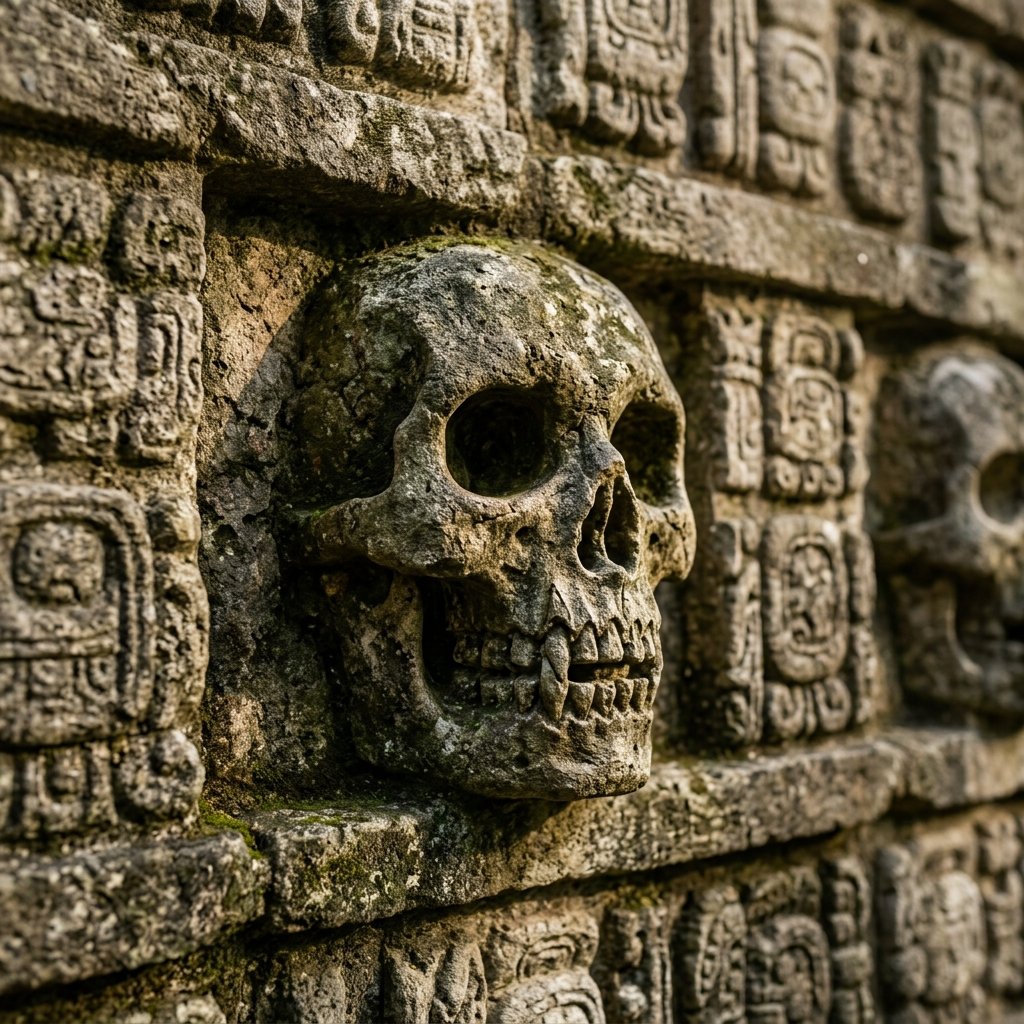
Ah Puch at a Glance
"Death is not what you think it is. The Maya did not imagine death as an ending — a light going out, a door slamming shut. They conceived it as a road: dark, difficult, terrifying, but a road nonetheless. And at the end of that road, for those brave or fortunate enough to reach it, was the possibility of rebirth."
The Lord with No Flesh: Understanding God A
Ah Puch (pronounced "ah POOCH") is the most visually arresting deity in the Maya pantheon — a figure so explicitly associated with putrefaction that his very name variants reek of decay. The Yucatec Maya knew him as Yum Kimil ("Lord of Death") and Kisin or Cizin — a name derived from the Maya word for flatulence, meaning literally "The Flatulent One" or "The Stinking One." This is not mere crudity. It reflects the Maya's unflinching descriptive precision: death smells. The body decomposes. The death god embodies this process not as metaphor but as fact.
In the Schellhas classification system, Ah Puch is designated God A — the very first letter, given to the first deity Schellhas identified in the Maya codices. As Karl Taube has documented, God A "is one of the most frequently occurring supernatural figures in the Late Postclassic codices," appearing "in scenes of destruction, sacrifice, and journeying through the underworld" (Taube, K., The Major Gods of Ancient Yucatan, Dumbarton Oaks, 1992, pp. 11–18). His ubiquity is telling: the death god is everywhere in Maya art because death is everywhere in life. The Maya did not hide from this reality — they depicted it, honored it, and built an elaborate theological architecture around it.
Iconography: Reading the Body of Death
God A is one of the most diagnostically unambiguous figures in Maya art — his features are so distinctive that even untrained observers can identify him instantly. Every element of his appearance carries meaning:
The Body
- Skeletal frame — visible ribs, spine, and long bones, representing the stripping away of flesh
- Bloated belly — the gases of decomposition, the body returning to the earth
- Black spots on skin — the livor mortis discoloration of death, which the Maya observed and faithfully recorded
- Protruding vertebrae — the skeleton beneath all flesh, the ultimate truth of the body
The Attributes
- "Percentage sign" eyes (%) — a diagnostic closed-eye motif representing the shutting of eyes in death
- Death collar — a necklace of disembodied eyeballs or severed heads
- Bells — attached to the hair or clothing, whose sound announces death's approach
- Moan bird headdress — the owl, whose nocturnal cry was a death omen throughout Mesoamerica
The "percentage sign" motif (%) is perhaps the single most important diagnostic marker. It appears as a closed eye with a curving element beneath it — representing the eye of a corpse, permanently shut. As David Stuart has demonstrated through his epigraphic work on Classic Maya death expressions, the Maya scribes used this motif consistently across centuries and regions as a "shorthand for the state of death" — appearing not only on the body of God A but on any figure or object associated with the underworld (Stuart, D., Sourcebook for the 30th Maya Hieroglyphic Forum, Department of Art and Art History, University of Texas at Austin, 2006).
Xibalba: The Architecture of the Underworld
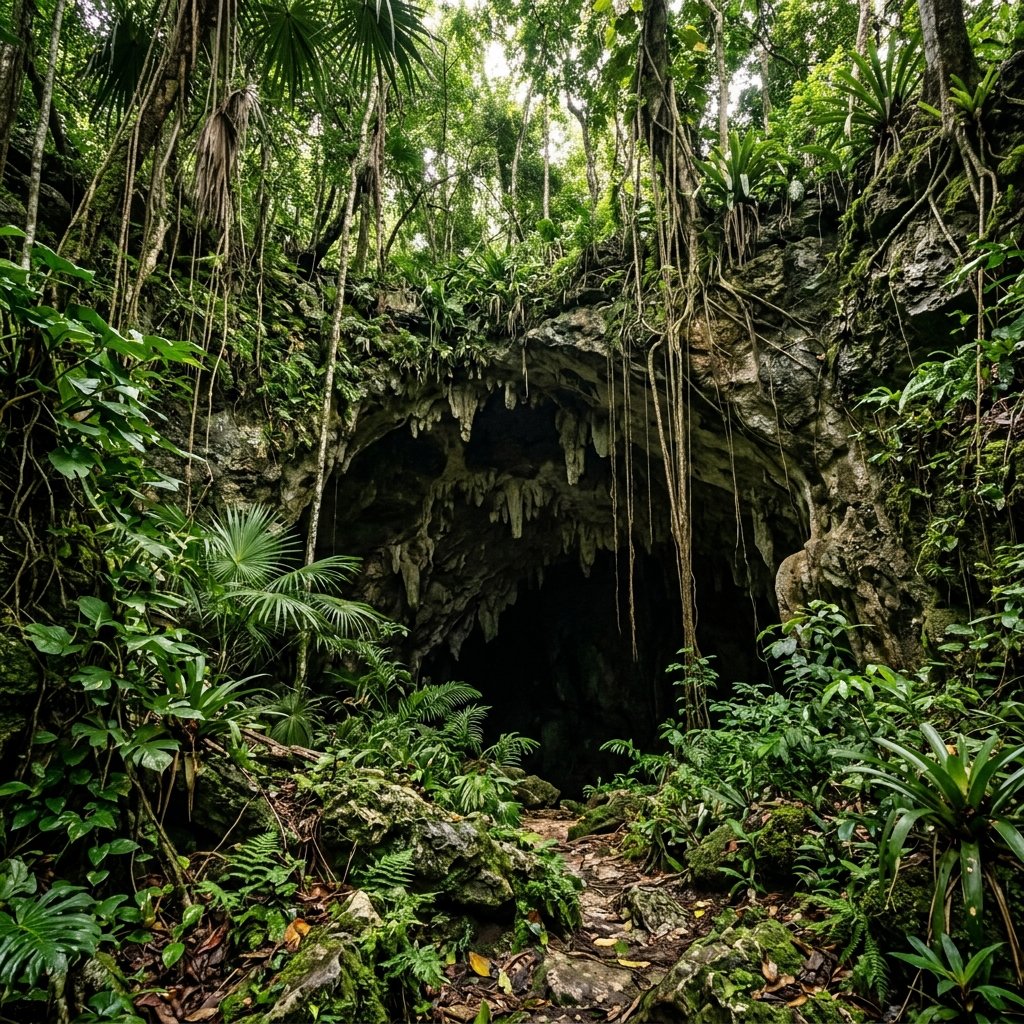
A limestone cave entrance in the Yucatan jungle. The ancient Maya believed that cave openings — ch'een in Yucatec — were literal portals to Xibalba, the underworld. The transition from blinding tropical sunlight to absolute subterranean darkness was understood as a passage between cosmic levels. Many caves in the Maya region contain archaeological evidence of ritual use: ceramics, incense burners, and human remains deposited as offerings to the lords of death.
The realm of Ah Puch is Xibalba (pronounced "shi-bal-BAH") — literally "Place of Fear" or "Place of Fright" in K'iche' Maya. Xibalba is not a simple "hell." It is a complex, geographically detailed underworld with its own roads, rivers, houses, and ruling council — an alternate reality that mirrors the surface world but inverts it. Where the living world has sunlight, Xibalba has perpetual darkness. Where the living world has maize and abundance, Xibalba has trial and deprivation.
The Popol Vuh provides the most detailed description of Xibalba's structure. The road to the underworld descends through a steep ravine and crosses several rivers — including a river of pus and a river of blood — before arriving at a crossroads where the traveler must choose between four roads (black, white, red, and yellow). Only the black road leads to Xibalba.
Within Xibalba, the soul encounters six houses of trial, each more terrible than the last:
These trials are not arbitrary cruelty. In Maya theology, the passage through Xibalba is a transformative ordeal — a spiritual journey that strips away the ego, tests courage and intelligence, and prepares the soul for possible rebirth. The Hero Twins, Hunahpú and Xbalanqué, famously navigate all six houses and defeat the lords of Xibalba through wit and sacrifice — a mythic template suggesting that death can be overcome, not through brute force, but through cleverness, humility, and self-sacrifice.
The Jade Road: Maya Burial and the Journey to Xibalba
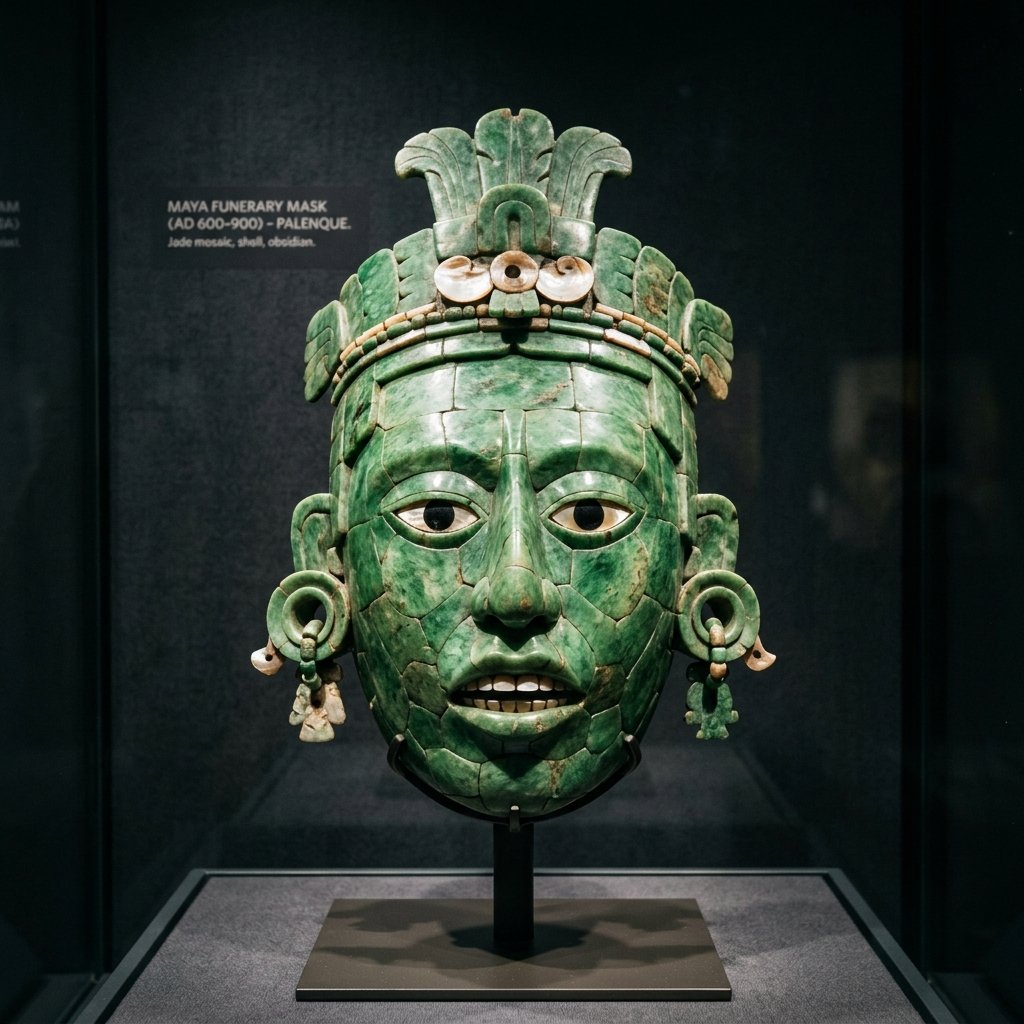
A Maya jade funerary mask of the type placed over the faces of deceased kings. Jade — the most precious substance in the Maya world — was associated with breath, water, and the life force. By covering the face of the dead in jade, the Maya symbolically provided the soul with the spiritual sustenance needed for the journey through Xibalba. The most famous example is the jade mosaic mask of K'inich Janaab Pakal, recovered from his tomb at Palenque.
Maya burial practices were not mere farewell gestures — they were engineering for the afterlife, carefully designed to equip the dead for the journey through Xibalba. The sophistication of royal tombs in particular reveals the depth of Maya death theology:
- Jade in the mouth: A piece of jade was placed in the mouth or on the tongue of the deceased. Jade (ya'ax) was the Maya symbol of ik' — breath, wind, and the life force. Placing it in the dead person's mouth symbolically provided them with the spiritual breath needed to navigate the underworld.
- Red cinnabar: Many Maya burials show the bones coated in red pigment (mercury sulfide), which the Maya associated with blood, life, and the east — the direction of rebirth and the rising sun.
- Ceramic vessels: Food containers were buried with the dead to sustain them on the road through Xibalba. Many are decorated with underworld scenes, including images of God A himself.
- Dogs: The Maya believed that dogs guided souls to and through the underworld. Ceramic figurines of dogs, and in some cases actual dog burials, have been found in Maya tombs.
Pakal's Tomb: The Most Famous Journey to Xibalba

A Maya royal tomb chamber. The most famous example is the tomb of K'inich Janaab Pakal, discovered by Alberto Ruz Lhuillier in 1952 deep within the Temple of the Inscriptions at Palenque. The tomb's painted walls, massive carved sarcophagus, and jade assemblage constitute one of the most important archaeological discoveries of the 20th century — and a detailed architectural document of Maya death theology.
The discovery of King K'inich Janaab Pakal's tomb at Palenque in 1952 by the Mexican archaeologist Alberto Ruz Lhuillier remains one of the defining moments in Maya archaeology. Deep inside the Temple of the Inscriptions, at the bottom of a hidden interior stairway choked with rubble (which took four seasons to clear), Ruz found a vaulted burial chamber containing a massive limestone sarcophagus — its lid carved with one of the most complex and beautiful compositions in Maya art.
The sarcophagus lid depicts Pakal at the moment of his death-transformation: falling into the open jaws of the earth (the skeletal earth-monster, an aspect of Ah Puch's realm), while the cosmic ceiba tree rises above him. David Stuart's decipherment of the tomb's inscriptions revealed that the Maya understood Pakal's death in explicitly cosmological terms — his descent into Xibalba mirrors the setting sun, and his anticipated rebirth mirrors the sun's return at dawn (Stuart, D. & Stuart, G., Palenque: Eternal City of the Maya, Thames & Hudson, 2008, pp. 155–197).
Inside the sarcophagus, Pakal's body was adorned with over 200 pieces of jade — including the famous mosaic jade mask, jade ear flares, jade rings on every finger, and a large jade sphere in one hand and a cube in the other, symbolizing the cosmic dualities the king would need to navigate in the underworld.
Death as Agricultural Metaphor
Perhaps the most profound aspect of Maya death theology is its intimate connection to agriculture. The Maize God — the most beloved figure in the Maya pantheon — is a deity who dies. Every year, the maize is harvested (killed), its seeds are buried in the earth (entombed), and from that burial, new plants emerge (rebirth). The agricultural cycle is the death cycle. Ah Puch does not contradict the Maize God — he makes the Maize God possible.
This insight transforms the meaning of Xibalba entirely. The underworld is not merely a place of punishment — it is the womb of the earth, the dark place where seeds germinate, where transformation occurs in the fertile darkness. When the Maya planted their maize, they were ritually enacting the same journey the Hero Twins made: descending into death with the faith that life would return. The scholar Michael Coe captured this connection: "The agricultural cycle of the Maya — planting, growth, harvest, death, and replanting — was understood as a microcosm of the cosmic cycle of creation and destruction that the death gods governed" (Coe, M.D., The Maya, 9th ed., Thames & Hudson, 2015, p. 228).
The Owl: Herald of Death
Ah Puch's most feared companion is the Moan bird — identified with the owl, whose nocturnal cry the Maya interpreted as a death omen. In the Popol Vuh, when the lords of Xibalba summon the Hero Twins' father (Hun Hunahpú) to the underworld, they send four owl messengers: Arrow Owl, One-Leg Owl, Macaw Owl, and Skull Owl. These messengers descend to the surface world and deliver the invitation to the ballcourt where Hun Hunahpú is playing.
The owl's association with death is not arbitrary — it derives from close observation of nature. Owls are nocturnal (associated with darkness and the underworld), silent in flight (the approach of death is soundless), and their cry is eerily human-like. The Maya association of owls with death also appears consistently in Classic Maya art, where owl figures accompany underworld scenes on painted ceramics. This association persists in contemporary Maya and Mexican folk belief, where hearing an owl near one's home is still considered an omen of misfortune or death.
Ah Puch and Día de los Muertos
The modern Día de los Muertos (Day of the Dead) celebrated across Mexico and Guatemala on November 1–2 has deep roots in pre-Columbian death worship, including Maya traditions associated with Ah Puch and the ancestors. The holiday's distinctive character — its playful, celebratory attitude toward death, with sugar skulls, marigold altars, graveyard feasts, and humorous epitaphs — echoes the Maya understanding that death and life are partners, not enemies.
In Maya communities of the Yucatan, the festival known as Hanal Pixan ("Food for the Souls") preserves specifically Maya elements of Day of the Dead observance. Families prepare special foods — mucbipollo (a large tamale cooked underground) and atole — and set elaborate altars with photographs, candles, and the favorite foods of the deceased. The dead are invited to return, eat, and spend time with the living — a ritual premised on the Maya conviction that the boundary between the living and the dead is permeable, not absolute.
References
- Christenson, A.J. Popol Vuh: The Sacred Book of the Maya. University of Oklahoma Press, 2007.
- Coe, M.D. The Maya. 9th ed. Thames & Hudson, 2015.
- Ruz Lhuillier, A. El Templo de las Inscripciones, Palenque. INAH, 1973.
- Stuart, D. Sourcebook for the 30th Maya Hieroglyphic Forum. University of Texas at Austin, 2006.
- Stuart, D. & Stuart, G. Palenque: Eternal City of the Maya. Thames & Hudson, 2008.
- Taube, K. The Major Gods of Ancient Yucatan. Dumbarton Oaks, 1992.
- Tedlock, D. Popol Vuh: The Definitive Edition of the Mayan Book of the Dawn of Life. Simon & Schuster, 1996.
Frequently Asked Questions
Is Ah Puch evil?
Not in the Western sense. The Maya did not divide the cosmos into simple "good" and "evil" — they understood it as an interplay of complementary forces. Ah Puch is feared and respected, but he serves an essential cosmic function: he governs the transition from life to death that makes renewal possible. Without death, there is no rebirth; without the burial of the seed, there is no maize. Ah Puch is more accurately understood as the guardian of a necessary transformation than as a force of malice. He is terrifying — but he is also, in the deepest sense, necessary.
What is Xibalba?
Xibalba ("Place of Fear") is the Maya underworld — a complex, nine-layered subterranean realm ruled by Ah Puch and other death lords. It is not a simple "hell" but a geographically detailed alternate reality with its own roads, rivers, houses, and a ruling council. The Popol Vuh describes it in rich detail, including six houses of trial: the Dark House, Rattling House, Jaguar House, Bat House, Razor House, and Hot House. The journey through Xibalba is a transformative ordeal — terrifying but potentially leads to rebirth.
Why was jade placed in the mouths of the dead?
Jade (ya'ax) was the most precious substance in the Maya world — more valuable than gold. It was associated with ik': breath, wind, and the life force. Placing jade in the mouth of the deceased symbolically provided them with spiritual breath for the journey through Xibalba. It was, in effect, life-support for the afterlife — a material provision of the vital force that the body could no longer produce on its own.
Is Ah Puch the same as the Aztec death god?
The Aztec death god Mictlantecuhtli shares significant similarities with Ah Puch — both are skeletal lords of a multi-layered underworld (Xibalba for the Maya, Mictlan for the Aztec). Both are accompanied by owls and dogs. However, they belong to distinct cultural traditions with different mythological narratives, ritual calendars, and cosmological frameworks. They likely share a common Mesoamerican ancestral concept, but they are not identical deities.