El Mirador at a Glance
"Deep in the most impenetrable jungle of Guatemala sits a city that shouldn't exist. Before the Maya supposedly found their footing, before Tikal raised its great towers, El Mirador was already a sprawling megalopolis containing the largest pyramid on planet Earth."
Rewriting the Timeline
For decades, historians believed that the timeline of Maya civilization was relatively linear: small villages in the Preclassic period (2000 BC – 250 AD) slowly evolved into the massive, sophisticated urban centers of the Classic period (250 – 900 AD). The Preclassic was treated as a formative prelude — important but modest.
The discovery and excavation of El Mirador — led since the 1970s by archaeologist Richard D. Hansen of Idaho State University — shattered this comfortable narrative entirely.
El Mirador reached its staggering zenith around 300 BC. That is roughly 600 years before Tikal became a regional superpower. Furthermore, the sheer scale of El Mirador dwarfs almost everything built during the so-called "Classic" era. This forced archaeologists to confront a stunning truth: the Maya achieved a massive, highly sophisticated urban civilization much earlier than anyone thought, completely dominating the Mirador Basin ecosystem with a population potentially exceeding one million people across the interconnected basin cities (Hansen, "The first cities," in Maya: Divine Kings of the Rain Forest, Könemann, 2001).
La Danta: A Mountain Built by Human Hands
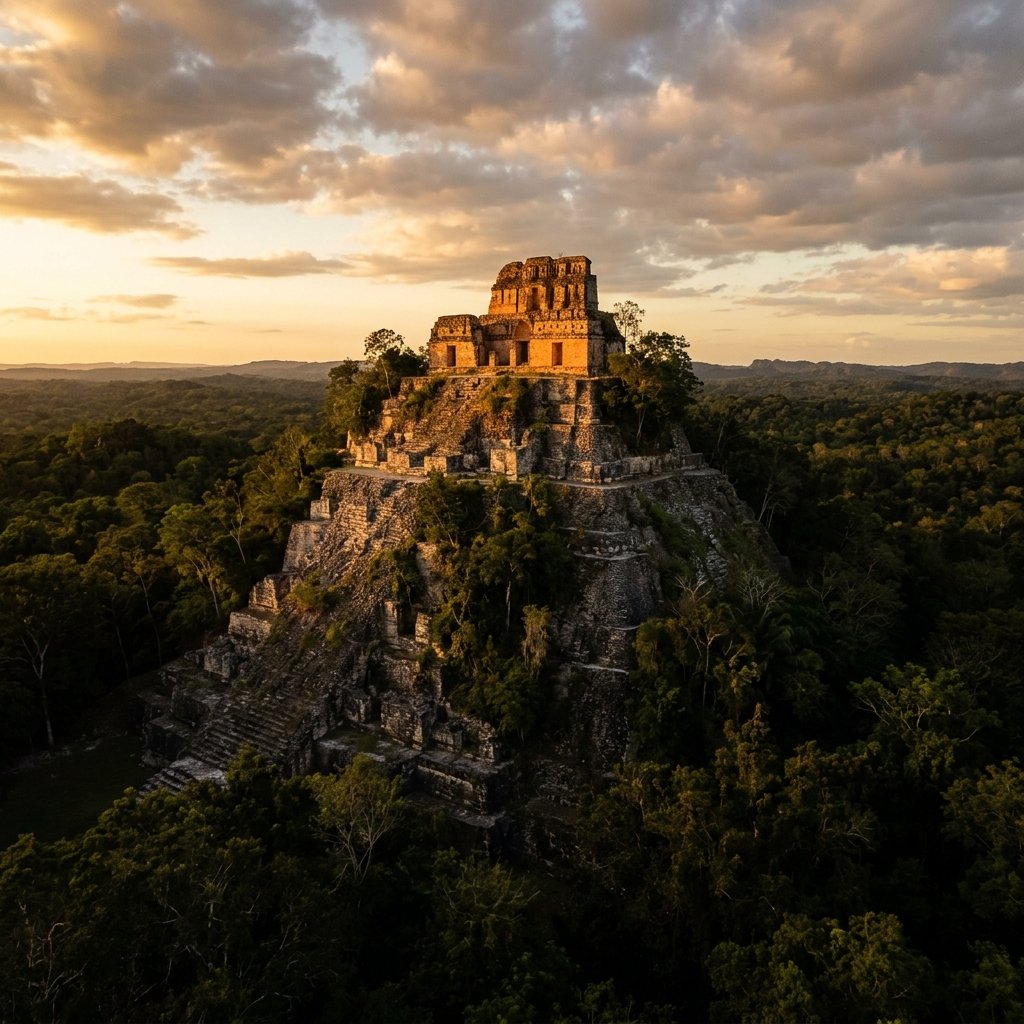
La Danta — visible from miles away, its upper platforms pierce the jungle canopy like a man-made mountain. By total volume (an estimated 2.8 million cubic meters), La Danta is the largest ancient structure in the Americas and one of the largest in the world, significantly exceeding the volume of the Great Pyramid of Giza.
The crowning architectural achievement of the ancient Americas is La Danta ("The Tapir"). It sits on the eastern edge of El Mirador, connected to the city center by a massive sacbé causeway.
La Danta is not merely a pyramid; it is an entire artificial mountain. The structure is built upon a staggering basal platform covering roughly 180,000 square meters — roughly the area of 35 football fields. Rising from this platform are heavily tiered structural groupings that culminate in a triadic temple towering 72 meters (236 feet) above the forest floor.
By total volume — an estimated 2,800,000 cubic meters of limestone fill — La Danta is considered by many archaeologists to be the largest ancient structure in the Western Hemisphere, and one of the largest in the world, significantly exceeding the volume of the Great Pyramid of Giza (2,583,000 m³). The fact that this was constructed without metal tools, wheels, or beasts of burden in the deepest jungle of Central America, by a civilization that supposedly hadn't yet reached its peak, is almost incomprehensible (Hansen, 2001; Sharer & Traxler, The Ancient Maya, Stanford University Press, 2006).
The Great Highways (Sacbeob)
El Mirador did not exist in isolation. It was the hub of the first ancient highway system in the Americas.
The city was connected to surrounding satellite cities — including the earlier metropolis of Nakbé, the substantial city of Tintal, and numerous smaller centers — by a network of massive, elevated white limestone roads known as sacbeob (singular: sacbé). Some of these causeways were incredibly long, spanning up to 24 miles (38 km) through the jungle.
The causeways themselves were engineering marvels: raised up to 6 feet above the seasonal swamps, measuring 60 to 130 feet wide, and heavily coated in glaring white stucco that would have been visible at great distances in the flat basin. These arteries allowed for the rapid movement of armies, merchants, and agricultural goods throughout the basin — essentially functioning as the interstate highways of the ancient Maya world.
The First Stucco Masks
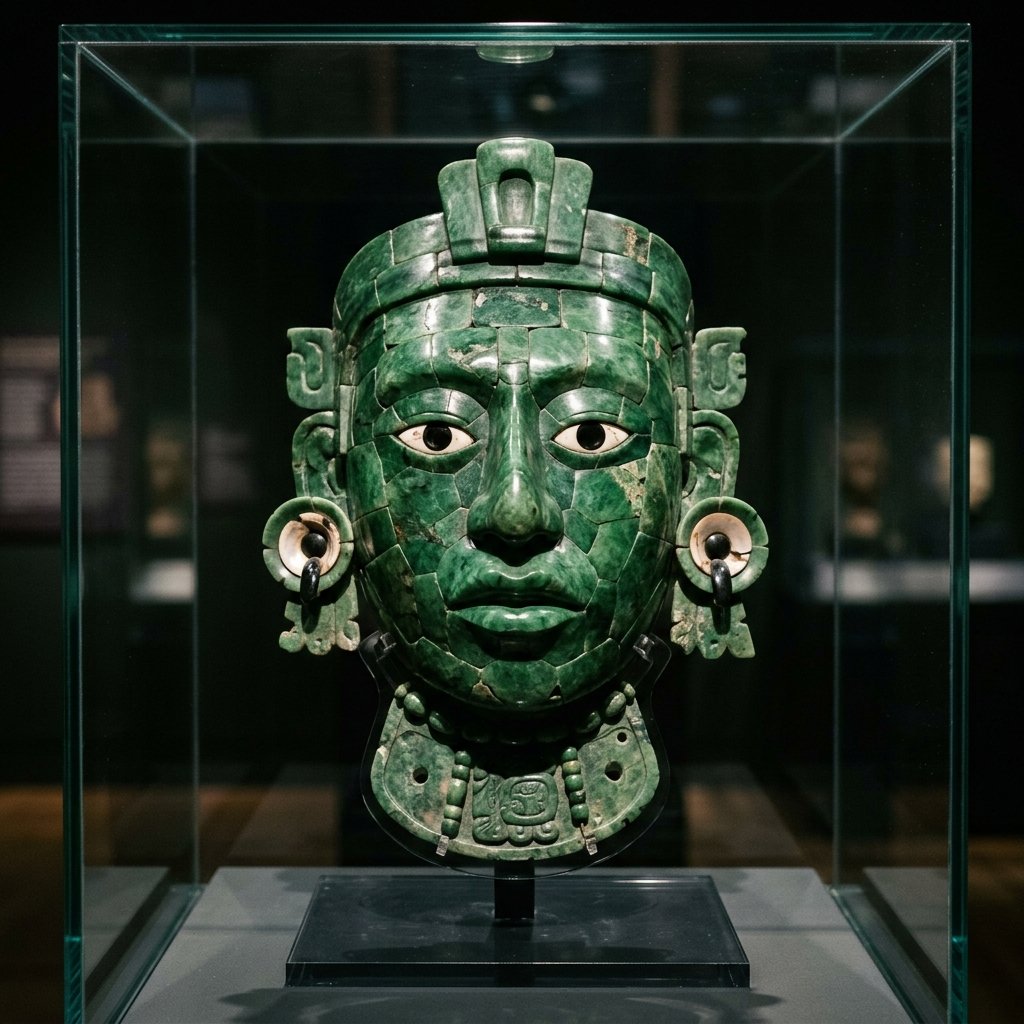
Monumental stucco masks — like this one from the Petén region — flanked the great Preclassic pyramids of El Mirador. Some measured over 10 feet tall and depicted cosmic deities such as the Principal Bird Deity (Vucub Caquix). These massive plaster reliefs required burning enormous quantities of wood, ultimately contributing to the environmental catastrophe that destroyed the city.
Unlike the deeply carved stone stelae of the later Classic era, the rulers of El Mirador projected their power through massive architectural stucco. The pyramids at El Mirador are flanked by colossal stucco masks of cosmic deities — particularly the Principal Bird Deity (an early form of Vucub Caquix, the arrogant false sun defeated by the Hero Twins) and aspects of the Sun God.
Some of these masks measure over 10 feet tall and were originally painted in brilliant hues of red and cream. They represent the earliest known monumental art program in the Maya lowlands — the genesis of a visual propaganda tradition that would last two millennia (Coe, The Maya, Thames & Hudson, 2011).
Practical Travel Guide: The Ultimate Expedition
The 5-Day Trek
El Mirador is arguably the most difficult major archaeological site to visit in the world. There are no roads. The traditional method is a grueling 5-to-6 day guided hiking expedition departing from the village of Carmelita (reachable from Flores). You will walk 40 to 50 kilometers in extreme heat and humidity, guided by local chicleros (gum harvesters who know the trails), while pack mules carry the water, food, and hammocks.
The Helicopter Option
For those who wish to bypass the massive physical toll of the hike, chartering a helicopter from Flores is possible but expensive (expect $800–$1,500 per person depending on group size). The flight takes approximately 30 minutes each way and offers unparalleled aerial views of La Danta rising out of the endless sea of green.
What to Expect
Expect virtually zero modern amenities. The site is an active archaeological camp run by Dr. Richard Hansen's FARES Foundation. Much of the city is still heavily overgrown by jungle. You will sleep in hammocks under tarps. Standing atop La Danta as the sun sets over the unbroken canopy — with not a single sign of modern civilization visible in any direction — is widely considered one of the greatest travel experiences on earth.
When to Go
The trek is only possible during the dry season (approximately January–May). During the rainy season, the bajo (seasonal swamp) that surrounds the site floods, making the trails impassable. February and March offer the best conditions. Book guides well in advance through operators in Flores or Carmelita.
The Preclassic Collapse: A Civilization That Consumed Itself
The most haunting aspect of El Mirador is its precipitous fall. Around 150 AD, the great city — and its surrounding basin consisting of perhaps hundreds of thousands of people — was entirely abandoned. The greatest Maya city that had ever existed simply ceased to exist, centuries before the Classic period even began.
The exact cause of this "Preclassic Collapse" is fiercely debated, but current archaeological evidence points toward an environmental catastrophe caused by the Maya themselves. Hansen's research reveals a devastating chain reaction: applying the incredibly thick layers of stucco to their massive pyramids required burning millions of tons of green wood to heat limestone into calcium oxide. This massive deforestation stripped the surrounding hillsides bare. Without tree roots to hold the soil, catastrophic topsoil runoff filled and choked the shallow seasonal swamps (bajos) with clay sediment (Hansen, 2001).
Once the bajos — which had served as the basin's primary agricultural zones and water retention systems — became choked with clay, the agricultural base collapsed. The great metropolis starved. The ruling Kan (Snake) dynasty fled northward, eventually resettling at Calakmul — where, centuries later, they would create a new superpower and wage the famous Cold War against Tikal.
While the rest of the Maya world recovered and entered the Classic period, the mighty El Mirador was never reoccupied. The jungle swallowed the enormous pyramids whole, and for nearly 2,000 years, the largest ancient structure in the Americas sat in total silence beneath the canopy.
Frequently Asked Questions
What is the largest pyramid in the world?
By total volume, La Danta at El Mirador is considered one of the largest ancient structures in the world — containing an estimated 2.8 million cubic meters of fill. This significantly exceeds the volume of the Great Pyramid of Giza (2.58 million m³). By height alone, the Great Pyramid is taller, but La Danta's massive basal platform gives it far greater total mass.
How do you get to El Mirador?
There are no roads. You must either undertake a grueling 5-to-6 day jungle trek departing from the village of Carmelita (guided by local chicleros with pack mules), or charter a helicopter from Flores (~30 minutes each way, $800–$1,500/person). The trek is only feasible during the dry season (January–May).
When was El Mirador built?
El Mirador peaked during the Late Preclassic period (approximately 300 BC to 150 AD). It was largely abandoned roughly 600 years before famous Classic cities like Tikal and Palenque reached their heights — proving that sophisticated Maya civilization existed far earlier than previously believed.
What caused the Preclassic Collapse?
Lead archaeologist Richard Hansen argues that massive self-inflicted deforestation — caused by burning millions of tons of wood to produce the lime stucco that coated the enormous pyramids — led to catastrophic topsoil erosion. This runoff choked the seasonal swamps (bajos) that served as the basin's agricultural and water systems, collapsing the food supply and forcing the population to abandon the region.
Is the El Mirador trek worth it?
If you are physically fit and adventurous — absolutely. Standing atop La Danta at sunset, looking out over an unbroken ocean of jungle canopy with no sign of modern civilization in any direction, is widely described by travelers as one of the most profound experiences available on earth. It is the closest you can get to the feeling of genuine archaeological discovery.
References
- Hansen, R. D. "The first cities: The beginnings of urbanization and state formation in the Maya lowlands." Maya: Divine Kings of the Rain Forest. Könemann, 2001, pp. 50-65.
- Hansen, R. D. et al. "Climatic and Environmental Variability in the Rise of Maya Civilization." Ancient Mesoamerica, vol. 13, no. 2, 2002, pp. 273–295.
- Sharer, R. J., & Traxler, L. P. The Ancient Maya. Stanford University Press, 6th ed., 2006.
- Coe, M. D. The Maya. Thames & Hudson, 8th ed., 2011.