The Story at a Glance
Background: The Popol Vuh
The story of the Hero Twins is told in the Popol Vuh — the sacred book of the K'iche' Maya of highland Guatemala. The text was transcribed in Latin script by K'iche' nobles between 1554 and 1558, preserving an oral tradition that archaeological evidence confirms extends back at least to the Classic period (250–900 AD). The original K'iche' manuscript was later copied by the Dominican friar Francisco Ximénez around 1701–1703. That copy, now held at the Newberry Library in Chicago, is the only surviving version (Christenson, A.J., Popol Vuh: The Sacred Book of the Maya, 2007, pp. 19–36).
The Hero Twins narrative occupies roughly the second quarter of the Popol Vuh. It follows a two-generational story: first, the father and uncle of the Twins (One Hunahpu and Seven Hunahpu) are summoned to Xibalba and killed by the Lords of Death. Then their sons — Hunahpu and Xbalanque — grow up, discover their inheritance, and descend to the underworld to avenge them.
Part I: The Father's Defeat
One Hunahpu and Seven Hunahpu were skilled ballplayers whose noisy games on the surface of the earth disturbed the Lords of Xibalba below. The underworld lords — led by One Death and Seven Death — summoned the brothers to Xibalba to play a ballgame.
But the summons was a trap. The brothers were subjected to a series of trick houses — the Dark House, the Razor House, the Cold House, the Jaguar House, and the Bat House — tests designed to humiliate and kill them. One Hunahpu and Seven Hunahpu failed these tests and were sacrificed. One Hunahpu's head was placed in a calabash tree, where it remained as a skull among the gourds.
A young woman named Xquic (Blood Moon) visited the tree, and the skull of One Hunahpu spat into her hand, miraculously impregnating her. She fled to the surface world, where she gave birth to the Hero Twins: Hunahpu and Xbalanque.
Part II: The Twins Grow Up
Hunahpu and Xbalanque were raised by their grandmother, Xmucane. Their older half-brothers — One Monkey and One Artisan — were jealous and mistreated them. The Twins eventually tricked their half-brothers into climbing a tree, which grew so tall they could not descend. The half-brothers were transformed into monkeys — the patron spirits of artists and scribes in Maya tradition (this is why the monkey-face day sign, Chuen, is associated with artistry and writing).
The Twins then discovered their father's ballgame equipment hidden in the rafters of the house. They retrieved the rubber ball, the yokes, and the arm guards, and began playing on the very ballcourt where their father had played.
Part III: The Descent to Xibalba
As with their father, the noise of the Twins' ballgame disturbed the Lords of Xibalba, who again issued a summons. But Hunahpu and Xbalanque had learned from their father's mistakes.
Before descending, they sent a mosquito ahead as a spy. The mosquito bit each of the Lords of Death in turn, and when each lord cried out in pain, the others called him by name — thus revealing the names and identities of all the lords to the Twins. This was critical: in the Maya underworld, knowing someone's name gave you power over them.
When the Twins arrived in Xibalba, they were subjected to the same trick houses that had killed their father. But they survived each one through cleverness:
- The Dark House — they were given a torch and cigars that had to remain lit until morning. Instead of lighting them, they tied a macaw's tail feather to the torch (its red glow resembling fire) and placed fireflies on the tips of the cigars. In the morning, the torch and cigars appeared unburned.
- The Cold House — they survived by building a fire from old logs.
- The Jaguar House — they fed bones to the jaguars instead of their own flesh.
- The Razor House — they negotiated with the obsidian blades, promising them the flesh of animals in exchange for safe passage.
- The Bat House — Hunahpu peeked out of their blowgun and was decapitated by Camazotz, the death bat. Xbalanque replaced his brother's head with a carved squash and continued the game.
Part IV: The Ballgame and the Sacrifice
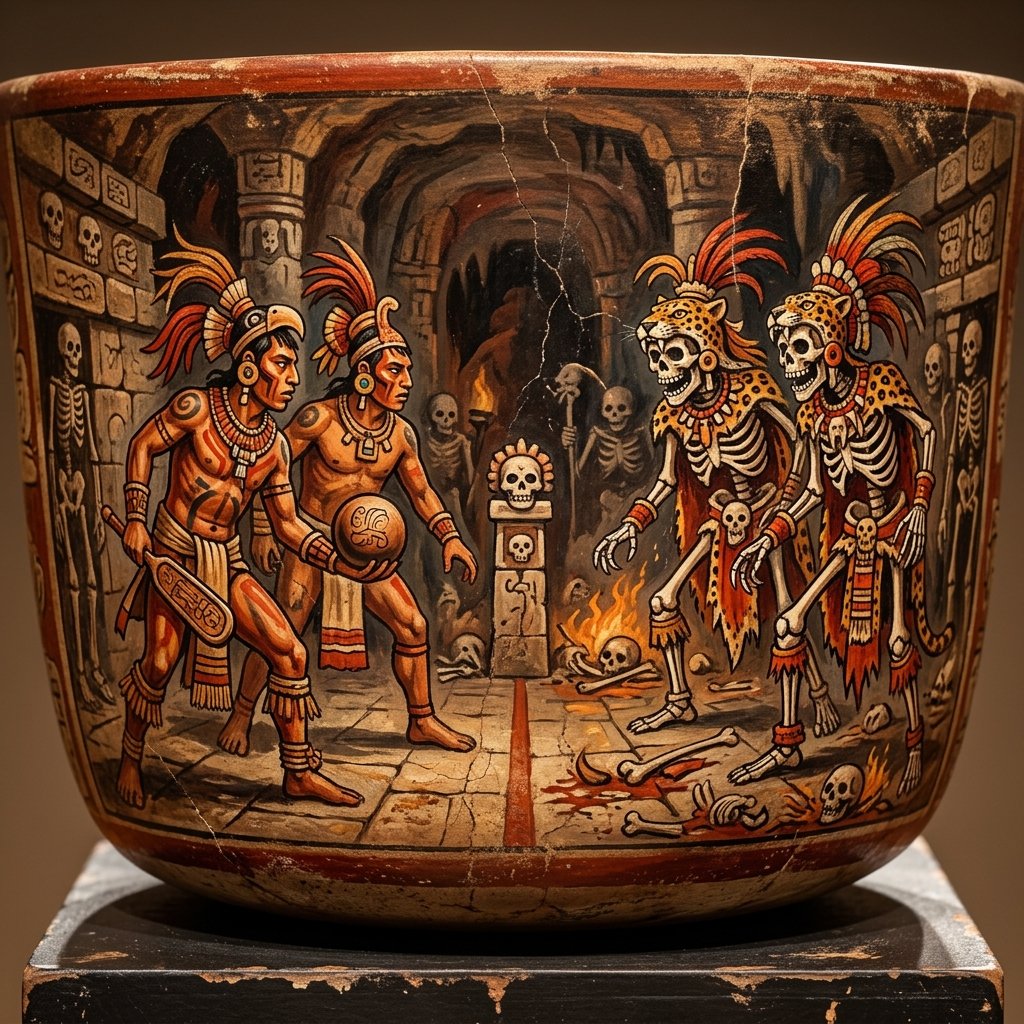
The Twins played the Lords of Death in the sacred ballgame. During the game, Xbalanque managed to recover Hunahpu's real head and restore it. The Twins then performed their greatest trick: they allowed themselves to be killed.
Their bones were ground into powder and thrown into a river. Five days later, the Twins reappeared as traveling performers — fishmen who danced, performed miracles, and could sacrifice each other and bring each other back to life.
Hearing of these miraculous performers, One Death and Seven Death invited them to court. The Twins demonstrated their power by sacrificing a dog and bringing it back to life, then burning a house and restoring it. Amazed, the lords demanded: "Do it to us! Sacrifice us!"
The Twins sacrificed One Death and Seven Death — but did not bring them back. With the Lords of Death destroyed, Xibalba's power was broken. The Twins ascended to the sky, where they became the sun and the moon.
Archaeological Evidence
The Hero Twins story is not preserved only in the colonial-era Popol Vuh. It was a living tradition for over a thousand years before the Spanish arrival. The evidence includes:
- Classic-period painted ceramics (600–900 AD): Hundreds of polychrome vessels depict scenes recognizable from the Hero Twins narrative — the ballgame, the lords of death, the mosquito, the decapitation, and the resurrection. These paintings predate the written Popol Vuh by nearly a millennium, confirming the story's antiquity (Coe, M.D., "The Hero Twins: Myth and Image," in The Maya Vase Book, Vol. 1, 1989).
- The San Bartolo murals (c. 100 BC): Discovered in 2001 in northeastern Guatemala, these extraordinarily well-preserved murals depict the Maya Maize God in scenes consistent with the Popol Vuh creation narrative. They push the iconographic record of these myths back to the Late Preclassic period (Saturno, W.A. et al., "Early Maya Writing at San Bartolo, Guatemala," Science, 2006).
- Ballcourts: Over 1,300 ballcourts have been identified at Maya sites. The ballgame was not merely a sport — it was a ritual reenactment of the cosmic struggle between the Hero Twins and the Lords of Death (Miller, M.E. & Houston, S., "The Classic Maya Ballgame and Its Architectural Setting," RES: Anthropology and Aesthetics, 1987).
What the Story Means
The Hero Twins narrative is not simply an adventure story. It encodes fundamental Maya beliefs about the nature of reality:
- Death is not final. The Twins die and return, establishing the principle that sacrifice leads to resurrection — a concept central to Maya kingship, where rulers were expected to "feed" the gods through bloodletting rituals.
- Cunning defeats brute force. The Twins never overpower the Lords of Death. They outwit them. Intelligence, trickery, and knowledge of names (identity) are the ultimate weapons.
- The ballgame is cosmic. Every Maya ballgame reenacted this primordial struggle. The rubber ball represented the sun; the court was the boundary between life and death.
- Sacrifice creates the world. The Twins' willing self-sacrifice is what enables them to transcend death. The Maya understood sacrifice not as destruction but as transformation.
References
- Tedlock, D. Popol Vuh: The Definitive Edition of the Mayan Book of the Dawn of Life. Simon & Schuster, 1996.
- Christenson, A.J. Popol Vuh: The Sacred Book of the Maya. University of Oklahoma Press, 2007.
- Coe, M.D. "The Hero Twins: Myth and Image." In The Maya Vase Book, Vol. 1, Kerr Associates, 1989.
- Saturno, W.A. et al. "Early Maya Writing at San Bartolo, Guatemala." Science, Vol. 311, 2006, pp. 1281–1283.
- Miller, M.E. & Houston, S. "The Classic Maya Ballgame and Its Architectural Setting." RES: Anthropology and Aesthetics, No. 14, 1987, pp. 46–65.
Frequently Asked Questions
Are the Hero Twins a real Maya myth or a modern invention?
They are a documented pre-Columbian Maya myth. While the most complete written version comes from the colonial-era Popol Vuh (c. 1554–1558), scenes from the Hero Twins narrative appear on painted pottery and carved monuments dating to the Classic period (250–900 AD) — and possibly as early as 100 BC at San Bartolo, Guatemala. The story predates European contact by over a millennium.
Did the Hero Twins really become the sun and moon?
In the Popol Vuh narrative, yes — the Twins ascend to the sky and become celestial bodies after defeating the Lords of Death. Some scholars interpret Hunahpu as the sun and Xbalanque as the moon, though others have proposed different identifications. The transformation represents the Maya concept that celestial order was established through sacrifice and the triumph over death.
What is the connection between the Hero Twins and the Maya ballgame?
The ballgame is central to the story — it is the activity that summons both the father (One Hunahpu) and later the Twins to Xibalba. The ritual ballgame practiced at over 1,300 known Maya ballcourts was understood as a reenactment of this cosmic struggle. The movement of the rubber ball represented the movement of celestial bodies, and the outcome of the game mirrored the victory of life over death.