Maya Cosmology at a Glance
A Universe Built and Rebuilt
The Maya did not believe the world was created once and forever. They understood the cosmos as a work in progress — a universe that had been built, found wanting, destroyed, and rebuilt multiple times. Each creation corrected flaws in the previous one. Each destruction cleared the way for something better. The current world — our world — is merely the latest attempt, and it too will eventually end.
This is a profoundly different worldview from the Abrahamic tradition, where creation is a single, definitive event. For the Maya, creation was iterative. The gods were brilliant but not omniscient. They experimented. They failed. They tried again. The universe we inhabit is not the first draft but the carefully revised edition (Freidel, D., Schele, L. & Parker, J., Maya Cosmos, 1993, pp. 59–95).
The Three Cosmic Levels
Maya cosmology organized the universe into three vertical tiers:
- The Upper World — 13 layers of sky, home of celestial deities. Each layer had its own god and associations. The uppermost level was the home of Itzamná, the supreme creator.
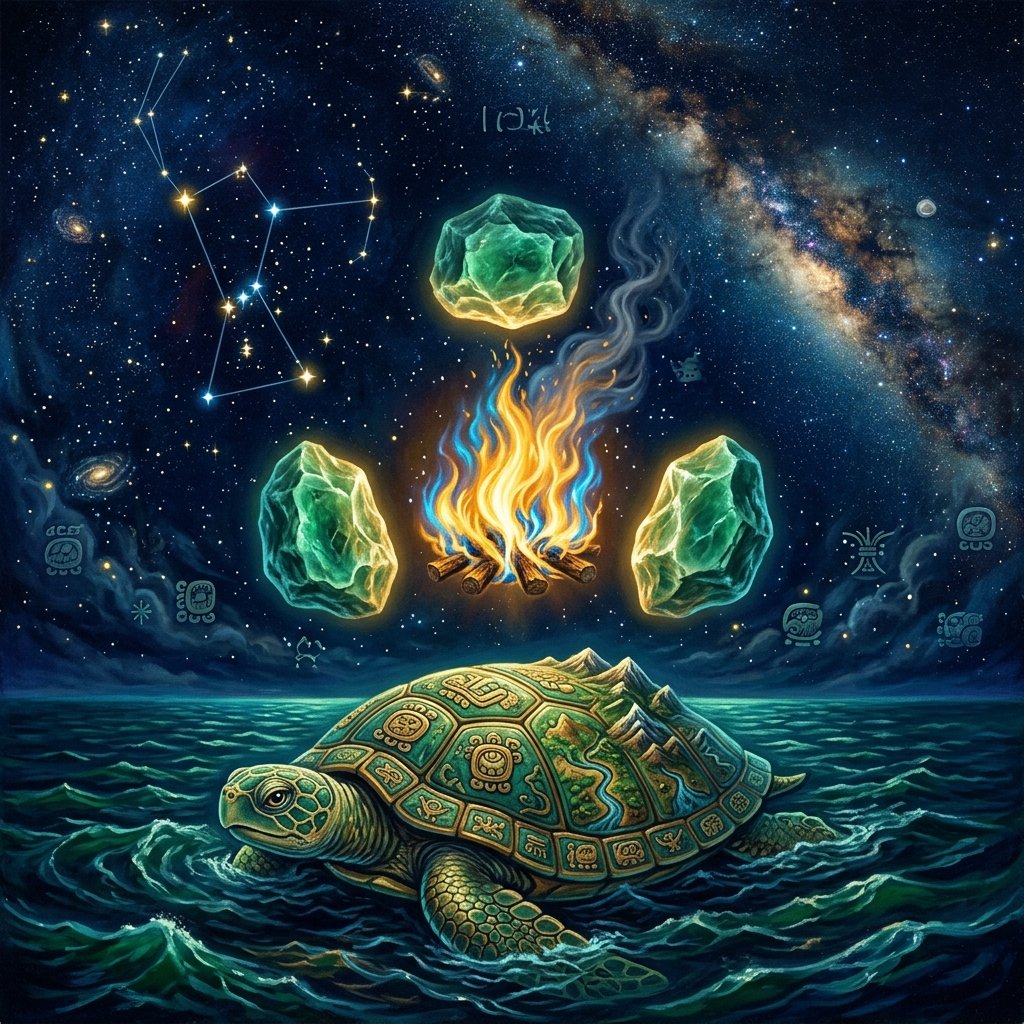
- The Middle World — the surface of the earth, conceived as the back of a great crocodile or turtle floating on the primordial sea. The four cardinal directions were marked by specific colors and cosmic trees.
- Xibalba — the nine-layered underworld, realm of the Lords of Death. Not a moral punishment afterlife but a dangerous place through which all souls passed after death.
Connecting all three levels was the World Tree (Wakah-Chan) — the cosmic axis mundi that rose from the center of the earth through the sky. Maya kings identified themselves with this tree, placing themselves at the center of the cosmos.
The Creation Date: 13.0.0.0.0
The Maya Long Count calendar anchors the current creation to a specific date: 13.0.0.0.0, 4 Ahau 8 Kumk'u — corresponding to August 11, 3114 BC in the Gregorian calendar. This is the "zero point" from which all Long Count dates are calculated.
What happened on this date? The Quiriguá Stela C provides the most detailed account: at the creation event, the gods "set the three stones" of the cosmic hearth. These three stones are identified with three stars in the constellation Orion — the triangular foggy patch below Orion's Belt known as the Orion Nebula. Just as a Maya household began by setting three hearthstones around a fire, the gods began creation by setting three cosmic hearthstones in the sky and kindling the fire of the universe.
The Temple of the Cross at Palenque elaborates further: at creation, three deities were "born" or manifested — the Palenque Triad gods (GI, GII, and GIII) — who then became the patron gods of the Palenque dynasty. The city's rulers thus traced their authority back to the very moment of cosmic creation (Stuart, D., The Order of Days, 2011, pp. 195–220).
The Previous Ages
From the Popol Vuh
The Popol Vuh describes three distinct attempts at creating humanity:
- The Mud Creation: Beings formed from clay. They could not hold their shape and their speech was meaningless. Dissolved and destroyed.
- The Wood Creation: Carved wooden figures that could speak, reproduce, and build. But they had no hearts, no souls, and no gratitude toward their creators. Destroyed by a flood and a revolt of their own possessions. Survivors became monkeys.
- The Maize Creation: The successful attempt. Humans formed from white and yellow maize by the grandmother goddess Xmucane. (See The Maya Creation Myth for the full account.)
From the Chilam Balam
The Books of Chilam Balam describe a somewhat different sequence of world destructions, emphasizing cyclical K'atun-based catastrophes: worlds destroyed by water floods, by fire from the sky, and by earth-splitting events. These Yucatec traditions may preserve an older, lowland cosmological framework distinct from the highland K'iche' version in the Popol Vuh.
Parallels: The Maya and Other Traditions
The concept of multiple world ages is not unique to the Maya — it appears across Mesoamerica. The Aztec "Five Suns" mythology describes five successive worlds, each destroyed by a different element. But the Maya version is distinctive in key ways:
- Materials matter: The Maya focus on the substance from which humans are made (mud → wood → maize), implying that the material determines the soul. The Aztecs focus on the element of destruction (water, wind, fire, jaguars).
- Failure leads to improvement: Each Maya creation is better than the last — gods who learn from mistakes. This is a strikingly empirical worldview.
- Calendar as cosmic framework: The Maya embedded creation in their mathematical calendar system, giving the current world age a precise starting date and an implicit (though debated) ending point — something no other Mesoamerican tradition did with such precision.
Will the Current World End?
The notorious "2012 phenomenon" — the pop-culture belief that the Maya predicted the world would end on December 21, 2012 — was based on a misunderstanding. That date marked 13.0.0.0.0 in the Long Count — a completion of one Great Cycle. But the Maya calendar does not stop at that point. Just as an odometer turning over to 000000 does not mean the car has ceased to exist, the Long Count simply advanced to the next great cycle: 14.0.0.0.0.
Inscriptions at Palenque calculate dates millions of years into the future, and the Tortuguero Monument 6 — the only inscription that actually references the 2012 date — describes it as a ceremony, not an apocalypse. The Maya understood time as cyclical but infinite — creation and destruction repeating endlessly, each cycle an opportunity for renewal.
Frequently Asked Questions
How many creations did the Maya believe in?
Maya cosmology describes multiple world ages. The Popol Vuh records three attempts to create humanity, while Classic inscriptions and the Chilam Balam reference additional previous ages. The Long Count calendar itself begins at a creation date of August 11, 3114 BC, marking the start of the current era.
What destroyed the previous Maya world ages?
The first world (mud people) was dissolved by water. The second world (wooden people) was destroyed by a great flood plus a revolt of objects. The Chilam Balam describes destructions by water, fire, and earth-splitting. Each destruction cleared the way for an improved creation.
What is the Maya creation date?
13.0.0.0.0, 4 Ahau 8 Kumk'u — August 11, 3114 BC (GMT correlation). On this date, the gods "set the three stones" of the cosmic hearth — three stars in Orion — and kindled the first fire. This date is inscribed on monuments at Coba, Quiriguá, and Palenque.
Scholarly References
- Freidel, D., Schele, L. & Parker, J. Maya Cosmos: Three Thousand Years on the Shaman's Path. William Morrow, 1993.
- Stuart, D. The Order of Days: The Maya World and the Truth About 2012. Harmony Books, 2011.
- Tedlock, D. Popol Vuh: The Definitive Edition. Simon & Schuster, 1996.
- Taube, K.A. The Major Gods of Ancient Yucatan. Dumbarton Oaks, 1992.