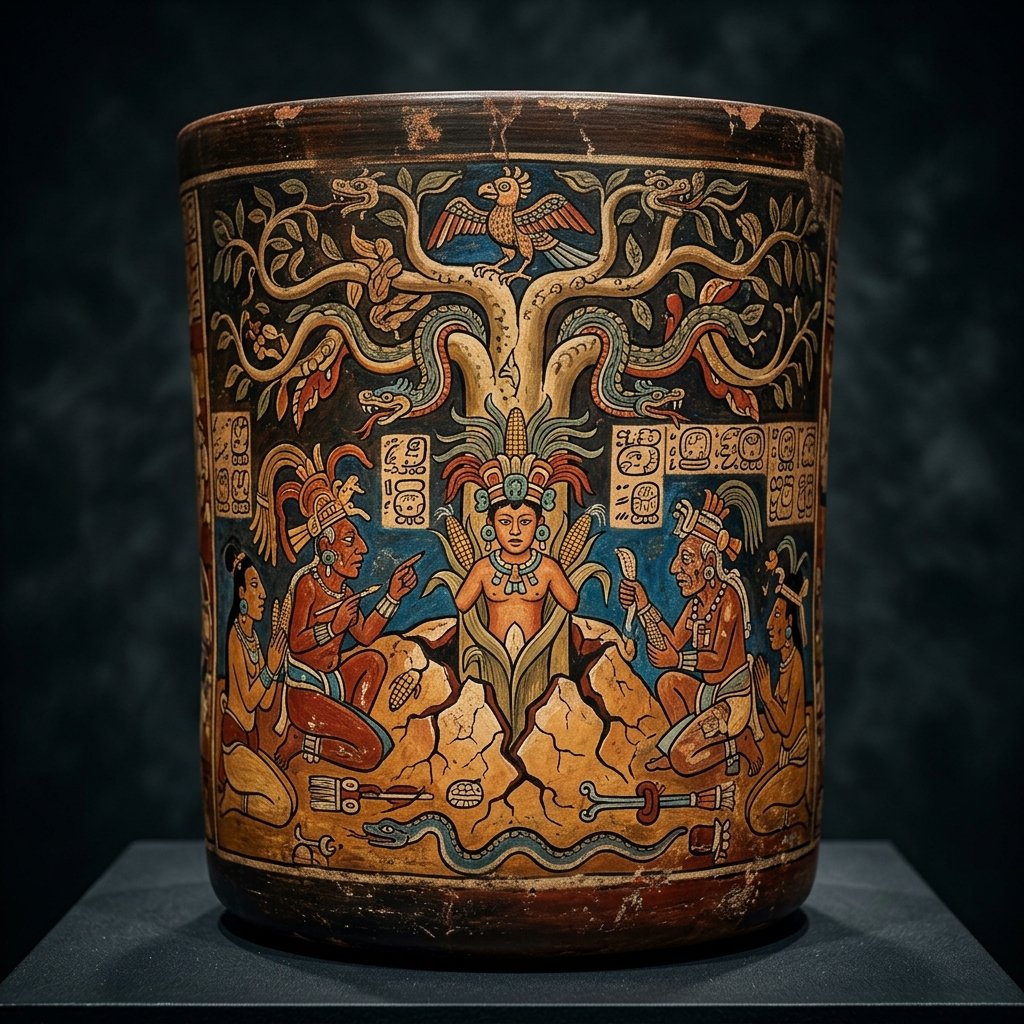
The Creation Story at a Glance
Before the Beginning
The Popol Vuh — the sacred book of the K'iche' Maya — opens with one of the most haunting creation scenes in world literature. Before the world existed, there was only stillness:
"There is not yet one person, one animal, bird, fish, crab, tree, rock, hollow, canyon, meadow, forest. Only the sky alone is there; the face of the earth is not clear. Only the sea alone is pooled under all the sky; there is nothing whatever gathered together." — Popol Vuh, trans. Dennis Tedlock (1996), p. 64
In this primordial void, the creators existed — Tepeu (Sovereign) and Gukumatz (Quetzal Serpent), together known as the Heart of Sky. They were joined by Huracán (Hurricane), the great wind deity. Through speech and thought alone, they conceived the creation of the earth, the mountains, the rivers, and all living things.
"Let it be done!" they said — and the earth rose from the waters. Mountains emerged, rivers carved their paths, and the great forests grew. The gods populated the world with animals — deer, birds, jaguars, serpents, and all the creatures of forest and sky. The creation of the physical world was complete.
But there was a problem.
The First Attempt: The Mud People
The gods wanted beings who could speak, pray, and keep the days — creatures who would honor their creators and maintain the sacred calendar. The animals could not do this. They squawked, howled, and chattered, but they could not form words of praise.
So the gods attempted to create humans from mud. But the mud people were a disaster:
- Their bodies dissolved in water — they could not hold their shape.
- They could speak, but their words were meaningless.
- They had no minds, no souls, and no ability to worship.
The gods destroyed the mud people and began again. This first failure established a crucial principle: the material from which humans are made determines their nature. Mud — formless, soft, without internal structure — could not produce beings capable of thought, devotion, or civilization.
The Second Attempt: The Wooden People
For their second attempt, the gods carved humans from wood. The wooden people were a significant improvement over the mud people:
- They could speak and multiply — they populated the earth.
- They built houses and formed communities.
- They had the physical form of humans.
But the wooden people had a fatal flaw: they had no hearts, no minds, and no memory of their creators. They walked the earth without purpose, feeling, or gratitude. They could function but they could not think. They abused their animals, mistreated their tools, and failed to honor the gods.
The gods sent a great flood to destroy the wooden people. But the destruction went further — in a terrifying passage, the Popol Vuh describes how the objects of the wooden people's daily life rose up against them:
- Their grinding stones crushed their faces.
- Their cooking pots burned them.
- Their dogs bit them, saying: "You beat us. Now it is our turn."
- Their hearthstones leaped from the fire and struck them.
The survivors fled to the trees, where they became monkeys — a reminder of the failed creation. The Maya saw monkeys as degraded remnants of the wooden people, which explains the complex relationship between monkeys and writing in Maya art: the monkey scribes (Batz') represent both the artistic talent of the earlier creation and its ultimate failure (Coe, M.D., The Maya, 2011, pp. 232–233).
The Hero Twins: Preparing the Way
Before the gods made their third and final attempt at creating humanity, the Popol Vuh recounts the epic adventures of the Hero Twins — Hunahpu and Xbalanque. Their story is a necessary prelude to human creation because the Twins must first defeat the lords of Xibalba (the underworld) and restore cosmic order.
The Twins' father, Hun Hunahpu (the Maize God), had been killed by the death lords. Through their cleverness and ball-playing skill, the Twins descend to Xibalba, outwit the death gods, and resurrect their father — who rises as the reborn Maize God, emerging from the cracked earth like a maize plant bursting from the seed.
This resurrection is the pivotal moment in Maya cosmology: the Maize God's rebirth makes the final creation possible. Human flesh will be made from maize — and maize can only grow because the Maize God has conquered death. Life, death, and resurrection are thus bound together in an eternal agricultural-spiritual cycle (Taube, K., "The Classic Maya Maize God," in Fifth Palenque Round Table, 1983).
The Third Attempt: The Maize People
With the cosmic order restored, the gods made their final, successful attempt. The animals — especially the fox, coyote, parrot, and crow — led the gods to a mountain called Paxil ("Split Place"), filled with yellow and white maize.
The grandmother goddess Xmucane ground the maize nine times and mixed it with water. From this maize dough — corn flour mixed with the water of creation — she formed the flesh and blood of the first four true humans:
These maize people were everything the gods had hoped for. They could think, speak, see, hear, walk, and grasp. They immediately gave thanks to their creators. They kept the sacred days. They understood the cosmos.
In fact, the maize people were too perfect. Their vision was so clear that they could see everything in the universe — the full extent of creation, from the smallest insect to the farthest star. The gods, concerned that humans with godlike perception would never be humble enough to worship, misted their eyes — like breathing on a mirror — limiting human vision to what is nearby and immediate. This is why humans can no longer see the full truth of the cosmos unaided (Tedlock, 1996, pp. 146–148).
Why Maize? The Theology of Corn
The choice of maize as the substance of human flesh is not arbitrary — it is the foundational theological statement of Maya civilization. Consider the implications:
- Humans are literally food. We are made of the same substance we eat. The act of eating maize is thus a form of communion — consuming the same divine material from which we are made.
- Agriculture is sacred duty. If humans are made of maize, then growing maize is not merely farming — it is the perpetuation of human existence itself. Neglecting the milpa (cornfield) is a cosmic offense.
- Death feeds life. The Maize God must die (be buried as seed) to be reborn (as the new crop). Likewise, humans must eventually return to the earth to nourish the next cycle. Death is not an ending but a planting.
- The calendar and agriculture are one. The Maya calendar system exists, in part, to ensure that maize is planted and harvested at the correct times — making the calendar itself a tool of human survival and cosmic maintenance.
Parallels and Uniqueness
The Maya creation story shares structural features with other world creation myths — the multiple attempts, the flood, the use of local staple foods — but it is unique in critical ways:
- No creation from nothing. Unlike the Genesis account, the Maya creators work with pre-existing materials (water, earth, organic matter). Creation is craftsmanship, not conjuration.
- Gods who fail. The Maya gods are powerful but not omniscient. They experiment, fail, destroy, and try again — a strikingly scientific model of trial and error.
- Humans as flawed by design. The misting of human eyes is a deliberate limitation — the gods choose to make us imperfect. We are designed to need faith because we can no longer see everything directly.
- No separation from nature. Humans are made from a plant. There is no dominion narrative, no separation from the natural world. Humans are nature, shaped into a new form.
Living Traditions
The creation myth is not merely historical. Among contemporary K'iche', Kaqchikel, Mam, and other Maya communities in Guatemala and southern Mexico, maize remains sacred. Traditional Maya farmers still perform ceremonies before planting, asking permission of the earth and offering prayers to the Maize God. The 260-day Tzolk'in calendar, maintained by ajq'ijab' (daykeepers), continues to structure ritual life — a direct inheritance from the creation story's mandate that humans must "keep the days."
Frequently Asked Questions
What is the Maya creation myth?
The Maya creation myth, recorded in the Popol Vuh, describes how the gods created the world and attempted to make humanity three times — first from mud, then from wood, and finally successfully from maize dough. The maize-flesh humans became the ancestors of the K'iche' Maya people. Each failed attempt taught the gods what qualities true humans needed: not just physical form, but hearts, minds, and the ability to worship.
How many times did the gods try to create humans?
The gods attempted to create humanity three times. The mud people dissolved and could not think. The wooden people could function but had no souls, hearts, or memory of their creators — they were destroyed in a great flood and became monkeys. The maize people, formed from ground corn mixed with creation water, were the successful third attempt.
What is the Popol Vuh?
The Popol Vuh is the sacred creation narrative of the K'iche' Maya people of highland Guatemala. Written in K'iche' using the Latin alphabet in the mid-16th century, it preserves an ancient oral tradition that recounts the creation of the world, the adventures of the Hero Twins in the underworld, and the genealogy of the K'iche' royal lineage. It is sometimes called the "Maya Bible," though it predates European contact.
Why is maize so important in the Maya creation story?
Maize is central because humans are literally made from it. This belief made corn more than a staple crop — it was the sacred substance of human life. Growing maize became a sacred duty, eating maize became a form of communion, and the agricultural cycle of planting, growth, harvest, and replanting mirrored the cycle of human life, death, and rebirth embodied by the Maize God.
Scholarly References
- Tedlock, D. Popol Vuh: The Definitive Edition of the Mayan Book of the Dawn of Life. Simon & Schuster, 1996.
- Christenson, A. Popol Vuh: The Sacred Book of the Maya. University of Oklahoma Press, 2007.
- Coe, M.D. The Maya. Thames & Hudson, 8th edition, 2011.
- Taube, K.A. "The Classic Maya Maize God: A Reappraisal." In Fifth Palenque Round Table, 1983, pp. 171–181.
- Sharer, R. & Traxler, L. The Ancient Maya. Stanford University Press, 6th edition, 2006.