The Popol Vuh at a Glance
The Greatest Work of Indigenous American Literature
The Popol Vuh — "Council Book" or "Book of the Community" — is the sacred creation narrative of the K'iche' Maya of highland Guatemala. It is, without exaggeration, the single most important literary work to survive from the pre-Columbian Americas. Within its pages, the K'iche' recorded their understanding of how the universe was created, how humanity came into being, and how their own royal dynasty traced its authority back to the gods themselves.
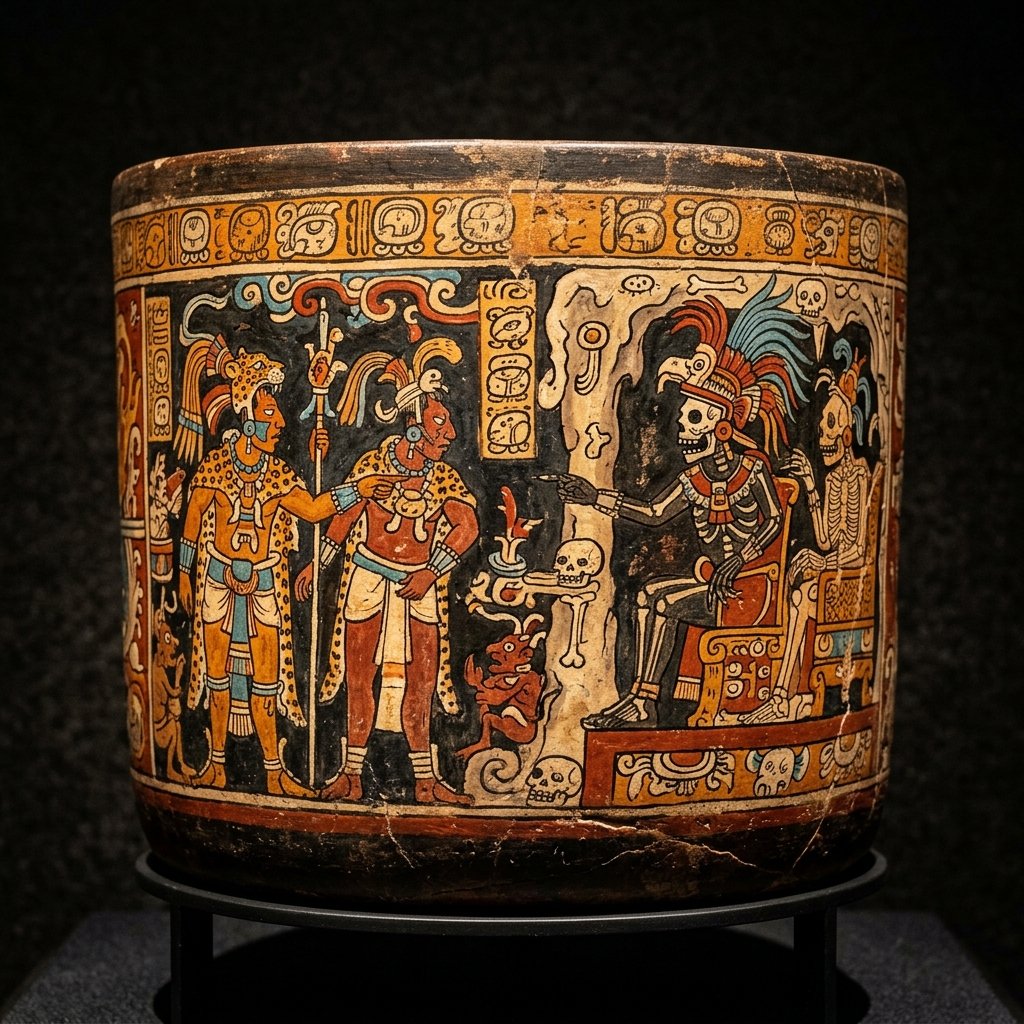
The existing text was written in K'iche' using the Latin alphabet around 1554–1558 — barely a generation after the Spanish conquest. But the stories it contains are far older. Elements of the Hero Twins narrative appear on Classic-period painted ceramics dating to 600–900 AD, and the San Bartolo murals (c. 100 BC) depict creation scenes that match the Popol Vuh's account. The oral tradition preserved in this text spans at least two thousand years (Christenson, A., Popol Vuh: The Sacred Book of the Maya, 2007, pp. 16–38).
Part One: The Creation
Before the Beginning
The Popol Vuh opens in absolute stillness. Before creation, there is only the sky and the sea — calm, dark, and silent. The creator deities exist within this void: Tepeu (Sovereign Plumed Serpent) and Gukumatz (Quetzal Serpent), together called the Heart of Sky, joined by the wind deity Huracán (Hurricane).
Through speech alone — "Let it be done!" — they raise the earth from the waters, create mountains, rivers, and forests, and populate the world with animals. But the animals cannot speak, pray, or keep the days. The gods want beings who will honor their creators and maintain the sacred calendar.
The Three Creations
The gods attempt to create humans three times:
- Mud People: Dissolve in water. They can speak but their words are meaningless. Destroyed.
- Wooden People: They can speak, reproduce, and build houses — but they have no hearts, no minds, no memory of their creators. A great flood destroys them. Their own grinding stones, cooking pots, and dogs attack them. The survivors become monkeys.
- Maize People: Made from white and yellow maize dough by the grandmother goddess Xmucane. They can think, speak, see, and give thanks. They are the first true humans — the ancestors of the K'iche' people. (For the full creation story, see The Maya Creation Myth.)
Part Two: The Hero Twins
The longest and most dramatic section of the Popol Vuh recounts the adventures of Hunahpu and Xbalanque — the Hero Twins. Their story is the heart of Maya mythology.
The Father's Defeat
Before the Twins are born, their father Hun Hunahpu (the Maize God) and uncle Vucub Hunahpu are summoned to Xibalba (the Underworld) by the Lords of Death, who are angered by the noise of their ball-playing. The brothers fail the tests of the Houses of Terror and are sacrificed. Hun Hunahpu's severed head is hung in a calabash tree, where it spits into the hand of the underworld maiden Xquic (Blood Moon), impregnating her with the Hero Twins.
The Twins' Youth
Hunahpu and Xbalanque grow up on the surface of the earth, raised by their grandmother Xmucane. They are tormented by their jealous older half-brothers, Hun Batz and Hun Chowen (the Monkey Twins, patrons of artists and scribes). The Hero Twins trick the Monkey Twins into climbing a tree, then magically cause the tree to grow impossibly tall. The Monkey Twins are transformed into spider monkeys — which is why monkeys exist and why they are associated with the arts.
The Descent to Xibalba
The Hero Twins discover their father's ball-playing equipment hidden in the rafters of the house and begin to play. The noise reaches Xibalba, and the Lords of Death summon them — just as they had summoned the father. But the Twins are smarter.
Before descending, they send a mosquito ahead as a spy. The mosquito bites each Lord of Death, and when the Lords cry out, their companions address them by name — revealing their names to the spy. This gives the Twins a crucial advantage: knowing your enemy's name is power.
The Houses of Terror
The Twins are subjected to the same lethal tests that killed their father — but they survive through cleverness:
- Dark House: Given a torch that must stay lit all night. The Twins substitute a macaw's tail feathers (which glow red) for the flame, deceiving the Lords.
- Razor House: Filled with slashing obsidian blades. The Twins convince the blades to stop by promising them the flesh of animals.
- Cold House: They survive the freezing hail by burning pine logs.
- Jaguar House: They feed bones to the jaguars, satisfying them.
- Bat House: Hunahpu peeks out and is decapitated by Camazotz (the Death Bat). Xbalanque replaces his brother's head with a carved squash, and the gods help restore Hunahpu's real head.
The Defeat of Death
The climax comes when the Twins voluntarily die. They allow themselves to be killed and ground into powder, which is thrown into a river. Five days later, they reappear as catfish, then as wandering magicians who perform miraculous tricks — burning houses that restore themselves, killing a man who comes back to life. The Lords of Death, fascinated, demand the trick be performed on them.
The Twins sacrifice the supreme Lords — One Death and Seven Death — but do not bring them back. With the Lords destroyed, the power of Xibalba is broken forever. Death will still come for all, but it will never again rule absolutely.
The Resurrection of the Father
The Twins return to the ballcourt where their father was buried, attempt to reassemble him, and partially succeed. The Maize God is reborn — he rises from the earth like a maize plant from a seed. But he remains incomplete, frozen in the moment of resurrection, which is how he appears forever after in Maya art: eternally young, eternally rising, eternally beautiful.
The Hero Twins themselves ascend to the sky to become the Sun and Venus (or, in some interpretations, the Sun and the Moon).
Part Three: The Maize People
With the Underworld defeated and the Maize God reborn, the stage is set for the creation of true humans. The full account of the maize people — the four original men, the misting of their eyes, and their wives — is told in detail in the Creation Myth article.
Part Four: The K'iche' Genealogy
The final section traces the lineage of the K'iche' royal family from the first maize people through the founding of their capital at Q'umarkaj (Utatlán). This section functions as a political document — establishing the divine right of the K'iche' ruling houses by connecting them directly to the primal ancestors created by the gods.
The text records migrations, the founding of cities, conflicts with neighboring Maya groups, and the establishment of the four great K'iche' lineages: the Cavec, Nijaib, Ahau Quiche, and Zaquic. The narrative ends with the list of kings down to the generation of the Spanish conquest.
The Manuscript's Journey
The history of the Popol Vuh's survival is itself remarkable:
- c. 1554–1558: K'iche' nobles transcribe the oral tradition into the Latin alphabet, likely from a pre-existing hieroglyphic text.
- c. 1701: Dominican friar Francisco Ximénez discovers the manuscript in Chichicastenango, Guatemala. He copies the K'iche' text and creates a parallel Spanish translation.
- 1857: The European scholar Carl Scherzer publishes the first printed edition.
- 1861: Brasseur de Bourbourg publishes a French translation that brings the Popol Vuh to international attention.
- 1996: Dennis Tedlock publishes the definitive English translation, informed by work with living K'iche' daykeepers.
The original Ximénez manuscript is now in the Newberry Library in Chicago.
Frequently Asked Questions
What is the Popol Vuh about?
Three interconnected stories: the creation of the world and humanity (through three attempts — mud, wood, and maize); the Hero Twins' journey through the Underworld; and the genealogy and migrations of the K'iche' royal lineages. It is the most important surviving work of indigenous American literature.
When was the Popol Vuh written?
The surviving text dates to c. 1554–1558, written in K'iche' Maya using the Latin alphabet. But the oral traditions it records are far older — Hero Twins imagery appears on Classic Maya ceramics from 600–900 AD, and the San Bartolo murals (c. 100 BC) show creation scenes matching the text.
Is the Popol Vuh the "Maya Bible"?
This comparison is misleading. The Popol Vuh is specifically K'iche' Maya — other Maya groups had their own sacred narratives (such as the Books of Chilam Balam). It also combines creation myth, hero epic, and political genealogy in a structure with no direct Biblical parallel.
Can you read the Popol Vuh today?
Yes. Dennis Tedlock's 1996 translation is the standard English edition. Allen Christenson's 2007 translation provides extensive scholarly notes. The original K'iche' text with Ximénez's Spanish translation is in the Newberry Library in Chicago.
Scholarly References
- Tedlock, D. Popol Vuh: The Definitive Edition of the Mayan Book of the Dawn of Life. Simon & Schuster, 1996.
- Christenson, A. Popol Vuh: The Sacred Book of the Maya. University of Oklahoma Press, 2007.
- Coe, M.D. The Maya. Thames & Hudson, 8th edition, 2011.
- Saturno, W.A., Taube, K.A. & Stuart, D. The Murals of San Bartolo. Center for Ancient American Studies, 2005.
- Recinos, A. Popol Vuh: The Sacred Book of the Ancient Quiché Maya. University of Oklahoma Press, 1950.