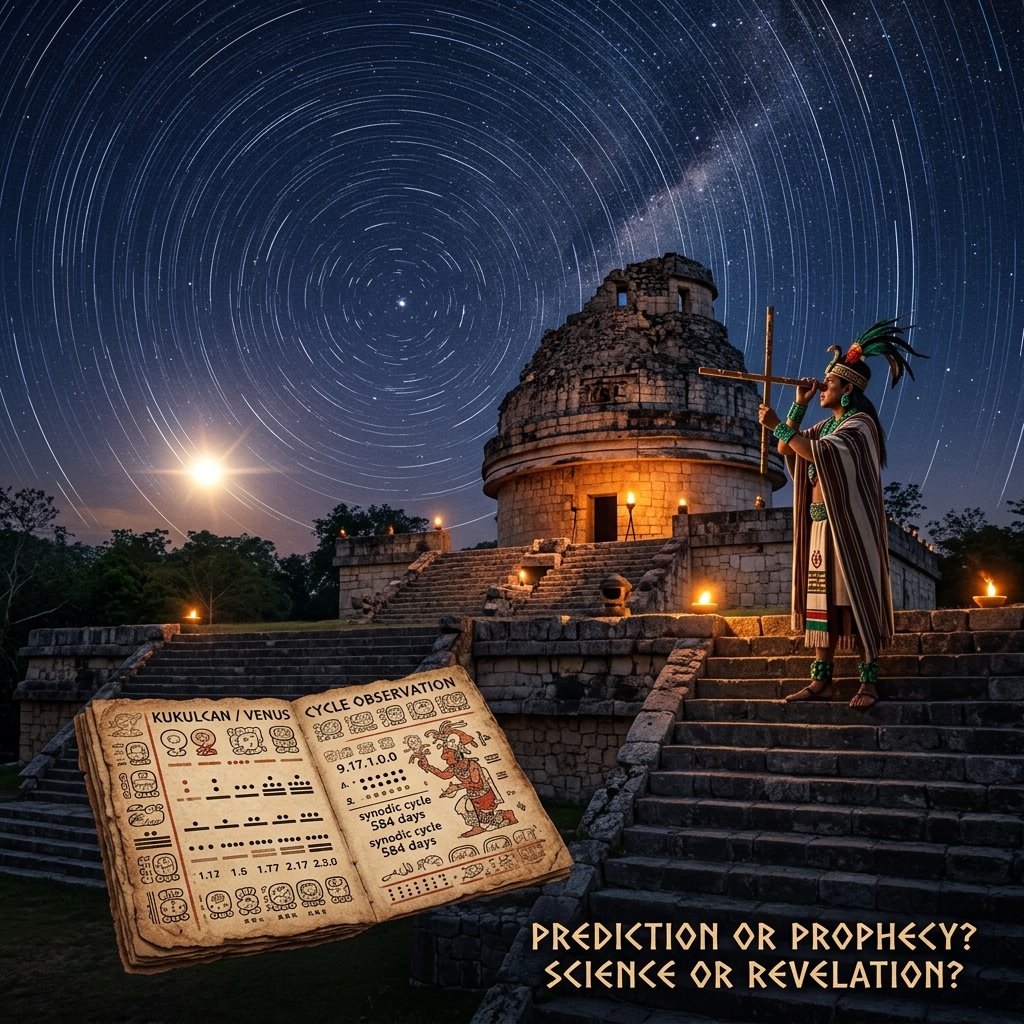
Short Answer: Yes, But Not the Way You Think
The Maya did predict the future — with documented, verifiable success in astronomy, climate patterns, and political cycles. But they did it through observation, mathematics, and pattern-recognition, not through supernatural powers. Their methods were closer to modern data science than to crystal balls. And that makes their achievement more remarkable, not less.
What They Got Right
| Domain | Their Prediction | Accuracy | Method |
|---|---|---|---|
| Solar/lunar eclipses | Eclipse windows every 148 or 177 days | ±33 minutes over 400 years | 405-lunation tables |
| Venus cycle | 583.92-day synodic period | ±2 hours over 481 years | Dresden Codex tables |
| Drought cycles | Katun-associated drought periods | Correlates with paleoclimate data | Katun prophecy cycle |
| Foreign invasion | Katun 8 Ahau = arrival of strangers | Spanish arrived during Katun 8 Ahau | Chilam Balam records |
How Prediction Shaped Policy
Maya prediction wasn't theoretical — it drove real political and military decisions:
- Star wars: Military campaigns were timed to Venus's first appearance as morning star. Kings waited months — sometimes years — for the right celestial alignment before attacking (Schele & Freidel, A Forest of Kings, 1990).
- Agricultural planning: The Tzolk'in and Haab calendars together determined planting windows. Today's K'iche' Maya daykeepers still use the 260-day count for agricultural decisions (Tedlock, 1982).
- Succession and legitimacy: Royal accessions were scheduled to coincide with auspicious Long Count dates. Pakal of Palenque planned his own funerary monument decades in advance, calculating the calendrical significance of future dates.
Were They Better at Predicting Than We Are?
In some domains — yes. The Maya lunar synodic month (29.53086 days) was more accurate than Europe's value until the work of Tycho Brahe in the 16th century. Their Venus calculations weren't matched until Copernicus. And their eclipse tables remained functional for centuries without correction — something no modern weather model can claim for even a week.
The difference isn't intelligence — it's methodology. The Maya had centuries of continuous observation by specialists whose sole job was watching the sky. We traded observational depth for observational breadth. They mastered a few variables perfectly; we model many variables imperfectly.
Frequently Asked Questions
Were Maya prophecies really accurate?
Astronomically, yes — their predictions are verifiable and astonishingly precise. Politically, the Katun prophecies show genuine pattern-matching with historical events. Whether the Books of Chilam Balam represent prediction or retrospective editing is debated. In all cases, the Maya approached the future as a disciplined intellectual exercise, not mystical guesswork.