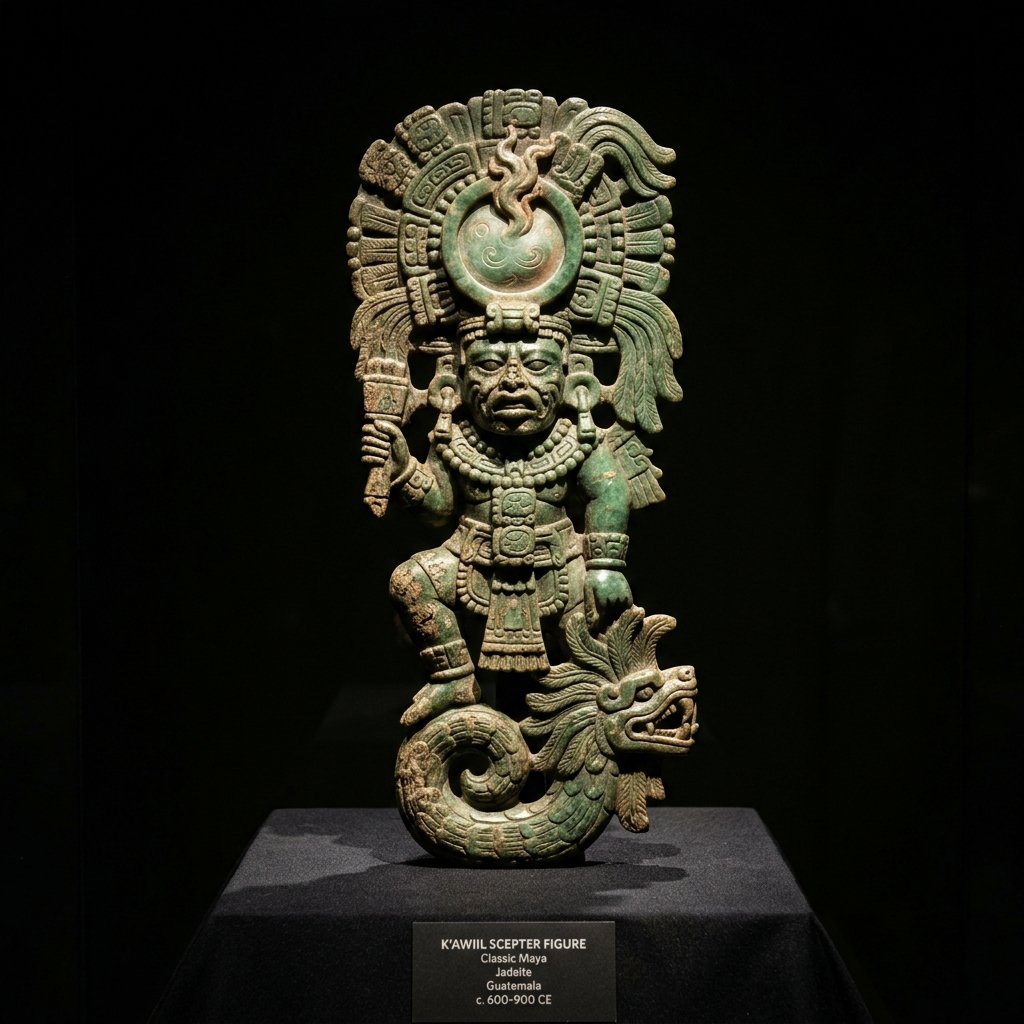
K'awiil at a Glance
The Lightning of Legitimacy
K'awiil is the god who made kings divine. He was the embodiment of royal authority itself. To hold the K'awiil scepter was to hold the lightning bolt of legitimate power — the divine mandate that separated a K'uhul Ajaw from a pretender.
K'awiil's iconography is immediately recognizable: one leg transforms into a writhing serpent, while his forehead is pierced by a smoking axe blade or obsidian mirror. His face is elongated with a beak-like snout. This combination connects K'awiil to lightning — the most dramatic manifestation of divine power (Stuart, D., "The Fire Enters His House," 1998).
The Scepter of Kings
The K'awiil scepter (Mannikin Scepter) was the single most important item of Maya royal regalia. A small carved figure of K'awiil mounted on a handle, it was presented to new kings at accession. Inscriptions describe the event as "he took K'awiil" — the moment the ruler became divine.
On countless stelae at Tikal, Copán, Yaxchilán, and dozens of other sites, kings hold the K'awiil scepter. It became the diagnostic marker for royal portraits: if a figure holds K'awiil, he is a king.
K'awiil in Royal Names
- Jasaw Chan K'awiil I — the great Tikal king who defeated Calakmul in 695 AD.
- K'inich K'an Joy Chitam II — the Palenque king captured by Toniná.
- Waxaklajun Ubah K'awiil — "18 Rabbit," the great king of Copán.
To carry K'awiil in your name was to carry divine lightning in your identity.
Frequently Asked Questions
Who is K'awiil?
The Maya god of lightning, royal power, and dynastic authority. Depicted with a serpent leg and smoking mirror in his forehead. The K'awiil scepter was the most important item of royal regalia.
What is the K'awiil scepter?
A carved figure of K'awiil on a handle, presented to kings at accession. "He took K'awiil" was the Maya phrase for becoming king.
Scholarly References
- Stuart, D. "The Fire Enters His House." In Function and Meaning in Classic Maya Architecture. Dumbarton Oaks, 1998.
- Taube, K.A. The Major Gods of Ancient Yucatan. Dumbarton Oaks, 1992.
- Martin, S. & Grube, N. Chronicle of the Maya Kings and Queens. Thames & Hudson, 2nd ed., 2008.