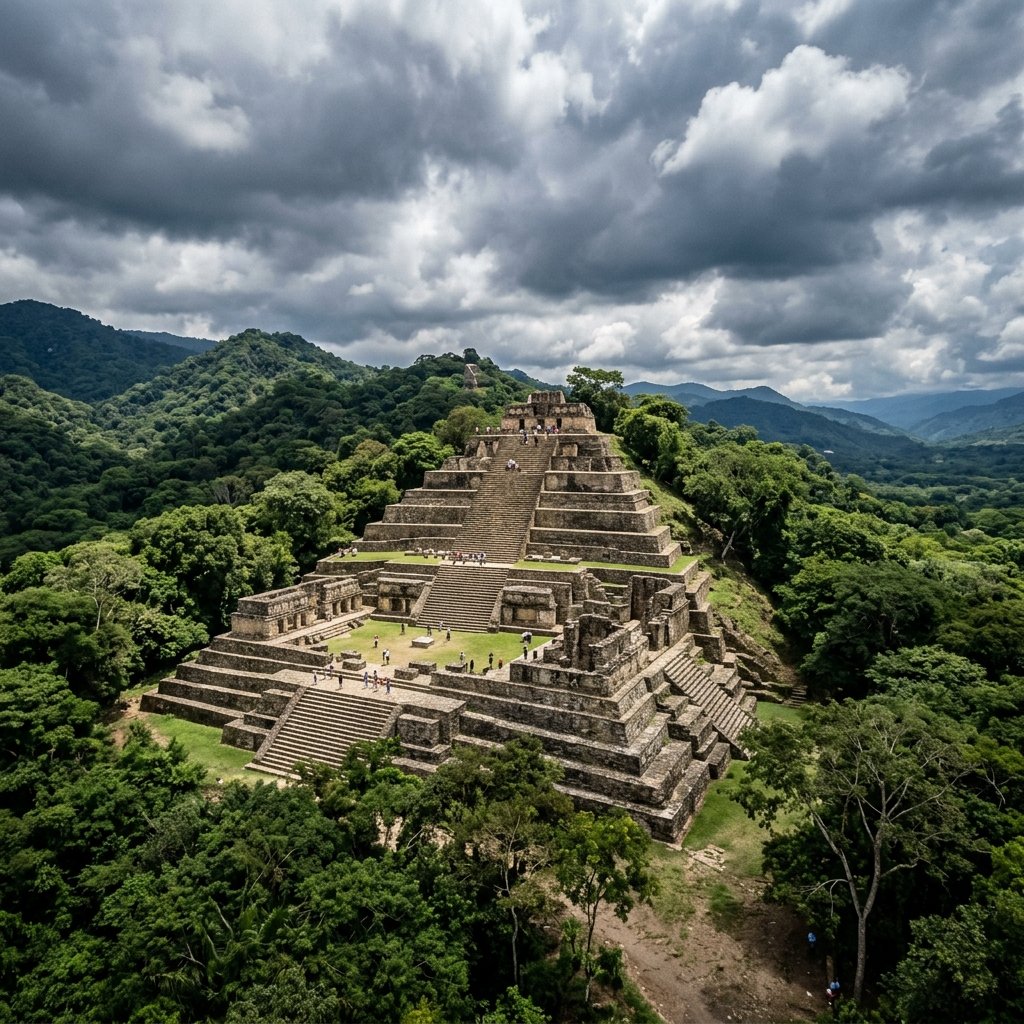
Toniná at a Glance
A City Built Into a Mountain
Toniná is unlike any other Maya city. Where Tikal and Palenque built their temples on flat ground, Toniná carved its entire urban center into a natural hillside, creating a terraced acropolis of seven platforms rising approximately 75 meters above the valley floor. The result is not so much a city as a man-made mountain — a fortress that is simultaneously a temple complex, a palace, and a monument to military power.
Each terrace contains temples, tombs, sculptures, and administrative buildings. The ascent from the base to the summit passes through increasingly sacred spaces — from the public ballcourt at the bottom to the private royal temples at the top. The entire complex functions as a vertical hierarchy of power: the higher you climb, the closer you are to the king and the gods.
The Warrior Kingdom
Toniná's kings were warriors. The site's sculpture program is among the most militaristic in the Maya world — featuring bound captives, stripped and humiliated enemy kings, and graphic depictions of sacrifice. Toniná's most famous military achievement was the capture of K'inich K'an Joy Chitam II, king of Palenque, in 711 AD.
A stone sculpture at Toniná shows the Palenque king bound as a captive — an extraordinary humiliation for one of the most prestigious dynasties in the Maya world. This event marked the beginning of Palenque's terminal decline and demonstrated that Toniná — though smaller and less known — was a formidable military power on the western Maya frontier (Martin, S. & Grube, N., Chronicle of the Maya Kings and Queens, 2008, pp. 183–186).
The Stucco Frieze of the Four Eras
One of Toniná's most remarkable discoveries is a large stucco mural depicting the four ages of creation — a cosmological narrative showing skeletal death figures, severed heads, and cosmic monsters arranged in a complex composition that rivals the creation narratives found in the Popol Vuh and Classic-period ceramics. The mural was found on the sixth platform and represents one of the most complete cosmological programs in Late Classic Maya art.
The Last Inscription
Toniná holds a melancholy distinction: it contains one of the last known dates in the Maya Long Count calendar. Monument 101, dated to 909 AD, is among the latest of all Classic Maya inscriptions — a literal final word from the Classic Maya world. By the time this monument was carved, most lowland Maya cities had been abandoned for generations. Toniná endured longer than almost anyone.
Visiting Toniná
- Access: Near Ocosingo, Chiapas — 85 km east of San Cristóbal de las Casas. The road passes through beautiful highland scenery.
- Time needed: 2–3 hours. The acropolis is steep — good footwear recommended.
- Site museum: Excellent — houses many of the original sculptures, including captive figures and the stucco frieze.
- Combine with: Palenque (3–4 hours north) — visit Toniná first, then Palenque, for chronological drama.
Frequently Asked Questions
What makes Toniná unique?
Its 75-meter terraced acropolis carved into a hillside — an entire city built vertically into the mountain. Plus some of the most graphic captive sculptures in Maya art and one of the last known Classic Maya inscriptions (909 AD).
Did Toniná defeat Palenque?
Yes. In 711 AD, Toniná captured Palenque's king K'inich K'an Joy Chitam II — one of the most dramatic political events in Classic Maya history. A sculpture at Toniná shows the king bound as a captive.
Where is Toniná?
In the highlands of Chiapas, Mexico, near Ocosingo, 85 km east of San Cristóbal de las Casas. One of the westernmost major Maya kingdoms.
Scholarly References
- Martin, S. & Grube, N. Chronicle of the Maya Kings and Queens. Thames & Hudson, 2nd ed., 2008.
- Yadeun, J. Toniná. INAH/El Equilibrista, 1993.
- Miller, M.E. Maya Art and Architecture. Thames & Hudson, 1999.