Yaxchilán at a Glance
The City of the Broken Sky
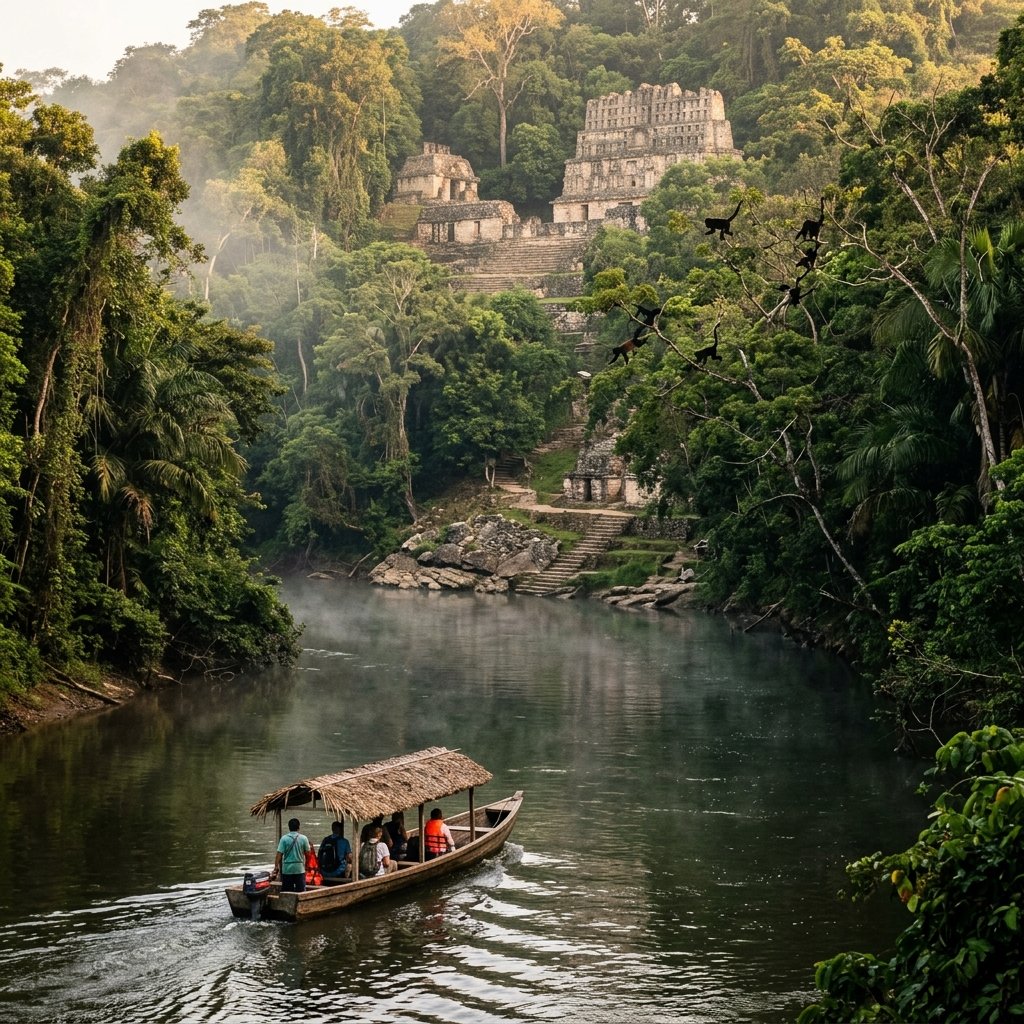
Getting to Yaxchilán is half the adventure. The site sits tightly enclosed within a dramatic horseshoe bend or "omega" curve of the Usumacinta River — the powerful waterway that forms the modern border between Mexico and Guatemala. There are no roads to Yaxchilán. The only way to reach the city is to travel precisely as the ancient Maya did: by boat down the river, surrounded by the dense, impenetrable walls of the Lacandón jungle.
In antiquity, the city was known as Pa' Chan, which translates to "Broken Sky" or "Cleft Sky." It was a formidable regional power that derived its wealth and military clout from controlling trade along the Usumacinta corridor — the primary superhighway of the western Maya lowlands connecting the Petén interior to the Gulf Coast (Golden & Scherer, "Border Problems: Recent Archaeological Research along the Usumacinta River," The PARI Journal, 2006).
But Yaxchilán is not famous today for its size or its military campaigns. It is famous because its sculptors mastered a specific artistic form — the carved stone lintel — using it to produce some of the most dynamic, intensely personal, and psychologically powerful images in all of pre-Columbian art.
The Journey and the River
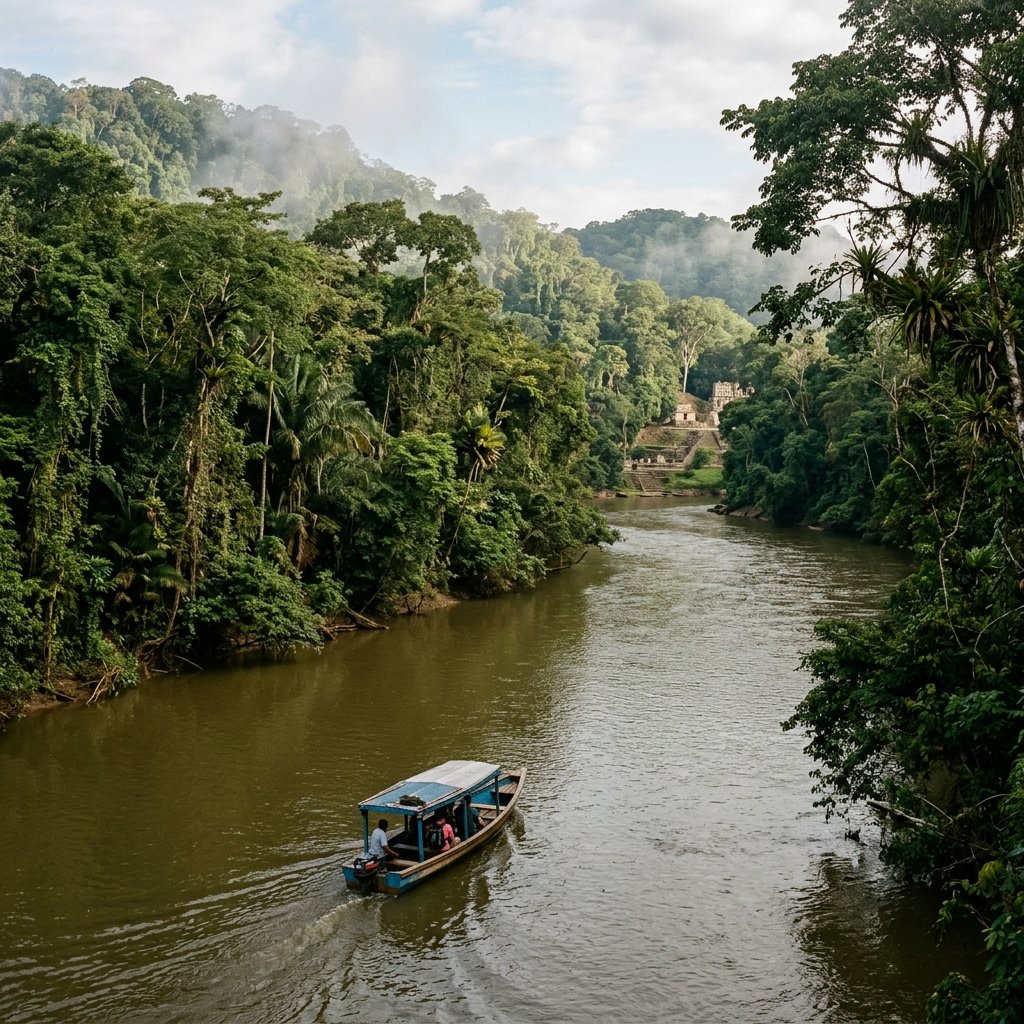
The approach to Yaxchilán via the Usumacinta River. Because the site sits entirely within a sharp bend in the river, it functions ecologically as an island. This isolation protected it from looting for centuries and gives visitors today an authentic sense of the deep jungle wilderness.
The Usumacinta River was the lifeblood of the western Maya kingdoms. Trade canoes laden with jade, obsidian, quetzal feathers, cacao, and captive slaves traveled this route. By positioning their capital on a steep natural peninsula created by a river bend, the rulers of Yaxchilán created a perfectly defensible tollbooth. They could monitor and tax all river traffic while remaining protected by water on three sides (Martin & Grube, Chronicle of the Maya Kings and Queens, Thames & Hudson, 2000).
This geography also created a fierce, multi-generational geopolitical rivalry with Piedras Negras, the next major kingdom downriver. The two cities fought a centuries-long proxy war over control of the Usumacinta, capturing each other's nobles and recording the victories in stone.
Structure 33: The Centerpiece of Pa' Chan
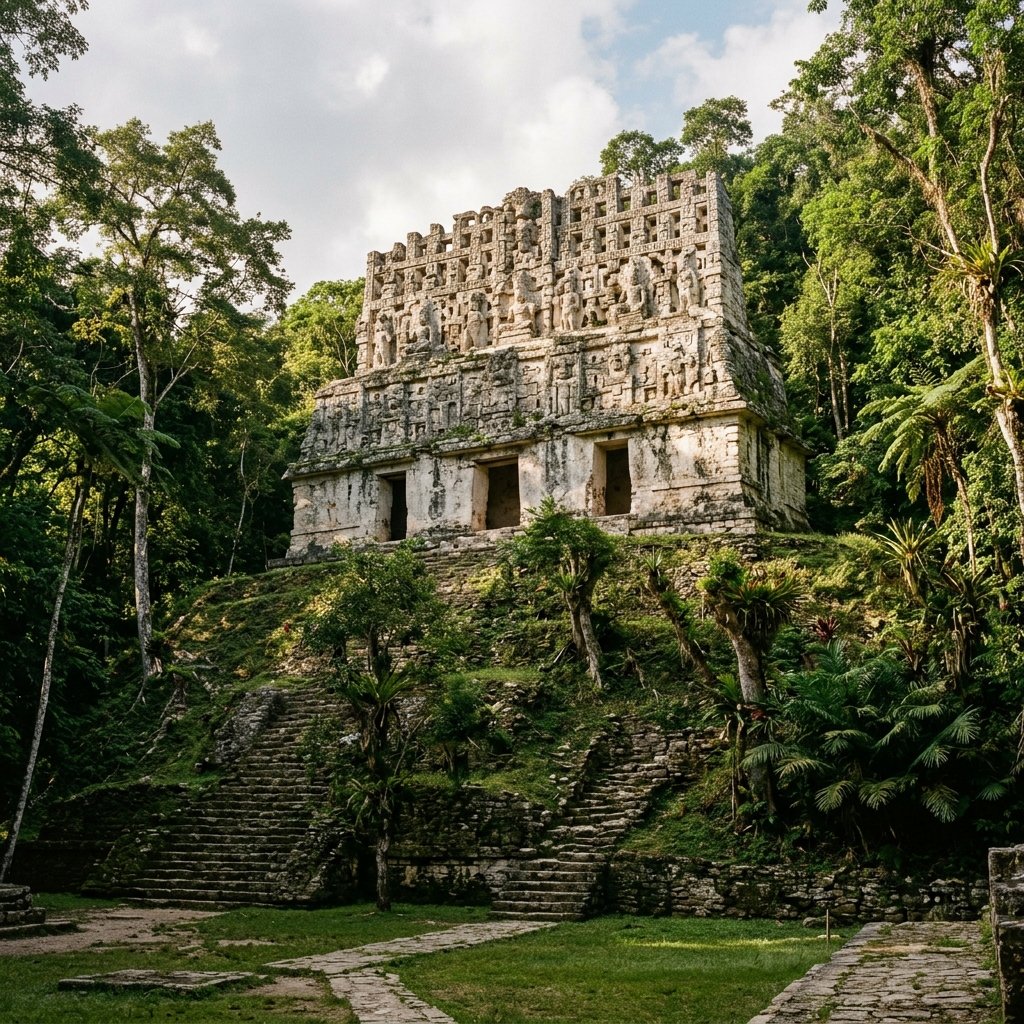
Structure 33 sits dramatically atop the Acropolis hill overlooking the main plaza. The building is defined by its massive "roof comb" — an architectural billboard designed to make the temple look much taller from the river and the plaza below. A nearly headless statue of King Bird Jaguar IV still sits in the central niche.
The most iconic building at Yaxchilán is Structure 33, which sits dramatically atop a set of steep terraces overlooking the Main Plaza. The temple represents the absolute pinnacle of Yaxchilán's architectural style, built c. 752 AD by Bird Jaguar IV to legitimize his controversial succession to the throne.
The building's defining feature is its colossal roof comb. While many Maya cities used roof combs, Yaxchilán pushed the engineering to its limits — the comb is almost as tall as the building supporting it. It functioned as a massive, sky-high billboard. In antiquity, it featured a giant stucco portrait of the king, painted in brilliant red, blue, and yellow, visible to canoes far down the river. The deep niches and lattice-like stonework kept it light enough to prevent the roof from collapsing under its own weight (Tate, Yaxchilan: The Design of a Maya Ceremonial City, University of Texas Press, 1992).
Lady K'abal Xook and the Lintels of Yaxchilán
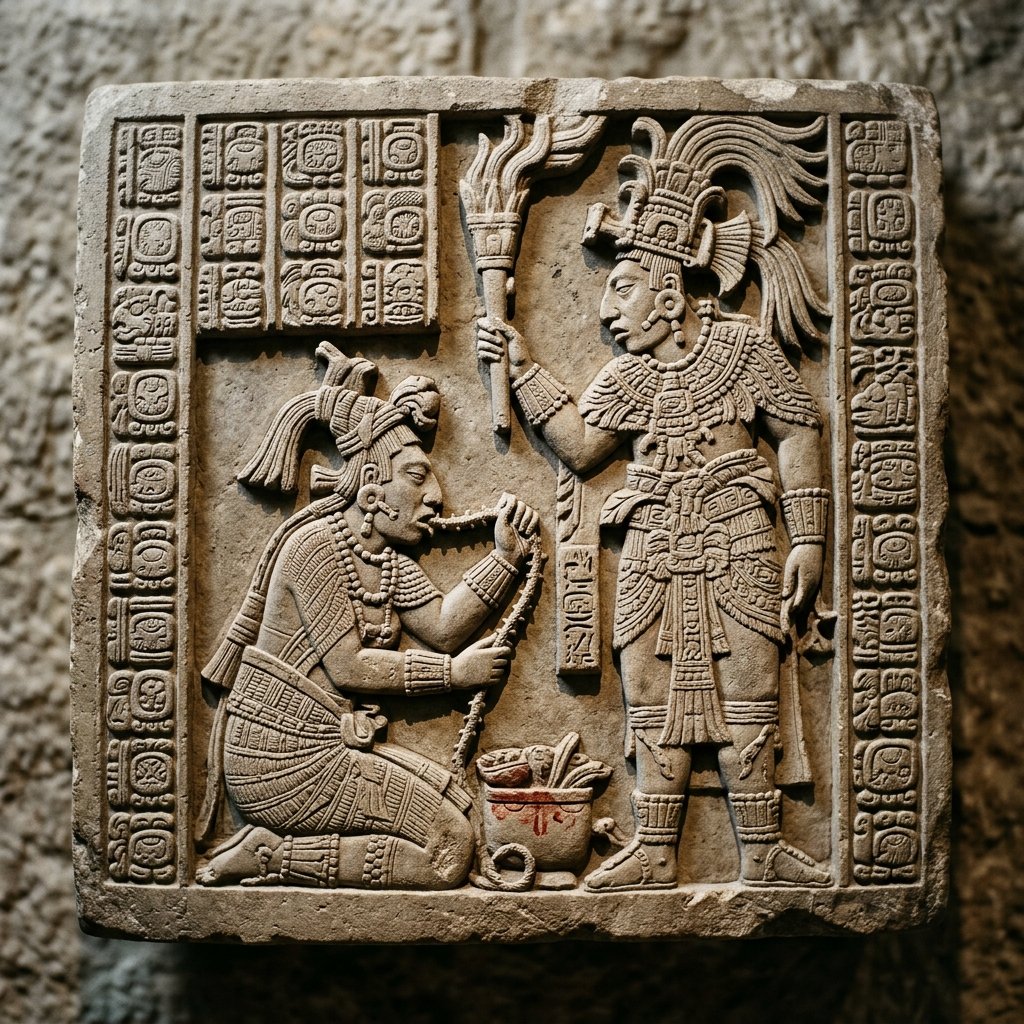
Based on Yaxchilán Lintel 24 — one of the masterworks of global ancient art. Queen Lady K'abal Xook kneels, passing a thorn-studded rope through her tongue in a bloodletting ritual. King Shield Jaguar II stands above her holding a torch. The extraordinarily delicate carving of the textile patterns and hieroglyphs marks the absolute peak of Maya relief sculpture.
While other cities recorded their histories on freestanding vertical stelae, Yaxchilán's sculptors preferred lintels — the horizontal stone blocks spanning the doorways of temples. Visitors had to literally walk under the history and authority of the king to enter the building.
The most famous of these is the trio of lintels from Structure 23 (Lintels 24, 25, and 26), mostly now housed in the British Museum. They depict Lady K'abal Xook, the principal wife of King Itzamnaaj B'ahlam II (Shield Jaguar II). These carvings are unique in the Maya world because they prominently feature a woman taking the active, central role in state ritual, rather than merely accompanying a king.
In Lintel 24, Lady K'abal Xook kneels and pulls a rope studded with obsidian thorns through a hole in her tongue. The blood drips onto paper strips in a basket below. In the next scene (Lintel 25), the blood-soaked paper has been burned, and from the curling smoke rises a two-headed Vision Serpent. From the serpent's mouth emerges the patron deity of the city, dressed in the armor of Teotihuacan.
Art historians Linda Schele and Mary Ellen Miller describe this series as "the most famous and powerful of all Maya sculptures." It condenses an entire theological system — royal sacrifice, altered states of consciousness induced by blood loss, and the conjuring of gods — into a few square feet of impossibly delicate stone carving. The artist signed the work, but time has eroded his name; scholars simply call him the "Master of Structure 23" (Schele & Miller, The Blood of Kings, Kimbell Art Museum, 1986).
The Labyrinth
One of the most physically disorienting experiences at any Maya site occurs the moment you enter Yaxchilán. Visitors must pass through Structure 19, commonly known as "The Labyrinth."
It is a complex of dark, windowless rooms, highly vaulted ceilings, and blind alleys inhabited by hundreds of bats. You enter from the jungle side and must navigate the dark interior passages to exit onto the sunlit Main Plaza. This forced subterranean transit was intentional architectural psychology. Archaeologists believe the building served as a physical metaphor for Xibalba (the Maya underworld). To reach the sacred plaza, one had to first survive a journey through the dark, echoing the journey of the Hero Twins in the Popol Vuh creation myth.
The Howler Monkeys: The Voice of the Jungle
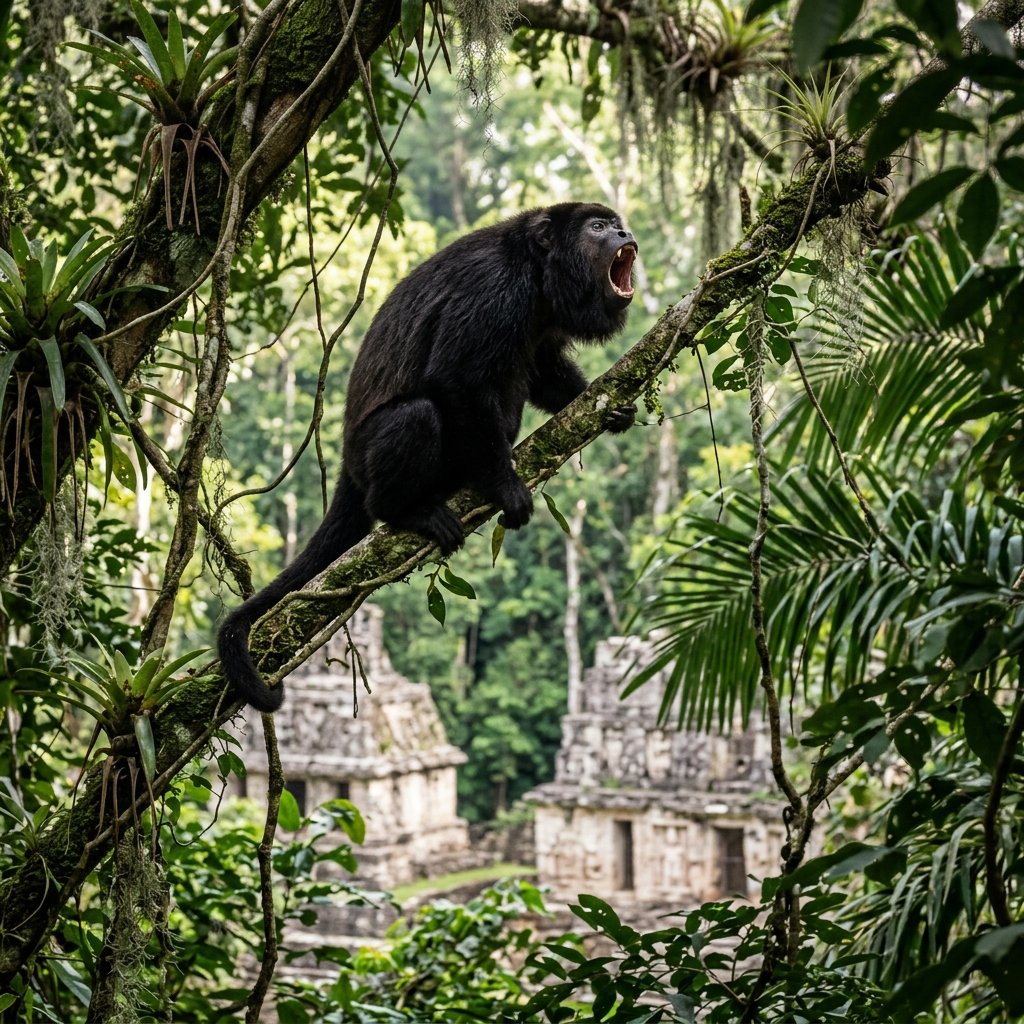
A black howler monkey near the ruins. Because Yaxchilán is enveloped by the Lacandón jungle and cut off from road traffic, it possesses a vibrant acoustic environment. The terrifying, booming roar of howler monkeys echoing off the ancient stone pyramids is an unforgettable part of the site's atmosphere.
You do not simply look at Yaxchilán; you listen to it. Because it is so isolated, the site retains an intense connection to the surrounding Lacandón jungle. The most prominent feature of this environment is the population of black howler monkeys (Alouatta pigra) that live in the canopy directly above the ruins.
The howler monkey's territorial call is one of the loudest sounds produced by any land animal — a terrifying, guttural roar that evolved to carry for miles through dense vegetation. When multiple troops begin howling simultaneously, the sound bounces off the stone temples and creates an overwhelming acoustic experience that feels deeply ancient. To the Classic Maya, the monkey was a patron deity of scribes and artisans, and hearing their roar echoing through the courtyards is as close as a modern visitor can get to the sensory reality of the ancient city.
Practical Travel Guide
Getting There
From Palenque, drive or take a colectivo 3 hours southeast to the border town of Frontera Corozal. From there, you must hire a lancha (motorboat) at the river cooperative for the 45-minute trip down the Usumacinta to the ruins. The boat driver will wait for you (usually 3 hours) and bring you back.
Exploration Tips
Bring a strong flashlight or headlamp to navigate the dark, bat-filled passages of The Labyrinth (Structure 19) safely. Wear sturdy hiking shoes; the climb up the hillside to Structure 33 involves uneven, slippery stone steps heavily degraded by tree roots.
Jungle Conditions
Yaxchilán is significantly hotter, more humid, and "junglier" than Palenque or Chichén Itzá. Mosquitoes here are aggressive. Bring strong DEET-based insect repellent, wear breathable long sleeves/pants, and carry plenty of water — there are no facilities at the ruins.
Combine With
Most travelers combine Yaxchilán with the nearby site of Bonampak (famous for the most brightly painted, violent murals in the Maya world), which is a 30-minute drive from Frontera Corozal into the Lacandón reserve. Both can be done in one long day trip from Palenque.
Visitor Comparison
| Feature | Yaxchilán | Palenque | Tikal |
|---|---|---|---|
| Best Feature | Carved Lintels / River approach | Pakal's Tomb / Stucco | Massive towering pyramids |
| Accessibility | Difficult (Boat only) | Very Easy (Road) | Moderate (Road/Air) |
| Atmosphere | Wild, isolated, remote | Elegant, refined | Monumental, vast |
| Crowd Level | Very Low | Moderate | Moderate–High |
| Time Needed | 3 hours (plus boat transit) | 3–4 hours | 4–6 hours |
Key Academic References
- Golden, Charles & Scherer, Andrew. "Border Problems: Recent Archaeological Research along the Usumacinta River." The PARI Journal, 7(2), 2006.
- Martin, Simon & Grube, Nikolai. Chronicle of the Maya Kings and Queens. Thames & Hudson, 2000.
- Schele, Linda & Miller, Mary Ellen. The Blood of Kings: Dynasty and Ritual in Maya Art. Kimbell Art Museum, 1986.
- Tate, Carolyn E. Yaxchilan: The Design of a Maya Ceremonial City. University of Texas Press, 1992.
Frequently Asked Questions
Why is Yaxchilán only accessible by boat?
The city was intentionally built on a sharp "omega" bend of the Usumacinta River during the Classic period, using the river as a natural defensive moat and a tollgate to control regional trade. Today, the surrounding Lacandón jungle remains legally protected wilderness, and no modern roads have been built to the site to preserve both the archaeological integrity and the dense jungle biosphere.
Who was Lady K'abal Xook?
She was the principal wife of King Shield Jaguar II, one of Yaxchilán's most powerful rulers. She is famous because the carvings commissioned for her building (Structure 23) feature her taking the primary, active role in divine bloodletting rituals, rather than merely standing passively beside the king. Her prominent depiction demonstrates the immense political and ritual power that high-ranking Maya women could hold.
Are the original lintels still there?
Many are still in place above the temple doorways at the ruin (look up when entering buildings!). However, several of the most famous and pristine masterworks — notably Lintels 24, 25, and 26 depicting Lady K'abal Xook — were removed by British explorer Alfred Maudslay in the 1880s and are now on display in the British Museum in London. Mexico's National Museum of Anthropology in Mexico City also holds several pieces.
What is the "Labyrinth"?
Structure 19, known as the Labyrinth, is the first building visitors encounter after walking up from the river. It is a multi-level structure with completely dark, windowless interior passages that visitors must navigate to reach the Main Plaza. Archaeologists believe this forced passage through darkness was designed to simulate a harrowing journey through the Maya underworld (Xibalba) to reach the sacred precinct of the city.
Is it safe to border the river next to Guatemala?
Yes, the boat trip from Frontera Corozal to Yaxchilán is a well-established and safe tourist route managed by a local Chol Maya cooperative. While the river forms the international border — meaning you are looking at Guatemala on the right bank and Mexico on the left — there are no border checkpoints required if you are simply visiting the ruins and returning to Frontera Corozal.