Huracan at a Glance
The Creator of the World
In the Popol Vuh — the K'iche' Maya creation epic — Huracan is the primary creative force that brings the world into existence. Before creation, there was only stillness: "Only the sky alone is there; the face of the earth is not clear. Only the sea alone is pooled under all the sky; there is nothing whatever gathered together" (Tedlock, 1996, p. 64).
Into this primordial stillness, Huracan speaks. His creative power is verbal — he speaks reality into being. The Popol Vuh describes this in language remarkably parallel to the Genesis creation account: "It was simply their word that caused it... 'Earth!' they said, and the earth arose" (Christenson, 2007, p. 71).
Huracan does not work alone. He is one half of a creative partnership with Tepeu (the Sovereign) and Q'ukumatz (the Feathered Serpent — the K'iche' equivalent of Kukulkán). Together, these sky-dwelling creators consult with one another, deliberate, and then speak the world into being through shared conversation — a notable detail that presents creation as a collaborative, dialogic process rather than the act of a single all-powerful being.
The Three Aspects of Huracan
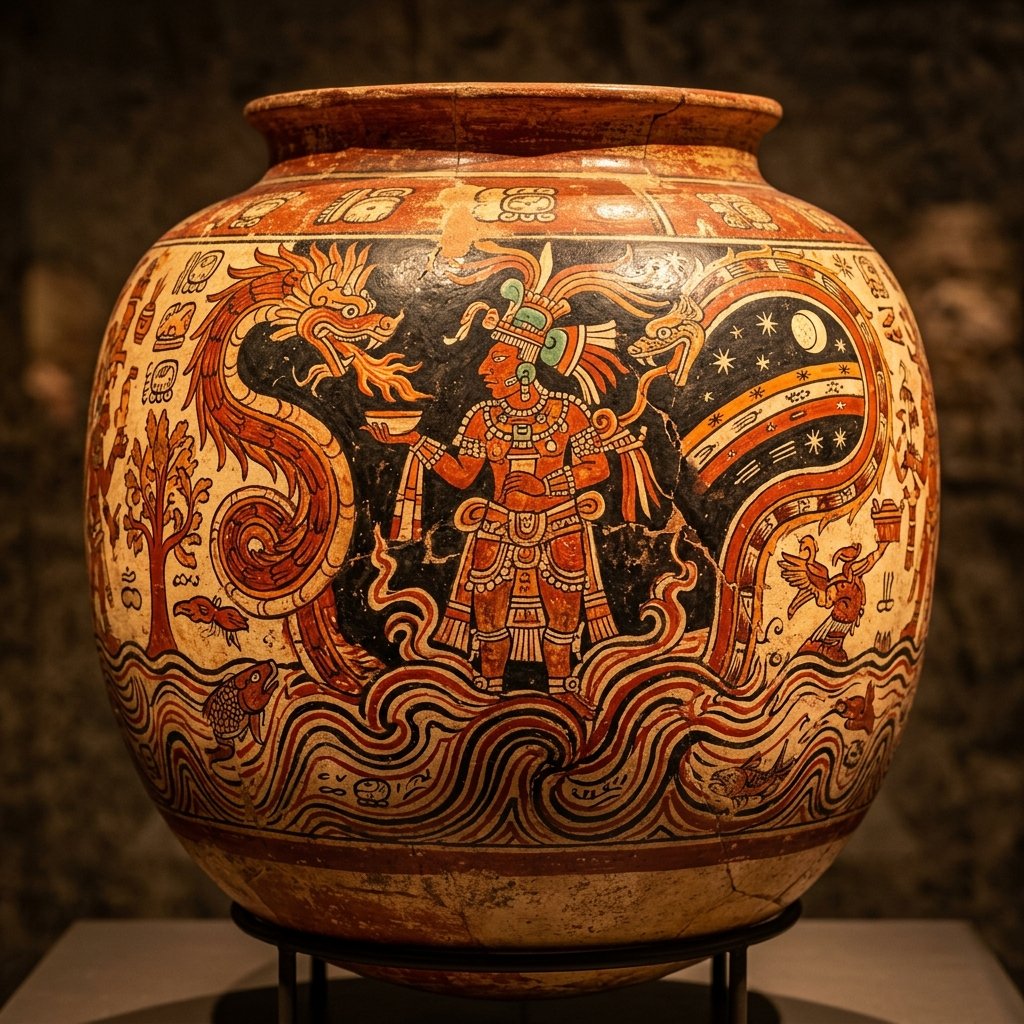
One of the most distinctive features of Huracan's character is his triple nature. The Popol Vuh describes him as having three manifestations:
- Caculhá Huracan — "Lightning Huracan" or "Lightning One Leg." The primary, full-power manifestation. Associated with the great thunderbolt.
- Chipi-Caculhá — "Newborn Lightning" or "Smallest Lightning." The spark, the momentary flash. Associated with sheet lightning visible on the horizon.
- Raxa-Caculhá — "Green Lightning" or "Sudden Lightning." The violent, unexpected strike. Associated with the greenish flash of close lightning.
Together, these three constitute "Heart of Sky" (u k'ux kaj in K'iche'). This trinitarian structure has attracted attention from scholars of comparative religion, though direct parallels to the Christian Trinity should be drawn cautiously — the Popol Vuh was transcribed after Christian contact, and some scholars argue that the triple structure may reflect colonial-era influence (Christenson, 2007, pp. 59–61).
However, triple-deity concepts exist in pre-Columbian Mesoamerican art, suggesting the structure may be genuinely pre-contact. The truth is likely complex: an indigenous theological concept that may have been emphasized or formalized by the K'iche' scribes who wrote the Popol Vuh under Spanish-era conditions.
The Name: From Maya God to English Word
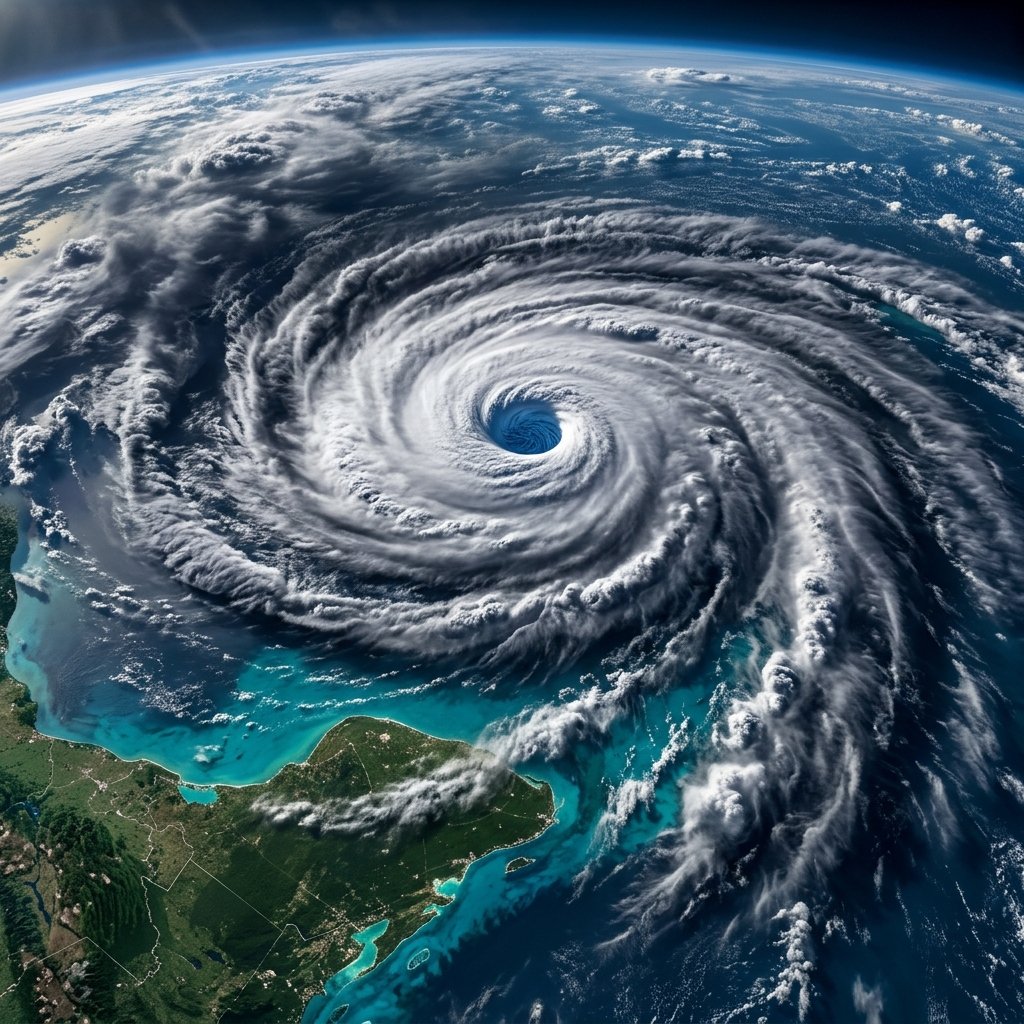
The English word "hurricane" derives directly from Huracan — making it one of the most globally successful loanwords in any language. The etymological path runs:
- K'iche' Maya: Juraqan ("One Leg" or "Heart of Sky")
- Taíno (Caribbean): Hurakán (storm deity, adopted from Mesoamerican contact)
- Spanish: huracán (recorded by the earliest Spanish explorers in the Caribbean)
- English: hurricane (borrowed from Spanish, first used in English c. 1555)
The Taíno people of the Caribbean — who the Spanish encountered first — had their own storm deity named Juracán, which shared a Mesoamerican origin. When Caribbean hurricanes devastated Spanish fleets, the word entered European languages permanently (Schwartz, S.B., Sea of Storms, 2015, pp. 11–14).
Huracan in the Creation Sequence
The Popol Vuh describes four successive creations — each an attempt by the gods to produce beings capable of worshipping them:
- The mud people: Huracan and his partners first attempt to create humans from mud (earth). The mud people dissolve in water — soft, formless, unable to speak properly. They are destroyed.
- The wooden people: The second attempt uses carved wood. The wooden people can walk and talk but have "no hearts and no minds" — they cannot worship. Huracan sends a great flood to destroy them, and the wooden people's own tools and animals rebel against them. The survivors become monkeys.
- The interregnum: Before the final creation, the earth is dominated by false powers — Vucub Caquix, Zipacna, and Cabrakan — whom the Hero Twins must defeat.
- The maize people: Finally, with the help of Xmucane, humanity is created from maize dough. The maize people can see, think, speak, and worship. They are so perfect that the gods must dim their vision to prevent them from becoming too powerful.
Throughout this sequence, Huracan is both creator and destroyer. He makes the world and then unmakes his failed versions of it. This dual role — creation through destruction — is a core theme of Maya theology and mirrors the annual agricultural cycle: the milpa (cornfield) must be burned before it can be replanted.
"One Leg" — The Physical Form
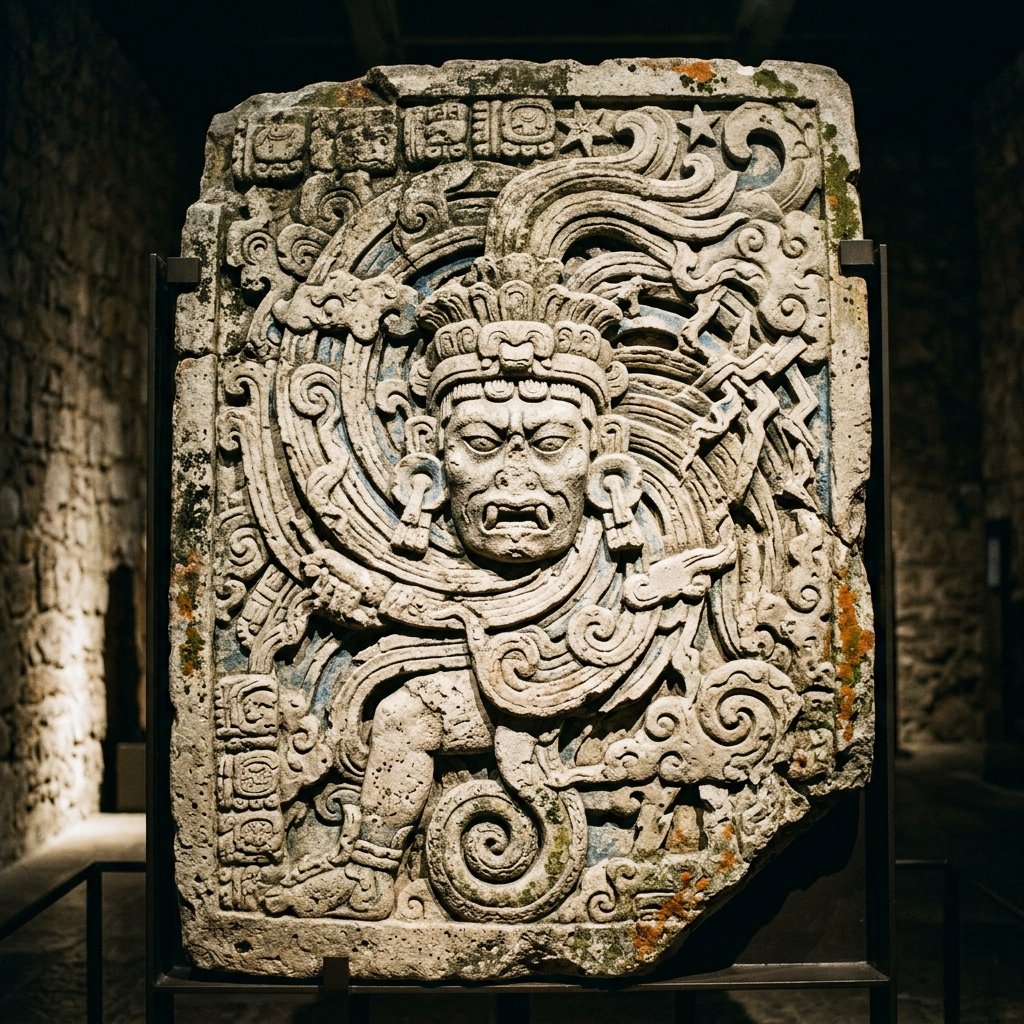
The name Juraqan is sometimes translated as "One Leg" (from jun = one, raqan = leg). This has led scholars to propose that Huracan may have been visualized as a figure with a single leg — perhaps a lightning bolt striking the earth, or a tornado's funnel touching down. The one-legged deity concept appears in the god K'awiil, whose serpent-leg may be a Classic-period representation of this same cosmic power (Taube, K., "The Classic Maya Maize God," in The Maya Vase Book, Vol. 5, 1997).
The "one leg" motif also appears across other Mesoamerican traditions — the Aztec god Tezcatlipoca lost a leg in the creation of the world, and Caribbean storm deities were similarly described as one-legged or whirlwind-shaped.
References
- Tedlock, D. Popol Vuh: The Definitive Edition of the Mayan Book of the Dawn of Life. Simon & Schuster, 1996.
- Christenson, A.J. Popol Vuh: The Sacred Book of the Maya. University of Oklahoma Press, 2007.
- Schwartz, S.B. Sea of Storms: A History of Hurricanes in the Greater Caribbean from Columbus to Katrina. Princeton University Press, 2015.
- Taube, K. "The Classic Maya Maize God: A Reappraisal." In Kerr, J. (ed.), The Maya Vase Book, Vol. 5, Kerr Associates, 1997.
- Coe, M.D. The Maya. Thames & Hudson, 9th edition, 2015.
Frequently Asked Questions
Does the word "hurricane" really come from a Maya god?
Yes. The English word "hurricane" derives from the K'iche' Maya deity name Juraqan ("Heart of Sky"), which passed through the Taíno language of the Caribbean into Spanish (huracán) and then into English. It is one of the most widely used loanwords of indigenous American origin in any European language. The word was first recorded in English around 1555.
Is Huracan the same as Kukulkan?
No — they are distinct deities who work together. In the Popol Vuh, Huracan (Heart of Sky) is the primary creative force, while Q'ukumatz (the K'iche' name for the Feathered Serpent/Kukulkán) is his creative partner. They collaborate on the creation of the world through conversation and shared deliberation. Huracan is associated with storms and lightning; Kukulkán with wind and the feathered serpent.
Why is Huracan called "One Leg"?
The name Juraqan may derive from K'iche' words meaning "one leg." Scholars propose this refers to the visual form of either a lightning bolt (a single leg of fire striking the earth from the sky) or a tornado/whirlwind (a single "leg" descending from the clouds). The one-legged deity motif appears across Mesoamerica and may connect to the god K'awiil, whose serpent-leg transformation may represent this same cosmic power.