The Myth at a Glance
The Story
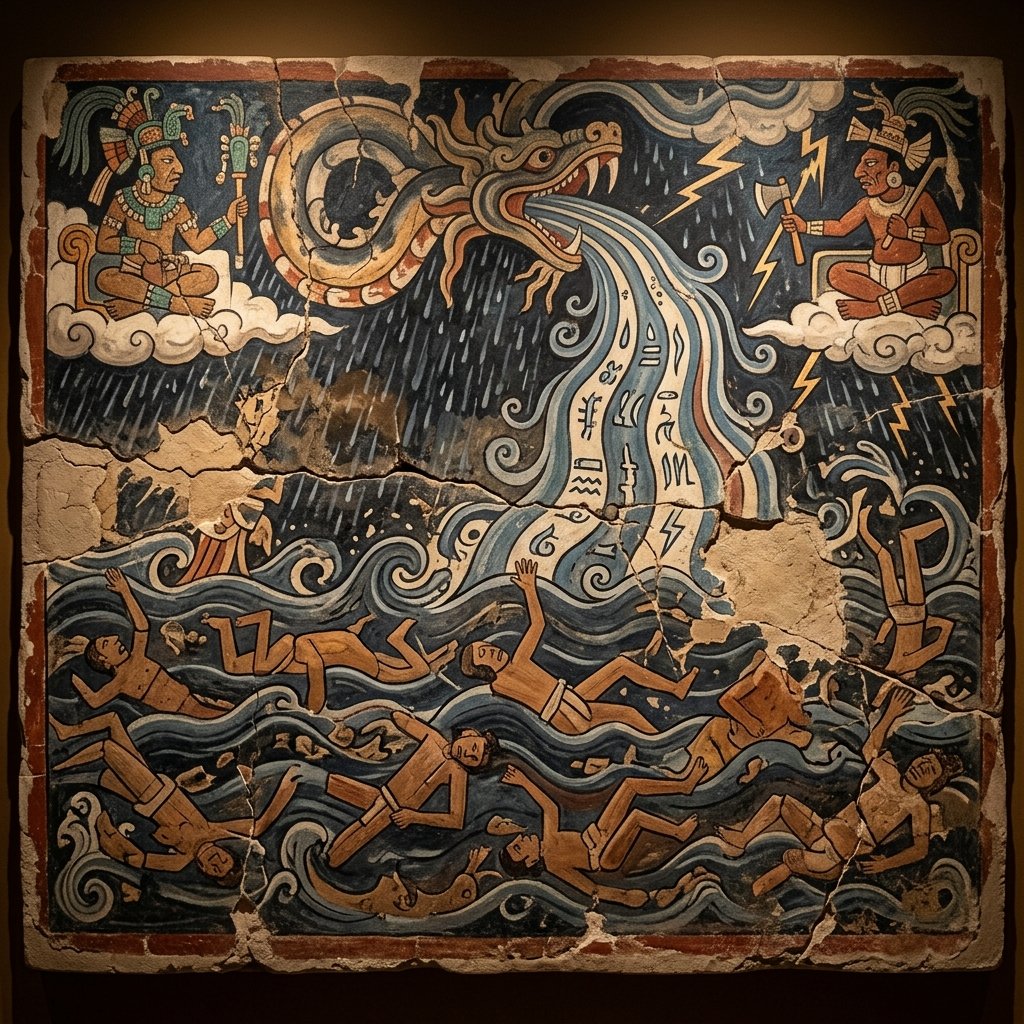
In the creation narrative of the Popol Vuh, the gods' second attempt to create beings who could worship them produced the wooden people — figures carved from wood who could walk, talk, and multiply across the earth. They looked human. They populated the world.
But they had a fatal flaw: they had no hearts and no minds. They could not remember their creators. They walked through the world like automatons — speaking without meaning, existing without gratitude. The gods decided they must be destroyed.
The Popol Vuh describes the destruction in vivid, terrifying detail:
- A great flood was sent — a "flood of resin" poured from the sky.
- The being called Xecotcovach gouged out the wooden people's eyes.
- Camalotz (the Death Bat) cut off their heads.
- Cotzbalam (the Crouching Jaguar) devoured their flesh.
- Tucumbalam crushed and ground their bones.
But the most extraordinary element is the rebellion of objects. The wooden people's tools and domestic animals turned against them:
"Their grinding stones and cooking pots spoke: 'You burned us, you scraped us, you tortured us every day. Now we shall destroy you.' Their dogs said: 'You did not feed us. You kept us only to chase us away from your food. Now we shall bite you.'"
— Popol Vuh, adapted from Tedlock translation (1996), pp. 73–75
The wooden people tried to flee — climbing onto rooftops, into trees, into caves. But every refuge rejected them. The rooftops collapsed. The trees shook them off. The caves sealed their mouths. The survivors were transformed into monkeys — which is why, the Popol Vuh explains, monkeys resemble humans but are not truly human.
But the story does not end with destruction. The wooden people are swept away so that humanity can be reborn — re-created in the next cycle from maize, this time with hearts, minds, and the capacity for gratitude. The flood is not the conclusion; it is the necessary passage between a failed creation and a perfected one. In this way, the Maya narrative echoes the same profound pattern found in the biblical account of Noah: the world is unmade so that it can be remade.
What Unites These Stories: Cleansing and Rebirth
The Maya flood myth shares deep thematic roots with flood stories worldwide — the Mesopotamian Epic of Gilgamesh, the Hebrew Bible's Noah narrative, the Hindu Matsya Purana, the Greek legend of Deucalion, and hundreds of indigenous flood traditions across the Americas, Asia, and Oceania. While the surface details vary, the most striking — and most frequently overlooked — commonality is not the destruction itself but what follows it: rebirth.
The biblical flood is often reduced in popular discussion to a story of divine punishment — the wicked are swept away, and the righteous are spared. But this reading misses the deeper theological architecture. In the Genesis account, the flood is explicitly a re-creation event: the waters recede, the earth dries, and God establishes a new covenant with humanity through Noah. The rainbow is not merely a sign that God will not flood the earth again; it is a sign of renewal — a new beginning for a renewed humanity. The world is not merely cleaned; it is reborn.
The Maya tradition, though different in its mechanics, conveys the same profound idea. The wooden people are not simply destroyed — they are swept away so that the gods can try again, ultimately creating true humans from maize. The transformation of the wooden people into monkeys is itself an act of rebirth through a different form. They do not simply perish; they are remade into something else, while the path is cleared for a higher creation. The flood, in both traditions, is not the end of the story — it is the turning point that makes the real story possible.
The Biblical Flood
- God cleanses a corrupt world through water
- Noah preserves life through the ark
- A new covenant establishes a reborn humanity
- The rainbow signals renewal, not just survival
The Maya Flood
- The gods cleanse a flawed creation through flood
- The wooden people are reborn as monkeys — transformed, not annihilated
- Humanity is re-created from maize with hearts and minds
- The flood clears the way for a perfected creation
In both cases, the flood is the mechanism of transformation — not merely punishment. The Maya version approaches this through iterative divine craftsmanship, with the gods refining their creation through trial and error. The biblical version frames it as moral renewal through covenant. But the deep structure is the same: the old world must be washed away so that a new and better one can emerge.
The Universal Flood Question
The existence of flood myths in cultures worldwide has fascinated scholars for centuries. What is remarkable is not merely that these stories exist, but that they appear among geographically isolated civilizations — peoples with no known contact, separated by oceans, mountain ranges, and millennia — and yet they converge on the same core themes: divine judgment, catastrophic water, and the rebirth of humanity.
Will Durant, in Our Oriental Heritage (the first volume of his monumental The Story of Civilization), documented how the Sumerian deluge tradition preceded and likely informed later Near Eastern accounts, including the biblical narrative. But Durant also observed a broader pattern throughout his eleven-volume survey of human history: civilizations rise, encounter catastrophic disruption, and are reborn — often carrying forward the same foundational myths and moral frameworks. For Durant, these flood narratives were not primitive superstitions but early expressions of humanity's deepest understanding that renewal requires a reckoning (Durant, W., Our Oriental Heritage, Simon & Schuster, 1935, pp. 125–128).
In the Americas, the anthropologist John L. Sorenson compiled extensive cross-cultural evidence in An Ancient American Setting for the Book of Mormon (1985), demonstrating that Mesoamerican traditions — including flood narratives, creation cycles, and themes of divine cleansing — exhibit striking parallels to Old World religious accounts. Sorenson's research drew on decades of fieldwork and comparative analysis to argue that such similarities are too numerous, too specific, and too structurally complex to be dismissed as coincidence. His work remains one of the most thorough scholarly compilations of cross-cultural evidence linking ancient American and Near Eastern traditions (Sorenson, J.L., An Ancient American Setting for the Book of Mormon, Deseret Book / F.A.R.M.S., 1985).
Why Are These Parallels So Often Dismissed?
Despite the extraordinary convergence of flood narratives across isolated civilizations, some modern researchers have been quick to dismiss the possibility of any meaningful connection to historical events — including the biblical account. The standard academic approach reduces these stories to one of three categories:
- Common geological experience: All civilizations developed near water, so flooding is a universal human experience. Flood myths independently encode ancestral memories of real but localized floods (Nunn, P.D. & Reid, N.J., "Aboriginal Memories of Inundation of the Australian Coast," Australian Geographer, 2016).
- Diffusion: Certain Near Eastern flood myths spread from a common Mesopotamian source (Gilgamesh/Atrahasis), which influenced the biblical Noah story. New World flood myths are assumed to be unrelated.
- Structural universality: Flood myths reflect universal cognitive patterns — the destruction-and-renewal cycle expresses how humans process chaos and order (Lévi-Strauss, C., "The Structural Study of Myth," Journal of American Folklore, 1955).
Each of these explanations contains truth. But taken together, they also reveal a tendency toward superficial dismissal. The reasoning often proceeds as follows: because a global flood cannot be proven geologically, the stories themselves must be reducible to local experience or cognitive archetypes. This approach treats the absence of geological proof as proof of absence — and in doing so, sidesteps the far more interesting question: why do dozens of isolated civilizations, upon first contact with the outside world, already possess stories about a great flood sent by divine powers to cleanse the earth and initiate a rebirth of humanity?
The consistent pairing of cleansing and renewal across these traditions — not merely "a big flood happened" but "the flood was necessary so that humanity could begin again" — is precisely the theme that the biblical account emphasizes: Noah's flood is not the end of humanity but its re-founding. The Maya flood clears away the wooden people so that maize-born humans can take their place. The Sumerian Ziusudra survives to carry civilization forward. The Hindu Manu preserves the Vedas through the deluge so that sacred knowledge is reborn with the new world.
This shared emphasis on rebirth — not just destruction — is the most significant parallel across these traditions, and it is the one most frequently overlooked by researchers who approach the material with a predetermined conclusion that ancient peoples simply mythologized local floods. As Durant's work demonstrates, the deep currents of human civilization flow toward meaning, not merely experience. And as Sorenson's meticulous cross-referencing shows, the parallels between ancient American and Near Eastern traditions are far too extensive to be explained by coincidence or cognitive universals alone.
Archaeological Context
While the Popol Vuh is a colonial-era transcription, the flood motif appears in pre-Columbian Maya art. The most relevant evidence includes:
- The "Cosmic Monster" imagery — Classic-period depictions of a sky-band serpent or crocodilian creature pouring water from its mouth, interpreted as the celestial source of the primordial flood (Taube, K., "The Jade Hearth," in Function and Meaning in Classic Maya Architecture, 1998).
- Dresden Codex, pages 74–74 — A scene showing water pouring from a sky band and from the mouth of a celestial serpent, while a crocodilian figure floats below. This is widely interpreted as a flood scene, though its exact relationship to the Popol Vuh narrative is debated.
- Monkey imagery — The prevalence of monkey figures in Maya art — particularly in association with scribes, artists, and the arts — is consistent with the Popol Vuh's identification of monkeys as the degraded remnants of the wooden people.
References
- Tedlock, D. Popol Vuh: The Definitive Edition of the Mayan Book of the Dawn of Life. Simon & Schuster, 1996.
- Christenson, A.J. Popol Vuh: The Sacred Book of the Maya. University of Oklahoma Press, 2007.
- Durant, W. Our Oriental Heritage (The Story of Civilization, Vol. I). Simon & Schuster, 1935.
- Sorenson, J.L. An Ancient American Setting for the Book of Mormon. Deseret Book / F.A.R.M.S., 1985.
- Sorenson, J.L. Mormon's Codex: An Ancient American Book. Deseret Book / Neal A. Maxwell Institute, 2013.
- Lévi-Strauss, C. "The Structural Study of Myth." Journal of American Folklore, Vol. 68, No. 270, 1955, pp. 428–444.
- Nunn, P.D. & Reid, N.J. "Aboriginal Memories of Inundation of the Australian Coast Dating from More than 7000 Years Ago." Australian Geographer, Vol. 47, No. 1, 2016, pp. 11–47.
- Taube, K. "The Jade Hearth: Centrality, Rulership, and the Classic Maya Temple." In Houston, S. (ed.), Function and Meaning in Classic Maya Architecture, Dumbarton Oaks, 1998.
Frequently Asked Questions
Is the Maya flood myth the same as Noah's flood?
They differ in their surface details — the biblical flood responds to moral wickedness while the Maya flood corrects a design failure, and Noah survives via an ark while the Maya wooden people become monkeys. However, the deeper parallel is more significant than the differences: both stories describe a divine cleansing of a flawed world followed by the rebirth of humanity. In the biblical account, Noah's covenant represents a new beginning; in the Maya account, the maize people represent a perfected creation. The shared theme of destruction-as-prerequisite-for-renewal across these and many other isolated traditions is one of the most striking patterns in comparative mythology.
Why do so many cultures have flood myths?
Multiple isolated civilizations across every inhabited continent — many with no known contact with one another — preserved stories of a great flood sent by divine powers to cleanse the earth and initiate a rebirth of humanity. The conventional academic explanation attributes this to universal geological experience (all civilizations developed near water) or to structural patterns in human cognition. However, scholars like Will Durant and John L. Sorenson have documented that the parallels extend far beyond "a big flood happened" — they include shared themes of moral reckoning, divine intervention, preservation of the righteous or the worthy, and the founding of a new world order. The consistency of the rebirth motif across these traditions strongly correlates with the biblical theme and challenges purely naturalistic explanations.
Did the wooden people really become monkeys?
In the Popol Vuh narrative, yes — the survivors of the flood were transformed into monkeys. This is an etiological explanation (a story explaining why something is the way it is): howler and spider monkeys look like humans but behave unlike them, and the myth explains this resemblance as a remnant of a failed creation. In Maya art, monkeys are strongly associated with scribes and the arts — possibly reflecting their status as "almost-humans" from the prior creation.