The Story at a Glance
The Problem the Gods Faced
According to the Popol Vuh, the gods created the earth, the mountains, the rivers, and the animals. But the animals could not speak — they could only squawk, chatter, and howl. They could not name the gods or praise them. The gods needed beings who could worship, who could keep track of the days, and who could sustain the gods through prayer and offering.
"Let us try to make obedient, respectful beings who will nourish and sustain us," the gods said. What followed were four attempts at creation — three failures and one success.
The First Attempt: Mud People
The gods shaped the first humans from mud. But the mud beings were soft and formless. They could not hold their shape. Their faces sagged, they could not turn their heads, and when they tried to speak, their words were meaningless babble. Worst of all, they dissolved in water. The gods destroyed them.
The Second Attempt: Wood People
Next, the gods carved humans from wood. The wooden people looked human, they could speak, and they multiplied across the earth. But they had no blood, no moisture in their flesh, and — critically — they had no memory and no hearts. They did not remember their creators. They walked and talked like automatons, but they did not think, did not feel gratitude, and did not worship.
The gods sent a great flood to destroy them. Their cooking pots, grinding stones, and even their dogs turned against them — the utensils saying, "You have burned us, scraped us, now we will crush you." The wooden people fled into the forest and became monkeys — which is why, the Popol Vuh says, monkeys resemble humans but are not truly human.
The Third Attempt
In some versions of the narrative, there is a brief, less detailed third attempt — beings of an unspecified material who also failed to properly worship the gods. Scholars debate whether this constitutes a distinct creation attempt or a variant tradition that was absorbed into the Popol Vuh text (Christenson, 2007, p. 88).
The Fourth Attempt: The Maize People
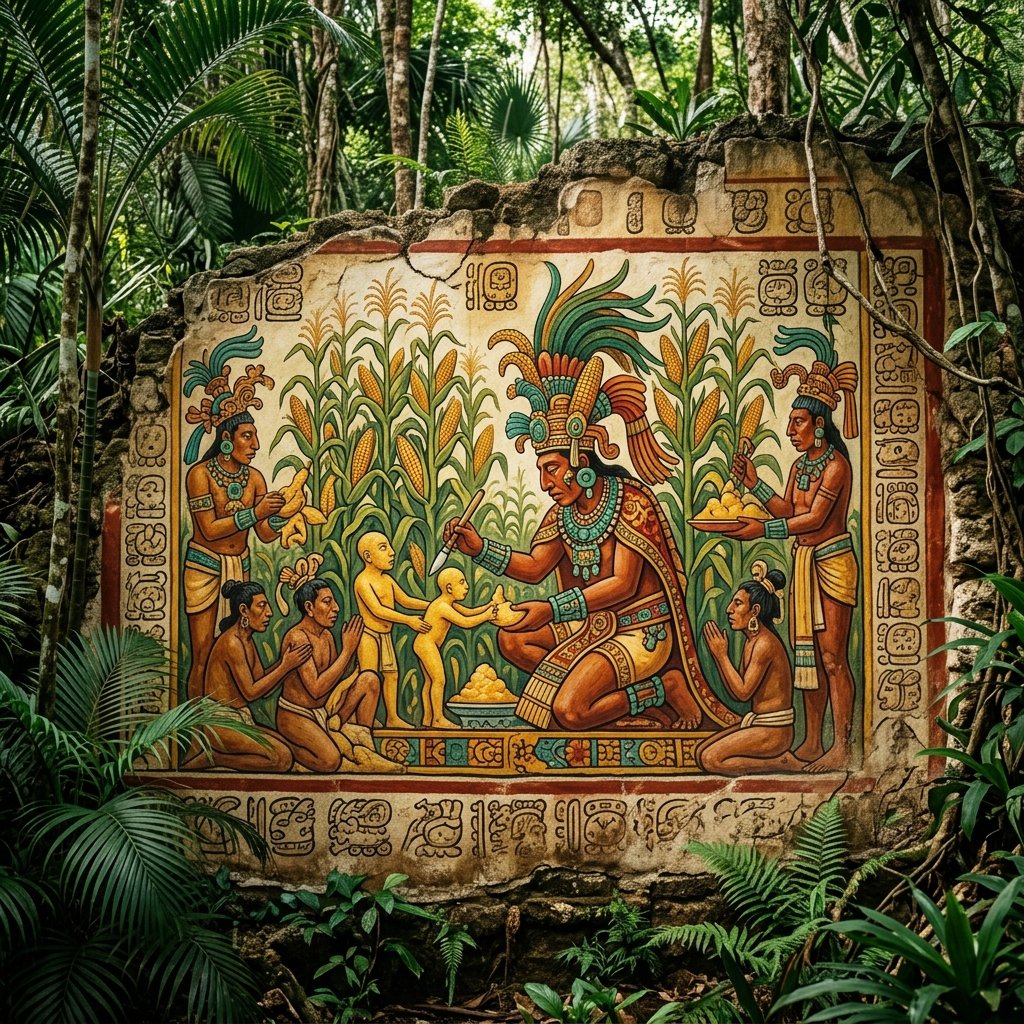
For the final attempt, the gods discovered maize — specifically, white and yellow corn — hidden inside a mountain called Paxil (Split Place). The fox, coyote, parrot, and crow led the gods to it. The grandmother goddess Xmucane ground the corn nine times, mixed the dough with water, and from this maize dough the gods shaped the first four true humans:
- Balam Quitze (Jaguar Who Smiles)
- Balam Acab (Jaguar of the Night)
- Mahucutah (Not Right Now — or "Renowned Name")
- Iqui Balam (Jaguar Moon)
These first four men were perfect. They could see everything — to the edges of the earth and into the sky. They immediately gave thanks to their creators. They were too perfect: their vision rivaled the gods themselves. So Heart of Sky breathed mist over their eyes, limiting their sight "to what was nearby" — the origin of human limitation, and the reason humans cannot see the full truth of the cosmos.
While the men slept, the gods created four women to be their wives. From these four couples descended all the K'iche' Maya lineages.
Why Maize?
This is not merely a poetic choice. Maize (Zea mays) was — and remains — the foundation of Mesoamerican civilization. Archaeological evidence shows that the Maya diet derived 60–80% of its calories from maize (Staller, J.E. et al., Histories of Maize, 2006). Isotope analysis of ancient Maya bones confirms this dependence: the carbon-13 signature in skeletal remains is consistent with extremely high maize consumption (White, C.D., "Stable Isotopes and the Human-Animal Connection in Maya Civilization," Journal of Archaeological Science, 2005).
To say that humans are made of maize is to state a biological and cultural truth: the Maya people were, quite literally, what they ate. Their bodies were built from the carbon, nitrogen, and minerals of corn. The creation myth encodes this reality as theology.
The Maize God in Art and Archaeology
The Tonsured Maize God (also known as the Young Maize God or First Father) is one of the most frequently depicted figures in Classic Maya art. He appears with a characteristic elongated head (mimicking an ear of corn), flowing hair (representing silk tassels), and a youthful, idealized face. His death and resurrection — being cut down like a harvested corn stalk and reborn from the earth — mirrors the agricultural cycle and the creation narrative.
Notable archaeological depictions include:
- The Maize God sculptures at Copán, Honduras — life-sized stone heads showing the deity emerging from the earth, found in the temple complex's eastern court (Fash, W.L., Scribes, Warriors, and Kings, 2001).
- The San Bartolo murals, Guatemala (c. 100 BC) — the earliest known depiction of the Maize God in full narrative context, showing him offering sacrificial maize in the cardinal directions (Saturno et al., 2005).
- The sarcophagus lid of K'inich Janaab Pakal at Palenque — the dead king is depicted falling into the underworld in the pose of the Maize God, with the expectation of resurrection (Schele & Miller, 1986).
References
- Tedlock, D. Popol Vuh: The Definitive Edition of the Mayan Book of the Dawn of Life. Simon & Schuster, 1996, pp. 145–167.
- Christenson, A.J. Popol Vuh: The Sacred Book of the Maya. University of Oklahoma Press, 2007.
- Taube, K. "The Classic Maya Maize God: A Reappraisal." In Fifth Palenque Round Table, 1983, PARI, 1985, pp. 171–181.
- Staller, J.E., Tykot, R.H. & Benz, B.F. (eds.) Histories of Maize: Multidisciplinary Approaches. Academic Press, 2006.
- Saturno, W.A., Stuart, D. & Beltrán, B. "Early Maya Writing at San Bartolo, Guatemala." Science, Vol. 311, 2006, pp. 1281–1283.
Frequently Asked Questions
Did the Maya really believe humans were made of corn?
Yes — this was a central belief recorded in the Popol Vuh and reflected across Maya art and ritual. It also encodes a biological reality: isotope analysis of ancient Maya bones shows that 60–80% of their dietary calories came from maize, meaning their bodies were quite literally built from corn at a molecular level.
Why did the gods limit human vision?
According to the Popol Vuh, the first maize-humans could see everything — the full extent of the earth and sky. The gods feared that beings with godlike perception would not worship or rely upon their creators. So Heart of Sky "breathed mist" over their eyes, reducing their sight to what was nearby. This explains why human understanding is limited and why the gods remain necessary.
Is the Maya creation story similar to other creation myths?
There are structural parallels — many traditions describe multiple failed creation attempts (the Norse Eddas, certain African traditions) and the creation of humans from earth or natural materials (Genesis, Greek mythology). However, the use of maize as the successful medium is unique to Mesoamerica and reflects the civilization's specific agricultural foundation. The Maya creation myth is independent of Old World traditions.