Bolon Yokte' K'uh at a Glance
The God at the Center of the 2012 Phenomenon
In the years leading up to December 21, 2012, a global media sensation emerged around the claim that the ancient Maya had predicted the end of the world. Movies were made, books were sold, and survival bunkers were purchased.
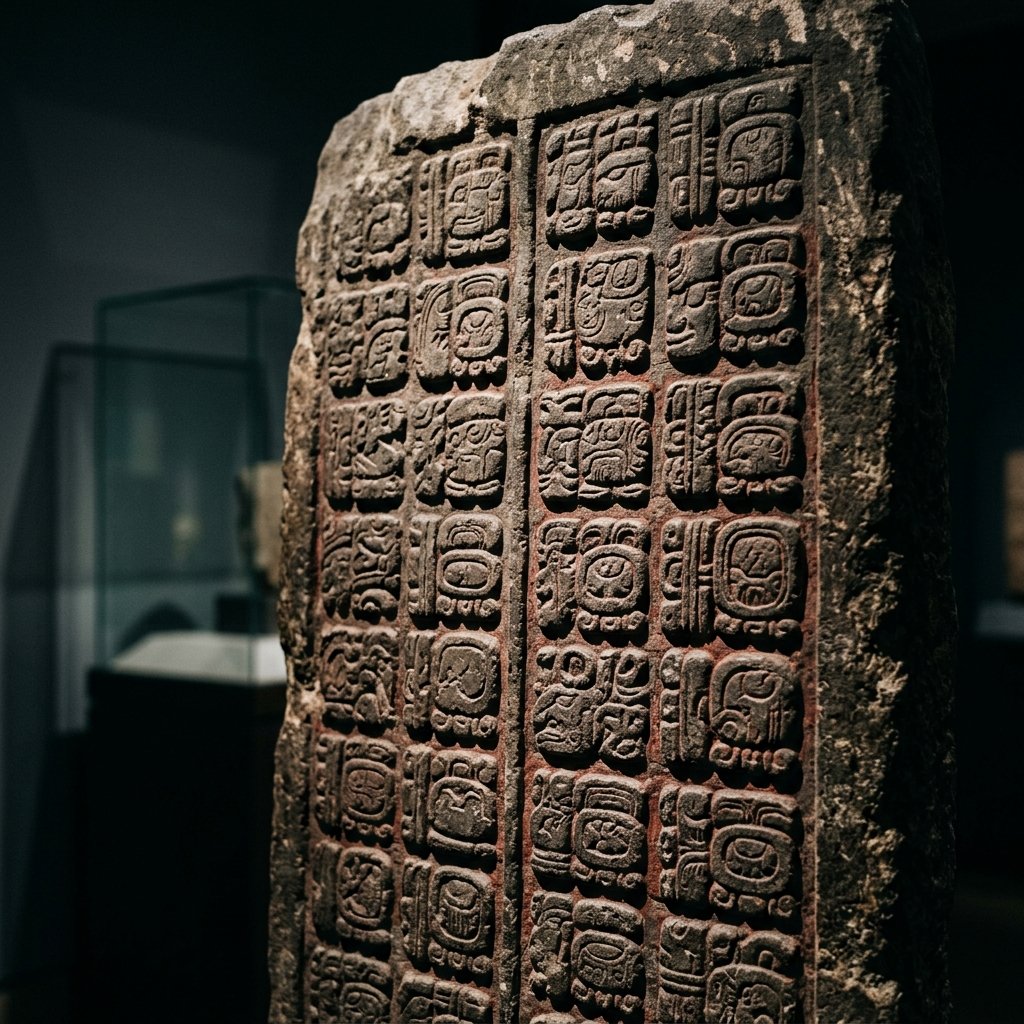
At the center of this phenomenon was a single, obscure artifact: Tortuguero Monument 6, a carved stone tablet from the site of Tortuguero in Tabasco, Mexico. This monument contains the only known ancient Maya inscription that explicitly references the date 13.0.0.0.0 — the completion of the 13th b'ak'tun, which in the Gregorian calendar corresponds to December 21, 2012.
The inscription names a deity who would be present at this cosmic transition: Bolon Yokte' K'uh.
What the Inscription Actually Says
The Tortuguero Monument 6 is badly damaged — the right panel, which contains the crucial 2012 passage, is broken and partially illegible. But epigraphers have reconstructed the surviving text. The relevant passage reads approximately:
"It will be completed the 13th b'ak'tun. It is 4 Ahau 3 K'ank'in [December 21, 2012]. [Something] will occur. It is the display of B'olon Yokte' [K'uh] in a great [investiture?]."
The damaged section makes full translation impossible. But what is clear is that the text describes Bolon Yokte' K'uh appearing or being displayed at the completion of the cycle — not the destruction of the world. The language is ceremonial, describing an investiture or cosmic transition, not an apocalypse (Gronemeyer, S. & MacLeod, B., "What Could Happen in 2012," Wayeb Notes, No. 34, 2010).
Who Was Bolon Yokte' K'uh?
The name Bolon Yokte' translates approximately as "Nine-Support" or "Nine-Strides" (bolon = nine, yok = foot/step, te' = tree/support). The suffix K'uh means "god" or "sacred one."
Bolon Yokte' K'uh is associated with several concepts:
- Period endings: He appears in inscriptions at the completion of major calendar cycles — k'atun endings (every 7,200 days) and b'ak'tun endings (every 144,000 days). He is a deity of cosmic transitions.
- The nine levels: The "nine" in his name connects him to the nine levels of Xibalba (the underworld) and the Nine Lords of the Night (Bolontiku), a group of deities who ruled the nocturnal hours in sequence.
- War and conflict: Colonial sources connect Bolon Yokte' with warfare. The Books of Chilam Balam mention him in the context of destruction and political upheaval — not cosmic apocalypse, but the very real violence of dynastic war and collapse.
- Creation: In the Dresden Codex, Bolon Yokte' appears in creation-related passages, suggesting he was present at the beginning of previous world ages as well as their endings.
The 2012 Phenomenon: What Went Wrong
The popular interpretation of the 2012 date as an "end of the world" prophecy was a product of modern Western apocalypticism projected onto Maya calendar mechanics. The problems with the apocalypse narrative:
- The Maya calendar doesn't "end" in 2012. The 13th b'ak'tun completion is simply a major period ending — like an odometer rolling over. The Long Count continues into 14th, 15th, and higher b'ak'tuns. Maya inscriptions at Palenque reference dates millions of years in the future.
- Only one inscription references 2012. Out of thousands of Maya inscriptions, exactly one mentions this date — and it's damaged. If the Maya considered 2012 cosmically significant, we would expect extensive discussion across many sites.
- No Maya community anticipated apocalypse. Modern K'iche', Yucatec, and other Maya communities universally denied the apocalypse interpretation. Maya spiritual leaders publicly called the doomsday narrative a Western distortion of their traditions.
- Period endings were celebrations. When the Maya marked the end of a k'atun or b'ak'tun, they celebrated with ceremonies, monument erection, and ritual renewal — not fear. Period endings were occasions for rebuilding, political renewal, and cosmic reset.
References
- Gronemeyer, S. & MacLeod, B. "What Could Happen in 2012: A Re-Analysis of the 13-Bak'tun Prophecy on Tortuguero Monument 6." Wayeb Notes, No. 34, 2010.
- Stuart, D. "Notes on a New Text from La Corona." Maya Decipherment, 2012.
- Eberl, M. & Prager, C. "B'olon Yokte' K'uh — Maya Conceptions of War, Conflict, and the Underworld." In Wars in the Americas, Vol. 2, Brill, 2005.
- Roys, R.L. The Book of Chilam Balam of Chumayel. University of Oklahoma Press, 1967.
- Coe, M.D. The Maya. Thames & Hudson, 9th edition, 2015.
Frequently Asked Questions
Did the Maya predict the end of the world in 2012?
No. The single Maya inscription referencing 2012 (Tortuguero Monument 6) describes a cosmic transition — the appearance of the deity Bolon Yokte' K'uh at the end of a major calendar cycle. It does not describe destruction, apocalypse, or the end of the world. The 2012 doomsday narrative was a modern Western invention with no basis in Maya scholarship or living Maya traditions.
What does the name Bolon Yokte' mean?
The name translates approximately as "Nine-Support God" or "God of Nine Steps" — connecting him to the nine levels of the underworld and the Nine Lords of the Night. He is associated with period endings, cosmic transitions, and the beginning and ending of world ages.
Why is there only one inscription about 2012?
Because the 2012 date was not particularly significant to the ancient Maya. The 13th b'ak'tun completion was simply a major calendar rollover — important enough to note, but not cosmically unique. Maya inscriptions at Palenque reference dates millions of years in the future, demonstrating that the Maya understood time as continuing indefinitely beyond any single period ending.