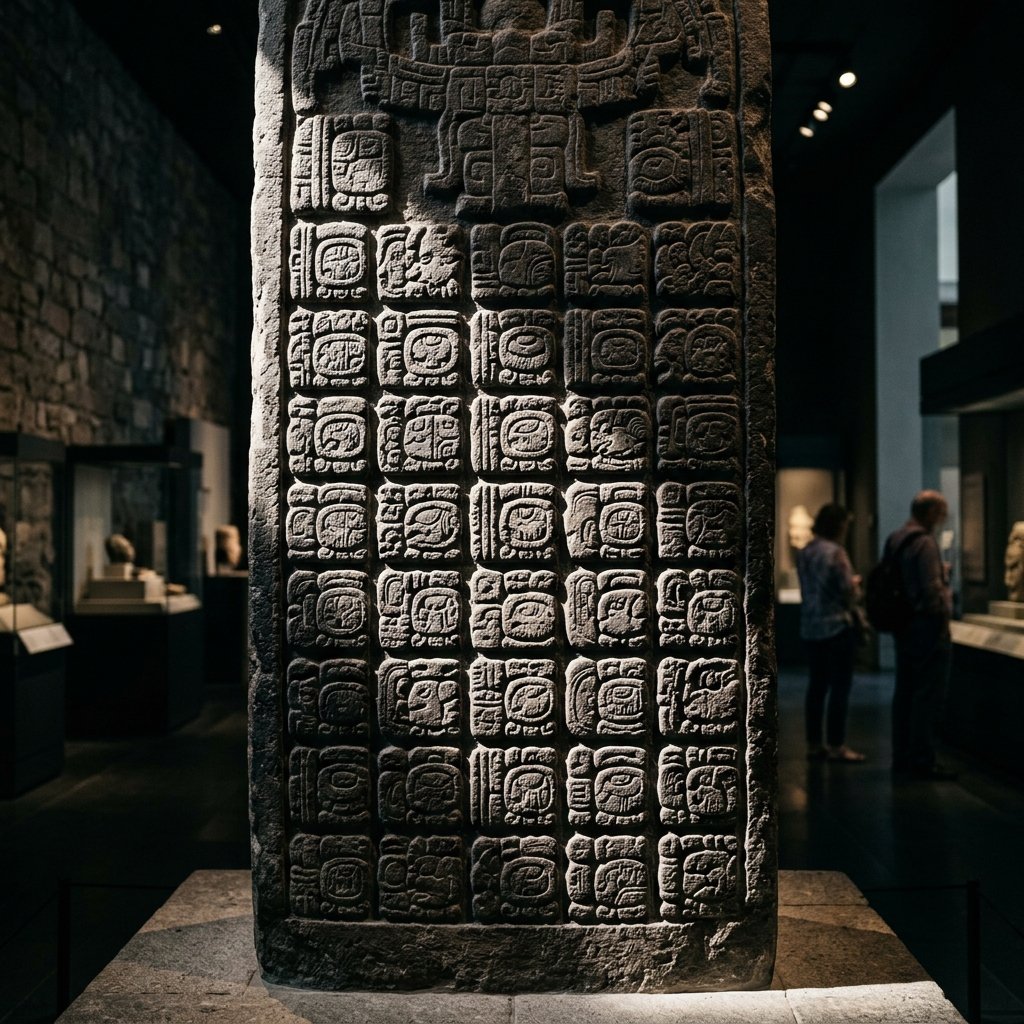
The Long Count at a Glance
"If the Calendar Round was a clock, the Long Count was an archive."
Why the Maya Needed the Long Count
The Haab and Tzolk'in together formed the Calendar Round — a system that uniquely identified any given day within a cycle of 18,980 days, or roughly 52 solar years. For everyday life, this was sufficient. But for history, it was not.
Imagine trying to record the coronation of a king using only a system that repeats every 52 years. Two centuries later, no one could determine which 52-year cycle the event belonged to. Did this accession happen 52 years ago, or 104, or 208? The Calendar Round could not answer (Sharer, R. J. and Traxler, L. P., The Ancient Maya, 6th ed., Stanford University Press, 2006, pp. 100–105).
The Long Count solved this problem definitively. It is a linear, non-repeating count of individual days elapsed since a fixed mythological starting point — what scholars call the "era date" or "creation date." Every Long Count date is unique. There is no ambiguity, no repetition, no confusion across centuries or millennia. The Smithsonian's National Museum of the American Indian describes it as "a continuous count of days" that allows events to be dated "precisely and without ambiguity" (NMAI, "Living Maya Time," 2024).
The Place-Value Structure
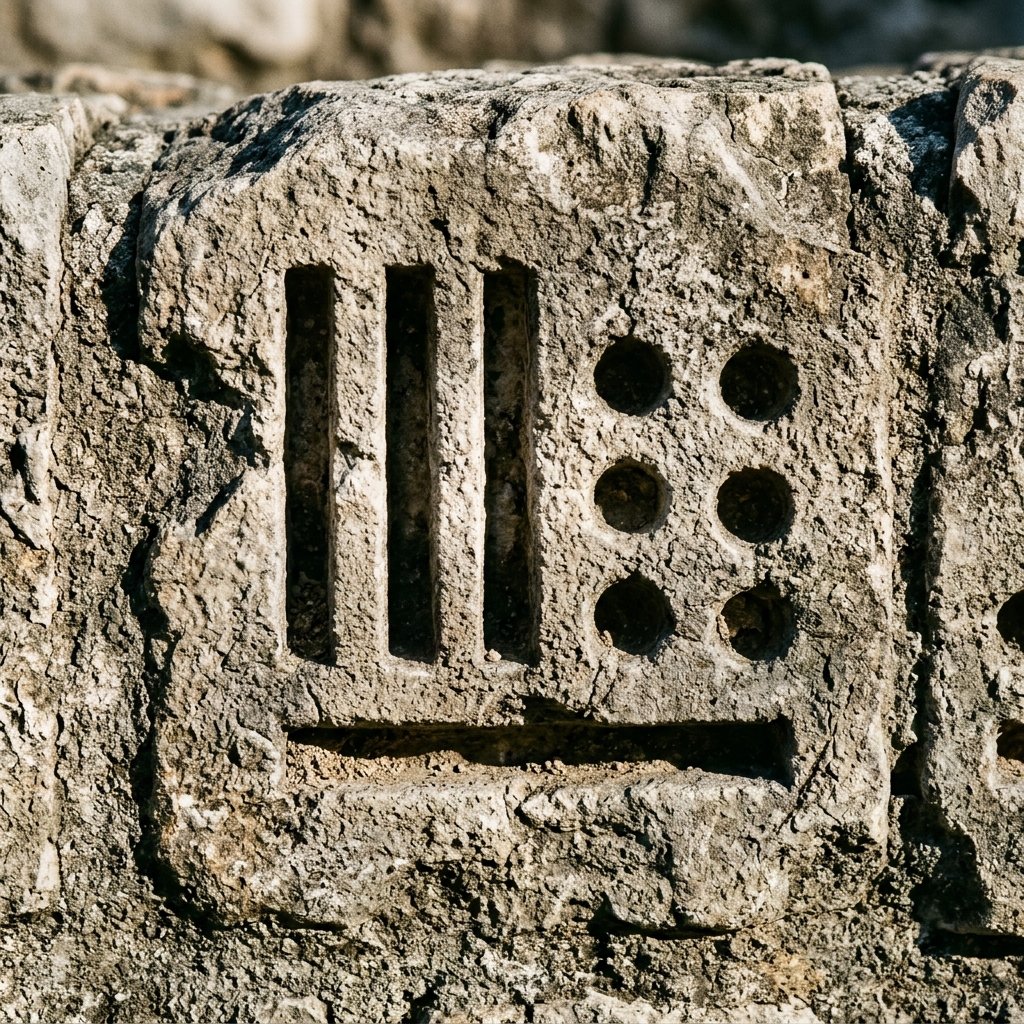
Maya numerals carved in limestone. The bar-and-dot system: a dot represents 1, a bar represents 5. These were combined to write any number from 0 to 19 in a single position. The Long Count used this notation in a place-value system — the first in the Western Hemisphere.
The Long Count is a place-value system — one of the earliest in the world. Like our decimal system, each position represents a progressively larger unit. But instead of powers of 10, the Maya used powers of 20 (vigesimal). A Long Count date is written as five numbers separated by dots, such as 9.15.6.14.6.
| Position | Unit Name | Value in Days | Approximate Period | Calculation |
|---|---|---|---|---|
| 5th (highest) | B'aktun | 144,000 | ~394.3 years | 20 × 7,200 |
| 4th | K'atun | 7,200 | ~19.7 years | 20 × 360 |
| 3rd | Tun | 360 | ~1 year | 18 × 20 |
| 2nd | Winal (Uinal) | 20 | 20 days | 20 × 1 |
| 1st (lowest) | K'in | 1 | 1 day | — |
The Base-18 Anomaly: Why 360 Instead of 400?
In a pure vigesimal system, the third position should represent 20 × 20 = 400 days. Instead, the Maya used 18 × 20 = 360. Why? Because 360 closely approximates the solar year, making the tun a practical unit for historical time. One b'aktun is roughly 394 years — close enough that Long Count calculations map intuitively onto generations, dynasties, and archaeological periods (Lounsbury, F. G., "Maya Numeration, Computation, and Calendrical Astronomy," Dictionary of Scientific Biography, 1978).
This deliberate deviation from pure base-20 reveals something profound about Maya mathematical thinking: they were willing to sacrifice mathematical purity for practical utility. The calendar was a tool for living, not a theoretical exercise (Aveni, A. F., Skywatchers of Ancient Mexico, University of Texas Press, 2001, pp. 161–168).
The Creation Date: 13.0.0.0.0
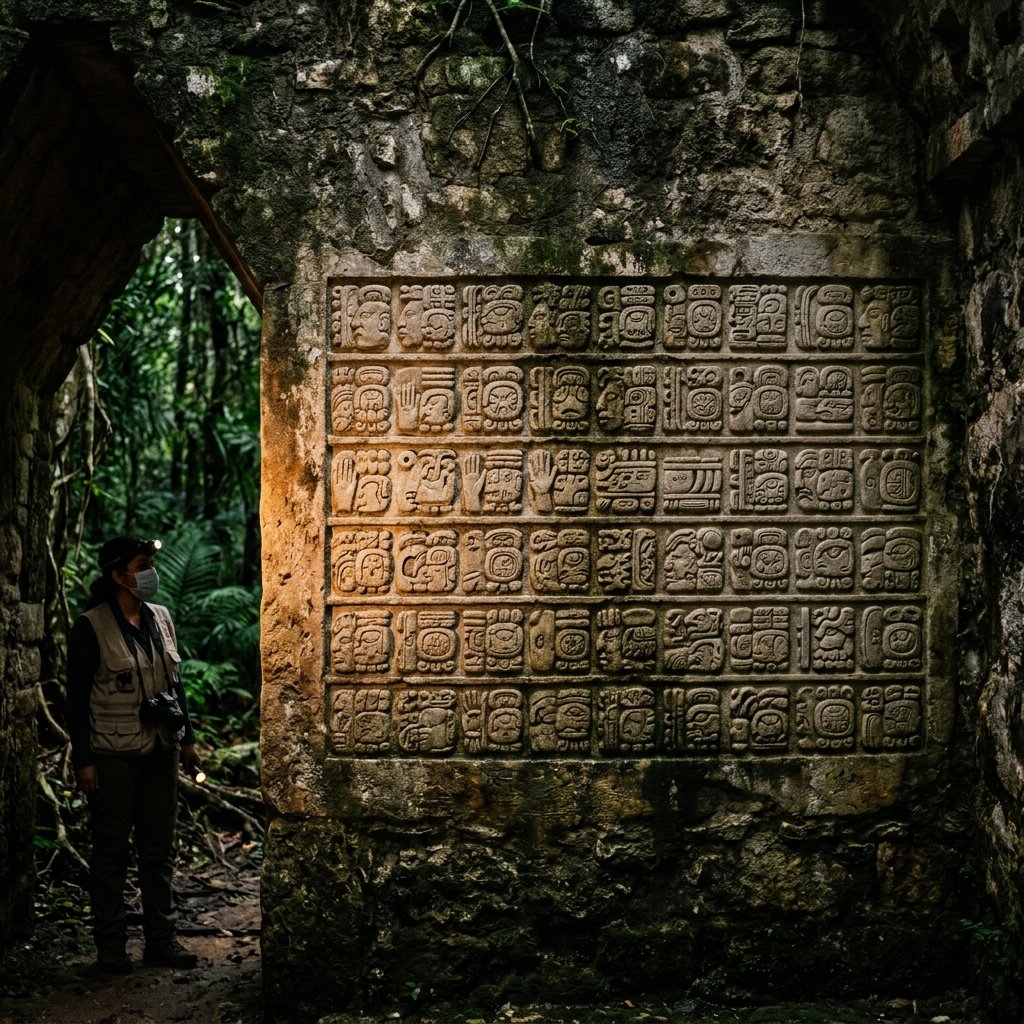
A carved hieroglyphic panel with Long Count and Calendar Round dates. Inscriptions like this one allowed the Maya to date their history with an absolute precision unmatched by any other pre-Columbian civilization. The Long Count effectively gave the Maya a Year Zero — millennia before the common era adopted one.
The Long Count begins at a mythological starting point: 13.0.0.0.0 4 Ahau 8 Kumk'u. Under the GMT (Goodman-Martinez-Thompson) correlation — the standard used by the majority of Maya scholars — this corresponds to August 11, 3114 BC in the proleptic Gregorian calendar (Thompson, J. E. S., Maya Hieroglyphic Writing: An Introduction, University of Oklahoma Press, 1960, pp. 149–163).
The creation event described in Maya mythology — the setting of the three hearthstones and the raising of the World Tree by the Maize God — is said to have occurred on this date. It is referenced explicitly on monuments at Palenque and in the creation narratives of the Popol Vuh (Freidel, D., Schele, L., and Parker, J., Maya Cosmos: Three Thousand Years on the Shaman's Path, William Morrow, 1993, pp. 59–82).
This was not merely a mythological backstory. By anchoring their chronology to a creation date, the Maya achieved something extraordinary: every historical event could be expressed as a precise number of days since the beginning of the current world. This is functionally identical to the Julian Day Number system used by modern astronomers — a system not developed in Europe until 1583, nearly seven centuries after the Classic Maya collapse (Meeus, J., Astronomical Algorithms, Willmann-Bell, 1991, p. 59).
How Long Count Dates Appear on Stelae
The Classic Maya erected carved stone monuments called stelae at regular intervals — typically every k'atun (7,200 days, ~20 years) or half-k'atun (3,600 days, ~10 years). These monuments almost always begin with an Initial Series Introductory Glyph (ISIG), followed by the five-position Long Count date, then the full Calendar Round (Tzolk'in + Haab) date, and finally the Supplementary Series (lunar age and other astronomical data) (Coe, M. D. and Van Stone, M., Reading the Maya Glyphs, Thames & Hudson, 2005, pp. 50–62).
A typical stela inscription might open with:
This inscription format gave the Maya something no other ancient American civilization possessed: a date-stamped historical record. It is the reason Maya history can be reconstructed with a precision rivaling that of ancient Rome or Egypt.
What 13.0.0.0.0 Actually Meant in 2012
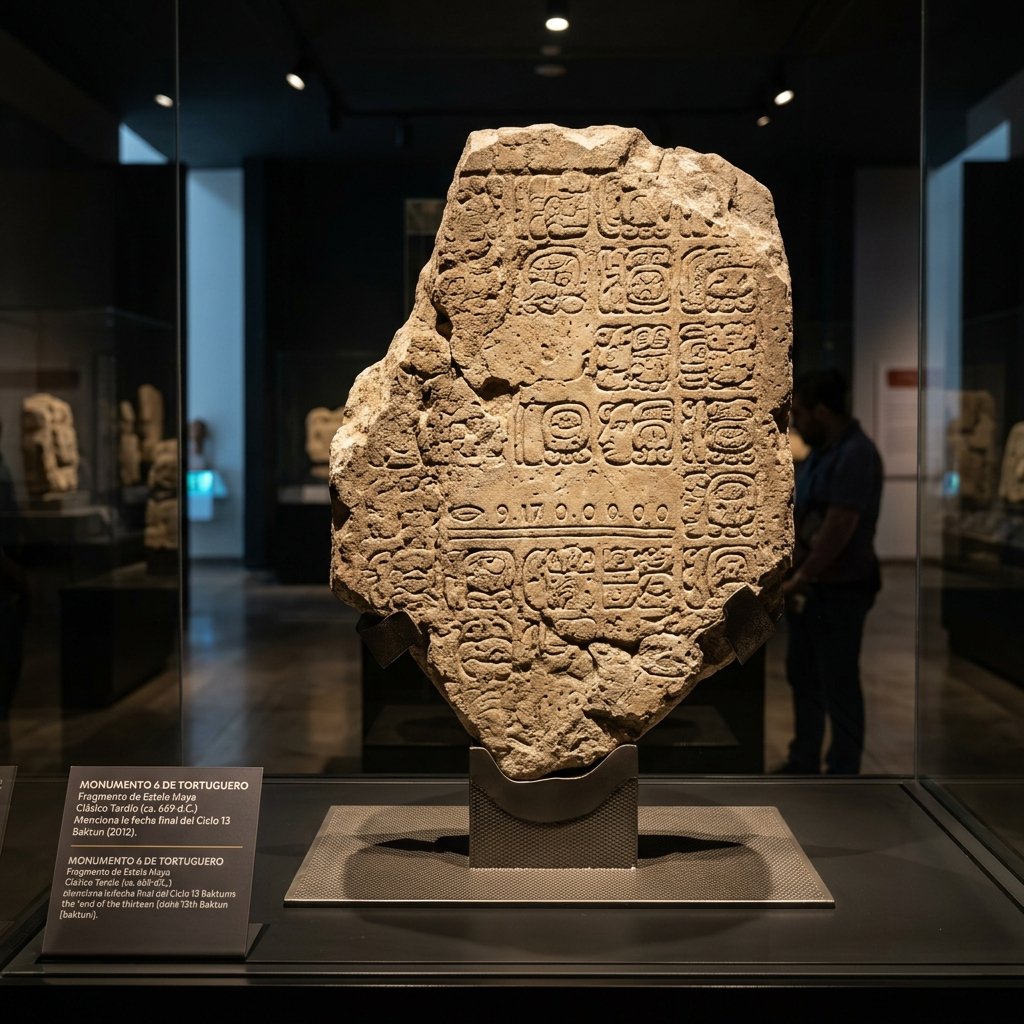
Monumental inscriptions referencing Long Count dates. The so-called "2012 prophecy" was a modern misinterpretation of the b'aktun cycle completion. The only known ancient Maya inscription mentioning the date — Tortuguero Monument 6 — describes it as the descent of a deity, not an apocalypse. The relevant passage is badly eroded and heavily debated.
Myth-Busting: 2012 Was a Rollover, Not an Apocalypse
On December 21, 2012, the Long Count completed its 13th b'aktun and reached 13.0.0.0.0 — the same numerical position as the creation date. This was widely misrepresented in popular culture as a "Maya prophecy of the end of the world." It was not.
Britannica describes the Long Count as "a continuous count" of days — not a countdown to an endpoint. The Smithsonian frames 13 b'aktuns as "one major cycle among many," not an end-of-world deadline. The comparison is simple: just as our calendar's rollover from December 31 to January 1 does not mean the universe ends, 13.0.0.0.0 simply means the 14th b'aktun begins (NMAI, "Living Maya Time," 2024; Britannica, "Maya calendar," 2024).
Only one ancient Maya inscription is known to reference the 2012 date — Tortuguero Monument 6. The relevant passage is badly eroded and much debated. Epigrapher David Stuart has argued it describes the "descent" of a deity (Bolon Yokte' K'uh), not an apocalypse (Stuart, D., "Notes on the Inscription at Tortuguero," 2012). No other Maya text references the date at all.
How Secure Is the GMT Correlation?
The Goodman-Martinez-Thompson (GMT) correlation is the standard used by the vast majority of Maya scholars to convert Long Count dates to the Gregorian calendar. It places the creation date at August 11, 3114 BC (Julian Day Number 584283). The correlation was developed through the work of Joseph Goodman (1905), Juan Martínez Hernández (1926), and J. Eric S. Thompson (1927, refined 1935) (Thompson, 1960, pp. 303–310).
The GMT correlation is supported by multiple independent lines of evidence:
- Colonial-era sources: Spanish chronicles recording the capture of Aztec ruler Moctezuma II can be dated in both European and Mesoamerican calendars, providing cross-correlation points.
- Astronomical events: Eclipses recorded on Maya monuments match the GMT dates to within a day or two.
- Radiocarbon dating: A 2013 study of sapodilla-wood lintels from Tikal confirmed the GMT correlation using high-precision radiocarbon dating, narrowing it to the "584283 variant" (Kennett, D. J. et al., "Correlating the Ancient Maya and Modern European Calendars with High-Precision AMS 14C Dating," Scientific Reports, 3, 2013).
- Living calendar tradition: K'iche' daykeepers in Guatemala maintain a Tzolk'in count that aligns with the GMT correlation (Tedlock, 1992).
While alternative proposals exist (most notably the Lounsbury or "584285" variant, which shifts everything by two days), the GMT-584283 correlation remains the working standard in the field (Martin and Grube, Chronicle of the Maya Kings and Queens, Thames & Hudson, 2000, pp. 12–14).
Beyond the B'aktun: Higher-Order Cycles
The Maya did not stop at five positions. Inscriptions at Palenque and Calakmul reference cycles far beyond the b'aktun:
- Piktun = 20 b'aktuns = 2,880,000 days (~7,885 years)
- Kalabtun = 20 piktuns = 57,600,000 days (~157,700 years)
- K'inchiltun = 20 kalabtuns = 1,152,000,000 days (~3.15 million years)
- Alautun = 20 k'inchiltuns = 23,040,000,000 days (~63 million years)
These enormous time units appear in mythological contexts at Palenque, where the birth of a patron deity is placed millions of years in the past. The Maya were not casually using big numbers — they were constructing a cosmological framework in which their dynasty was embedded in deep time, connecting royal legitimacy to the primordial acts of creation (Stuart, D., "The Inscriptions from Temple XIX at Palenque," PARI, 2005, pp. 156–172).
Frequently Asked Questions
Why does the third position equal 360 days, not 400?
In a pure base-20 system, the third position would be 20 × 20 = 400 days. The Maya intentionally modified this to 18 × 20 = 360 days (one tun) because 360 closely approximates the solar year. This made the calendar useful for tracking historical time in human-scale units — a deliberate sacrifice of mathematical purity for practical utility.
Did the Maya think the world would end in 2012?
There is zero archaeological evidence that the ancient Maya predicted an apocalypse in 2012. The date marks the completion of 13 b'aktuns and the beginning of a new cycle — comparable to a car's odometer rolling from 99,999 to 00,000. Only one ancient inscription (Tortuguero Monument 6) mentions the date, and its eroded text describes a deity's descent, not a cataclysm.
How secure is the Gregorian correlation?
The GMT correlation (Julian Day Number 584283) is supported by colonial-era calendar cross-references, eclipse records on Maya monuments, radiocarbon dating of carved wooden lintels, and the living Tzolk'in count maintained by K'iche' daykeepers in Guatemala. It is the standard working correlation used by virtually all active researchers in the field.
Is the Long Count still used today?
The Long Count fell out of active use after the Classic Maya collapse (~900 AD). The latest known Long Count inscription is from Toniná, dated to 909 AD. However, the Tzolk'in and elements of the Haab continue in use among modern K'iche' and Kaqchikel communities.
Scholarly References
- Aveni, A. F. (2001). Skywatchers of Ancient Mexico. University of Texas Press.
- Britannica. (2024). "Maya calendar." Encyclopædia Britannica.
- Coe, M. D. and Van Stone, M. (2005). Reading the Maya Glyphs. Thames & Hudson.
- Freidel, D., Schele, L., and Parker, J. (1993). Maya Cosmos: Three Thousand Years on the Shaman's Path. William Morrow.
- Kennett, D. J. et al. (2013). "Correlating the Ancient Maya and Modern European Calendars with High-Precision AMS 14C Dating." Scientific Reports, 3.
- Lounsbury, F. G. (1978). "Maya Numeration, Computation, and Calendrical Astronomy." Dictionary of Scientific Biography.
- Martin, S. and Grube, N. (2000). Chronicle of the Maya Kings and Queens. Thames & Hudson.
- Meeus, J. (1991). Astronomical Algorithms. Willmann-Bell.
- NMAI / Smithsonian. (2024). "Living Maya Time: Calendar Overview."
- Sharer, R. J. and Traxler, L. P. (2006). The Ancient Maya. 6th ed. Stanford University Press.
- Stuart, D. (2005). "The Inscriptions from Temple XIX at Palenque." Pre-Columbian Art Research Institute.
- Stuart, D. (2012). "Notes on the Inscription at Tortuguero."
- Tedlock, B. (1992). Time and the Highland Maya. University of New Mexico Press.
- Thompson, J. E. S. (1960). Maya Hieroglyphic Writing: An Introduction. University of Oklahoma Press.