Maya Astronomy at a Glance
Astronomy Without Telescopes
The Maya achieved astronomical precision that was not surpassed in Europe until the invention of the telescope in the 17th century — and they did it with nothing but their eyes, patience, and mathematical genius. No lenses. No metal instruments. No written mathematical notation in the modern sense. Just generations of observers recording the movements of celestial bodies from stone-and-plaster platforms in the tropical jungle.
Their achievements include:
- Venus tables tracking the planet's 584-day synodic cycle across 65 cycles (37,960 days) with built-in error corrections.
- Eclipse prediction tables (Dresden Codex pages 51–58) accurately predicting lunar eclipses across centuries.
- Solar observation using Group E complexes that tracked solstice and equinox sunrise positions to within a fraction of a degree.
- Mars tables (Dresden Codex pages 43–45) tracking Mars's 780-day synodic cycle.
- Lunar tracking — the Maya calculated the lunar month at 29.53020 days; the actual value is 29.53059 days. Their error: 0.00039 days — about 34 seconds per month.
The Observatories
El Caracol at Chichén Itzá
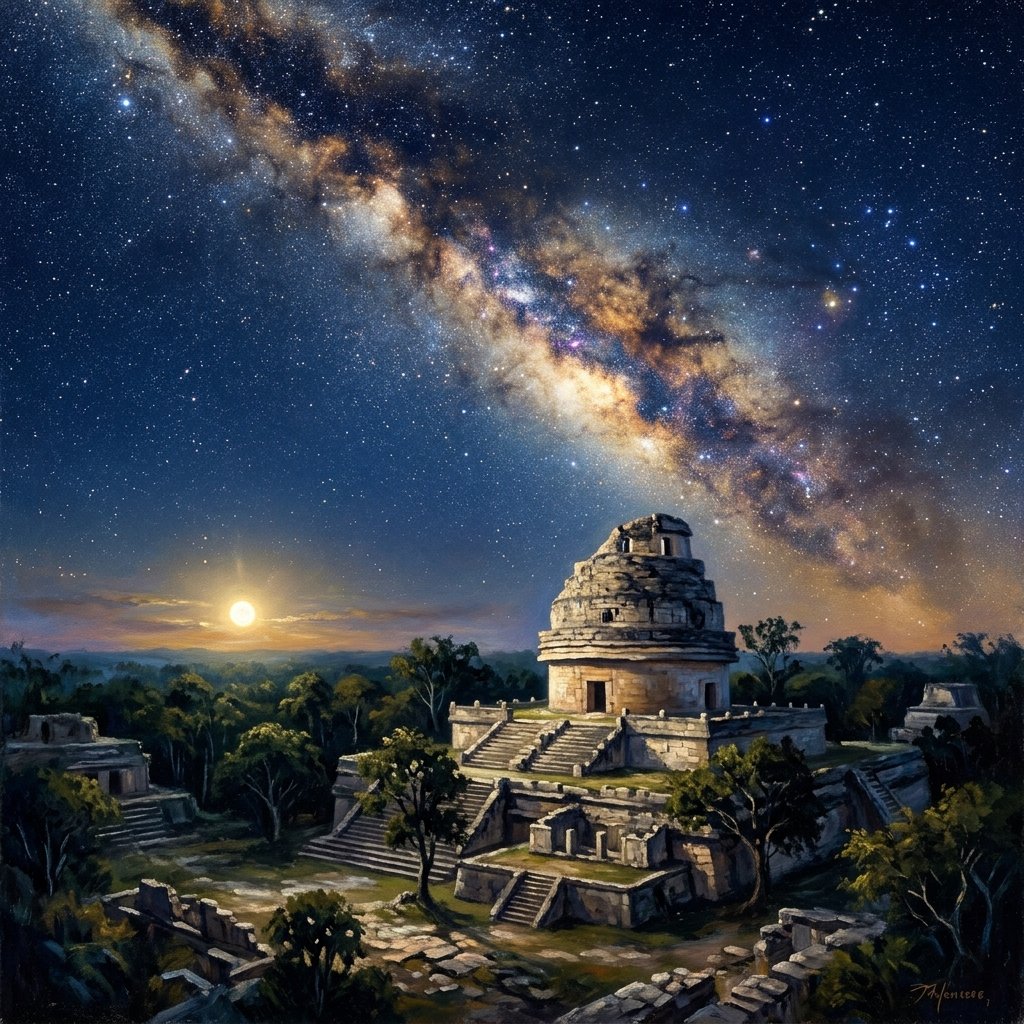
The most famous Maya observatory is El Caracol ("The Snail") at Chichén Itzá — named for its interior spiral staircase. This circular tower has three narrow windows in its upper chamber, each aligned with specific Venus positions on the horizon. The building's orientation is offset from the site's general layout, turned to face the northernmost Venus setting — demonstrating that astronomical alignment took priority over architectural symmetry (Aveni, A., Skywatchers of Ancient Mexico, 2001, pp. 259–282).
Group E Complexes
Named after Group E at Uaxactún (the first to be identified), these are solar observatories found across the Maya lowlands. The design is simple but effective: an observation platform on the west side of a plaza faces three temples on the east side. When viewed from the platform, the sun rises over the north temple at summer solstice, the center temple at equinox, and the south temple at winter solstice. Over 60 Group E complexes have been identified throughout the Maya world.
The Cosmological Sky
For the Maya, the night sky was not an abstract scientific subject — it was the visible surface of the supernatural world:
- The Milky Way: Interpreted as the World Tree (Wakah-Chan) or as the cosmic road (Sak Beh) that souls traveled to the underworld.
- Orion: The three hearthstones of creation — the triangular asterism below Orion's Belt with the Orion Nebula as the fire.
- Venus: The terrifying war god whose risings timed devastating Star Wars.
- The ecliptic: Interpreted as a double-headed serpent — the Cosmic Monster or Celestial Caiman — whose body arched across the sky.
Why It Matters
Maya astronomy was not for curiosity. It was for survival. Accurate astronomical observation drove the calendar system, which timed agriculture (plant too early or too late and the crop fails), warfare (attack at the wrong Venus phase and you lack divine sanction), and ritual (miss a period ending and the cosmic order frays). Astronomy, calendar, agriculture, religion, and politics were one integrated system — and the astronomer-priests who managed it held enormous power.
Frequently Asked Questions
How advanced was Maya astronomy?
Extraordinarily advanced. Without telescopes, the Maya calculated Venus's cycle to 99.98% accuracy, predicted eclipses, tracked Mars and Jupiter, and created the most precise calendar in the ancient Americas. Their lunar month calculation was accurate to within 34 seconds.
Did the Maya have observatories?
Yes. El Caracol at Chichén Itzá was a Venus observatory with sightline windows. Group E complexes (over 60 identified) were solar observatories tracking solstice and equinox. Many Maya buildings were deliberately aligned to celestial events.
What celestial bodies did the Maya track?
The Sun, Moon, Venus (most important planet), Mars, Jupiter, Saturn, and likely Mercury. They also predicted eclipses. The Milky Way was interpreted as the World Tree — the cosmic axis connecting earth and sky.
Scholarly References
- Aveni, A. Skywatchers of Ancient Mexico. University of Texas Press, 2001.
- Bricker, H.M. & Bricker, V.R. Astronomy in the Maya Codices. American Philosophical Society, 2011.
- Milbrath, S. Star Gods of the Maya: Astronomy in Art, Folklore, and Calendars. University of Texas Press, 1999.
- Aveni, A. & Hartung, H. "Maya City Planning and the Calendar." Transactions of the American Philosophical Society, vol. 76, 1986.