Modern Maya Languages at a Glance
A Language Family That Spans Millennia
The Mayan language family is one of the oldest documented language families in the Americas. Proto-Mayan — the single ancestral language from which all modern Mayan languages descend — was spoken approximately 4,000 years ago in the highlands of Guatemala. From that single tongue, 30+ distinct languages diverged over millennia, carried by migrations, trade, and political expansion across southern Mexico, Guatemala, Belize, and western Honduras.
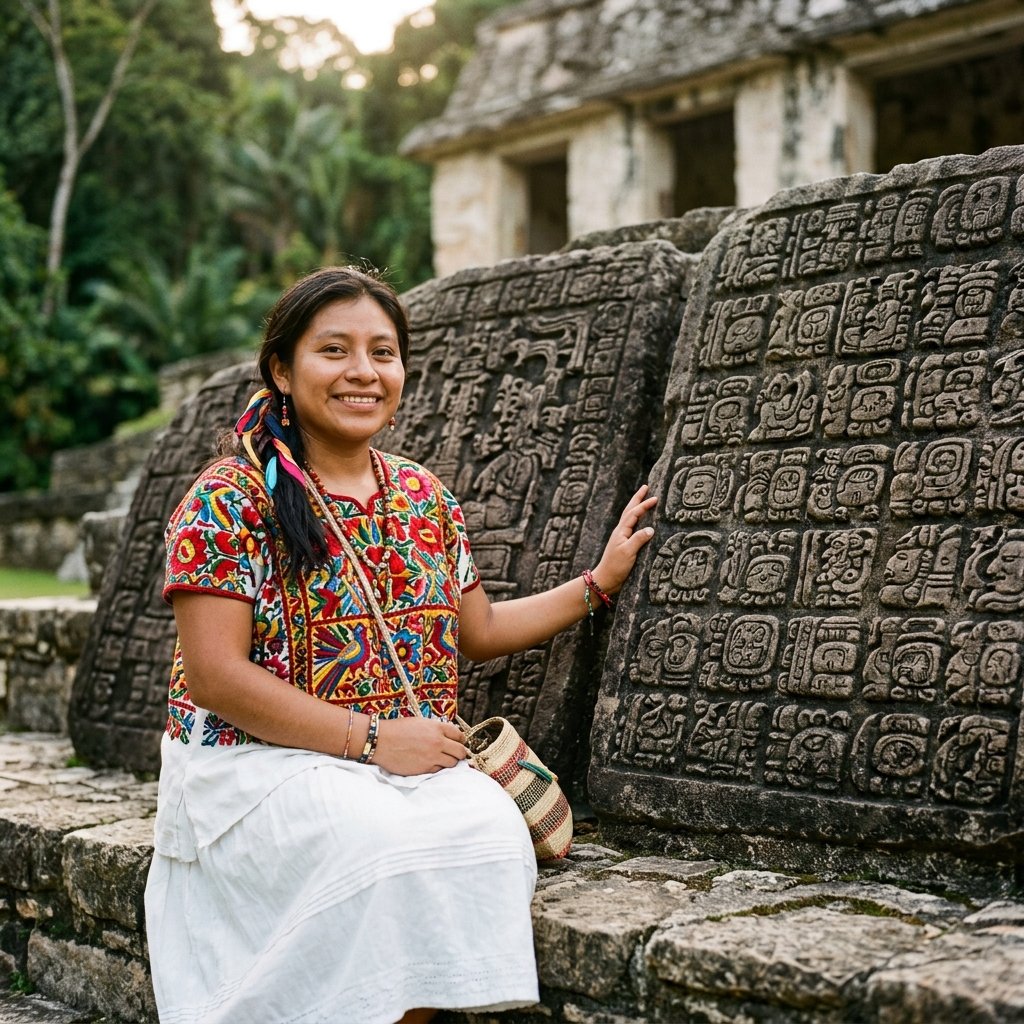
Today, approximately 6 million people speak a Mayan language — making it one of the most successful Indigenous language families in the Americas. The ancient Maya scribes who carved hieroglyphic inscriptions at Palenque and Copán wrote in Ch'olti'an, a language whose direct descendant (Ch'orti') is still spoken in eastern Guatemala and western Honduras (Campbell, L. & Kaufman, T., "A Linguistic Look at the Olmecs," 1976).
The Major Languages
Endangered Languages
While the major languages are relatively stable, many smaller Mayan languages face extinction. Itza' — the language of the last independent Maya kingdom, which resisted Spanish conquest until 1697 — has fewer than 100 elderly speakers. Lacandón, spoken by a small community in the Chiapas rainforest, has approximately 1,000 speakers. Mopán, spoken in Belize and Guatemala, is declining.
The Academia de Lenguas Mayas de Guatemala (ALMG) works to standardize orthographies, produce educational materials, and train teachers in Mayan languages. In Mexico, the INALI (National Institute of Indigenous Languages) supports similar efforts for Yucatec Maya, Tzotzil, and other varieties.
Frequently Asked Questions
How many Maya languages are spoken today?
Approximately 30 distinct languages spoken by about 6 million people across Guatemala, Mexico, Belize, and Honduras. These are not dialects — they are mutually unintelligible languages that diverged over thousands of years.
Are Maya languages endangered?
Some are — Itza' has fewer than 100 speakers, and Lacandón and Mopán are declining. But the major languages (K'iche', Yucatec, Q'eqchi') have hundreds of thousands of speakers and are relatively stable.
Is "Maya" or "Mayan" correct?
In academic usage, "Maya" = people/civilization, "Mayan" = language family. So: "Maya art" but "Mayan languages." In everyday English, "Mayan" is used for everything, which linguists consider imprecise but widely accepted.
Scholarly References
- Campbell, L. & Kaufman, T. "A Linguistic Look at the Olmecs." American Antiquity, vol. 41, 1976.
- England, N.C. A Grammar of Mam, a Mayan Language. University of Texas Press, 1983.
- Fischer, E.F. & McKenna Brown, R. Maya Cultural Activism in Guatemala. University of Texas Press, 1996.