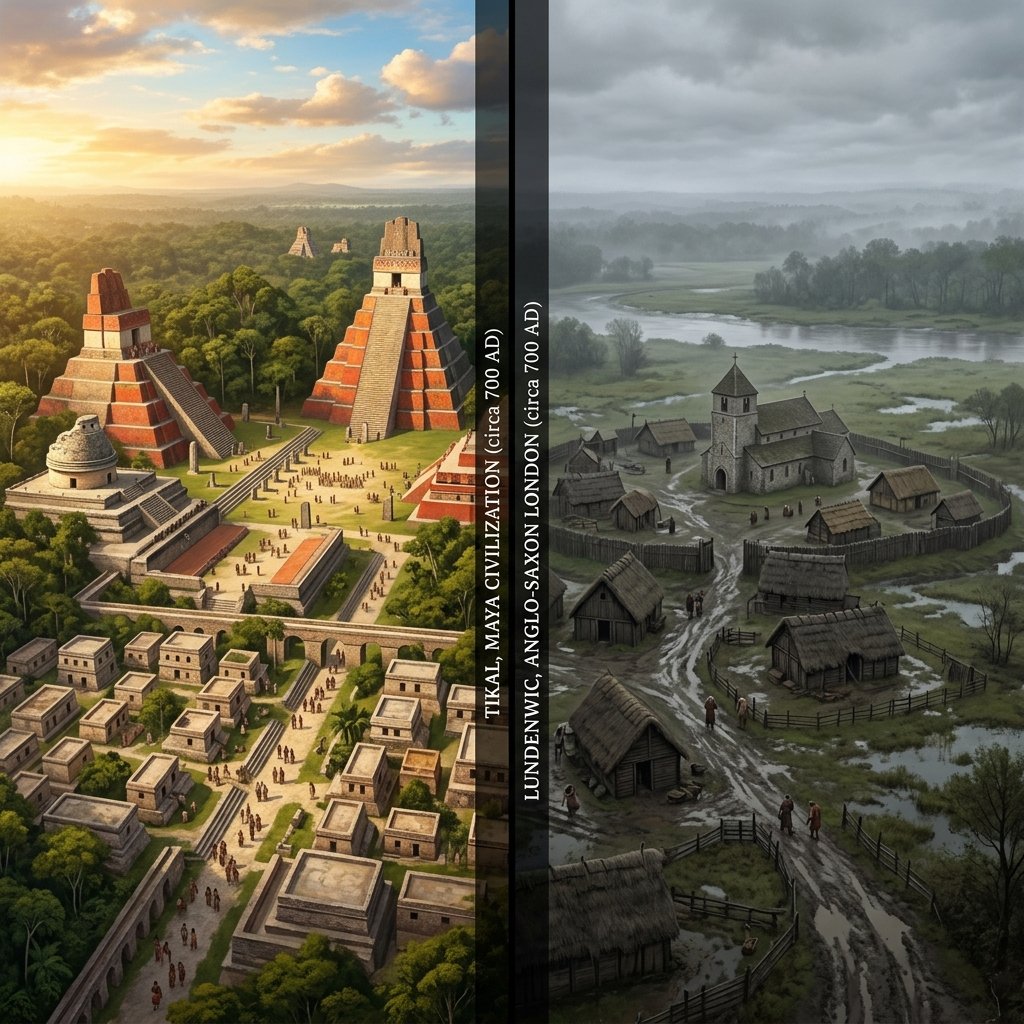
The Short Answer: More Advanced Than You Were Taught
The Maya are routinely presented as a "mysterious lost civilization" — exotic but secondary to the "real" civilizations of Egypt, Greece, and Rome. This framing is not just wrong — it's a product of colonial-era bias that persists because most education systems still center European history. When you compare the Maya to their contemporaries on equal terms, the results are humbling.
The Comparison Table Nobody Shows You
| Achievement | Maya (by 800 AD) | Contemporary Europe |
|---|---|---|
| Writing | Full logo-syllabic script, ~800 signs | Latin alphabet (inherited from Romans) |
| Mathematics | Positional base-20 with zero (invented independently) | Roman numerals (no zero, no positional notation) |
| Astronomy | Predicted eclipses to ±33 min, Venus to ±2 hrs | Ptolemaic model, no eclipse prediction tables |
| Calendar accuracy | 365.2420 days/year (error: 17 sec/year) | Julian calendar: 365.25 (error: 11 min/year) |
| Urban population | Tikal: ~100,000; regional: 7–11 million | London: ~10,000; Paris: ~25,000 |
| Hydraulic engineering | Pressurized aqueducts (Palenque), reservoirs | Roman aqueducts in ruins; no new construction |
| Visual art | True fresco, 28+ pigments, individual portraiture | Flat iconographic style, limited palette |
Where the Maya Exceeded Everyone
In several domains, the Maya weren't just "not behind" — they were ahead of every contemporary civilization on Earth:
- Zero: The Maya used positional zero from at least 36 BC. Europe didn't adopt it until the 13th century — 1,200 years later.
- Lunar calculation: Maya accuracy (29.53086 days) exceeded Europe's until Tycho Brahe in the 1570s.
- Material science: Maya Blue is a nanostructured hybrid pigment that modern chemists didn't fully understand until 1996. Nothing comparable existed in Europe before the Industrial Revolution.
- Water engineering: The Palenque aqueduct created water pressure — a technology thought to be a post-Roman European achievement.
Where They Differed (Not "Lacked")
It's important to note where Maya technology diverged from — rather than "fell behind" — Old World developments:
- Metallurgy: The Maya used jade, obsidian, and bone rather than metal. In their environment, obsidian proved superior to copper or bronze for cutting tools.
- Wheel: The Maya knew the wheel (wheeled toys have been found) but didn't use it for transport — rational in a terrain of dense jungle and steep terrain with no draft animals.
- Arch: The Maya used the corbeled arch rather than the true arch — a structural choice, not a failure, that produced buildings still standing after 1,300 years.
Why This Reframing Matters
The persistent underestimation of Maya civilization isn't just historically inaccurate — it has real consequences. It perpetuates the colonial narrative that "advanced civilization" is a European monopoly, and it obscures the genuine intellectual heritage of 6 million living Maya people. When we say the Maya were "advanced," we're not being generous — we're being accurate (Restall, When Montezuma Met Cortés, 2018).
Frequently Asked Questions
Were the Maya more advanced than the Romans?
In mathematics and astronomy — yes, by a significant margin. In infrastructure and military engineering — the Romans had the advantage. In writing — both had sophisticated systems. "Advancement" isn't a single axis: civilizations optimize for different things based on their environment, resources, and values. The Maya optimized for time, astronomy, and environmental adaptation; Rome optimized for roads, law, and military logistics.
References & Further Reading
- Sharer, R. J. & Traxler, L. P. (2006). The Ancient Maya. 6th ed. Stanford UP.
- Aveni, A. F. (2001). Skywatchers. UT Austin Press.
- Restall, M. (2018). When Montezuma Met Cortés. Ecco/HarperCollins.
- French, K. D., et al. (2012). "The Archaeology of Water Pressure at Palenque." J. Archaeological Science, 39.